How to Distinguish Coconut Shell Activated Carbon: 4 Simple Identification Methods 2026
Coconut shell activated carbon and coal-based activated carbon look similar but have fundamentally different performance characteristics. Knowing how to distinguish coconut shell activated carbon from cheaper alternatives is essential for buyers who need high micropore volume, low ash content, and superior hardness. This guide covers four practical identification methods — density, shape, water float test, and bubble size — that require no special equipment. CHIWATEC supplies certified coconut shell activated carbon with full quality specifications for water and gas treatment applications.
How to Distinguish Coconut Shell Activated Carbon by Density and Weight
Coconut shell activated carbon has a lower density and feels noticeably lighter in the hand compared to coal-based activated carbon of the same volume. This is because coconut shell carbon develops a more porous internal structure during activation, resulting in higher void volume. When comparing equal weights, coconut shell activated carbon occupies a significantly larger volume than coal-based carbon. This density difference is the simplest and most reliable way to distinguish coconut shell activated carbon at a glance.
Typical bulk density ranges:
- Coconut shell AC: 400–480 kg/m³
- Coal-based AC: 500–600 kg/m³
- Wood-based AC: 300–400 kg/m³
Method 2: Particle Shape and Appearance
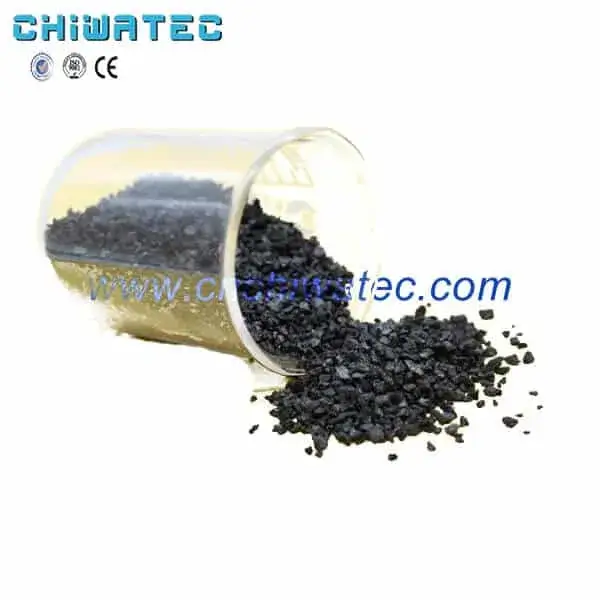
The physical form of activated carbon provides a strong visual clue. Coconut shell activated carbon is typically produced as broken granular or flake particles with irregular shapes and sharp edges. This particle morphology results from crushing and sieving the activated coconut shell char. In contrast, coal-based activated carbon is often manufactured in uniform cylindrical or spherical shapes through extrusion or agglomeration processes. If you see perfectly round or uniformly cylindrical activated carbon particles, the product is almost certainly coal-based rather than coconut shell-derived.
Method 3: Water Float Test
This simple field test requires only a glass of water. Drop a sample of activated carbon into the water and observe how it behaves:
- Coconut shell activated carbon: Due to its lower density and higher porosity, it floats on the water surface for a longer period before slowly sinking as water displaces air from the pores. The gradual sinking process can take 30 seconds to several minutes, depending on particle size.
- Coal-based activated carbon: Its higher density causes it to sink more rapidly. Most coal-based carbon particles will settle to the bottom within seconds.
As the coconut shell activated carbon adsorbs water and approaches saturation, you will observe a fascinating effect — tiny bubbles clinging to each particle, crystal clear and shimmering. This is the air being displaced from the micropores by water molecules.
Method 4: Bubble Size Observation
When activated carbon is placed in water, the air trapped in its pore structure is displaced by water molecules, forming bubbles that rise to the surface. The size and density of these bubbles reveals the pore structure of the carbon:
- Coconut shell activated carbon: Its predominantly microporous structure (pore diameter <2 nm) produces many very fine, densely packed bubbles that are barely visible to the naked eye. These tiny bubbles stream upward continuously during the wetting process, creating a mist-like appearance.
- Coal-based activated carbon: The larger pore structure (more mesopores and macropores) generates fewer but visibly larger bubbles. The bubble stream is coarser and less uniform than what coconut shell carbon produces.
Quick Reference: Coconut Shell vs. Coal-Based Activated Carbon
| Identification Method | Coconut Shell AC | Coal-Based AC |
|---|---|---|
| Density (feel) | Lightweight, low density (400–480 kg/m³) | Heavier, higher density (500–600 kg/m³) |
| Particle shape | Irregular broken granular or flake | Uniform cylindrical or spherical |
| Water float time | Floats 30 sec – several minutes | Sinks within seconds |
| Bubble appearance | Very fine, dense, mist-like | Fewer, larger, coarser |
| Micropore volume | 0.40–0.55 cm³/g | 0.25–0.40 cm³/g |
| Hardness | 95–99% | 80–90% |
Frequently Asked Questions (FAQ)
Why is coconut shell activated carbon more expensive than coal-based carbon?
Coconut shell activated carbon costs 30–50% more than coal-based carbon due to limited raw material supply (coconut shells are a byproduct of the coconut industry), higher activation energy requirements, and the need for careful sorting and washing to achieve low ash content.
Can I use the water float test on powdered activated carbon?
No. The water float test only works for granular activated carbon (8×30 mesh or larger). Powdered activated carbon (<0.15 mm) disperses too quickly in water for the float time difference to be observed.
Does coconut shell activated carbon always have irregular shapes?
Most coconut shell activated carbon is sold as broken granular particles. However, some manufacturers grind coconut shell carbon and re-agglomerate it into cylindrical pellets. In this case, the water float test and density comparison are more reliable identification methods.
How does the pore structure differ between coconut shell and coal-based carbon?
Coconut shell carbon has a predominantly microporous structure (<2 nm pores) with micropore volume of 0.40–0.55 cm³/g. Coal-based carbon has a broader pore size distribution with more mesopores (2–50 nm), giving it a micropore volume of only 0.25–0.40 cm³/g but better performance for larger molecules.
Is coconut shell activated carbon always better than coal-based?
Not for every application. Coconut shell carbon is superior for small-molecule adsorption (VOCs, chlorine, pesticides) and high-purity applications. Coal-based carbon performs better for color removal, large-molecule adsorption, and applications where lower cost per unit weight is the primary consideration.
Conclusion & Call to Action
Identifying coconut shell activated carbon is straightforward using four simple methods: density comparison, particle shape inspection, the water float test, and bubble size observation. These field tests help buyers verify product quality without laboratory equipment. For certified coconut shell activated carbon with documented iodine values, hardness, and pore structure analysis, contact the CHIWATEC team at [email protected] or [email protected].
Related Resources and Further Reading
- Coconut Shell Activated Carbon Applications: Water, Air, and Gas Treatment Guide
- Activated Carbon Quality Specifications
- Activated Carbon Filter for Water Treatment 2026: Complete Guide
- Water Purifier Activated Carbon Filter Element: Complete Guide to Types
- Activated Carbon Filter Products — CHIWATEC Product Line
Do you have a water treatment project we can help with
* Designing,machining,installing,commissioning, customize and one-stop service
 English
  Spanish
  Portuguese