FRP Integrated Sewage Treatment Equipment: Working Principle and Process Guide 2026
The growing volume of industrial and domestic sewage has created an urgent need for efficient, durable, and compact treatment solutions. CHIWATEC‘s FRP integrated sewage treatment equipment combines advanced AO biological treatment technology with corrosion-resistant fiberglass reinforced plastic construction, delivering reliable wastewater purification for residential complexes, hotels, hospitals, and industrial facilities. This guide explains the complete working principle and treatment process of FRP integrated sewage treatment equipment.
What is FRP Integrated Sewage Treatment Equipment?
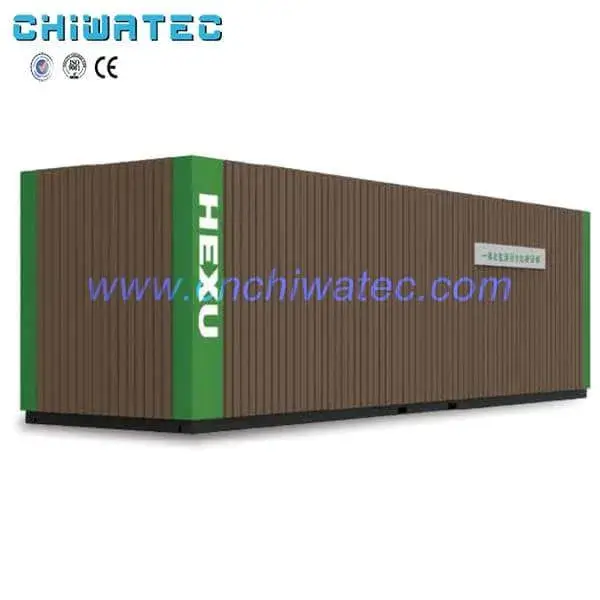
FRP integrated sewage treatment equipment is a prefabricated, modular treatment system constructed from fiberglass reinforced plastic (FRP). It integrates multiple treatment stages — anaerobic, aerobic, sedimentation, and disinfection — into a single compact unit. The FRP material offers exceptional corrosion resistance, light weight, and structural strength, making it ideal for below-ground installation in residential communities, hotels, hospitals, and rural sewage treatment projects.
Key specifications of typical FRP integrated sewage treatment equipment:
| Parameter | Typical Range |
| Treatment capacity | 1–500 m³/day |
| BOD₅ removal rate | ≥ 90% |
| COD removal rate | ≥ 85% |
| NH₃-N removal rate | ≥ 80% |
| Design service life | 30+ years |
| Operating temperature | 5–40 °C |
Core Components of FRP Integrated Sewage Treatment Equipment
The FRP integrated sewage treatment equipment consists of several interconnected compartments, each responsible for a specific treatment stage:
- Primary sedimentation tank — Removes settleable solids and floating debris through gravity separation.
- Anaerobic (A-level) tank — Where facultative microorganisms perform hydrolysis, acidogenesis, and denitrification under oxygen-free conditions.
- Aerobic (O-level) tank — Biological contact oxidation chamber where aerobic microorganisms decompose organic pollutants.
- Secondary sedimentation tank — Separates biological sludge from treated water.
- Disinfection chamber — UV or chlorine dosing for pathogen elimination before discharge.
- Control system — Automated PLC-based operation for pumps, blowers, and monitoring.
AO Biological Treatment Process: The Core Technology
The heart of the FRP integrated sewage treatment equipment is the anaerobic-aerobic (AO) biological process. This two-stage system achieves high removal rates of organic matter and nitrogen compounds through the synergistic action of facultative and aerobic microorganisms.
The AO process removes organic pollutants (BOD/COD) and nitrogen through two complementary stages:
| Treatment Stage | Environmental Condition | Primary Function |
| A-level (Anaerobic) | DO < 0.3 mg/L | Denitrification, hydrolysis, organic acid production |
| O-level (Aerobic) | DO ≥ 2.0 mg/L | Organic oxidation, nitrification, CO₂ and H₂O production |
Anaerobic Stage (A-Level): Hydrolysis and Denitrification
In the anaerobic tank, dissolved oxygen is maintained below 0.3 mg/L. Facultative microorganisms break down complex organic molecules into simpler forms through hydrolysis and acidogenesis. Simultaneously, denitrifying bacteria convert NO₃⁻ and NO₂⁻ into nitrogen gas (N₂), which escapes into the atmosphere.
This stage serves two critical functions:
- Organic load reduction — The anaerobic microorganisms decompose a portion of the organic pollutants, reducing the burden on the subsequent aerobic stage.
- Nitrogen removal — Denitrification eliminates nitrogenous pollutants, preventing eutrophication in receiving water bodies.
Aerobic Stage (O-Level): Oxidation and Nitrification
The effluent from the anaerobic stage flows into the aerobic biological contact oxidation tank, where dissolved oxygen is maintained at ≥ 2.0 mg/L through forced aeration. Aerobic microorganisms, attached to biofilm media, decompose residual organic matter into CO₂ and H₂O. Autotrophic nitrifying bacteria convert ammonia nitrogen (NH₃-N) into nitrite (NO₂⁻) and nitrate (NO₃⁻).
A portion of the aerobic tank effluent is recirculated back to the anaerobic stage to provide nitrate electron acceptors for denitrification. This recirculation loop is essential for achieving total nitrogen removal efficiencies above 80%.
Sedimentation and Sludge Management
After biological treatment, the water enters the secondary sedimentation tank where biological sludge settles by gravity. The clarified effluent overflows to the disinfection stage. Excess sludge is periodically discharged and can be further treated in sludge thickening or dewatering equipment.
The sedimentation tank design ensures minimal sludge carryover, achieving effluent suspended solids concentrations below 30 mg/L, compliant with Chinese discharge standard GB 18918-2002.
Disinfection and Effluent Discharge
The final treatment stage is disinfection, which eliminates pathogenic microorganisms. Common disinfection methods used in FRP integrated sewage treatment equipment include:
- UV sterilization — Chemical-free, effective against bacteria and viruses, no residual byproducts.
- Sodium hypochlorite dosing — Low-cost chlorine-based disinfection with residual protection.
- Ozone disinfection — Powerful oxidation for demanding applications.
The treated effluent meets or exceeds national discharge standards and can be safely released or reused for landscape irrigation and toilet flushing.
Advantages of FRP Material in Sewage Treatment Equipment
Fiberglass reinforced plastic offers several advantages over traditional materials like steel or concrete:
| Property | FRP Advantage |
| Corrosion resistance | Impervious to sewage chemicals, H₂S gas, and acidic environments |
| Weight | 1/4 the weight of steel, 1/10 the weight of concrete — easy transport and installation |
| Structural strength | High strength-to-weight ratio, withstands soil burial loads |
| Service life | 30+ years with minimal maintenance |
| Installation | Prefabricated, ready for burial — no on-site concrete work required |
| Leak-proof | Seamless construction prevents groundwater contamination |
Application Scenarios for FRP Integrated Equipment
FRP integrated sewage treatment equipment is widely deployed across multiple sectors:
- Residential communities — Centralized treatment for 50–500 households
- Hotels and resorts — On-site wastewater treatment in remote or scenic locations
- Hospitals — Medical wastewater treatment before municipal discharge
- Rural sewage projects — Decentralized treatment for villages without municipal sewer access
- Industrial parks — Pre-treatment of industrial wastewater before final polishing
- Construction sites — Temporary wastewater treatment during project development
Frequently Asked Questions
What is the working principle of FRP integrated sewage treatment equipment?
The equipment uses the AO biological treatment process, combining anaerobic denitrification and aerobic oxidation within a compact FRP vessel. Sewage flows through primary sedimentation → anaerobic tank (A-level) → aerobic tank (O-level) → secondary sedimentation → disinfection, achieving over 90% removal of BOD and 85% removal of COD.
How is FRP superior to concrete for sewage treatment tanks?
FRP is 10 times lighter than concrete, completely corrosion-resistant, and can be prefabricated and installed within days instead of weeks. It also eliminates the risk of cracking, leaking, and groundwater contamination that affects aging concrete structures.
What is the typical maintenance requirement for FRP integrated equipment?
Maintenance is minimal — periodic sludge discharge (monthly), blower filter cleaning (quarterly), and annual inspection of electrical components and aeration diffusers. The FRP tank itself requires no painting, coating, or corrosion protection.
Can FRP integrated sewage treatment equipment handle fluctuating flow rates?
Yes. The equipment is designed with hydraulic buffering capacity and PLC-controlled aeration that adjusts to incoming load variations. The anaerobic stage provides natural flow equalization, and the biofilm-based aerobic system is tolerant of shock loads.
What discharge standards can FRP integrated equipment achieve?
The equipment consistently meets Grade A or B discharge standards under GB 18918-2002 (China), with effluent BOD₅ < 10 mg/L, COD < 50 mg/L, SS < 10 mg/L, and NH₃-N < 5 mg/L achievable with proper operation and maintenance.
Conclusion and Call to Action
FRP integrated sewage treatment equipment offers a reliable, durable, and cost-effective solution for decentralized wastewater treatment. The AO biological process ensures high removal efficiencies for organic pollutants and nitrogen, while the FRP construction guarantees long service life with minimal maintenance. Whether for residential communities, hotels, hospitals, or industrial applications, this integrated system delivers compliant effluent that protects water resources and the environment.
For expert guidance on selecting and customizing FRP integrated sewage treatment equipment for your project, contact CHIWATEC today: email [email protected] or [email protected]. Our engineering team provides full support from design to commissioning.
Related Resources and Further Reading
Do you have a water treatment project we can help with
* Designing,machining,installing,commissioning, customize and one-stop service
 English
  Spanish
  Portuguese