

EDI Electrodeionization Equipment: Working Principle, System Design & 2026 Applications
Meta Description: Complete guide to EDI (Electrodeionization) equipment working principle in 2026. Learn how electrodeionization technology produces ultrapure water with 15-18 MΩ·cm resistivity for semiconductor, pharmaceutical, and power generation applications.
Introduction: EDI Technology in 2026
Electrodeionization (EDI) represents the most advanced pure water manufacturing technology available in 2026, combining ion exchange technology, ion exchange membrane technology, and ion electromigration technology into a single continuous process. Unlike traditional mixed bed systems requiring chemical regeneration, EDI uses electrical potential to continuously regenerate ion exchange resins—eliminating acid/base handling, reducing operating costs by 40-60%, and producing consistently high-purity water.
According to 2026 industry data, EDI systems now serve:
- Semiconductor manufacturing – 18.2 MΩ·cm ultrapure water for chip fabrication
- Pharmaceutical production – USP/EP compliant water for injection (WFI) pretreatment
- Power generation – Boiler feedwater for supercritical units (≥16 MΩ·cm)
- Laboratory applications – Type I reagent-grade water for analytical instruments
- Food & beverage – High-purity process water for premium products
Global EDI market size reached $1.8 billion in 2025, projected to grow at 8.3% CAGR through 2030, driven by semiconductor capacity expansion and stricter pharmaceutical water quality regulations.
What is EDI (Electrodeionization)?
EDI (Electrodeionization)—sometimes written as Elcctrodeionization due to typographical errors—is a hybrid water purification technology that cleverly combines electrodialysis and ion exchange processes. The system uses high-voltage electrodes at both ends of the module to move charged ions in water, working cooperatively with ion exchange resin and selective ion-exchange membranes to accelerate ion movement and removal.
Key Performance Specifications (2026 Standards)
- Resistivity: 15-18.2 MΩ·cm (depending on feedwater quality)
- TOC (Total Organic Carbon): <50 ppb
- Salts removal rate: 99% or higher
- Continuous operation: 24/7 without regeneration downtime
- Recovery rate: 90-95% (significantly higher than traditional IX)
When paired with reverse osmosis (RO) pretreatment—which typically reduces conductivity to 10-40 μS/cm—EDI can consistently produce ultrapure water with resistivity exceeding 15 MΩ·cm, meeting the most stringent industrial requirements.
EDI Working Principle: Step-by-Step Process
1. Ion Exchange in Pure Water Chamber
Tap water or RO permeate contains dissolved salts including sodium (Na⁺), calcium (Ca²⁺), magnesium (Mg²⁺), chloride (Cl⁻), nitrate (NO₃⁻), and silica (SiO₂). These salts exist as positively charged cations and negatively charged anions in solution.
Within the EDI module pure water chamber, ion exchange resins perform the initial purification:
- Cation exchange resin exchanges H⁺ ions for cations (Na⁺, Ca²⁺, Mg²⁺)
- Anion exchange resin exchanges OH⁻ ions for anions (Cl⁻, NO₃⁻, HCO₃⁻)
The exchange reactions follow standard ion exchange chemistry:
R-H + Na⁺ → R-Na + H⁺
R-OH + Cl⁻ → R-Cl + OH⁻
2. Electrical Migration and Ion Removal
A DC electric field (typically 200-600V) is applied between the anode (+) and cathode (-) at both ends of the module. This electric potential drives ion migration:
- Cations (Na⁺, Ca²⁺, H⁺) migrate toward the cathode, passing through cation-selective membranes into the concentrated water stream
- Anions (Cl⁻, OH⁻, NO₃⁻) migrate toward the anode, passing through anion-selective membranes into the adjacent concentrated water stream
The selective membranes create alternating pure water and concentrate chambers. Cations pass through cation membranes but are blocked by anion membranes; anions pass through anion membranes but blocked by cation membranes. This selective permeability concentrates ions in the concentrate chambers while purifying water in the dilute (pure water) chambers.
3. Continuous Resin Regeneration via Water Splitting
The breakthrough feature of EDI technology is continuous electrical regeneration of ion exchange resins—eliminating the need for chemical regeneration with acids and bases.
In high-potential zones within the resin bed, water molecules undergo electrochemical decomposition (water splitting):
H₂O → H⁺ + OH⁻
These continuously generated H⁺ and OH⁻ ions regenerate the exhausted ion exchange resins in situ:
R-Na + H⁺ → R-H + Na⁺
R-Cl + OH⁻ → R-OH + Cl⁻
The displaced Na⁺ and Cl⁻ ions then migrate into the concentrate stream under the electric field. This self-regenerating mechanism keeps the resin in optimal condition indefinitely, enabling continuous operation without chemical regeneration downtime.
4. Concentrate Stream Discharge
Impurity ions (Na⁺, Cl⁻, Ca²⁺, etc.) accumulate in the concentrated water chambers but cannot migrate further due to the blocking effect of adjacent exchange membranes. The concentrated water stream continuously removes these ions from the module, typically discharging 5-10% of total flow as concentrate waste.
EDI System Configuration and Components
Core Module Structure
- Ion exchange resin beds – Mixed bed or layered configuration
- Cation exchange membranes – Permeable only to positively charged ions
- Anion exchange membranes – Permeable only to negatively charged ions
- Electrodes (anode/cathode) – Apply DC electric field across the stack
- Pure water chambers – Where product water is purified
- Concentrate chambers – Where ions accumulate and are flushed out
Complete System Components
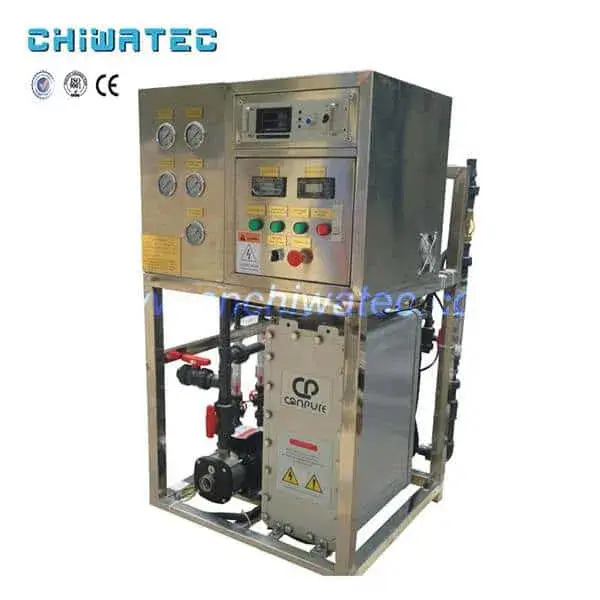
- EDI module stack – Multiple cell pairs for required capacity
- DC power supply – Rectifier providing 0-600V DC, 0-10A
- Flow control valves – Regulate product, concentrate, and recirculation flows
- Instrumentation – Resistivity/conductivity meters, flow meters, pressure gauges
- PLC control panel – Automated operation with alarm functions
- Pretreatment system – RO + degasification for optimal feedwater
EDI Feedwater Requirements (Critical for Performance)
Proper pretreatment is essential for EDI reliability and longevity. Poor feedwater quality causes scaling, fouling, and premature module failure.
Standard Feedwater Specifications
| Parameter | Acceptable Range | Optimal Range |
|---|---|---|
| Conductivity | <40 μS/cm | 10-30 μS/cm |
| Hardness (as CaCO₃) | <1.0 ppm | <0.5 ppm |
| Silica (SiO₂) | <1.0 ppm | <0.5 ppm |
| TOC | <500 ppb | <200 ppb |
| Free Chlorine | <0.05 ppm | Non-detectable |
| Iron/Manganese | <0.01 ppm | Non-detectable |
| pH | 6.0-9.0 | 7.0-8.5 |
Recommended Pretreatment Configuration
Multimedia Filter → Activated Carbon → Water Softener → 5μm Security Filter → Reverse Osmosis → Degasification (optional) → EDI → Polishing Mixed Bed (optional)
For CO₂ removal and improved silica rejection, install a membrane degasifier or caustic injection system between RO and EDI.
System Features and Advantages
Operational Benefits
- High and stable water quality – Consistent 15-18 MΩ·cm resistivity
- Continuous water production – No shutdown for regeneration cycles
- No chemical regeneration – Eliminates acid/base storage, handling, and disposal
- Fully automatic operation – Minimal operator attention required
- Simple and safe – No hazardous chemical handling risks
Economic Advantages
- Low operating costs – 40-60% reduction vs. traditional mixed bed
- Reduced maintenance costs – No resin replacement for 5-7 years
- No acid-base logistics – Eliminate transportation and storage expenses
- Compact footprint – Modular stacking design saves 50-70% floor space
- High water recovery – 90-95% vs. 70-80% for conventional IX
Environmental Benefits
- No chemical discharge – Eliminate acid/base waste streams
- Reduced wastewater volume – Higher recovery means less blowdown
- Lower carbon footprint – Reduced chemical manufacturing and transport
- LEED certification support – Contributes to green building credits
EDI vs. Traditional Mixed Bed: Comparison
| Parameter | EDI System | Mixed Bed IX |
|---|---|---|
| Water Quality | Continuous 15-18 MΩ·cm | Variable (declines between regenerations) |
| Operation Mode | Continuous, no downtime | Batch (requires regeneration shutdown) |
| Chemical Usage | None | HCl + NaOH for regeneration |
| Operating Cost | ¥8-12/m³ | ¥15-25/m³ |
| Labor Requirement | Minimal (automated) | Regular (manual regeneration) |
| Waste Generation | Low (concentrate only) | High (acid/base waste) |
| Module Life | 5-7 years | Resin 2-3 years |
2026 Industry Applications
1. Power Generation
Supercritical and ultra-supercritical boiler units require feedwater conductivity <0.15 μS/cm. EDI systems provide:
- Continuous high-purity water for 600-1000 MW units
- Condensate polishing applications
- Zero chemical handling in power plant environment
2. Semiconductor & Electronics
Chip fabrication demands ultrapure water with 18.2 MΩ·cm resistivity and ultra-low TOC:
- Wafer rinsing and cleaning processes
- Photolithography operations
- Integration with UV oxidation for TOC reduction
3. Pharmaceutical & Biotechnology
EDI serves as pretreatment for Water for Injection (WFI) generation:
- USP/EP/ChP compliant purified water production
- Consistent quality meeting pharmacopeia requirements
- Validated systems with 21 CFR Part 11 compliance
4. Food & Beverage
Premium product manufacturing requires consistent water quality:
- Beverage formulation and dilution
- Ingredient water for high-end products
- Bottle/packaging rinsing applications
5. Laboratory & Analytical
Type I reagent-grade water for sensitive instruments:
- HPLC, GC-MS, ICP-MS feedwater
- Cell culture and molecular biology applications
- Research laboratory centralized purification systems
2026 Technology Advancements
Smart Monitoring & IoT Integration
- Real-time resistivity monitoring with data logging
- Predictive maintenance alerts based on performance trends
- Remote diagnostics via cloud-connected controllers
- Energy optimization through adaptive voltage control
Enhanced Module Design
- Higher current density – Improved ion removal efficiency
- Advanced membrane materials – Better chemical resistance and selectivity
- Modular scalability – Easy capacity expansion
- Extended service life – 7-10 year module lifespan (up from 5-7 years)
Conclusion
EDI (Electrodeionization) technology has matured into the industry standard for ultrapure water production in 2026, offering unmatched advantages over traditional ion exchange systems. By combining continuous operation, chemical-free regeneration, and consistent high-purity output, EDI delivers both economic and environmental benefits across power generation, semiconductor, pharmaceutical, and laboratory applications.
Key success factors for EDI implementation include:
- Proper pretreatment – RO permeate meeting feedwater specifications
- Consistent operation – Avoid frequent start/stop cycles
- Regular monitoring – Track resistivity, flow rates, and voltage
- Preventive maintenance – Annual inspection and cleaning as needed
As industries face increasing pressure to reduce chemical usage, minimize wastewater, and improve water quality consistency, EDI electrodeionization systems will continue gaining market share. The technology’s proven reliability, declining capital costs, and strong ROI (typically 18-36 month payback) make it the optimal choice for new installations and mixed bed replacements worldwide.
FAQ: EDI Electrodeionization Equipment
1. What is the typical lifespan of an EDI module?
Modern EDI modules last 5-7 years with proper operation and feedwater quality. Premium systems with enhanced membrane materials can achieve 7-10 years. Module replacement is indicated when resistivity consistently falls below specifications despite optimal operating conditions.
2. Does EDI require chemical cleaning?
Yes, periodic cleaning (every 6-12 months) removes accumulated scale and organic fouling. Cleaning solutions are typically mild acids (citric acid 1-2%) or specialized EDI cleaning agents—significantly less hazardous than mixed bed regeneration chemicals.
3. What happens during EDI startup and shutdown?
Startup: Flush module with feedwater for 15-30 minutes, then gradually apply voltage over 5-10 minutes to prevent hydraulic shock. Shutdown: Reduce voltage gradually, flush with product water for 10 minutes, and drain if freezing conditions are possible.
4. Can EDI remove silica and boron effectively?
EDI removes 90-95% of silica and boron at neutral pH. For higher removal rates (>99%), adjust feedwater pH to 8.5-9.0 using caustic injection, converting silica and boron to ionized forms that migrate more readily under the electric field.
5. What is the power consumption of EDI systems?
Typical power consumption ranges from 0.3-0.8 kWh/m³ depending on feedwater conductivity and product water requirements. For RO permeate at 20 μS/cm producing 16 MΩ·cm water, expect approximately 0.5 kWh/m³.
6. Is EDI suitable for seawater desalination?
No. EDI requires low-conductivity feedwater (<40 μS/cm). For seawater (≈50,000 μS/cm), use reverse osmosis or multi-stage flash distillation as primary desalination, with EDI as a polishing step for ultrapure applications.
7. How does EDI compare to polishing mixed bed for final purification?
EDI provides continuous operation without regeneration downtime, while polishing mixed beds offer slightly higher initial quality (18.2 MΩ·cm) but decline between regenerations. Many systems use EDI as primary purification with optional polishing mixed bed for critical applications.
Further Reading
- Electrodeionization (EDI) in Clean Water Production – EDI applications in pharmaceutical and clean water systems
- Operating Instructions for EDI Equipment – Complete operational procedures and maintenance guidelines
- EDI Replaces Mixed Bed Technology – Cost-benefit analysis of EDI vs. traditional mixed bed systems
Do you have a water treatment project we can help with
* Designing,machining,installing,commissioning, customize and one-stop service






 English
  Spanish
  Portuguese




