

RO Reverse Osmosis Water Treatment for Heavy Metal Removal 2026: Complete Guide & Performance Data
Meta Description: Yes, RO reverse osmosis water treatment effectively removes heavy metals. Learn removal rates for lead, chromium, nickel, arsenic. Expert guide from CHIWATEC on RO membrane technology and industrial applications.
Executive Summary: RO Technology for Heavy Metal Removal
Yes, RO (Reverse Osmosis) water treatment technology effectively removes heavy metals from contaminated water sources. RO membranes have pore sizes as small as 0.0001 microns (0.1 nanometers), allowing only water molecules to pass through while rejecting dissolved heavy metal ions, inorganic salts, organic compounds, bacteria, and viruses.
Key performance metrics:
- Heavy metal removal rate: 95-99.9% depending on metal type and valence
- Divalent ions (Pb²⁺, Cd²⁺, Hg²⁺): 97-99.9% rejection
- Monovalent ions: 90-97% rejection
- Produced water conductivity: <5 μS/cm (meets laboratory Grade III water standards)
- With ion exchange polishing: resistivity up to 18.2 MΩ·cm (ultrapure water)
The global RO water treatment system market for heavy metal removal is projected to reach $8.9 billion by 2028, driven by stricter environmental regulations and industrial wastewater treatment demands.
How RO Reverse Osmosis Technology Works
Membrane Separation Principle
RO technology uses pressure differential as the driving force to separate water molecules from dissolved contaminants:
- Membrane pore size: 0.0001 microns (1 nanometer = 10⁻⁹ meters)
- Operating pressure: 10-70 bar depending on feed water TDS and application
- Separation mechanism: Size exclusion + charge repulsion (Donnan effect)
Process flow:
Feed Water (with heavy metals) → High-Pressure Pump → RO Membrane → Permeate (pure water) + Concentrate (heavy metal waste)
Why Heavy Metals Are Intercepted
Heavy metal ions are physically larger than water molecules and carry electrical charges:
- Water molecule (H₂O): ~0.28 nanometers diameter
- Hydrated metal ions: 0.4-0.9 nanometers (larger due to hydration shell)
- Membrane surface charge: Negatively charged polyamide layer repels anionic metal complexes
Result: Heavy metal ions cannot pass through the RO membrane and are concentrated in the reject stream for proper disposal or metal recovery.
RO Membrane Materials
- Thin Film Composite (TFC): Most common, high rejection rate (99%+), pH 2-11
- Polyamide (PA): Excellent chemical resistance, widely used in industrial applications
- Polysulfone Amide: Superior acid and oxidation resistance (for chromium wastewater)
- Cellulose Acetate (CA): Lower cost, chlorine tolerant, but lower rejection rate
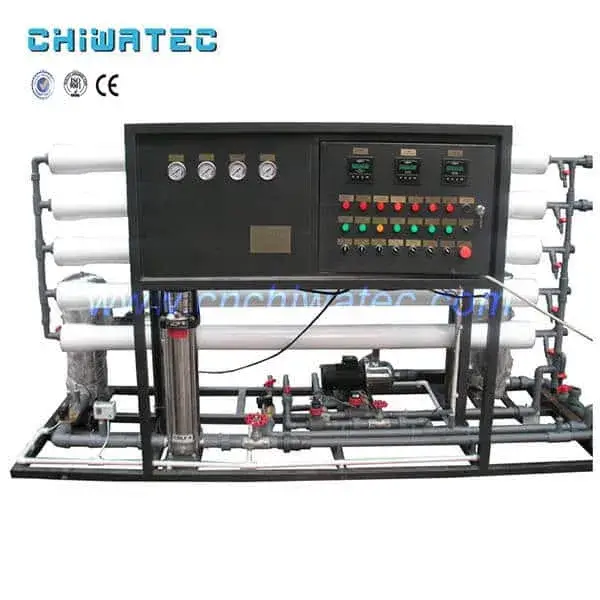
Heavy Metal Removal Performance by Metal Type
Lead (Pb²⁺)
- Removal rate: 96-99.5%
- EPA MCL: 0.015 mg/L (15 ppb)
- RO treated water: Typically <0.5 ppb
- Applications: Drinking water, battery manufacturing wastewater, mining effluent
Chromium (Cr⁶⁺, Cr³⁺)
- Removal rate: 93-98% (Cr⁶⁺), 96-99% (Cr³⁺)
- EPA MCL: 0.1 mg/L (total chromium)
- Membrane type: Polysulfone amide for acid chrome plating wastewater
- Applications: Electroplating, leather tanning, metal finishing
Nickel (Ni²⁺)
- Removal rate: 97.2-99%
- EPA MCL: 0.1 mg/L
- Nickel recovery: >99% from concentrated stream (valuable metal recovery)
- Applications: Nickel plating, battery manufacturing, stainless steel production
Arsenic (As³⁺, As⁵⁺)
- Removal rate: 90-98% (As⁵⁺ higher than As³⁺)
- EPA MCL: 0.010 mg/L (10 ppb)
- Pre-oxidation: Converting As³⁺ to As⁵⁺ improves removal efficiency
- Applications: Groundwater remediation, mining wastewater, semiconductor manufacturing
Cadmium (Cd²⁺)
- Removal rate: 96-99%
- EPA MCL: 0.005 mg/L (5 ppb)
- Applications: Battery manufacturing, metal plating, pigment production
Mercury (Hg²⁺)
- Removal rate: 95-99%
- EPA MCL: 0.002 mg/L (2 ppb)
- Applications: Chlor-alkali plants, mining, fluorescent lamp manufacturing
Copper (Cu²⁺)
- Removal rate: 97-99%
- EPA action level: 1.3 mg/L
- Applications: PCB manufacturing, metal finishing, mining
Zinc (Zn²⁺)
- Removal rate: 96-99%
- EPA MCL: 5 mg/L (secondary standard)
- Applications: Galvanizing, metal plating, rubber manufacturing
Engineering Application Cases
Case Study 1: Nickel Plating Wastewater Treatment (China)
- Challenge: Nickel-plating wastewater with Ni²⁺ concentration 500-2000 mg/L
- Solution: Two-stage RO system with acid-resistant membranes
- Operating conditions: Pressure 3.5-4.5 MPa, temperature 25-30°C
- Results:
- Nickel separation rate: 97.2-97.7%
- Water flux: 0.4 ton/m²·day
- Nickel recovery rate: >99% (from concentrate stream)
- Permeate quality: <5 mg/L Ni²⁺ (meets discharge standards)
- Economic benefit: Nickel recovery pays for 60% of operating costs
Case Study 2: Chromium Plating Wastewater (China)
- Challenge: Chromium-containing wastewater with Cr⁶⁺ 5000 mg/L, acidic conditions
- Solution: Polysulfone amide RO membranes with excellent acid and oxidation resistance
- Operating conditions: Pressure 4 MPa, pH 2-4
- Results:
- Water flux: 0.16-0.2 ton/m²·day
- Chromium removal rate: 93-97%
- Membrane lifespan: 2-3 years (vs. 1 year for standard TFC)
- Environmental impact: Zero liquid discharge achievable with evaporator for concentrate
Case Study 3: Mining Wastewater Treatment (Peru)
- Challenge: Acid mine drainage with multiple heavy metals (Cu, Zn, Pb, Cd, As)
- Solution: Pre-treatment (neutralization + coagulation) + Two-pass RO
- Results:
- Overall metal removal: >99% for all target metals
- Permeate quality: Meets drinking water standards
- Water recovery: 75% (reuse in mining operations)
- ROI: 3.2 years (water reuse + regulatory compliance)
Case Study 4: Semiconductor Manufacturing (Taiwan)
- Challenge: Ultra-pure water required with heavy metal specs <0.01 ppb
- Solution: Multi-stage RO + EDI + UV + 0.1μm polishing filtration
- Results:
- Heavy metal removal: >99.99%
- Final water quality: 18.2 MΩ·cm, TOC <3 ppb, particles <1 particle/mL
- System uptime: 99.97%
Factors Affecting RO Heavy Metal Removal Efficiency
1. Membrane Characteristics
- Pore size: Smaller pores = higher rejection but lower flux
- Surface charge: Affects rejection of charged metal complexes
- Material: TFC vs. CA vs. polysulfone amide
2. Operating Conditions
- Pressure: Higher pressure increases flux but may affect rejection
- Temperature: Optimal range 15-35°C (affects viscosity and diffusion)
- pH: Affects metal speciation and membrane surface charge
- Recovery rate: Higher recovery = higher concentrate concentration
3. Feed Water Quality
- TDS level: Higher TDS requires higher pressure
- Metal valence: Divalent/trivalent ions rejected better than monovalent
- Organic matter: Can foul membranes, reducing performance
- Suspended solids: Require pre-filtration to protect membranes
4. Pre-treatment Requirements
- Multimedia filtration: Remove suspended solids (>10 microns)
- Activated carbon: Remove chlorine, organics, improve taste/odor
- Water softening: Prevent scale formation (Ca, Mg)
- Antiscalant dosing: Inhibit scale in high-recovery systems
- pH adjustment: Optimize for membrane and metal removal
RO System Configurations for Heavy Metal Removal
Single-Pass RO
- Application: Moderate purity requirements, cost-sensitive projects
- Rejection rate: 95-98% for heavy metals
- Recovery: 50-75%
Double-Pass RO
- Application: High purity requirements, challenging feed water
- Rejection rate: 99-99.9% for heavy metals
- Recovery: 40-60% (overall)
RO + EDI (Electrodeionization)
- Application: Ultrapure water for electronics, pharmaceuticals
- Final quality: 15-18.2 MΩ·cm resistivity
- Heavy metals: <0.01 ppb detectable levels
RO + Evaporator (Zero Liquid Discharge)
- Application: Strict discharge regulations, valuable metal recovery
- Water recovery: 95-99%
- Metal recovery: Crystallized salts for reuse or safe disposal
Regulatory Compliance & Standards
Drinking Water Standards (EPA/WHO)
| Heavy Metal | EPA MCL (mg/L) | WHO Guideline (mg/L) |
|---|---|---|
| Lead (Pb) | 0.015 | 0.010 |
| Arsenic (As) | 0.010 | 0.010 |
| Cadmium (Cd) | 0.005 | 0.003 |
| Mercury (Hg) | 0.002 | 0.006 |
| Chromium (total) | 0.1 | 0.050 |
Industrial Wastewater Discharge Standards
- China GB 8978-1996: Comprehensive wastewater discharge standards
- EU Industrial Emissions Directive: BAT (Best Available Technology) requirements
- US EPA Effluent Guidelines: Industry-specific limits
Conclusion: RO Technology for Heavy Metal Removal
RO reverse osmosis water treatment is a proven, reliable technology for heavy metal removal with:
- Removal rates of 95-99.9% for most heavy metals
- Proven track record in drinking water, industrial wastewater, and ultrapure water applications
- Scalable from small residential systems to large industrial installations
- Cost-effective compared to alternative technologies (ion exchange, precipitation, distillation)
- Environmental benefits through water reuse and metal recovery
CHIWATEC provides comprehensive RO water treatment solutions for heavy metal removal, from system design and membrane selection to installation, commissioning, and ongoing technical support. Our engineering team helps you achieve regulatory compliance while optimizing operational costs.
Related Resources:
FAQ: RO Heavy Metal Removal
1. Can RO remove heavy metals from water?
Yes, RO (Reverse Osmosis) technology effectively removes 95-99.9% of heavy metals including lead, chromium, nickel, arsenic, cadmium, mercury, copper, and zinc. RO membranes have pore sizes of 0.0001 microns, physically blocking heavy metal ions while allowing water molecules to pass through.
2. What is the removal rate for lead in RO systems?
RO systems achieve 96-99.5% lead removal, reducing concentrations from typical contaminated levels (10-100 ppb) to below 0.5 ppb, well under the EPA MCL of 15 ppb. Divalent lead ions (Pb²⁺) are particularly well-rejected due to their larger hydrated radius.
3. Does RO remove arsenic effectively?
RO removes 90-98% of arsenic, with As⁵⁺ (arsenate) rejected better than As³⁺ (arsenite). Pre-oxidation converting As³⁺ to As⁵⁺ improves removal efficiency. RO is EPA-approved for arsenic remediation in drinking water applications.
4. How does RO compare to other heavy metal removal methods?
RO offers advantages over alternatives: higher removal rates than ion exchange (95-99% vs. 80-95%), lower chemical usage than precipitation, and lower energy consumption than distillation. RO also produces no hazardous sludge and enables water reuse.
5. What happens to the concentrated heavy metals?
Heavy metals concentrate in the RO reject stream (25-50% of feed volume). Options include: proper wastewater treatment and discharge, metal recovery (for valuable metals like nickel, copper), evaporation/crystallization for zero liquid discharge, or recycling back to the industrial process.
FOLLOW US
Do you have a water treatment project we can help with
Designing, machining, installing, commissioning, customize and one-stop service






 English
  Spanish
  Portuguese




