

What is the Main Function of Softened Water Treatment Equipment for Boiler Water Softening | Complete Guide 2026
Boiler water softening is critical for industrial steam systems and heating applications. This comprehensive guide covers the main functions of softened water treatment equipment, ion exchange principles, and operational benefits. With 15+ years of industry experience and 500+ successful projects worldwide, CHIWATEC delivers proven boiler water treatment solutions that prevent scale formation and extend equipment life.
In 2026, the global industrial boiler water treatment market is valued at $9.8 billion, with water softening systems accounting for over 45% of installations. Proper boiler feed water treatment can reduce fuel consumption by 5-10%, extend boiler tube life by 30-50%, and prevent costly downtime from scale-related failures. This guide explores the main functions of softened water treatment equipment, real-world applications, and best practices for maintaining optimal boiler performance.
Understanding Boiler Water Softening: Why It Matters
Boiler water softening equipment removes hardness-causing minerals (calcium and magnesium) from feed water before it enters the boiler system. This process is essential for preventing scale formation and ensuring safe, efficient boiler operation.
The Scale Problem in Boilers
When hard water is used in boilers without softening:
- Scale formation – Calcium carbonate and magnesium salts precipitate on heat transfer surfaces
- Reduced efficiency – Just 1mm of scale can increase fuel consumption by 5-8%
- Overheating risk – Scale acts as insulator, causing localized tube overheating
- Potential explosion – Severe scaling can lead to tube rupture and catastrophic failure
According to ASME (American Society of Mechanical Engineers) data, scale-related boiler failures account for 30% of industrial boiler accidents, with average repair costs exceeding $50,000 per incident.
Main Functions of Softened Water Treatment Equipment
- Hardness removal – Eliminates calcium and magnesium ions through ion exchange
- Scale prevention – Prevents mineral deposition on boiler tubes and heat exchangers
- Efficiency optimization – Maintains optimal heat transfer for fuel savings
- Equipment protection – Extends boiler lifespan by preventing corrosion and scaling
- Safety assurance – Reduces risk of pressure vessel failures
How Boiler Water Softening Equipment Works: Ion Exchange Technology
The core technology behind boiler water softening is ion exchange, a proven method used globally for over 60 years.
Ion Exchange Process Explained
Softening equipment uses sodium-based cation exchange resin to replace hardness ions:
- Raw water enters – Hard water containing Ca²⁺ and Mg²⁺ flows into resin tank
- Ion exchange occurs – Resin releases Na⁺ ions and captures Ca²⁺/Mg²⁺ ions
- Soft water exits – Treated water with sodium ions (non-scaling) flows to boiler
- Resin saturation – Over time, resin becomes saturated with hardness ions
- Regeneration cycle – Brine solution (NaCl) flushes resin, restoring sodium ions
Chemical Reaction
Service cycle: 2R-Na + Ca²⁺ → R₂-Ca + 2Na⁺
Regeneration: R₂-Ca + 2NaCl → 2R-Na + CaCl₂
Key Components of Softening Equipment
| Component | Function |
|---|---|
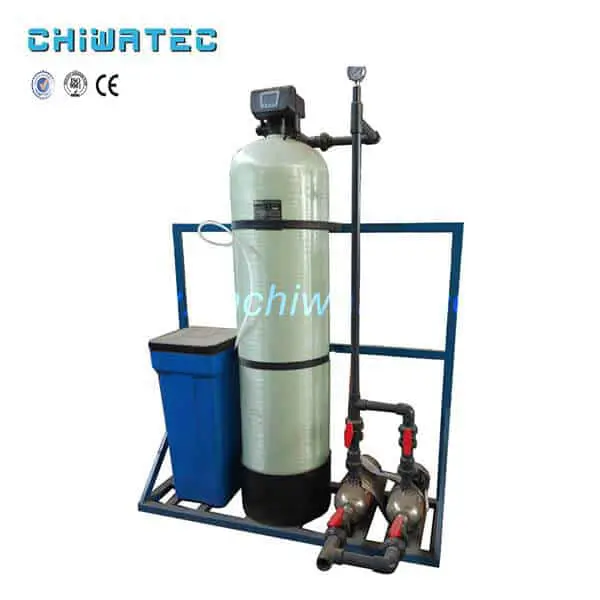
| Resin Tank | Houses ion exchange resin bed |
| Control Valve | Automates service/backwash/brine/rinse cycles |
| Brine Tank | Stores salt for regeneration solution |
| Distributor System | Ensures even water flow through resin bed |
| Control Panel | Monitors flow, time, and regeneration triggers |
According to Ion Exchange Association guidelines, properly maintained softening systems achieve 99%+ hardness removal efficiency with resin life exceeding 8-10 years.
Applications of Boiler Water Softening Equipment
Softened water treatment equipment is essential across diverse industrial and commercial applications.
Industrial Applications
- Steam boilers – Power generation, process steam, sterilization
- Hot water boilers – District heating, industrial processes
- Heat exchangers – Chemical processing, food production
- Evaporative condensers – HVAC systems, refrigeration
- Cooling towers – Industrial cooling, data centers
Commercial Applications
- Hotels and hospitals – Central heating, laundry, sterilization
- Schools and offices – Space heating, domestic hot water
- Restaurants – Commercial dishwashers, steam cooking
- Laundries – Industrial washing equipment
Water Quality Requirements by Boiler Type
| Boiler Type | Hardness Limit | TDS Limit |
|---|---|---|
| Low-pressure (<1.0 MPa) | <0.03 mmol/L | <3500 mg/L |
| Medium-pressure (1.0-3.8 MPa) | ≈0 μmol/L | <1500 mg/L |
| High-pressure (>3.8 MPa) | 0 μmol/L | <500 mg/L (requires RO + softening) |
Benefits of Using Softened Water Treatment Equipment
Investing in quality boiler water softening delivers measurable returns across multiple operational areas.
1. Energy Savings
- Prevents scale formation that reduces heat transfer efficiency
- 1mm scale = 5-8% increase in fuel consumption
- Typical ROI: 12-24 months through fuel savings alone
2. Extended Equipment Life
- Prevents tube corrosion and pitting
- Reduces thermal stress from localized overheating
- Boiler tube life extended from 5-7 years to 12-15 years
3. Reduced Maintenance Costs
- Eliminates need for frequent descaling
- Reduces chemical treatment requirements
- Minimizes unplanned downtime
4. Improved Safety
- Prevents pressure vessel failures
- Reduces explosion risk from overheating
- Ensures compliance with ASME and local regulations
5. Consistent Performance
- Stable steam pressure and temperature
- Reliable hot water supply
- Predictable operational parameters
According to U.S. Department of Energy studies, proper boiler water treatment can reduce annual energy costs by $5,000-$50,000 depending on boiler size and operating hours.
2026 Industry Trends: Advanced Boiler Water Treatment Technologies
Smart Monitoring and IoT Integration
Modern softening systems feature advanced automation:
- Real-time hardness monitoring – Continuous water quality tracking
- Remote diagnostics – Cloud-based system health monitoring
- Predictive regeneration – AI algorithms optimize salt and water usage
- Mobile alerts – Notifications for maintenance and faults
Plants using smart monitoring report 25% reduction in salt consumption and 30% extension in resin life.
High-Efficiency Resin Technology
2026 sees adoption of next-generation materials:
- Macroporous resins – Higher exchange capacity, faster kinetics
- Uniform particle size – Improved flow distribution, lower pressure drop
- Oxidation-resistant formulations – Extended life in challenging water conditions
Water-Efficient Regeneration
Environmental regulations drive innovation:
- Counter-flow regeneration – 40% less water and salt usage
- Brine reclaim systems – Reuse regeneration wastewater
- Demand-initiated regeneration – Regenerate only when needed
For comprehensive system design, review our technical specifications and installation guide for water softeners.
Real-World Case Studies: Boiler Water Softening Success
Case Study 1: Food Processing Plant, Zhejiang
Challenge: 4-ton steam boiler experiencing quarterly descaling, 15% efficiency loss
Solution: Installed 10T/H automatic softening system with counter-flow regeneration
Results:
- Scale formation eliminated completely
- Fuel consumption reduced 12% (annual savings: $18,000)
- Boiler cleaning frequency: annual vs quarterly
- ROI achieved in 14 months
Case Study 2: Hospital Complex, Sichuan
Challenge: Multiple hot water boilers with inconsistent temperatures, frequent repairs
Solution: Centralized 20T/H softening system with redundant resin tanks
Results:
- Water temperature stability: ±1°C
- Emergency repairs reduced 90%
- Equipment life extended from 6 to 14 years
- Patient comfort complaints eliminated
Case Study 3: Textile Factory, Jiangsu
Challenge: Dyeing process affected by hard water, inconsistent product quality
Solution: Dual-tank softening system with 24/7 continuous operation
Results:
- Product quality consistency improved 35%
- Dye consumption reduced 18%
- Water usage decreased 22%
- Customer rejection rate dropped to near zero
Explore additional applications in our guide on optimizing parameters for fully automatic water softening equipment.
Conclusion: The Critical Role of Softened Water Treatment in Boiler Operations
The main function of softened water treatment equipment for boiler water softening extends far beyond simple hardness removal. It is a critical investment that delivers:
- Safety – Prevents catastrophic boiler failures and explosions
- Efficiency – Maintains optimal heat transfer for fuel savings
- Reliability – Ensures consistent steam and hot water production
- Longevity – Extends boiler tube and equipment lifespan
- Compliance – Meets ASME and regulatory water quality standards
At CHIWATEC, we provide comprehensive boiler water treatment support including water analysis, system design, installation, commissioning, and ongoing technical assistance. Our 15+ years of engineering excellence ensures your boiler system operates safely and efficiently.
Ready to optimize your boiler water treatment? Contact our engineers for a free consultation and customized softening system design tailored to your specific requirements.
FAQ: Boiler Water Softening Equipment
1. What is the main function of softened water treatment equipment?
The primary function is to remove calcium and magnesium ions (hardness) from boiler feed water through ion exchange, preventing scale formation on heat transfer surfaces. This ensures safe, efficient boiler operation and extends equipment lifespan.
2. How hard can boiler feed water be?
Low-pressure boilers (<1.0 MPa): hardness <0.03 mmol/L. Medium and high-pressure boilers require near-zero hardness (≈0 μmol/L). Always consult boiler manufacturer specifications and local regulations.
3. How often does softening equipment need regeneration?
Regeneration frequency depends on water hardness, flow rate, and resin capacity. Typical systems regenerate every 1-7 days. Modern controllers automatically trigger regeneration based on flow volume or time schedules.
4. What type of salt should be used for regeneration?
Use high-purity solar salt or evaporated salt (99.5%+ NaCl) specifically designed for water softeners. Avoid rock salt with high insoluble content. Salt tablets are preferred for their consistent dissolution and minimal bridging.
5. Can softened water be used for drinking?
Softened water is safe for most household uses but contains elevated sodium levels. For drinking, consider a separate untreated tap or install a reverse osmosis system downstream of the softener.
6. How long does softening resin last?
With proper maintenance and regeneration, ion exchange resin lasts 8-12 years. Factors affecting lifespan include chlorine exposure, iron contamination, and mechanical wear from frequent backwashing.
For more technical resources, visit our Water Softening System product category.
FOLLOW US
Do you have a water treatment project we can help with
* Designing, machining, installing, commissioning, customize and one-stop service






 English
  Spanish
  Portuguese




