Mine Water Treatment Technology: Complete Guide to Purification and Desalination 2026
China’s coal mining industry generates billions of cubic meters of mine water annually — water that is contaminated with suspended solids (primarily coal dust), dissolved salts, oily substances, and microorganisms. Effective mine water treatment technology transforms this waste stream into valuable resources for industrial use, domestic consumption, and even drinking water after desalination. This guide covers the full spectrum of mine water treatment methods — from conventional coagulation and sedimentation to advanced RO desalination — helping mining engineers and water treatment professionals design and operate compliant, cost-effective systems.
Overview of Mine Water Treatment Technology
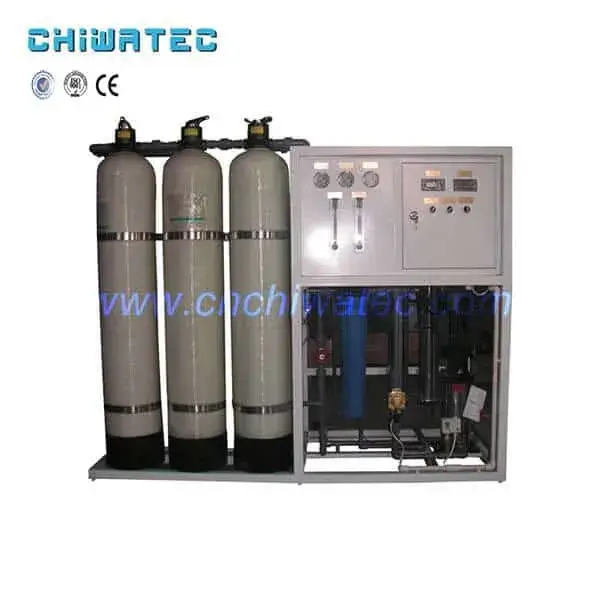
China’s mine water purification treatment technology began development in the late 1970s. Today, most coal mine water treatment systems handle capacities from hundreds to tens of thousands of tons per day, using process trains adapted from surface water treatment: pre-sedimentation, reaction sedimentation (or clarification), and filtration. After purification, mine water can serve as industrial process water or domestic water. For water with high salt content, desalination using reverse osmosis (RO) membrane technology is required to meet drinking water standards.
| Treatment Goal | Required Process | Typical Effluent Quality |
| Industrial process water | Coagulation + sedimentation + filtration | SS < 10 mg/L, turbidity < 3 NTU |
| Domestic water | Coagulation + clarification + filtration + disinfection | Meets GB 5749-2022 drinking water standards (except TDS) |
| Drinking water (high TDS) | Purification + RO desalination + disinfection | TDS < 500 mg/L, meets all GB 5749 standards |
Coagulation and Flocculation in Mine Water Treatment
Coagulation is the primary step in removing suspended solids from mine water. The two most common coagulant types are:
- Aluminum salts — Polyaluminum chloride (PAC) is the most widely used coagulant for mine water. Dosage typically ranges from 20–50 mg/L depending on raw water turbidity (100–500 NTU typical for coal mine water). Polyaluminum iron is also used in some installations
- Iron salts — Ferric chloride or ferric sulfate, less common but effective at lower temperatures
- Flocculant — Polyacrylamide (PAM) anionic or non-ionic, dosed at 0.5–2 mg/L as a flocculant aid to enhance floc formation and settling
Mixing methods for coagulants in mine water treatment include: pump mixing (most common, utilizing the pump impeller for rapid dispersion), pipeline mixer (in-line static mixer), and mechanical mixing (motor-driven impeller in a flash mixing chamber). Proper mixing is critical — insufficient mixing leads to poor floc formation and carryover of fine coal particles to downstream processes.
Sedimentation and Clarification Technologies
After coagulation, the flocculated water enters sedimentation or clarification units. Three main technologies are used in mine water treatment:
Sedimentation Tanks
Both advection (horizontal flow) and inclined tube/plate sedimentation tanks are used. Advection tanks are simple but require large footprints. Inclined tube settlers (typically 60° inclination, 50–80 mm tube diameter) increase surface loading rates to 2–5 m³/m²·h while reducing footprint by 50–70%.
Hydraulic Circulation Clarifiers
This technology integrates coagulation reaction and sedimentation in a single structure. Water enters through a central draft tube, where it mixes with recirculated sludge (sludge blanket). Key advantages include: low power consumption (only the feed pump), strong load impact resistance, simple maintenance, and convenient operation. The sludge blanket in the hydraulic clarifier also provides excellent oil removal — destabilized emulsified oil droplets are trapped and adsorbed by the large volume of return sludge.
Mechanically Accelerated Clarifiers
These use a motor-driven impeller to create internal recirculation. They occupy less area than hydraulic clarifiers but have higher energy consumption and more mechanical maintenance. In practice, hydraulic circulation clarifiers demonstrate superior treatment performance for typical coal mine water applications.
Filtration Systems for Mine Water Purification
Filtration is the final polishing step before disinfection or RO desalination. Two filter types are commonly employed in mine water treatment:
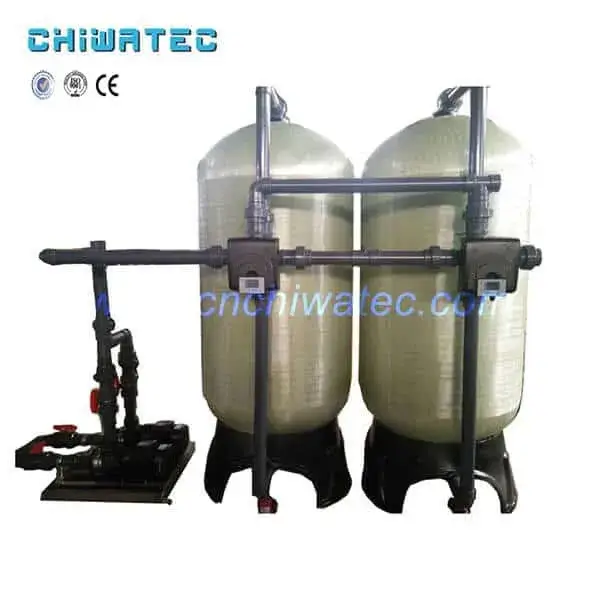
- Rapid gravity filters — Dual-media (anthracite + quartz sand) filters operating at 6–12 m/h filtration rate. Backwash at 12–15 L/m²·s for 5–10 minutes. The pipe and valve system is complex, and backwashing requires operator attention
- Gravity valveless filters — These automatically initiate backwash when head loss reaches a preset level (typically 1.5–2.0 m). The siphon-driven backwash eliminates the need for valves and control systems, making operation simpler and reducing maintenance. Widely preferred in unattended mine water treatment plants
Filter media is typically a dual-layer configuration: anthracite (0.8–1.2 mm, 400–500 mm depth) on top and quartz sand (0.5–1.0 mm, 200–300 mm depth) below. This arrangement allows the coarse anthracite to trap larger particles while the finer sand polishes the water.
Disinfection and RO Desalination in Mine Water Treatment
Disinfection Methods
When mine water is treated for domestic use, disinfection is mandatory after filtration. Chlorine dioxide (ClO₂) is the preferred disinfectant for mine water applications due to its strong oxidation capacity, minimal trihalomethane (THM) formation, and effectiveness across a wide pH range (pH 4–10). Sodium hypochlorite (NaOCl) and liquid chlorine are used less frequently. Typical ClO₂ dosage: 0.5–2.0 mg/L with a contact time of 30 minutes.
RO Desalination for High-TDS Mine Water
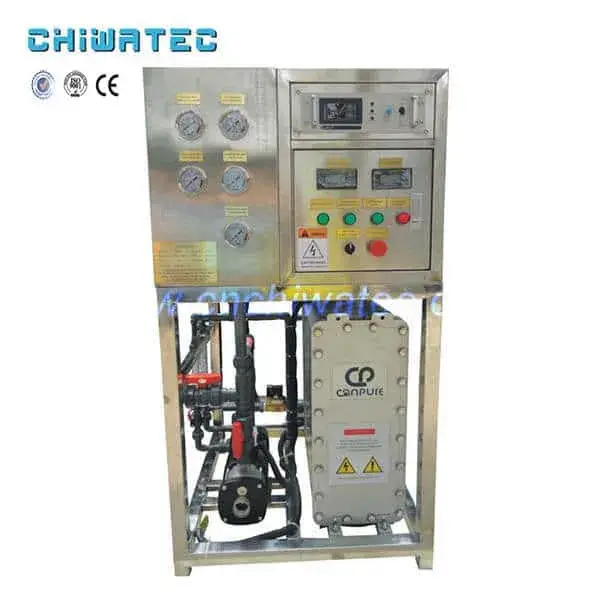
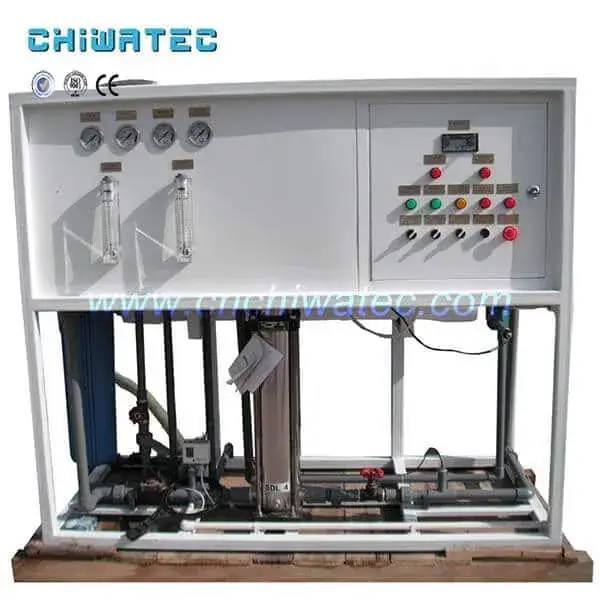
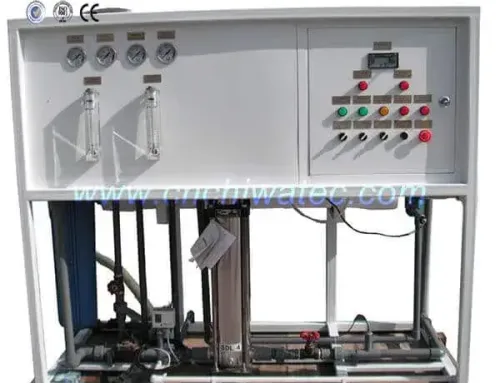
Many mine waters, especially those from deep coal seams, contain elevated total dissolved solids (TDS > 1,000 mg/L) that exceed drinking water standards even after purification. In these cases, reverse osmosis is required as a final desalination step. The RO system treats the clarified and filtered mine water, reducing TDS from 1,000–3,000 mg/L to below 200 mg/L — well within the WHO guideline of 500 mg/L TDS for drinking water. Key design considerations for mine water RO applications include:
- Pretreatment — Cartridge filtration (5 µm) and antiscalant injection are essential to protect RO membranes from scaling and particulate fouling
- Membrane selection — Brackish water RO membranes (e.g., Vontron LP series, Dow FilmTec BW30) operating at 150–250 psi are suitable for most mine water TDS levels
- Recovery rate — Typically 65–75% recovery, limited by silica and calcium sulfate scaling potential
Special Challenges in Coal Mine Water Treatment
Coal mine water presents unique challenges that distinguish it from conventional surface water treatment:
- Coal dust suspended solids — Mine water contains fine coal particles (< 50 µm) that give the water a black color. The alum flocs formed after coagulant dosing have a loose structure and settle slowly. Proper coagulant selection and dosage optimization are critical for effective removal
- Oily contaminants — Mining machinery uses emulsified oil and motor oil that enter the mine water. Conventional coagulation and inclined tube sedimentation cannot effectively remove oily substances. The hydraulic circulation clarifier addresses this through sludge blanket adsorption — the electrolyte coagulant destabilizes the oil emulsion, and the return sludge traps the oil droplets
- Variable water quality — Suspended solids concentrations vary widely between different coal mines (50–5,000 mg/L), requiring site-specific coagulant type and dosage determination. Many treatment plants lack online monitoring for incoming and outgoing water quality, flow rate, dosage, and tank levels, resulting in suboptimal performance
- Design vs. actual performance — Some mine water treatment projects fail to meet design specifications after commissioning because the reaction, sedimentation, and filtration units are oversized relative to actual flow, while pumping, dosing, disinfection, and control equipment are designed for the full design capacity — causing significant investment waste
A well-designed mine water treatment technology system incorporates automatic dosing, automatic sludge discharge, and automatic backwashing, with PLC-based monitoring of dosing flow, treatment flow, tank levels, and effluent turbidity.
Frequently Asked Questions
What is mine water treatment technology?
Mine water treatment technology encompasses the processes used to treat water extracted from underground mining operations — primarily coal mines. It includes coagulation, sedimentation, clarification, filtration, disinfection, and when needed, reverse osmosis desalination to produce water suitable for industrial, domestic, or drinking use.
What are the main pollutants in mine water?
The primary pollutants in coal mine water are: suspended solids (coal dust, fine rock particles, 50–5,000 mg/L), dissolved salts (TDS 500–3,000 mg/L), oily substances (emulsified oil and motor oil from mining machinery), and microorganisms. Some mine waters also contain heavy metals depending on the geology.
Can mine water be treated for drinking?
Yes. After purification (coagulation, clarification, filtration, disinfection), mine water can meet domestic water standards. For high-TDS mine water (>1,000 mg/L), additional RO desalination is required to bring TDS below the drinking water standard of 500 mg/L. The purified water is safe and has been successfully implemented in many coal mining communities in China.
What is the difference between a hydraulic circulation clarifier and a settling tank?
A hydraulic circulation clarifier integrates coagulation reaction and sedimentation in one unit with a sludge blanket that captures fine particles and oil droplets. It has lower power consumption, stronger load impact resistance, and easier maintenance compared to conventional sedimentation tanks, which are simpler but require more space and are less effective at removing emulsified oil.
Why is RO used in mine water treatment?
Reverse osmosis is used when mine water has high total dissolved solids (TDS > 1,000 mg/L) that exceed drinking or process water standards. RO membranes remove >99% of dissolved salts, producing water with TDS < 200 mg/L. This enables mine water to be used as a reliable drinking water source in water-scarce mining regions.
Conclusion and Call to Action
Mine water treatment technology has evolved from basic sedimentation to integrated systems combining coagulation, hydraulic clarification, filtration, disinfection, and RO desalination — enabling coal mines to transform a waste stream into a valuable water resource. Proper coagulant selection, robust clarification design, automatic monitoring, and appropriate RO desalination are the keys to successful mine water treatment projects. CHIWATEC provides complete mine water treatment solutions — from conventional purification systems to advanced RO desalination plants — for mining operations of all scales. Contact us for technical consultation and system design: [email protected] or [email protected].
Related Resources and Further Reading
Do you have a water treatment project we can help with
* Designing,machining,installing,commissioning, customize and one-stop service
 English
  Spanish
  Portuguese