

What Is the Turbidity of Water? Definition, Standards, Causes & Treatment Methods
Learn what water turbidity is, how it is measured (NTU, JTU, FTU), what causes turbidity, and why controlling turbidity is essential in drinking water treatment, industrial processes, and desalination systems.
1. What Is the Turbidity of Water?
Turbidity refers to the cloudiness or haziness of water caused by suspended and colloidal particles. When these particles scatter or absorb light, originally clear water becomes visually turbid. The degree of this cloudiness is measured as turbidity.
Turbidity is a key factor in water quality evaluation and directly affects:
- Drinking water safety
- Industrial process performance
- Desalination pretreatment efficiency
- Cooling water systems
- Wastewater treatment outcomes
Because turbidity reflects the presence of particles, microorganisms, and organic matter, it is widely monitored in environmental, municipal, and industrial water systems.
2. How Turbidity Is Measured: Units and Standards
2.1 Traditional Units: JTU and “Degrees”
Historically, turbidity was expressed in Jackson Turbidity Units (JTU).
- 1 JTU equals the turbidity caused by 1 mg of SiO₂ (white clay) suspended in 1 L of water.
- This was measured using the Jackson Candle Turbidimeter, an optical comparison instrument.
2.2 Modern Instruments: NTU
Today, turbidity is commonly measured using nephelometric instruments, producing readings in NTU (Nephelometric Turbidity Units).
- 1 NTU = 1 JTU
- NTU is the global standard for drinking water and industrial water quality.
2.3 International Standard: FTU
Recently, the international community has adopted the Formazin Turbidity Unit (FTU) as a reproducible and reliable standard using a urotropine-hydrazine sulfate solution.
- 1 FTU = 1 NTU = 1 JTU
3. Why Does Turbidity Occur?
Turbidity is an optical phenomenon that occurs when particles in water scatter and absorb light. It is influenced by:
- Concentration of suspended solids
- Type and composition of impurities
- Particle size and distribution
- Particle shape
- Surface reflection characteristics
Typical sources of turbidity include:
- Silt and clay
- Organic matter
- Plankton and microorganisms
- Industrial wastewater
- Corrosion products in pipelines
- Colloidal particles from natural sources
4. Industrial and Drinking Water Turbidity Standards
Different applications require different turbidity levels to ensure system performance and product quality:
| Application Area | Maximum Turbidity Requirement |
|---|---|
| Drinking water (domestic) | ≤ 5 NTU |
| Cooling tower makeup water | 2–5 NTU |
| Reverse osmosis (RO) feed water | ≤ 3 NTU |
| Manufacturing of synthetic fibers | ≤ 0.3 NTU |
High turbidity can cause:
- Reduced disinfection efficiency
- Membrane fouling in RO and UF systems
- Heat exchanger scaling
- Pipeline blockages
- Poor product quality in manufacturing processes
5. Behavior of Turbidity Particles
Suspended and colloidal particles that create turbidity are:
- Generally stable
- Mostly negatively charged
- Too small to settle naturally
Without treatment, these particles remain dispersed indefinitely and do not settle at the bottom of the water column.
6. How to Reduce Turbidity in Water
In industrial water treatment, turbidity reduction is achieved through multiple processes:
6.1 Coagulation
Adding coagulants (such as alum, PAC, or ferric chloride) neutralizes particle charges, allowing them to attract and form larger aggregates (flocs).
6.2 Flocculation
Gentle mixing promotes the formation of larger, settleable flocs.
6.3 Sedimentation or Clarification
Flocs settle at the bottom of a clarifier, removing the majority of suspended particles.
6.4 Filtration
Sand filters, multimedia filters, activated carbon filters, ultrafiltration (UF), or membrane systems capture remaining fine particles.
6.5 Advanced Treatment (when required)
- Ultrafiltration (UF)
- Reverse osmosis (RO)
- Dissolved air flotation (DAF)
- Membrane bioreactors (MBR)
These processes ensure turbidity is reduced to meet the strictest water quality standards.
Conclusion
The turbidity of water is a key indicator of water clarity and quality, caused by suspended and colloidal particles that scatter light. Measured in units such as NTU, JTU, and FTU, turbidity affects a wide range of applications—from drinking water treatment to industrial and desalination processes. Since turbidity-causing particles are stable and do not settle naturally, effective water treatment requires techniques like coagulation, clarification, filtration, and advanced membrane processes. Controlling turbidity ensures safe, efficient, and reliable operation across all water treatment systems.
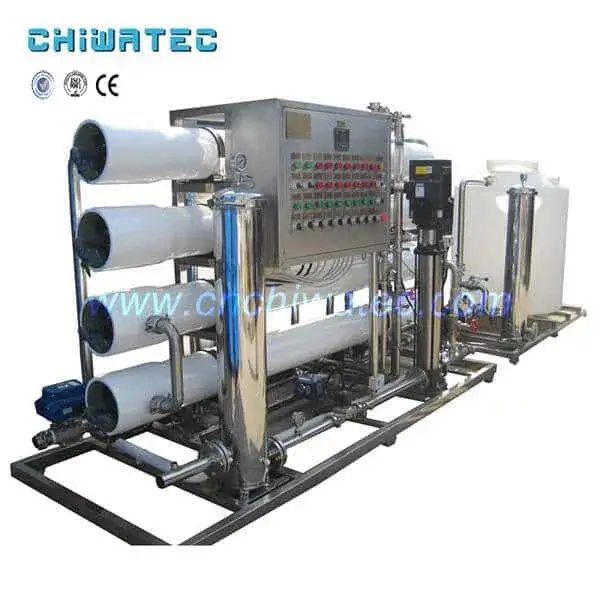
For advanced RO and pretreatment systems, explore CHIWATEC’s full product range:
👉 CHIWATEC Water Treatment Equipment & Solutions
FAQ: Turbidity of Water
1. What is turbidity in simple terms?
Turbidity is the cloudiness or haziness of water caused by suspended particles that scatter light.
2. What are common causes of turbidity?
Sources include soil erosion, organic matter, microorganisms, industrial discharge, and corrosion byproducts.
3. What unit is used to measure turbidity?
Modern instruments use NTU (Nephelometric Turbidity Units), which are equivalent to JTU and FTU.
4. Why is turbidity important in drinking water?
High turbidity can protect bacteria from disinfection, reduce water clarity, and indicate contamination.
5. How can turbidity be removed?
Turbidity is removed through coagulation, sedimentation, filtration, ultrafiltration, or advanced membrane technologies.
6. What turbidity level is required for reverse osmosis?
RO systems generally require influent turbidity below 3 NTU to prevent membrane fouling.
Xi’an CHIWATEC Water Treatment Technology is a high-tech enterprise specialized in various water processing devices. Aside from these individual products, which cover a number of types and series, we can also help with related comprehensive engineering projects. Thanks to our hard work and dedication upon our founding, we are now one of the fastest-developing water treatment equipment manufacturers in Western China.
Further reading:
FOLLOW US
Do you have a water treatment project we can help with
* Designing,machining,installing,commissioning, customize and one-stop service






 English
  Spanish
  Portuguese




