

What Is the Resistivity of Water? | Definition, Principles & Measurement
Learn what the resistivity of water is, how it is measured, and why it is a critical parameter in water quality analysis. Understand the relationship between resistivity, conductivity, ion concentration, and purity levels in industrial and ultrapure water systems.
1. What Is the Resistivity of Water?
The resistivity of water is a key indicator used to describe how strongly water resists the flow of electric current. It is the inverse of conductivity, meaning:
- High resistivity = low conductivity → water is purer
- Low resistivity = high conductivity → water contains more ions
Because pure water contains virtually no ions, its ability to conduct electricity is extremely weak. In contrast, water containing salts, minerals, and dissolved ions conducts electricity much more easily.
2. The Relationship Between Resistivity and Conductivity
Resistivity is derived directly from Ohm’s Law, which describes the relationship between voltage, current, and resistance. When measuring water quality:
- The resistance (R) measured between two electrodes
- Depends on the distance between the electrodes (L)
- And the cross-sectional area of the electrode surface (F)
To standardize measurements, resistivity is defined using:
- Electrode area (F): 1 cm²
- Distance between electrodes (L): 1 cm
Under these conditions, the measured resistance is equivalent to the true resistivity of the water sample.
3. What Determines the Resistivity of Water?
Water resistivity is primarily controlled by the type and amount of dissolved ions. Factors influencing resistivity include:
Ion concentration
More ions (e.g., Na⁺, Ca²⁺, Mg²⁺, Cl⁻, SO₄²⁻) → lower resistivity.
Ion charge
Ions with higher charges conduct electricity more efficiently → contribute to lower resistivity.
Ion mobility
Ions that move faster in solution (e.g., H⁺, OH⁻) decrease resistivity.
Salt content
Salt dissolves into ions, dramatically reducing resistivity.
Because of these relationships:
- Pure water has very few ions → very high resistivity
- Ultrapure water (used in semiconductors, electronics, and laboratories) has an even higher resistivity, approaching the theoretical maximum of 18.2 MΩ·cm at 25°C
4. Typical Resistivity Ranges of Different Water Types
| Water Type | Typical Resistivity | Notes |
|---|---|---|
| Seawater | very low | High salt concentration → strong conductivity |
| Tap water | 1,000–50,000 Ω·cm | Contains minerals, ions |
| Softened water | higher than tap water | Removes Ca²⁺, Mg²⁺ but still contains ions |
| RO (reverse osmosis) water | 0.1–1 MΩ·cm | Significantly reduced ion content |
| Deionized water | 1–18 MΩ·cm | Very low ionic concentration |
| Ultrapure water | up to 18.2 MΩ·cm | Highest possible purity at 25°C |
These values help evaluate the quality and suitability of water for applications such as boilers, electronics manufacturing, pharmaceuticals, and laboratory use.
5. Why Is Resistivity Important in Water Treatment?
Resistivity is one of the most important indicators for assessing the purity of water, especially in:
- Power plants and boiler systems
(high resistivity ensures minimal scale and corrosion) - Semiconductor & microelectronics manufacturing
(requires ultrapure water to avoid defects) - Pharmaceutical production
(water quality must meet strict standards) - Laboratories & research environments
(accurate chemical analysis requires high-purity water)
Monitoring resistivity allows operators to verify:
- Ion exchange resin performance
- RO membrane efficiency
- DI/EDI system performance
- Contamination levels in water distribution loops
Conclusion
The resistivity of water serves as a vital parameter for determining water purity. High resistivity indicates low ion content and high water quality, making it essential for industries requiring ultrapure or highly treated water. Understanding the relationship between resistivity, conductivity, and ion concentration helps ensure water systems operate efficiently, safely, and within required specifications.
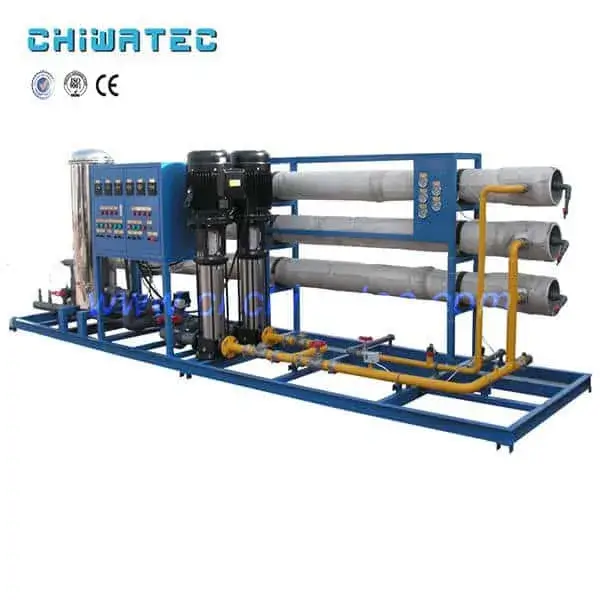
For advanced RO and pretreatment systems, explore CHIWATEC’s full product range:
👉 CHIWATEC Water Treatment Equipment & Solutions
FAQ (Frequently Asked Questions)
1. Why does pure water have high resistivity?
Because pure water lacks dissolved ions, which are necessary to conduct electricity.
2. What is the resistivity of ultrapure water?
The theoretical maximum is 18.2 MΩ·cm at 25°C, typical in high-end DI/EDI systems.
3. How is resistivity related to conductivity?
They are inversely related:
Resistivity = 1 / Conductivity.
4. Does higher resistivity mean cleaner water?
Yes. High resistivity indicates fewer ions and higher purity.
5. What causes water to have low resistivity?
High salt content, dissolved minerals, industrial contaminants, or high concentrations of ions.
Xi’an CHIWATEC Water Treatment Technology is a high-tech enterprise specialized in various water processing devices. Aside from these individual products, which cover a number of types and series, we can also help with related comprehensive engineering projects. Thanks to our hard work and dedication upon our founding, we are now one of the fastest-developing water treatment equipment manufacturers in Western China.
Further reading:
FOLLOW US
Do you have a water treatment project we can help with
* Designing,machining,installing,commissioning, customize and one-stop service






 English
  Spanish
  Portuguese




