

What Is the Hardness of Water? Complete Definition, Causes & Impact on Water Treatment
Learn what the hardness of water means, how calcium and magnesium ions create scale, why water hardness affects boilers and industrial systems, and how hardness is measured and treated using water softening or desalination.
1. Introduction: What Is Water Hardness?
The hardness of water refers to the concentration of certain dissolved metal cations—primarily calcium (Ca²⁺) and magnesium (Mg²⁺)—that react with anions in water to form scale when heated or concentrated.
When water containing these ions is heated, the dissolved minerals precipitate and deposit on heat-transfer surfaces, forming solid layers of scale that reduce thermal efficiency and damage equipment.
In industrial and domestic applications, understanding water hardness is essential for:
- Preventing scale formation
- Protecting boilers, heat exchangers, and pipelines
- Ensuring efficient energy usage
- Maintaining stable water quality in manufacturing and processing
2. What Causes Hardness in Water?
Calcium and Magnesium Ions: The Main Sources
Natural water contains various dissolved minerals, but calcium and magnesium ions are the primary components contributing to hardness. These ions come from:
- Dissolution of limestone and dolomite
- Geological formations
- Industrial and agricultural runoff
These ions combine with common anions such as:
- Carbonate (CO₃²⁻)
- Bicarbonate (HCO₃⁻)
- Sulfate (SO₄²⁻)
- Chloride (Cl⁻)
- Nitrate (NO₃⁻)
This combination forms carbonate hardness, sulfate hardness, chloride hardness, etc.
Although ions like iron (Fe²⁺) and manganese (Mn²⁺) can also contribute to hardness, their concentration in natural water is usually very low, so they are often ignored in hardness calculations.
3. Types of Water Hardness
3.1 Temporary Hardness (Carbonate Hardness)
Temporary hardness is mainly caused by:
- Calcium bicarbonate (Ca(HCO₃)₂)
- Magnesium bicarbonate (Mg(HCO₃)₂)
It can be removed by:
- Heating (boiling)
- Aeration
- Lime softening
During heating, bicarbonates decompose into carbonates and precipitate, forming scale.
3.2 Permanent Hardness (Non-Carbonate Hardness)
Permanent hardness is caused by:
- Sulfates
- Chlorides
- Nitrates of calcium and magnesium
This hardness cannot be removed by boiling and requires proper water treatment methods such as:
- Ion exchange softening
- Nanofiltration
- Reverse osmosis
- Chemical softening
4. Why Is Water Hardness Important?
4.1 Scale Formation
Hard water forms scale on:
- Boiler tubes
- Heat exchanger surfaces
- Household appliances
- Industrial heating equipment
Scale reduces heat transfer efficiency, increases energy consumption, and leads to equipment overheating or failure.
4.2 Industrial Impact
In industrial boilers and steam-generation systems, even small increases in hardness can cause:
- Lower heat efficiency
- Pipe blockage
- Increased fuel consumption
- Risk of equipment damage
Therefore, boiler feedwater must be strictly controlled to meet hardness limits.
5. How to Measure Water Hardness
Water hardness is usually expressed as:
- mg/L (milligrams per liter)
- ppm (parts per million)
- mmol/L
Most standards convert hardness into CaCO₃ concentration for consistency.
Common measurement methods include:
- EDTA titration
- Ion chromatography
- Hardness test kits
- Online water quality analyzers
6. How to Reduce or Eliminate Water Hardness
6.1 Ion Exchange Water Softening
This is the most commonly used method for household and industrial applications.
Resin exchanges calcium and magnesium ions for sodium ions, reducing hardness to nearly zero.
6.2 Reverse Osmosis (RO)
RO membranes remove:
- Calcium
- Magnesium
- Other dissolved minerals
Ideal for high-purity industrial water and drinking water purification.
6.3 Nanofiltration (NF)
NF selectively removes divalent ions, reducing hardness while retaining some salts.
6.4 Lime Softening
Used in large-scale water plants; lime reacts with calcium and magnesium to form precipitates.
Conclusion
The hardness of water is determined by the concentration of calcium and magnesium ions. These minerals react with anions to form scale, affecting heat transfer and damaging equipment—especially industrial boilers. Understanding the causes, classification, and effects of water hardness is essential for designing effective treatment systems such as water softeners, reverse osmosis, nanofiltration, or lime softening. Proper control of hardness improves water quality, reduces energy consumption, and protects long-term equipment performance.
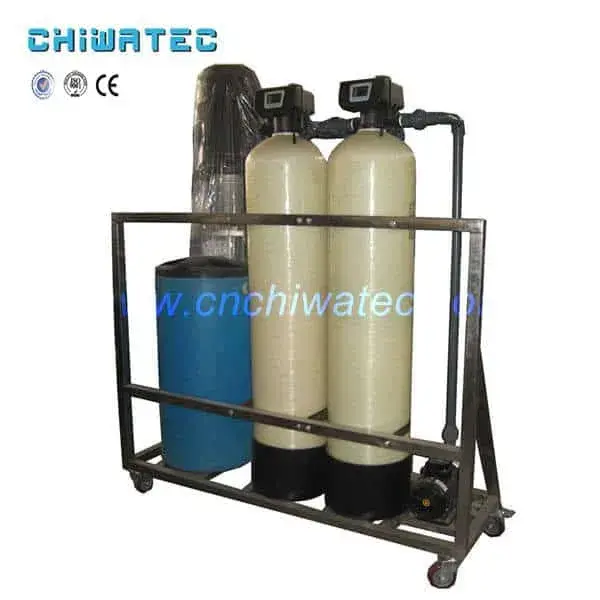
For advanced RO and pretreatment systems, explore CHIWATEC’s full product range:
👉 CHIWATEC Water Treatment Equipment & Solutions
FAQ: Hardness of Water
1. What causes water hardness?
Water hardness is mainly caused by calcium and magnesium ions dissolved from natural minerals like limestone and dolomite.
2. Why is hard water a problem?
Hard water forms scale when heated, reducing heat-transfer efficiency and damaging boilers, heat exchangers, appliances, and pipelines.
3. Can boiling remove hardness?
Boiling removes temporary hardness (bicarbonate hardness) but not permanent hardness (sulfate, chloride, nitrate salts).
4. How do you remove hardness from water?
Common methods include ion-exchange softeners, reverse osmosis, nanofiltration, and chemical precipitation.
5. How is water hardness measured?
Water hardness is typically measured as mg/L or ppm of CaCO₃ using titration or digital hardness analyzers.
Xi’an CHIWATEC Water Treatment Technology is a high-tech enterprise specialized in various water processing devices. Aside from these individual products, which cover a number of types and series, we can also help with related comprehensive engineering projects. Thanks to our hard work and dedication upon our founding, we are now one of the fastest-developing water treatment equipment manufacturers in Western China.
Further reading:
FOLLOW US
Do you have a water treatment project we can help with
* Designing,machining,installing,commissioning, customize and one-stop service






 English
  Spanish
  Portuguese




