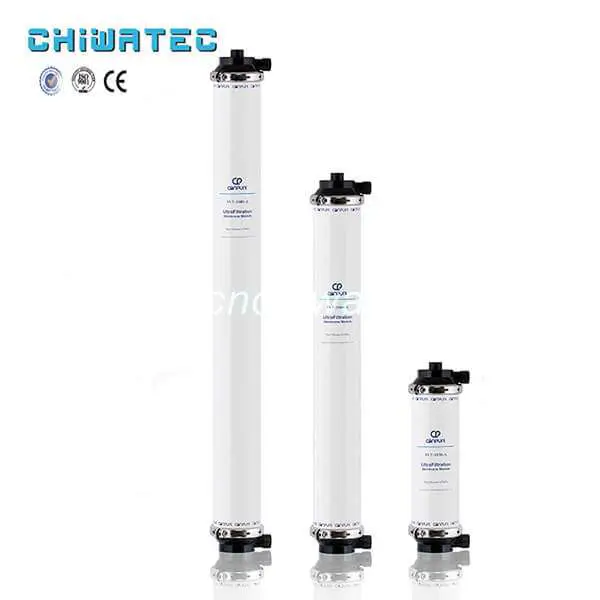
Hollow Fiber Ultrafiltration Membrane: Complete Guide to HF UF Membrane Technology, Specifications, and Applications
Discover the world of hollow fiber ultrafiltration (HF UF) membranes — the most advanced and widely adopted UF membrane configuration for water purification, wastewater treatment, and industrial separation processes.
Hollow fiber ultrafiltration membrane
The hollow fiber ultrafiltration membrane is the most mature and technologically advanced configuration in the UF membrane family, accounting for over 75% of installed UF capacity worldwide. Unlike spiral-wound or flat-sheet configurations, hollow fiber membranes consist of thousands of self-supporting capillary tubes with precise dimensions:
- Fiber outer diameter: 0.5–2.0 mm (typically 0.8–1.3 mm for PVDF, 0.5–0.9 mm for PES)
- Fiber inner diameter: 0.3–1.4 mm
- Wall thickness: 0.1–0.3 mm, with micropores throughout the tube wall
- Pore size: 0.01–0.05 µm (PVDF) or 0.01–0.02 µm (PES)
- MWCO (Molecular Weight Cut-Off): 10,000–500,000 Daltons
HF UF membranes operate in two primary configurations:
- Inside-out (internal pressure): Feed water flows through the fiber lumen, and permeate is collected on the shell side — preferred for high-quality feed water
- Outside-in (external pressure): Feed water surrounds the fibers, and permeate is drawn into the lumen — ideal for higher-turbidity feed water with more suspended solids
The dynamic cross-flow filtration nature of HF UF ensures that retained particles are continuously swept away, preventing permanent clogging and enabling long-term continuous operation with periodic backwashing. UF was one of the first polymer-based separation membranes to be commercially developed, and HF UF remains the dominant configuration due to its high packing density, backwashability, and cost-effectiveness.
The global hollow fiber UF membrane market is a significant segment of the broader ultrafiltration market (USD 5.8 billion in 2023, projected to reach USD 10.2 billion by 2032). HF UF membranes are the dominant configuration due to their unique combination of advantages:
- Simple process design — compact, skid-mounted systems with automated PLC control
- No heating required — ambient temperature operation preserves water chemistry
- Low pressure operation — 1–5 bar (15–75 psi), consuming only 0.2–0.4 kWh/m³
- Small footprint — high packing density reduces equipment footprint by 50–70% vs. conventional filtration
- High recovery — typical water recovery of 90–97%
- Excellent filtrate quality — SDI < 2.0, turbidity < 0.1 NTU, >4-log pathogen removal
Beyond water purification, HF UF technology is widely deployed for: solution separation (protein concentration, enzyme recovery), wastewater reuse (MBR systems, industrial effluent treatment), and useful substance extraction (pharmaceutical intermediates, valuable byproducts from industrial streams).
Hollow Fiber Ultrafiltration Membrane Applications
Hollow fiber UF membranes serve a diverse range of applications across residential, commercial, and industrial sectors:
Drinking Water Purification
HF UF membranes are the core filtration element in point-of-use (POU) water purifiers, under-sink systems, and direct drinking (straight drinking) machines widely used in homes and offices across Asia. UF purifiers provide >99.99% removal of bacteria, viruses, and protozoa while preserving beneficial dissolved minerals — unlike RO systems that remove virtually all minerals.
Municipal Water Treatment
Large-scale HF UF systems are deployed in municipal drinking water plants producing millions of liters per day, meeting stringent standards such as EPA Long Term 2 Enhanced Surface Water Treatment Rule (LT2ESWTR) and China GB 5749-2022.
RO Pretreatment
HF UF is the preferred pretreatment technology for RO systems in seawater desalination, brackish water treatment, and industrial water reuse. UF pretreatment reduces RO membrane fouling by 50–80% and extends RO membrane life by 2–3×.
Industrial and Wastewater Applications
HF UF membranes are used in Membrane Bioreactors (MBR) for wastewater treatment, oil-water separation, food & beverage processing (juice clarification, wine filtration), and pharmaceutical production (sterile filtration, protein concentration, pyrogen removal).
Hollow Fiber UF Membrane Materials: PVDF vs. PES Comparison
The two dominant materials for commercial HF UF membranes are PVDF (polyvinylidene fluoride) and PES (polyethersulfone). Each offers distinct advantages depending on the application:
| Parameter | PVDF | PES |
|---|---|---|
| Market share (HF UF) | ~55% | ~35% |
| Typical pore size | 0.02–0.04 µm | 0.01–0.02 µm |
| Chlorine tolerance | Excellent (>500,000 ppm·h) | Limited (<1,000 ppm·h) |
| Hydrophilicity | Moderate (surface modified) | High (inherent) |
| Fouling resistance | Good | Excellent (natural) |
| Chemical cleaning tolerance | Excellent (pH 1–13) | Good (pH 2–12) |
| Typical lifespan | 7–10 years | 5–8 years |
| Best for | Municipal water, RO pretreatment | Pure water, food & beverage |
Ceramic hollow fiber membranes represent an emerging premium option, offering 15–20+ year lifespan and extreme chemical tolerance, but at 3–5× the cost of polymeric equivalents.
Hollow Fiber UF vs. Other Membrane Configurations
HF UF membranes offer distinct advantages compared to alternative UF configurations:
HF UF vs. Spiral-Wound UF
HF UF advantages: Self-supporting fibers allow backwashing (spiral-wound cannot); higher packing density; lower tendency for particulate fouling; easier cleaning. Spiral-wound advantages: Lower cost per unit area; easier to replace individual elements; more standardized dimensions.
HF UF vs. Tubular UF
HF UF advantages: Much higher packing density (10,000–15,000 m²/m³ vs. 100–400 m²/m³ for tubular); lower capital cost; lower energy consumption. Tubular UF advantages: Handles extremely high suspended solids (>5% TSS); larger flow channels resist clogging; suitable for oily wastewater and pulp & paper applications.
HF UF vs. Flat-Sheet (Plate-and-Frame) UF
HF UF advantages: More compact; self-supporting (no support plates needed); lower replacement cost. Flat-sheet advantages: Easier inspection and replacement; lower operating pressure; preferred for MBR applications.
Latest Trends in Hollow Fiber UF Membrane Technology (2024–2025)
Enhanced PVDF Membranes with Hydrophilic Modification
Next-generation PVDF HF membranes with permanent hydrophilic surface modification achieve 30–50% higher flux than conventional PVDF while maintaining excellent chlorine tolerance. These membranes reduce fouling rates and cleaning frequency in challenging feed water applications.
Reinforced Hollow Fiber Membranes
New reinforced HF fibers with embedded polyester or polymer braids provide double the mechanical strength of conventional fibers, reducing fiber breakage rates and extending module lifespan in high-turbidity applications.
Low-Energy Gravity-Driven HF UF
Gravity-driven membrane (GDM) systems using submerged HF UF modules operate at ultra-low pressures (0.05–0.3 bar) without pumps, consuming zero electrical energy. These systems are gaining traction for decentralized water treatment in rural and developing regions.
Smart HF UF with Real-Time Integrity Monitoring
Integrated pressure decay tests (PDT) and air-water integrity testing systems now provide continuous, automated membrane integrity verification, meeting regulatory requirements for virus removal credit in municipal drinking water applications.
Frequently Asked Questions About Hollow Fiber Ultrafiltration Membranes
What is the difference between hollow fiber UF and spiral-wound RO membranes?
HF UF membranes have pores of 0.01–0.05 µm and operate at 1–5 bar, removing particles, bacteria, and viruses but NOT dissolved salts. Spiral-wound RO membranes have a dense, non-porous active layer and operate at 10–70 bar, removing nearly all dissolved solids including salts. They serve complementary roles in a treatment train: UF for pretreatment, RO for desalination.
How often should HF UF membranes be backwashed?
Typical backwash frequency is every 30–60 minutes for surface water applications, with each backwash lasting 30–90 seconds. Backwash water consumption is typically 5–10% of permeate production. CEB is performed every 1–5 days, and CIP every 1–3 months.
How long do hollow fiber UF membranes last?
With proper operation and maintenance: PVDF HF membranes: 7–10 years, PES HF membranes: 5–8 years, ceramic HF membranes: 15–20+ years. Key factors affecting lifespan: feed water quality, chemical cleaning regimen, operating pressure, and temperature.
Can hollow fiber UF membranes be repaired if fibers break?
Yes. Individual broken fibers can be potted (sealed) at the module ends to isolate them from the permeate stream. A module can tolerate up to 1–3% fiber breakage before replacement is needed. This repair capability is a key advantage over spiral-wound membranes.
What is the typical flux rate of HF UF membranes?
Typical operating flux ranges: 40–80 L/m²/h (LMH) for surface water treatment, 60–120 LMH for groundwater, 20–50 LMH for MBR applications. Flux is selected based on feed water quality to balance capital cost (higher flux = fewer modules) and operating cost (lower flux = less fouling).
Further Reading
Explore these related articles for deeper insights into hollow fiber UF membrane technology:
- Membrane Separation Technology: Complete Guide to MF, UF, NF, and RO Membranes — Comprehensive overview of all membrane types and their principles
- Ultrafiltration Membrane Process: Operating Parameters — Technical guide to UF operating parameters and optimization
- Ultrafiltration Membrane Pretreatment Requirements — Feed water quality requirements and pretreatment design for UF systems
- Influencing Factors of Ultrafiltration Flux — Understanding variables affecting UF membrane performance
- Ultrafiltration System Operating Instructions and Technical Advantages — Operational best practices for UF systems
Do you have a water treatment project we can help with
* Designing,machining,installing,commissioning, customize and one-stop service
 English
  Spanish
  Portuguese