Fiber Ball Filter Media: Complete Guide to Fibrous Filtration Technology for Water Treatment
Discover how fiber ball filter media outperforms traditional granular filtration — delivering higher filtration speeds, greater contaminant capacity, and longer service cycles.
Fiber ball filter
Fiber ball filter media is made from continuous synthetic fiber filaments (polyester or polypropylene), formed into 15-30 mm spherical balls. Unlike sand or anthracite, it offers:
- Excellent elasticity – compresses under pressure, expands during backwash
- Density ~1.38 g/cm3 – stays positioned in the vessel
- Larger voids – deeper particle penetration, higher dirt capacity
- 3-5x longer cycles between backwashes vs sand
- Low head loss – 0.5-2m vs 2-5m for sand
The bed has an auto-grading property: voids decrease along the water flow direction. Key performance:
- Filtration speed: 20-85 m/h (3-8x sand at 5-15 m/h)
- Contaminant capacity: 6-10 kg/m3
- Backwash water: Only 1-2% of filtrate (vs 3-5% sand)
- Surface area: ~3,000 m2/m3
Fiber Ball Media Sizes and Specifications
Ball diameters: 15-25 mm (standard) and 25-30 mm (high-turbidity). Fiber filament diameters: 0.5-4.0 mm – finer (0.5-1.0mm) for filtration, coarser (2.0-4.0mm) for flow. Gradations: 0.5-1.0, 0.5-0.8, 0.6-1.2, 0.8-1.6, 1.0-2.0, 2.0-4.0 mm.
Fiber Ball Physical and Chemical Index
Physical and chemical properties of fiber ball filter media:
| Analysis project | Test data |
| Density | 1.38 g/cm3 |
| Filtration speed | 20-85 m/h |
| Filling density | 60-80 kg/m3 |
| Pollution load | 6-10 kg/m3 |
| Specific surface area | 3,000 m2/m3 |
| Ball diameter | 15-25 mm, 25-30 mm |
| Porosity | 96% |
| Appearance | White sphere or oval |
How Fiber Ball Filters Work
Fiber ball filters use compressible depth filtration:
- Filtration: Water flows downward. Fiber balls compress, creating graded-density layers – coarse at top, fine at bottom.
- Loading: 96% porosity and 3,000 m2/m3 area retain 6-10 kg solids/m3 before backwash needed.
- Backwash: Upward flow expands balls, releasing solids. Only 1-2% water consumed due to elastic recovery.
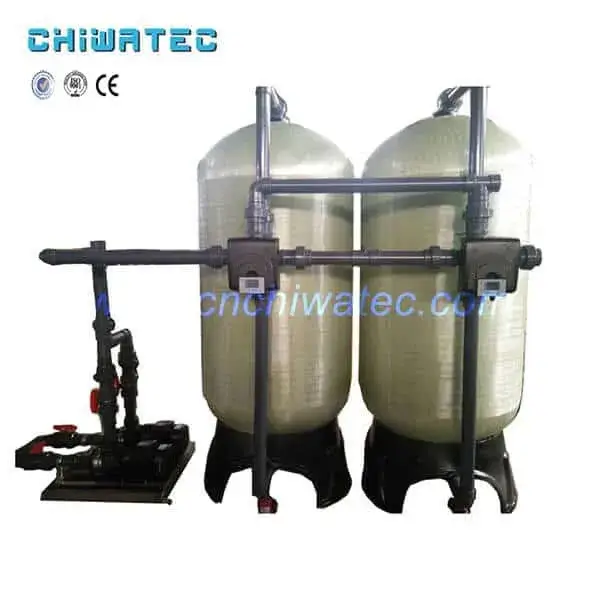
System: pressure vessel, distribution, 800-1,200mm media bed, backwash pump/air scour, PLC controls.
Fiber Ball vs Conventional Filters
| Parameter | Fiber Ball | Sand | Multimedia |
|---|---|---|---|
| Filtration speed | 20-85 m/h | 5-15 m/h | 10-25 m/h |
| Contaminant capacity | 6-10 kg/m3 | 1-3 kg/m3 | 2-4 kg/m3 |
| Backwash water | 1-2% | 3-5% | 4-6% |
| Head loss | 0.5-2 m | 2-5 m | 3-6 m |
| Media weight | 60-80 kg/m3 | 1,600-1,800 kg/m3 | 1,400-1,700 kg/m3 |
| Media life | 3-5 years | 5-8 years | 5-8 years |
| Footprint | 40-60% smaller | Baseline | 10-20% smaller |
Applications
Industrial Water
Circulating water, boiler feed pretreatment, steel cooling, oilfield produced water.
Municipal Drinking Water
High-rate clarification filters replacing flocculation-sedimentation trains.
Wastewater
Tertiary filtration, MBR polishing, industrial effluent – SS below 5-10 mg/L.
Seawater RO Pretreatment
Removes suspended solids, reduces SDI for RO membranes.
Latest Trends (2024-2025)
Hybrid Fiber + Media Filtration
Fiber balls on sand/anthracite combine high capacity with polishing ability.
Air-Scour Backwashing
Air scour (10-15 L/m2s) achieves 20-30% less water use during cleaning.
IoT Monitoring
Real-time pressure, flow, turbidity monitoring with PLC and remote alerts.
FAQ
How is it different from sand?
3-8x faster (20-85 vs 5-15 m/h), 2-3x more capacity, 50-70% less backwash water, much lighter media.
Media lifespan?
3-5 years with proper maintenance.
Oil removal?
Yes, 85-95% removal via oil adsorption.
Pressure drop?
0.5-1m clean, backwash at 1.5-2.5m.
Coagulant compatible?
Yes, in-line coagulation enhances fine particle removal.
Further Reading
Do you have a water treatment project we can help with
* Designing,machining,installing,commissioning, customize and one-stop service
 English
  Spanish
  Portuguese