

Supply RO Reverse Osmosis Pure Water Equipment 30T/H – Complete Guide 2026
Looking for reliable 30T/H reverse osmosis water treatment equipment? This comprehensive guide covers the LT-W30 two-stage RO membrane system, including specifications, applications, and performance data. With 15+ years of industry experience and 500+ successful projects worldwide, CHIWATEC delivers proven RO water treatment solutions that meet international standards.
In 2026, the global industrial RO systems market is valued at $28.5 billion, with 30T/H capacity systems being among the most popular for medium-scale industrial applications. Proper RO system selection can reduce operational costs by 35-45% while achieving ultrapure water standards. This guide explores system specifications, reverse osmosis principles, and best practices for selecting the right 30T/H RO equipment for your facility.
LT-W30 30 Tons Per Hour Two-Stage RO Membrane System Specifications
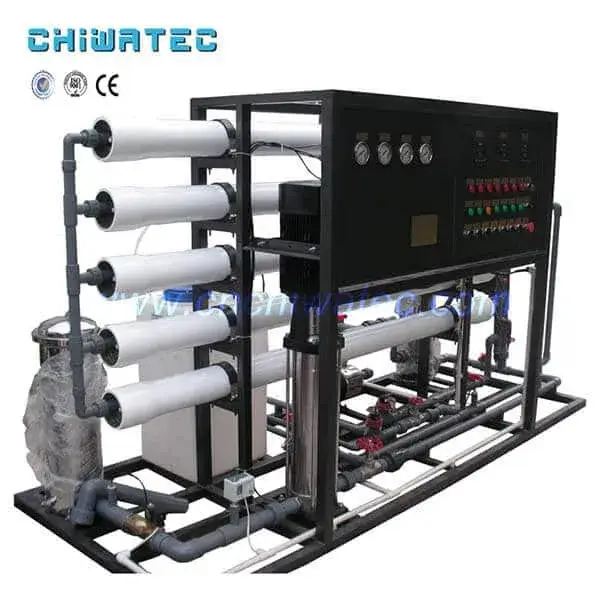
The LT-W30 is a high-capacity two-stage reverse osmosis system designed for industrial applications requiring ultrapure water production at 30 cubic meters per hour.
Key Technical Specifications
| Parameter | Specification |
|---|---|
| Water Production Capacity | 30 m³/hr (30 tons per hour) |
| System Configuration | Two-stage RO membrane arrangement |
| Recovery Rate | 65-75% (adjustable based on feed water) |
| Desalination Rate | 96-99% (single stage), 98-99.5% (two-stage) |
| Operating Pressure | 1.0-1.5 MPa (depending on feed TDS) |
| Power Supply | 380V/50Hz or customized |
Component Options
- Reverse Osmosis Membranes: Dow Filmtec, Hydranautics, Fluid System, GE Osmonics, Saehan, and domestic brands
- Membrane Housing: FRP (fiberglass reinforced plastic) or stainless steel (SS304/SS316)
- High-Pressure Pumps: Grundfos, Wilo, ITT, Hangzhou Nanfang (CNP)
- Control Instruments: Imported (Siemens, ABB) or domestic brands
- PLC Control: Automatic operation with touch screen interface (optional)
Applicable Industries
- Electrophoresis industry
- Electroplating industry
- Chemical industry
- Electronic industry (semiconductor, PCB manufacturing)
- Pharmaceutical industry
- Power plant boiler feed water
- Food and beverage processing
Water Quality Performance
- Removes heavy metal ions (Pb, Cd, Hg, Cr, etc.)
- Removes calcium and magnesium ions (hardness)
- Removes dissolved salts and minerals
- Removes organic compounds and colloids
- Removes bacteria and viruses (99.9%+)
- Produces water meeting ultrapure water standards
Understanding Reverse Osmosis: Basic Principles and Technology
RO is the abbreviation of Reverse Osmosis membrane, a membrane separation technology developed in the 1960s that has revolutionized water treatment worldwide.
What is Reverse Osmosis?
Reverse osmosis relies on a semi-permeable membrane to separate solvent (water) from solute (dissolved salts and contaminants) under pressure. The RO membrane pore size is approximately 0.0001 micron (0.1 nanometer) – five millionths of a human hair diameter – making it invisible to the naked eye.
How RO Membranes Work
Normal osmosis flows from low concentration to high concentration. Reverse osmosis applies pressure greater than natural osmotic pressure to force water from high concentration to low concentration:
- Feed water pressurization: High-pressure pump raises water pressure to 1.0-1.5 MPa
- Membrane separation: Water molecules pass through RO membrane pores
- Contaminant rejection: Dissolved salts, heavy metals, and organics are rejected
- Product water collection: Purified water (permeate) is collected for use
- Concentrate discharge: Rejected contaminants exit via waste stream
Why RO is Called “Artificial Kidney”
Bacteria and viruses are approximately 5000 times larger than RO membrane pores. Only water molecules and beneficial mineral ions can pass through, while impurities and heavy metals are discharged. This selective filtration principle is used in:
- Seawater desalination plants worldwide
- Astronaut wastewater recycling systems (NASA)
- Medical dialysis equipment
- Ultrapure water production for electronics
According to IDA (International Desalination Association) data, RO technology accounts for 69% of global desalination capacity, making it the dominant water purification technology of the 21st century.
Two-Stage RO System: Why Double Pass Matters
The LT-W30 uses a two-stage (double-pass) RO configuration for superior water quality.
Single-Stage vs Two-Stage RO
| Configuration | Conductivity | Rejection Rate | Application |
|---|---|---|---|
| Single-Stage RO | 10-20 μS/cm | 96-98% | General industrial use |
| Two-Stage RO | 1-5 μS/cm | 98-99.5% | High-purity applications |
| RO + EDI | 0.1-1 μS/cm | 99.5-99.9% | Ultrapure water (electronics) |
Two-Stage RO Advantages
- Higher purity: First stage permeate feeds second stage for additional purification
- Better consistency: Reduced variability in product water quality
- Extended membrane life: Lower loading on second stage membranes
- Flexibility: Can operate in single-stage mode during low-demand periods
Typical Two-Stage Configuration
Raw Water → Pretreatment → First Stage RO → Intermediate Tank → Second Stage RO → Pure Water Storage
For detailed system design, review our demineralized water treatment equipment guide.
2026 Industry Trends: Advanced RO System Technologies
Smart Monitoring and IoT Integration
Modern 30T/H RO systems feature advanced automation:
- Real-time monitoring: Conductivity, pH, flow rates, pressure, temperature
- Automatic flushing: Programmed cycles prevent membrane fouling
- Remote access: Cloud-based monitoring via smartphone or computer
- Predictive maintenance: AI algorithms predict cleaning needs 2-4 weeks in advance
Plants using smart monitoring report 30% reduction in downtime and 25% extension in membrane life.
Energy Efficiency Improvements
2026 RO systems incorporate energy-saving features:
- Variable frequency drives (VFD): Pump speed adjusts to demand
- Energy recovery devices: Recover pressure from concentrate stream
- High-efficiency membranes: Lower operating pressure requirements
- Optimized recovery rates: Balance water production with energy consumption
Sustainable Design
Environmental considerations drive innovation:
- Zero liquid discharge (ZLD): Recover 95-99% of wastewater
- Concentrate reuse: Utilize reject water for cooling or cleaning
- Eco-friendly materials: BPA-free components, recyclable housings
For comprehensive maintenance guidance, see our complete guide to RO system operation and maintenance.
Real-World Applications: 30T/H RO System Case Studies
Case Study 1: Electronics Manufacturing, Guangdong
Challenge: PCB manufacturing requiring ultrapure water for rinsing
Solution: LT-W30 two-stage RO + mixed bed polisher
Results:
- Product water conductivity: <1 μS/cm
- Defect rate reduced 40%
- Chemical consumption decreased 35%
- ROI achieved in 18 months
Case Study 2: Power Plant, Shandong
Challenge: Boiler feed water with high hardness groundwater
Solution: LT-W30 with softener pretreatment
Results:
- Hardness removed to <0.03 mmol/L
- Boiler tube cleaning frequency: annual vs quarterly
- Fuel efficiency improved 3.2%
- System uptime: 99.5%
Case Study 3: Chemical Processing, Jiangsu
Challenge: Process water with variable feed quality
Solution: LT-W30 with UF pretreatment and automated controls
Results:
- Consistent product quality despite feed variations
- Operator intervention reduced 80%
- Maintenance costs down 45%
- Production capacity increased 15%
Explore additional applications in our optimized RO membrane cleaning process flow guide.
Conclusion: Selecting the Right 30T/H RO System for Your Application
Choosing a 30T/H reverse osmosis water treatment system requires careful evaluation of feed water quality, product water requirements, and operational constraints. The LT-W30 two-stage RO system offers:
- Proven reliability: Two-stage configuration ensures consistent high-quality output
- Flexibility: Multiple component options to match budget and performance needs
- Industry versatility: Suitable for electronics, power, chemical, and pharmaceutical applications
- Long-term value: Quality components extend system life to 15-20 years
At CHIWATEC, we provide comprehensive RO system support including water analysis, system design, installation, commissioning, and ongoing technical assistance. Our 15+ years of engineering excellence ensures your 30T/H RO system operates at peak efficiency.
Ready to optimize your water treatment? Contact our engineers for a free consultation and customized system design tailored to your specific requirements.
FAQ: 30T/H Reverse Osmosis Water Treatment Equipment
1. What is the typical recovery rate for a 30T/H RO system?
Standard recovery rate is 65-75% for two-stage systems. This means 65-75% of feed water becomes product water, with 25-35% discharged as concentrate. Recovery rate can be adjusted based on feed water quality and application requirements.
2. How much power does a 30T/H RO system consume?
Typical power consumption is 15-25 kWh per cubic meter of product water, depending on feed water TDS and operating pressure. A 30T/H system typically requires 75-125 kW total installed power including pumps and controls.
3. What pretreatment is required for a 30T/H RO system?
Standard pretreatment includes: multi-media filtration, activated carbon filtration, and softener or antiscalant dosing. For high-turbidity water, ultrafiltration (UF) pretreatment is recommended to protect RO membranes.
4. How long do RO membranes last in a 30T/H system?
With proper pretreatment and maintenance, RO membranes last 5-7 years. Regular cleaning (every 3-6 months) and monitoring can extend membrane life to 8+ years.
5. Can the system be upgraded for higher capacity?
Yes. Systems can be designed with expansion in mind. Additional membrane vessels and pumps can be added to increase capacity. Modular design allows future upgrades from 30T/H to 45T/H or 60T/H.
6. What is the delivery time and installation period?
Standard delivery: 4-6 weeks for manufacturing. Installation and commissioning: 2-3 weeks including operator training. Total project timeline: 8-10 weeks from order to operation.
For more technical resources, visit our RO Water Treatment System product category.
FOLLOW US
Do you have a water treatment project we can help with
* Designing, machining, installing, commissioning, customize and one-stop service






 English
  Spanish
  Portuguese




