

Community Sewage Treatment Equipment: Complete Guide to Residential Wastewater Solutions 2026
Introduction: The Growing Need for Community Sewage Treatment
As urbanization accelerates globally, community sewage treatment equipment has become essential for areas beyond municipal pipe network coverage. According to 2025 industry data, the global decentralized wastewater treatment market is projected to reach $18.6 billion by 2027, with residential sewage treatment systems accounting for over 35% of installations.
A community represents a relatively independent area with one or more functions, including residential complexes, hospitals, parks, tourist resorts, university towns, and highway service areas. These locations typically fall outside urban municipal pipe networks, requiring independent sewage treatment facilities. While the United States limits single-structure processing capacity to 3,785 m³/day, China recommends defining residential sewage treatment plants as facilities handling below 4,000 m³/day.
Residential sewage in communities differs from urban sewage (which may include industrial wastewater). Its characteristics include: hourly water quality and quantity variation coefficients, lower pollutant concentrations than urban sewage, excellent biodegradability, and reduced treatment difficulty. Research shows domestic water usage breaks down as: 5% for cooking/drinking, 20-30% for toilet flushing, with air conditioning cooling water, ground flushing, and vehicle cleaning also classified as domestic miscellaneous water with lower quality requirements.
Community sewage reuse provides new water sources for water-deficient areas while preventing pollution even in water-abundant regions, alleviating pressure on urban sewage pipe networks and treatment facilities.
1. Understanding Community Sewage Characteristics
1.1 Water Quality Parameters
Typical residential sewage exhibits the following characteristics (2025 standards):
- COD (Chemical Oxygen Demand): 200-400 mg/L
- BOD₅ (Biochemical Oxygen Demand): 100-250 mg/L
- SS (Suspended Solids): 150-300 mg/L
- NH₃-N (Ammonia Nitrogen): 20-50 mg/L
- Total Phosphorus: 3-8 mg/L
- pH Value: 6.5-8.5
These parameters are typically 30-50% lower than urban sewage containing industrial wastewater, making residential wastewater treatment more technically feasible with lower operational costs.
1.2 Water Quantity Fluctuations
Community sewage flow varies significantly throughout the day:
- Peak Hours: 6:00-9:00 AM and 6:00-10:00 PM (morning and evening usage)
- Low Flow: 10:00 PM – 6:00 AM
- Peak Coefficient: 2.5-3.5 times average flow
Modern sewage treatment equipment must accommodate these fluctuations through equalization tanks and intelligent control systems.
2. Typical Treatment Processes for Residential Sewage
Residential sewage treatment processes evolved from traditional urban wastewater treatment. Common municipal secondary biological treatment processes include: oxidation ditch technology, SBR (Sequencing Batch Reactor) series, BAF (Biological Aerated Filter) process, A²/O process, and biological treatment + constructed wetland systems.
For community applications, residential sewage treatment facilities should feature:
- Reasonable process flow with stable treatment effects
- Integrated facility design
- Buried treatment preference with ground greening
- Above-ground options must coordinate with surrounding environment
- Minimized secondary pollution (odor, noise, sludge)
For advanced treatment methods and color removal techniques, see our detailed guide on Advanced Wastewater Treatment Processes.
3. Advanced Reuse Technologies for Community Sewage
Through foreign technology adaptation and domestic research, community reuse technology has developed rapidly. Advanced treatment purposes include further removing suspended solids (SS), organic matter, nutrients (nitrogen/phosphorus), and soluble inorganic salts.
3.1 Common Residential Sewage Reuse Processes
Based on reuse destination, China typically adopts these processes:
- Greening/Flushing (Secondary Effluent): Disinfection → Reuse
- Air Conditioning Cooling Water: Filtration → Disinfection → Reuse
- Car Wash/Fire Fighting/Cooling: Coagulation + Sedimentation → Sand Filtration → Disinfection → Reuse
For comprehensive greywater reuse strategies, explore our Feasibility Study on Greywater Reuse Technology.
3.2 Biological Activated Carbon Technology
Biological activated carbon effectively removes trace organic matter through coordinated biodegradation and physical adsorption. Wang Zhansheng and colleagues developed particle filler biological contact oxidation using cheap porous materials (ceramsite or slag) instead of activated carbon, successfully applied in urban sewage advanced treatment.
Performance Metrics:
- Final effluent COD: ~30 mg/L
- BOD, SS, chroma meet reuse requirements
- Slightly higher engineering investment than traditional coagulation/clarification/filtration
- Lower operating costs long-term
3.3 Membrane Bioreactor (MBR) Technology
MBR represents cutting-edge sewage treatment and water reuse technology with excellent application prospects in residential sewage reuse. MBR integrates bioreactor biodegradation with high-efficiency membrane separation, offering:
- Superior effluent quality
- High processing load
- Compact footprint
- Reduced sludge production
- Easy automatic control
- Direct reuse after disinfection (potential drinking water source)
While MBR has been well-applied in developed countries, high membrane costs, complex operating systems, and elevated operating expenses hinder widespread residential wastewater reuse adoption in China. Learn more about Mobile Stand-Alone MBR Systems.
3.4 Membrane Technology Overview
Membrane separation technologies include nanofiltration, ultrafiltration, permeation, and reverse osmosis. Residential sewage effluent after secondary treatment and RO membrane technology can serve as industrial or domestic water. However, high costs and complex operation limit widespread Chinese adoption.
4. Key Considerations for Community Sewage Reuse
As relatively independent living areas, communities present unique requirements and challenges for sewage reuse technology promotion and operation.
4.1 Technology Reliability
After years of R&D, domestic sewage reuse technology has matured. Since the main purpose is domestic miscellaneous water with high quality/stability requirements, actual engineering design must select reasonable, reliable processing technology based on:
- Community domestic sewage quality and quantity
- Community function and environmental requirements
- Long-term safe, reliable operation considerations
4.2 Intelligent Facility Management
Community residential sewage reuse facilities feature small treatment scales with part-time management. Intelligent management (such as PLC automatic control) must be considered in design. PLC automation ensures:
- Stable, reliable facility operation
- Effluent water quality safety
- Enhanced promotion of advanced processes (SBR, A²/O) requiring sophisticated control systems
For detailed PLC applications, reference our Applications of PLC in Wastewater Treatment Engineering.
4.3 Reused Water Safety
Since community residential sewage reuse targets domestic miscellaneous water and non-contact ornamental landscape water, facilities must:
- Minimize toxic/harmful non-domestic sewage entering treatment stations
- Prevent damage to normal station operation affecting effluent quality
- Implement strict disinfection from sanitation/health perspectives
- Avoid sprinkler irrigation for green water when possible
- Prevent landscape water applications forming water mist (waterfalls, fountains)
4.4 Environmental Coordination
Communities concentrate people in independent areas. Process selection and single-structure design must consider harmony with surrounding residential environments. Residential sewage reuse facilities require:
- Advanced technology with stable operation
- Intelligent management systems
- Effective noise and odor solutions (landscape bamboo forests, artificial wetland technology)
- Sludge digestion/treatment considerations
- Reduced external sludge discharge
Conclusion
Community sewage treatment equipment plays a vital role in sustainable urban development. With proper technology selection, intelligent management systems, and safety considerations, residential wastewater can be effectively treated and reused for various non-potable applications. The integration of advanced processes like MBR, biological activated carbon, and PLC automation ensures efficient, reliable, and environmentally friendly wastewater management for communities worldwide.
FAQ: Community Sewage Treatment
What is the typical capacity of community sewage treatment equipment?
Community sewage treatment facilities typically handle 100-4,000 m³/day, with China recommending below 4,000 m³/day for residential sewage treatment plants and the US limiting single structures to 3,785 m³/day.
What are the main treatment processes for residential sewage?
Common processes include oxidation ditch technology, SBR (Sequencing Batch Reactor), BAF (Biological Aerated Filter), A²/O process, and biological treatment combined with constructed wetlands.
How safe is reused community sewage water?
After proper treatment including disinfection, reused community sewage meets safety standards for non-potable applications like toilet flushing, greening, car washing, and cooling water. However, sprinkler irrigation and water mist applications should be avoided.
What is MBR technology and why is it recommended?
MBR (Membrane Bioreactor) combines biological degradation with membrane separation, offering superior effluent quality, compact footprint, reduced sludge production, and easy automatic control. It’s ideal for space-constrained communities requiring high-quality reused water.
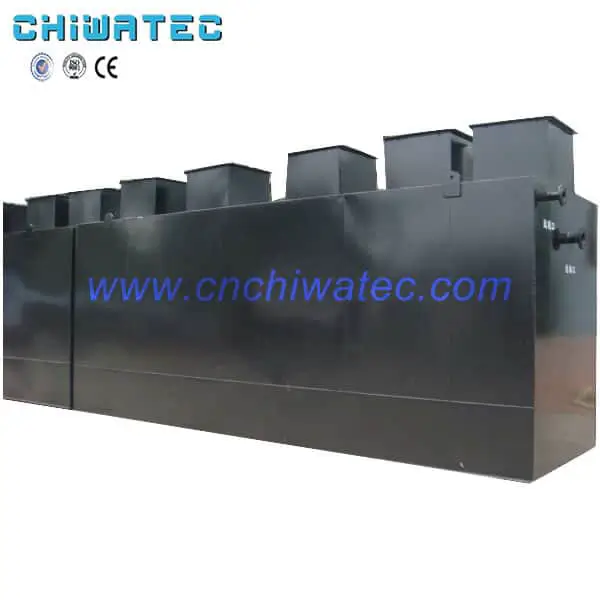
Xi’an CHIWATEC Water Treatment Technology is a high-tech enterprise specialized in various water processing devices. Aside from these individual products, which cover a number of types and series, we can also help with related comprehensive engineering projects. Thanks to our hard work and dedication upon our founding, we are now one of the fastest-developing water treatment equipment manufacturers in Western China.
Further reading
- Advanced Wastewater Treatment Processes and Effective Color Removal Methods for Industrial Effluents
- Feasibility Study on Greywater Reuse Technology: A Sustainable Water Solution
- Process of Slaughterhouse Wastewater Treatment
- Mobile Stand-Alone MBR Membrane Bioreactor Wastewater Treatment Integrated System Technology
Do you have a water treatment project we can help with
* Designing,machining,installing,commissioning, customize and one-stop service






 English
  Spanish
  Portuguese




