Industrial Circulating Water Treatment Equipment: Complete Process Guide 2026
Industrial circulating water treatment equipment is essential for cooling systems in power plants, petrochemical facilities, steel mills, and manufacturing operations. This comprehensive guide covers ion exchange methods, alternative treatment processes, side-stream filtration, and 2026 best practices for maximizing water efficiency and minimizing operational costs.
Overview of Industrial Circulating Water Systems
System Purpose and Challenges
Industrial circulating cooling water systems serve critical functions:
- Heat Removal: Absorb and dissipate process heat from equipment, reactors, and machinery
- Temperature Control: Maintain optimal operating temperatures for industrial processes
- Water Conservation: Recycle water multiple times to reduce fresh water consumption
- Cost Efficiency: Minimize water, chemical, and energy costs
Key Challenges:
- Scaling: Calcium carbonate, calcium sulfate, silica deposition on heat exchanger surfaces
- Corrosion: Metal degradation from dissolved oxygen, chlorides, low pH
- Biofouling: Microbial growth (bacteria, algae, fungi) forming biofilms
- Fouling: Suspended solids, organic matter, process leaks accumulating in system
According to 2025 industry data, the global industrial water treatment market reached $8.4 billion USD, with circulating water treatment accounting for approximately 35% of total consumption. Proper treatment can increase concentration ratio from 3-4 cycles to 6-10 cycles, reducing water consumption by 40-60%.
Ion Exchange Method for Circulating Water Treatment
Traditional Ion Exchange: Limitations
Conventional ion exchange methods used for pure water preparation face significant challenges in circulating water applications:
- High Chemical Consumption: Daily operation consumes large quantities of acid (HCl, H₂SO₄) and alkali (NaOH)
- Wastewater Generation: Regeneration produces substantial acidic/alkaline wastewater requiring neutralization
- High Treatment Cost: Chemical costs and wastewater treatment increase operational expenses
- Na-Type Resin Issues: When used for softening:
- High industrial salt (NaCl) purchase costs
- Chloride ions (Cl⁻) introduced during regeneration increase cooling water corrosion tendency
- Chloride stress corrosion cracking risk for stainless steel equipment
Weak Acid Cation Exchange Resin: Economical Alternative
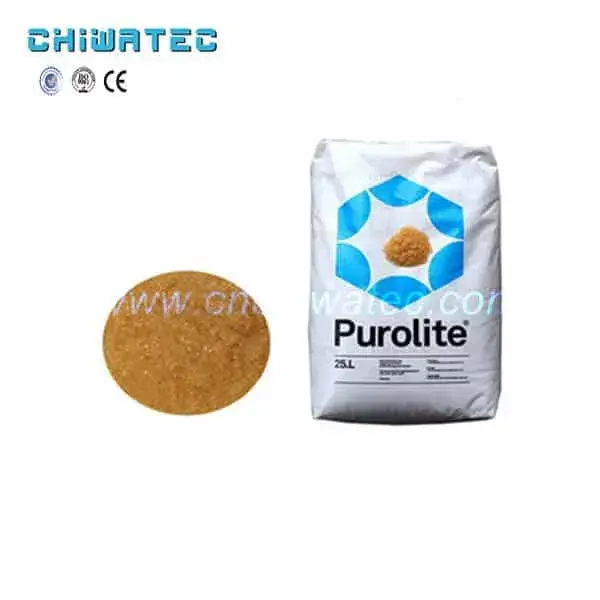
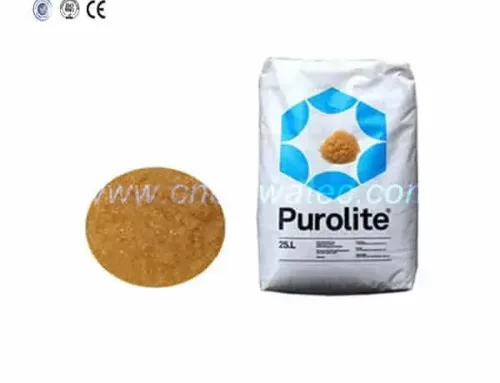
Weak acid cation exchange resin (WAC) offers significant advantages for circulating water softening:
Working Principle
WAC resin contains carboxyl groups (-COOH) that selectively remove carbonate hardness:
Reaction: 2R-COOH + Ca(HCO₃)₂ → (R-COO)₂Ca + 2CO₂ + 2H₂O
Key Advantages
| Parameter | Weak Acid Resin | Strong Acid Resin |
|---|---|---|
| Working Exchange Capacity | ~2000 mmol/L (2.0 eq/L) | ~800-1000 mmol/L (0.8-1.0 eq/L) |
| Capacity Ratio | 2-2.5× higher than SAC | Baseline |
| Regenerant Consumption | 1.05-1.10× theoretical value | 1.5-2.0× theoretical value |
| Hardness Removal | Carbonate hardness only (to HCO₃⁻ alkalinity equivalent) | All hardness (carbonate + non-carbonate) |
Economic Benefits
- Regenerant Options: Hydrochloric acid (HCl) or sulfuric acid (H₂SO₄)
- HCl cost: ~3× higher than H₂SO₄
- H₂SO₄ requires strict concentration and flow rate control to prevent CaSO₄ precipitation
- Near-Stoichiometric Regeneration: 1.05-1.10× theoretical value minimizes chemical usage
- Higher Capacity: 2× working exchange capacity reduces resin volume and equipment size
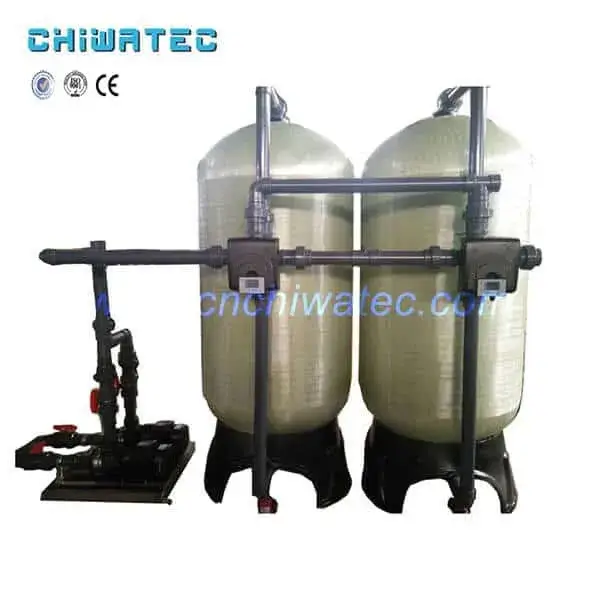
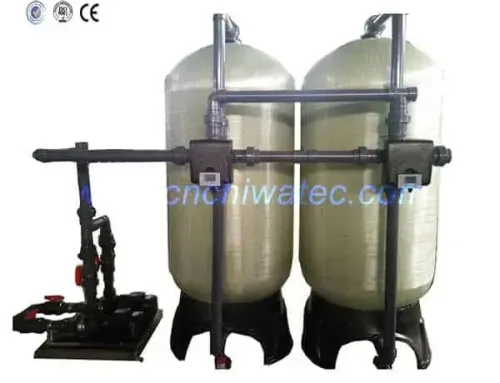
Dual-Flow Ion Exchanger Design
Dual-flow (double-stream) ion exchangers offer additional advantages:
- Investment Savings: Single vessel replaces multiple units, reducing capital cost by 20-30%
- Water Savings: Reduced backwash and rinse water consumption by 30-40%
- Land Occupation: Compact footprint saves 40-50% floor space
- Higher Regeneration Efficiency: Counter-current regeneration achieves 80-90% efficiency vs. 50-60% for co-current
Side-Stream Treatment Application
Research on weak acid resin side-stream treatment for circulating cooling water began in 1998 and has matured significantly:
Design Considerations
The construction scale of weak acid systems is directly related to the alkalinity that circulating cooling water scale inhibitors can maintain:
- Higher Alkalinity Tolerance: Smaller throughput required, better economy
- Lower Alkalinity Tolerance: Larger throughput needed, higher capital cost
- Optimization: Balance between chemical treatment (scale inhibitors) and physical treatment (ion exchange)
System Configuration
- Side-Stream Rate: Typically 5-20% of total circulating flow
- Target: Remove carbonate hardness to maintain Langelier Saturation Index (LSI) near zero
- Integration: Works alongside chemical treatment (corrosion inhibitors, biocides, dispersants)
Limitations and Constraints
Despite advantages, weak acid resin softening has notable limitations:
- Suspended Solids Sensitivity:
- Presence of suspended solids severely impacts operating cycle
- Requires upstream filtration (sand filter, cartridge filter) to protect resin bed
- Turbidity should be <5 NTU for optimal performance
- Organic Fouling:
- Organic matter in water adsorbs onto resin, reducing exchange capacity
- Requires activated carbon pretreatment or enhanced coagulation
- TOC should be <2 mg/L for extended resin life
- High Resin Cost:
- Weak acid resin costs 2-3× more than strong acid resin
- Longer payback period (3-5 years vs. 1-2 years)
- Justified only for large-scale systems (>500 m³/h)
- Complex Regeneration:
- Multi-step regeneration process requires skilled operators
- Acid handling requires safety protocols and containment
- Wastewater neutralization adds operational complexity
Other Treatment Methods
Thermal Evaporation and Vapor Compression
Process Description
Heating and evaporating sewage with vapor compression and condensation:
- Sewage is heated to evaporation temperature
- Vapor is compressed to increase temperature and pressure
- Compressed vapor condenses, releasing latent heat to evaporate more water
- Concentrated brine (95% volume reduction) contains harmful components
- Condensate (95% of original volume) is recovered as high-purity water
Applications
- Zero Liquid Discharge (ZLD): Complete wastewater elimination
- Water Recovery: 95% condensate returned to system as circulating water and boiler makeup
- Concentrate Management: Harmful components (heavy metals, salts, organics) concentrated for disposal
Economic Considerations
- Energy Consumption: Very high – 25-40 kWh/m³ of water recovered
- Operating Cost: $3-8/m³ depending on energy prices and feedwater quality
- Justification: Only economical in water-scarce regions or where discharge restrictions are severe
- Payback: 5-10 years in optimal conditions
Phosphate-Based Water Treatment Programs
Constant-Rate Dosing
Phosphate-based treatment programs enable controlled, constant-rate chemical dosing:
- Orthophosphate: Corrosion inhibition through metal surface passivation
- Polyphosphate: Scale inhibition through threshold effect and crystal modification
- Organophosphate: Enhanced stability and performance at high temperatures
Automatic Dosing Systems
Modern automatic dosing devices improve treatment effectiveness:
- Flow-Proportional Dosing: Chemical feed rate matches makeup water flow
- Chemical Feed Pumps: Peristaltic, diaphragm, or peristaltic pumps for precise delivery
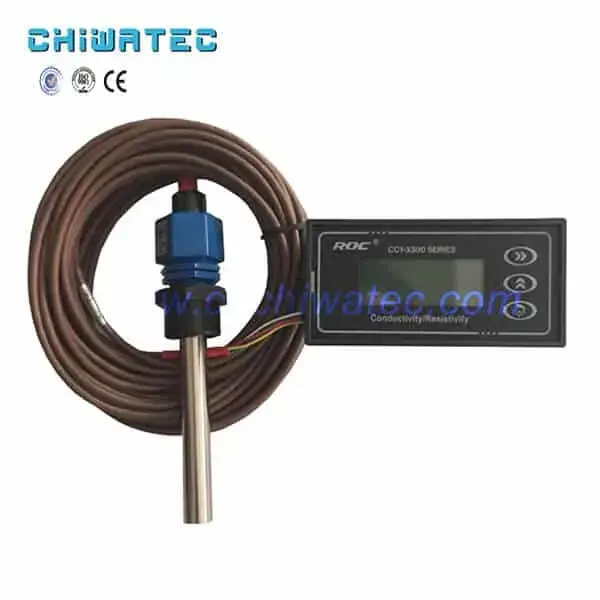
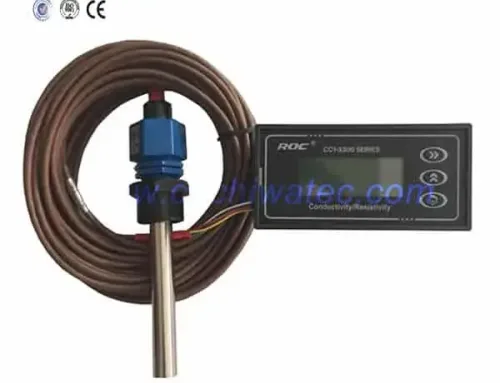
- Controllers: pH, ORP, conductivity-based control for optimized dosing
- Monitoring: Real-time residual phosphate measurement for feedback control
Benefits
- Increased Concentration Ratio: From 3-4 cycles to 6-10 cycles
- Water Savings: 40-60% reduction in makeup water consumption
- Chemical Efficiency: Optimized dosing reduces chemical consumption by 20-30%
- Corrosion Control: Consistent protection extends equipment life
Oil Removal in Petrochemical Applications
Problem Source
Petrochemical companies frequently experience oil leaks into cooling water systems from:
- Heat exchanger tube failures
- Pump seal leaks
- Process equipment leaks
- Storage tank leaks
Grease Trap Solutions
- API Separators: Gravity-based oil-water separation
- CPI Separators: Corrugated plate interceptors for enhanced separation
- Skimmers: Mechanical, weir, or oleophilic skimmers for surface oil removal
- Coalescers: Media-based coalescing for fine oil droplet removal
Side-Stream Oil Removal
- Target: Remove oil from circulating water to prevent fouling and microbial growth
- Technology: Dissolved air flotation (DAF), membrane separation, or adsorption
- Efficiency: 90-99% oil removal achievable
Emerging Technologies (2026)
Side-Stream Filtration
- Sand Filtration: Removes suspended solids (10-50 μm)
- Disc Filtration: Fine particle removal (5-100 μm)
- Membrane Filtration: UF/MF for sub-micron particle and bacteria removal
- Target Rate: 1-5% of circulating flow continuously filtered
Advanced Oxidation
- Ozone Treatment: Oxidizes organics, controls biofouling
- UV Treatment: Disinfection without chemical residuals
- Electrochemical Treatment: In-situ generation of oxidants
Smart Monitoring and Control
- Real-Time Sensors: pH, conductivity, ORP, turbidity, phosphate residual
- Predictive Analytics: AI-based scaling and corrosion prediction
- Automated Blowdown: Conductivity-controlled blowdown optimization
- Cloud Connectivity: Remote monitoring and expert system support
2026 Industry Best Practices
Integrated Treatment Approach
Optimal circulating water treatment combines multiple methods:
- Pretreatment: Make-up water clarification, softening, or membrane treatment
- Chemical Treatment: Scale inhibitors, corrosion inhibitors, biocides, dispersants
- Side-Stream Treatment: Filtration, ion exchange, or oil removal
- Monitoring and Control: Real-time sensors, automated dosing, data analytics
Sustainability Initiatives
- Water Efficiency: Maximize concentration ratio to minimize blowdown
- Chemical Reduction: Optimize dosing to reduce chemical consumption
- Energy Efficiency: Variable frequency drives on pumps, optimized heat exchanger design
- Zero Liquid Discharge: Evaporation/crystallization for complete water recovery
- Carbon Footprint: Lifecycle assessment for treatment chemical selection
Economic Optimization
| Treatment Method | Capital Cost | Operating Cost | Best Application |
|---|---|---|---|
| Weak Acid Ion Exchange | Medium-High | Low-Medium | High hardness, large systems |
| Chemical Treatment | Low | Medium | General applications |
| Side-Stream Filtration | Low-Medium | Low | High suspended solids |
| Thermal Evaporation | Very High | Very High | Water-scarce regions, ZLD |
Conclusion
Industrial circulating water treatment equipment and processes continue to evolve in 2026, balancing water conservation, chemical efficiency, and operational costs. Weak acid ion exchange offers economical softening for high-hardness applications, while thermal evaporation provides zero liquid discharge for water-scarce regions. Integrated treatment approaches combining chemical programs, side-stream filtration, and smart monitoring deliver optimal performance. As sustainability regulations tighten and water scarcity increases, advanced treatment technologies and automation will become increasingly critical for industrial cooling water management.
Xi’an CHIWATEC Water Treatment Technology is a high-tech enterprise specialized in various water processing devices. We provide comprehensive engineering solutions including designing, machining, installing, commissioning, and customization services. As one of the fastest-developing water treatment equipment manufacturers in Western China, we are committed to delivering innovative and sustainable water treatment solutions.
Further Reading
Do you have a water treatment project we can help with
* Designing,machining,installing,commissioning, customize and one-stop service
 English
  Spanish
  Portuguese