

Ion Exchange Water Softening: Complete Guide to Domestic Softening Systems 2026
Ion exchange water softening is the most widely adopted technology for domestic drinking water treatment, utilizing cation exchange resins to remove calcium and magnesium hardness ions. This comprehensive guide covers ion exchange working principles, resin types, regeneration processes, corrosion control, and system design for residential and municipal applications. Learn how water softening treatment maintains optimal water quality while preventing pipe network corrosion and scaling in 2026.
1. How Ion Exchange Softening Works
1.1 Basic Exchange Principle
The ion exchange method continuously passes water through a cation exchanger where calcium and magnesium ions are exchanged with sodium or hydrogen ions:
Sodium Cycle Softening:
Exchange reaction: 2R-Na + Ca²⁺ → R₂-Ca + 2Na⁺
- R-Na represents sodium-form cation exchange resin
- Ca²⁺ represents hardness ions in water
- R₂-Ca represents resin after exchanging with calcium
Hydrogen Cycle Demineralization:
Exchange reaction: R-H + Na⁺ → R-Na + H⁺
- R-H represents hydrogen-form cation exchange resin
- Produces acidic water requiring neutralization
- Used for complete demineralization applications
1.2 Common Ion Exchange Materials
- Cation exchange resin: Synthetic polymer beads with sulfonic acid functional groups
- Sulfonated coal: Natural organic material with ion exchange capacity
- Zeolite: Natural or synthetic aluminosilicate minerals
1.3 Working Exchange Capacity
The total exchange capacity of ion exchangers is limited and affected by multiple factors:
- Raw water quality: Total salt content and ionic composition
- Resin bed height: Taller beds provide better utilization
- Operating flow rate: Higher rates reduce contact time
- Water temperature: Optimal range 15-30°C
- Regeneration efficiency: Chemical type, concentration, temperature, flow rate
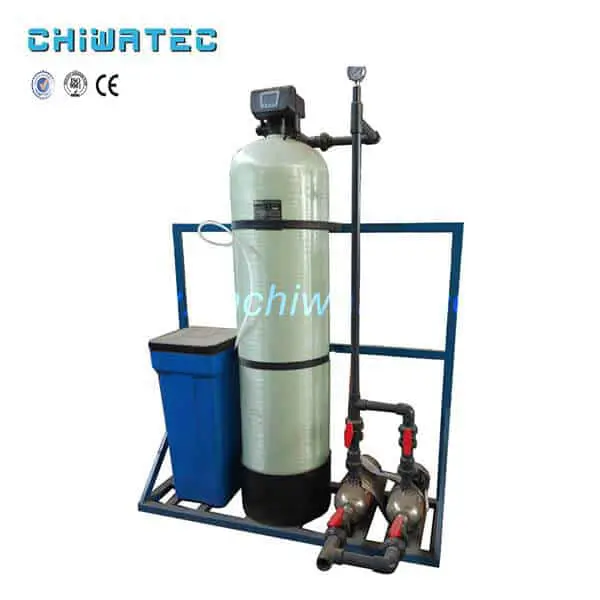
2. Resin Regeneration Process
2.1 When Regeneration Is Required
Ion exchange resin must be regenerated when it loses exchange capacity:
- Hardness breakthrough: Effluent hardness exceeds specification
- Capacity exhaustion: Based on throughput volume calculations
- Pressure drop increase: Resin bed becomes fouled or compacted
2.2 Regeneration Steps
- Backwash: Reverse flow expands resin bed, removes suspended solids (10-15 minutes)
- Brine draw: Concentrated NaCl solution (8-12%) flows through resin bed
- Slow rinse: Displacement rinse pushes brine through resin (1-2 bed volumes)
- Fast rinse: Rapid rinse removes residual salt until effluent meets standards
- Return to service: System ready for normal softening operation
2.3 Regeneration Chemical Requirements
| Parameter | Standard Range | Optimal Value |
|---|---|---|
| NaCl Concentration | 8-12% | 10% |
| Dosage | 100-250 g/L resin | 150 g/L |
| Flow Rate | 2-4 BV/h | 3 BV/h |
| Temperature | 15-30°C | 25°C |
2.4 Salt Consumption Optimization
- Counter-current regeneration: More efficient than co-current (20-30% salt savings)
- Demand-initiated regeneration: Based on actual water usage vs. timer-based
- Brine recycling: Reuse portion of spent brine for next regeneration
3. Corrosion Control in Softened Water
3.1 Corrosion Mechanisms
Ion exchange softening can increase water corrosiveness through three pathways:
(1) Metal Corrosion By-products
- Softened water dissolves protective scale layers
- Iron, copper, lead leach into drinking water
- Health concerns from heavy metal exposure
- Red water complaints from iron corrosion
(2) Chemical Property Changes
- pH reduction: Hydrogen cycle produces acidic water
- Alkalinity decrease: Reduced buffering capacity
- Langelier Index: Shifts from scale-forming to corrosive
- Conductivity changes: Affects electrochemical corrosion rates
(3) Pipe Network Film Damage
- Protective mineral films dissolve in soft water
- Bare metal surfaces exposed to water
- Accelerated uniform and pitting corrosion
- Increased lead and copper release
3.2 Corrosion Control Strategies
Blending with Raw Water
- Partial softening: Blend softened water with untreated raw water
- Target hardness: Maintain 80-120 mg/L as CaCO₃
- Benefits: Retains natural alkalinity and minerals
- Control: Automated blending valves maintain consistent quality
Corrosion Inhibitor Addition
- Orthophosphates: Form protective film on pipe surfaces
- Silicates: Create barrier between water and metal
- Zinc orthophosphate: Enhanced protection for lead service lines
- Dosage: Typically 1-3 mg/L as PO₄
pH and Alkalinity Adjustment
- Caustic soda (NaOH): Raises pH and alkalinity
- Lime (Ca(OH)₂): Adds calcium and alkalinity
- Soda ash (Na₂CO₃): Increases alkalinity without pH spike
- Target LSI: Slightly positive (0.2-0.5) for stability
Post-Treatment Remineralization
- Calcite contactors: Dissolve calcium carbonate into water
- CO₂ injection: Controls calcite dissolution rate
- Target calcium: 40-60 mg/L for pipe stability
4. System Design Considerations
4.1 Residential System Sizing
- Daily flow rate: Based on household size and usage patterns
- Hardness removal: Grains per day capacity requirement
- Resin volume: Typically 0.5-2.0 cubic feet for homes
- Regeneration frequency: Every 3-7 days optimal
4.2 Municipal Plant Design
- Multiple vessels: Parallel operation for continuous flow
- Standby capacity: N+1 configuration for reliability
- Automation level: PLC-based control with remote monitoring
- Brine handling: Storage, dosing, and disposal systems
4.3 Pretreatment Requirements
- Sediment filtration: Remove suspended solids (>50 microns)
- Activated carbon: Remove chlorine that damages resin
- Iron removal: Oxidation/filtration if Fe >0.3 mg/L
- Water softening: Required if hardness causes scaling
5. 2026 Market Trends & Technology Advances
5.1 Global Market Growth
- Market size: Ion exchange softening segment reaching $6.8 billion by 2027
- Growth rate: CAGR 5.9% driven by water quality awareness
- Residential segment: 45% of market from health consciousness
- Asia-Pacific: Fastest growth from urbanization and pollution
5.2 Technology Innovations
- High-capacity resins: 10-15% higher exchange capacity
- Low-salt systems: Reduced brine discharge (30-40% less salt)
- Smart controllers: WiFi-enabled monitoring and control
- Compact designs: Space-saving configurations for small homes
- Eco-friendly resins: Bio-based materials with lower environmental impact
5.3 Regulatory Trends
- Brine discharge limits: Stricter regulations in water-scarce regions
- Sodium restrictions: Some areas limit sodium addition to drinking water
- Potassium chloride: Alternative regenerant for sodium-sensitive applications
- Water efficiency: Minimum efficiency standards for new systems
6. Comparison with Other Softening Methods
6.1 Technology Comparison
| Method | Capital Cost | Operating Cost | Effluent Hardness | Best Application |
|---|---|---|---|---|
| Ion Exchange | Medium | Medium | <1 mg/L | Residential, commercial |
| Lime Softening | Low-Medium | Low | 50-100 mg/L | Municipal, high flow |
| RO/NF Membrane | High | Medium-High | <5 mg/L | High quality needs |
6.2 Advantages of Ion Exchange
- Proven technology: 50+ years of reliable operation
- Low maintenance: Simple automatic regeneration
- Consistent quality: Predictable effluent hardness
- Compact footprint: Suitable for space-constrained installations
- Cost-effective: Competitive for small to medium flows
6.3 Limitations
- Sodium addition: Concerns for low-sodium diets
- Brine discharge: Environmental impact in sensitive areas
- Corrosion potential: Requires corrosion control measures
- Resin replacement: 5-10 year lifespan before replacement
7. Conclusion
Ion exchange water softening remains the dominant technology for domestic and commercial water treatment, offering reliable hardness removal with proven performance. While the process can increase water corrosiveness, proper corrosion control strategies including blending, inhibitor addition, and pH adjustment effectively mitigate these concerns.
Key takeaways:
- ✓ Exchange principle: Calcium/magnesium replaced with sodium/hydrogen ions
- ✓ Regular regeneration: Required to restore resin exchange capacity
- ✓ Corrosion control: Essential for protecting pipe networks and water quality
- ✓ System design: Proper sizing and pretreatment ensure optimal performance
- ✓ Technology advances: High-capacity resins, smart controls, eco-friendly options
Xi’an CHIWATEC Water Treatment Technology supplies complete ion exchange softening systems for residential, commercial, and municipal applications. Our product range includes automatic water softeners, industrial softening plants, and corrosion control solutions with comprehensive technical support and operator training.
8. FAQ: Ion Exchange Water Softening
Q1: How often should water softener resin be regenerated?
Regeneration frequency depends on water hardness and daily usage. Typical residential systems regenerate every 3-7 days. Modern demand-initiated systems regenerate based on actual water consumption rather than fixed timers, optimizing salt and water usage.
Q2: Does softened water add too much sodium to my diet?
Ion exchange adds approximately 7.5 mg sodium per liter per grain of hardness removed. For moderately hard water (10 gpg), this equals 75 mg/L—less than a slice of bread (150 mg). Those on strict low-sodium diets may consider potassium chloride regenerant or RO drinking water.
Q3: Why is my softened water corrosive?
Softened water can dissolve protective mineral films in pipes. Solutions include: blending with raw water to maintain 80-120 mg/L hardness, adding corrosion inhibitors (orthophosphates), adjusting pH and alkalinity, or remineralization through calcite contactors.
Q4: How long does water softener resin last?
With proper maintenance and pretreatment, cation exchange resin lasts 5-10 years. Factors affecting lifespan include feedwater quality, chlorine exposure, iron contamination, and regeneration frequency. Regular cleaning and proper pretreatment extend resin life.
Do you have a water treatment project we can help with
* Designing,machining,installing,commissioning, customize and one-stop service






 English
  Spanish
  Portuguese




