

Power Boiler Water Softening Equipment: Complete Guide to Make-Up Water Treatment Systems 2026
Looking for reliable water softening equipment for your power boiler make-up water system? In thermal power plants, the quality of boiler feed water directly impacts operational efficiency, equipment lifespan, and plant safety. Hard water containing calcium and magnesium ions can cause severe scaling on boiler tubes, reducing heat transfer efficiency by 10-30% and leading to costly tube failures. This comprehensive guide covers everything about power boiler water softening equipment – from working principles and ion exchange technology to system design, operation, and maintenance best practices for 2026.
*Last Updated: May 2026 | Industry-Verified Data*
Why This Guide Matters
The global power generation market relies heavily on water treatment, with boiler feed water treatment representing a critical subsector. A typical 500 MW coal-fired power plant consumes 40,000-60,000 m³ of water annually for boiler make-up alone, and inadequate water softening can reduce boiler efficiency by 5-15% while increasing maintenance costs by 20-40%. With global electricity demand projected to grow by 3.4% annually through 2030, proper selection and operation of power boiler water softening equipment is essential for reliable, efficient power generation.
Key Industry Trends (2026 Update)
- Smart Water Softening Systems: IoT-enabled water softeners with real-time hardness monitoring, automated regeneration triggering based on actual water usage rather than fixed timers, and remote diagnostic capabilities are reducing chemical consumption by 15-25% and extending resin life.
- High-Efficiency Resin Technology: New uniform particle size (UPS) cation exchange resins with improved kinetics and higher operating capacities (1.9-2.1 eq/L) are enabling smaller equipment footprints and longer run lengths between regenerations for boiler make-up systems.
- Boiler Feed Water Quality Monitoring: Online analyzers for hardness, conductivity, pH, and dissolved oxygen are becoming standard, with real-time data integration into plant DCS systems enabling immediate response to feed water quality excursions.
- Zero Liquid Discharge (ZLD) Integration: Power plants increasingly integrate water softening with ZLD systems, recovering 95-98% of water for reuse and minimizing wastewater discharge, driven by tightening discharge regulations worldwide.
1. Why Is Water Softening Critical for Power Boiler Make-Up Water?
The Problem of Hard Water in Boilers
Raw water used for boiler make-up contains dissolved calcium (Ca²&sup4;) and magnesium (Mg²&sup4;) ions that form hard carbonate and sulfate scales when heated. At boiler operating temperatures of 300-600 degrees C, even small amounts of hardness (1-2 ppm as CaCO&sub3;) can precipitate and form insulating scale deposits on heat transfer surfaces. Scale thickness of just 1 mm can increase fuel consumption by 5-10%, while 3 mm of scale can cause tube overheating and catastrophic failure.
Boiler Feed Water Quality Standards
Power boilers require feed water with hardness below 0.03 ppm (as CaCO&sub3;) for high-pressure drum boilers and below 0.01 ppm for once-through supercritical boilers. Other critical parameters include: pH 8.8-9.3 (for corrosion control), conductivity below 0.2 μS/cm (for supercritical units), dissolved oxygen below 7 ppb, silica below 10 ppb, and iron below 10 ppb. Water softening equipment is the first and essential step in meeting these stringent feed water quality requirements.
2. How Does Power Boiler Water Softening Equipment Work?
The Ion Exchange Process
Power boiler water softening equipment operates on the principle of ion exchange. Water passes through a pressure vessel containing strong acid cation exchange resin in the sodium form (R-Na&sup4;). As hard water flows through the resin bed, calcium and magnesium ions exchange with sodium ions: 2R-Na + Ca²&sup4; → R&sub2;-Ca + 2Na&sup4;. The result is softened water containing sodium bicarbonate and sodium sulfate – compounds that remain soluble at boiler temperatures and do not form scale. The resin bed continues to soften water until the available sodium ions are depleted, at which point regeneration is required.
System Components
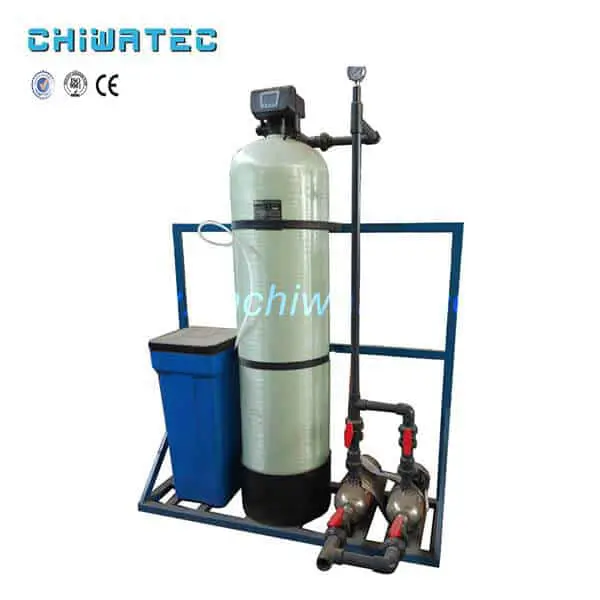
A typical power boiler water softening system includes: (1) feed water pump with variable frequency drive; (2) multi-media mechanical filter for suspended solids removal; (3) activated carbon filter for chlorine and organic removal (if feed water is chlorinated); (4) the main softener vessel containing cation exchange resin, with a multiport control valve; (5) brine tank for regenerant (sodium chloride) storage and preparation; and (6) effluent quality monitoring instruments (hardness analyzer, conductivity meter, flow meter). For larger power plant applications, duplex or triplex softener configurations provide continuous softened water supply during regeneration cycles.
3. What Are the Key Specifications for Boiler Make-Up Water Softeners?
Design Parameters
- Flow Rate: Typical boiler make-up flow rates for power plants range from 20-200 m³/h depending on plant capacity. The softener must handle both normal make-up and peak demand during startup and load changes.
- Resin Volume: Calculated based on feed water hardness (typically 100-400 ppm as CaCO&sub3; for surface water), desired service flow rate (15-30 m/h linear velocity), and target run length between regenerations (24-72 hours for power plant applications).
- Vessel Size: Standard diameters range from 1,000-3,000 mm for power plant softeners, with aspect ratios of 2:1 to 3:1 (height:diameter).
- Operating Pressure: Typically 3-6 bar at the softener inlet. Higher pressures may require thicker vessel walls and higher pressure-rated valves.
- Water Temperature: Standard cation resin operates effectively at 5-50 degrees C. Feed water above 50 degrees C requires high-temperature resin grades.
4. What Is the Regeneration Process for Boiler Water Softening Equipment?
Step-by-Step Regeneration Cycle
When the resin bed is exhausted (indicated by hardness breakthrough above 0.03 ppm), the automatic control valve initiates regeneration: (1) Backwash – upflow water at 8-15 m/h for 10-15 minutes to remove accumulated particulates and reclassify the resin bed; (2) Brine draw – 6-12% sodium chloride solution is drawn through the resin bed at 4-8 BV/h for 30-60 minutes, displacing accumulated calcium and magnesium ions; (3) Slow rinse – water at the same flow rate as brine to push the spent regenerant through the bed; (4) Fast rinse – water at service flow rate for 10-30 minutes to flush residual brine; (5) Return to service. Total regeneration time: 60-120 minutes.
Regenerant Consumption and Optimization
Salt consumption is typically 150-240 grams of NaCl per liter of resin per regeneration, with a dosing level of 2-3 times the stoichiometric requirement. Modern controllers optimize salt dose based on actual hardness removal, reducing salt consumption by 15-20% compared to fixed-dose systems. Reclaimed brine from regeneration should be neutralized or discharged according to local environmental regulations. How boiler softened water works provides additional detail on the regeneration cycle and chemistry.
5. How to Select the Right Water Softening Equipment for a Power Boiler?
Selection Criteria
- Feed water analysis: Complete analysis including total hardness, alkalinity, chloride, sulfate, iron, manganese, TDS, pH, temperature, and turbidity. Seasonal variations must be considered – surface water hardness often varies by 30-50% between wet and dry seasons.
- Flow rate requirements: Calculate both normal continuous make-up rate and maximum peak demand. Include a safety factor of 20-30% for future capacity expansion.
- Required effluent quality: Most power boilers require hardness below 0.03 ppm. If effluent quality requirements are more stringent (e.g., below 0.01 ppm for supercritical boilers), a secondary polishing step (mixed bed or EDI) will be needed after primary softening.
- Automation level: Power plants typically require fully automatic softeners with PLC control, remote monitoring capability, and integration with plant DCS systems.
- Space and layout constraints: Consider vessel dimensions, brine tank size, and access for resin replacement and maintenance.
6. What Are the Common Problems with Boiler Water Softening Systems?
Troubleshooting Guide
- Hardness breakthrough: Most common issue. Causes include: exhausted resin (capacity depletion), fouled resin (iron or organic fouling), channeling (improper flow distribution), incorrect regeneration settings (insufficient brine volume or contact time), or regenerant quality issues (contaminated salt).
- High pressure drop: Caused by fouled resin, broken resin beads creating fines, or accumulated debris from inadequate pretreatment. Backwash more frequently and check pretreatment system performance.
- Resin loss during backwash: Backwash flow rate too high or underdrain collector damage. Check backwash flow controller setting and inspect underdrain laterals.
- Salt bridging in brine tank: Salt forms a solid bridge above the water level. Break the bridge manually and consider using pellet salt instead of rock salt, which is more prone to bridging.
- Poor regeneration efficiency: Verify brine concentration (6-12% NaCl), contact time (30-60 minutes minimum), and brine temperature (above 10 degrees C recommended for optimal kinetics).
Understanding the causes of soft water hardness exceeding standards provides detailed diagnostic guidance for troubleshooting boiler softening systems.
7. How to Maintain Power Boiler Water Softening Equipment?
Daily, Weekly, and Monthly Maintenance
- Daily: Record treated water hardness, flow rate, pressure drop, and regeneration frequency. Check brine tank salt level and verify salt dosage.
- Weekly: Conduct a manual hardness test on treated water using titration kit to verify online analyzer accuracy. Inspect control valve operation during regeneration.
- Monthly: Clean brine tank and salt grid. Check and calibrate online instruments (conductivity meter, flow meter, hardness analyzer). Test regenerant brine concentration.
- Quarterly: Perform resin sampling and send for laboratory analysis (total capacity, moisture, fouling assessment). Clean brine educator nozzles and check injector performance.
- Annually: Complete resin replacement if capacity has declined below 70-80% of new resin specification. Inspect vessel internals, underdrain system, and distributor piping.
8. How Does Boiler Water Softening Fit Into the Overall Feed Water Treatment System?
Complete Treatment Train
Power boiler make-up water treatment typically follows this sequence: Raw water → Clarification (coagulation + sedimentation) → Filtration (multi-media + activated carbon) → Water softening (ion exchange) → Reverse osmosis (for high-TDS feed water) → Mixed bed polishing or EDI → Boiler feed water storage. The softening step protects downstream RO membranes from hardness scaling and reduces the ionic load on polishing stages. In plants without RO, the softener must provide consistent effluent hardness below 0.03 ppm directly to the boiler.
Integration Considerations
Key integration requirements include: (1) softened water storage capacity of 2-4 hours of normal make-up demand; (2) interlock between softener regeneration and plant demand to ensure softened water availability during peak periods; (3) bypass capability for emergency operation; and (4) alarm and shutdown logic triggered by hardness breakthrough. Comprehensive analysis of power boiler softened water equipment provides detailed information on system integration and design considerations for power plant applications.
9. What Are the Operating Costs of Boiler Water Softening Equipment?
Cost Breakdown
- Salt consumption: USD 0.02-0.05/m³ of treated water (based on NaCl at USD 100-200/ton). Represents the largest consumable cost for typical systems.
- Water consumption: Regeneration uses 2-5% of treated water volume for backwash and rinsing. At USD 0.50-1.50/m³ water cost, this adds USD 0.01-0.08/m³.
- Resin replacement: Cation resin costs USD 300-600/m³ and lasts 3-5 years in boiler softening service, adding USD 0.005-0.015/m³.
- Maintenance and labor: Approximately USD 0.005-0.01/m³ for routine maintenance, valve servicing, and instrument calibration.
- Total operating cost: USD 0.04-0.15/m³ of softened water, significantly cheaper than the cost of boiler tube replacement or efficiency loss from inadequate water treatment.
10. How to Upgrade or Retrofit Existing Boiler Water Softening Equipment?
Upgrade Options
- Control system upgrade: Replace timer-based controls with demand-initiated regeneration (DIR) controllers that trigger regeneration based on actual water usage, reducing salt consumption by 15-30% and extending run lengths.
- Resin upgrade: Replace conventional heterodisperse resin with uniform particle size (UPS) resin for improved kinetics, 20-30% longer run lengths, and better effluent quality. UPS resin also requires less backwash expansion, reducing water consumption.
- Counter-current regeneration conversion: Convert from co-current to counter-current (upflow) regeneration for improved regeneration efficiency, 20-40% salt savings, and better effluent quality during the initial service period.
- Add online hardness monitoring: Install a continuous hardness analyzer with automatic alarm and bypass capabilities to prevent untreated water from reaching the boiler.
CHIWATEC provides comprehensive solutions for power boiler water softening, from complete system design and equipment supply to retrofit packages and technical support. CHIWATEC engineers work with power plant operators to optimize softening performance, reduce operating costs, and ensure reliable boiler feed water quality.
Conclusion
Power boiler water softening equipment is a critical component of thermal power plant operations, protecting boilers from scale formation, maintaining heat transfer efficiency, and ensuring safe, reliable operation. From ion exchange fundamentals and regeneration procedures to system selection, maintenance, and cost optimization, every aspect of water softening directly impacts plant performance and profitability. As power plants face increasing pressure to improve efficiency, reduce water consumption, and minimize environmental impact, investing in modern water softening technology with smart controls and high-efficiency resins delivers measurable returns. Contact CHIWATEC today at [email protected] or [email protected] (WhatsApp available) for expert guidance on selecting, installing, and maintaining power boiler water softening equipment for your facility.
Frequently Asked Questions
Q1: What is the difference between water softening and demineralization for boiler feed water?
Water softening removes only hardness ions (calcium and magnesium) through sodium ion exchange. Demineralization removes all dissolved ionic solids through cation and anion exchange or RO, producing water with conductivity below 0.1 μS/cm. For high-pressure power boilers (above 60 bar), full demineralization is typically required; for low-pressure boilers, softening alone may be sufficient.
Q2: How often should boiler water softening resin be replaced?
Typical cation resin life in boiler softening service is 3-5 years. Replacement is indicated when: operating capacity drops below 70% of new resin, pressure drop increases by 50% despite cleaning, or effluent hardness cannot be maintained below 0.03 ppm. Regular annual resin analysis helps predict replacement timing.
Q3: Can a water softener handle the high flow rates required for power boilers?
Yes. Industrial water softeners for power plant applications are designed for flow rates of 20-200 m³/h or more, using vessels 1,000-3,000 mm in diameter. Multiple softeners in parallel (duplex or triplex configurations) provide redundant capacity and ensure continuous softened water supply during regeneration.
Q4: What happens if untreated hard water reaches the boiler?
Hard water entering a boiler causes immediate scaling on heat transfer surfaces. Scale thickness of 1 mm increases fuel consumption by 5-10%. Severe scaling can cause localized overheating, tube bulging, and catastrophic tube ruptures. In high-pressure boilers, even trace hardness (above 0.03 ppm) will concentrate in the boiler water and eventually precipitate as scale.
Q5: How do I reduce salt consumption in my boiler water softening system?
Strategies include: (1) upgrade to demand-initiated regeneration (DIR) controls; (2) convert to counter-current regeneration; (3) optimize brine concentration (use 8-10% NaCl rather than the minimum effective concentration); (4) verify brine contact time (minimum 30 minutes at design flow rate); and (5) consider UPS resin which requires less regenerant per unit of hardness removed.
Related Resources and Further Reading
- Comprehensive Analysis of Power Boiler Softened Water Equipment – Detailed power plant system analysis
- How Boiler Softened Water Works – Working principles and regeneration cycle
- Analysis of Soft Water Hardness Exceeding Standard in Boiler Softening – Troubleshooting hardness excursions
- Pure Water Preparation Scheme of Ion Exchange Equipment – Broader ion exchange water treatment reference
- Water Softening Systems by CHIWATEC – Explore industrial water softening solutions
Do you have a water treatment project we can help with
* Designing,machining,installing,commissioning, customize and one-stop service






 English
  Spanish
  Portuguese




