

Iron and Manganese Filter: Working Principle, Technical Parameters, and Process Flow Guide (2026 Updated)
An iron and manganese filter is a specialized water treatment system designed to remove dissolved iron (Fe) and manganese (Mn) from groundwater through oxidation, filtration, and contact adsorption processes. High concentrations of iron and manganese cause staining of laundry and plumbing fixtures, metallic taste in drinking water, and fouling of industrial equipment. Xi’an CHIWATEC engineers and manufactures iron and manganese removal filtration systems for residential, commercial, and industrial applications worldwide.
*Last Updated: March 2026
Why This Guide Matters
Iron and manganese are among the most common groundwater contaminants worldwide, affecting an estimated 30% of groundwater sources globally. The WHO guideline for iron in drinking water is 0.3 mg/L, and for manganese is 0.1 mg/L — concentrations above these levels cause brown or black staining, turbidity, and objectionable taste. In industrial settings, iron and manganese fouling can reduce the efficiency of RO membranes, ion exchange resins, and boilers. The global iron and manganese removal water treatment market was valued at approximately USD 3.2 billion in 2025, driven by increasing awareness of groundwater quality issues and tightening regulatory standards for drinking water (EPA Secondary Maximum Contaminant Levels: iron 0.3 mg/L, manganese 0.05 mg/L). Understanding the working principle, technical parameters, and process flow of iron and manganese filters is essential for water treatment professionals and facility managers dealing with challenging groundwater sources.
Key Industry Trends (2026 Update)
- Manganese-selective media development: New catalytic media formulations achieve manganese removal efficiency above 98% at concentrations up to 5 mg/L without chemical oxidation pretreatment, significantly reducing system complexity.
- Integrated aeration-filtration systems: Compact packaged units combining forced-draft aeration with manganese green sand filtration are replacing multi-tank systems, reducing footprint by 40-60% for small to medium flow applications.
- Self-cleaning filter designs: Automatic backwash iron and manganese filters with differential pressure control eliminate manual operator intervention for backwash scheduling, reducing maintenance labor by 70%.
- Iron bacteria remediation advances: New combination approaches using chlorine dioxide injection followed by catalytic filtration achieve 99.9% removal of iron bacteria biofilms that plague groundwater systems, particularly in regions with high organic content.
1. What Is an Iron and Manganese Filter?
Definition and Purpose
An iron and manganese filter is a pressure vessel filtration system that removes dissolved iron and manganese from water through oxidation, filtration, and adsorption. The filter media — typically manganese green sand (glauconite coated with manganese oxide), Birm, or catalytic media — promotes the oxidation and precipitation of iron and manganese ions, which are then trapped within the filter bed. The system includes a backwash mechanism to periodically clean the media and restore filtration capacity.
Why Iron and Manganese Must Be Removed
Iron concentrations above 0.3 mg/L cause reddish-brown staining on laundry, porcelain fixtures, and plumbing. Manganese above 0.05 mg/L causes dark brown or black staining and a metallic taste. In industrial water systems, iron and manganese deposits foul RO membranes, clog spray nozzles, reduce heat exchanger efficiency, and catalyze corrosion. For ion exchange systems, iron fouling permanently damages resin beads, requiring premature replacement. Iron bacteria (such as Gallionella and Leptothrix) can form slimy biofilms that clog well screens, pipes, and filtration equipment.
2. How Does an Iron and Manganese Filter Work?
Oxidation Step
The working principle begins with oxidation. Dissolved ferrous iron (Fe2+) and manganous manganese (Mn2+) in groundwater must be oxidized to their insoluble forms (Fe3+ and Mn4+) before they can be filtered out. Oxidation is achieved by aeration (forced or natural), chemical oxidation (chlorine, potassium permanganate, or ozone), or catalytic oxidation on the filter media surface. The oxidation reaction for iron: 4Fe(HCO3)2 + O2 + 2H2O to 4Fe(OH)3 + 8CO2. For manganese: 2Mn(HCO3)2 + O2 to 2MnO2 + 4CO2 + 2H2O.
Filtration and Adsorption
After oxidation, the water flows through the manganese green sand or catalytic media bed. The oxidized iron and manganese particles are physically trapped (strained) in the media pore spaces and adsorptively bonded to the media surface. The manganese oxide coating on green sand media acts as a catalyst, continuously oxidizing dissolved iron and manganese even without chemical feed, as long as dissolved oxygen is present. The media also provides a surface for biological iron and manganese oxidation, where naturally occurring iron bacteria (Crenothrix, Leptothrix) assist in the removal process — particularly effective in micro-polluted groundwater containing ammonia.
Backwash Regeneration
As precipitated iron and manganese accumulate in the filter bed, the pressure differential across the bed increases. The system initiates a backwash cycle — reversing flow through the bed at a rate sufficient to fluidize the media (backwash strength of 12-15 L/m2-s) and flush accumulated solids to drain. Backwash duration is typically 4-6 minutes. A surface wash or air scour (18-25 L/m2-s of compressed air) may be used for heavily loaded filters. After backwashing, the system returns to service flow until the next backwash is required.
3. What Are the Main Technical Parameters of Iron and Manganese Filters?
Design Specifications
| Parámetro | Value |
|---|---|
| Filtration velocity (single layer) | 7-10 m3/h-m2 |
| Filtration velocity (dual layer) | 10-12 m3/h-m2 (max 15) |
| Maximum influent turbidity | 15 mg/L |
| Effluent turbidity | 5 mg/L or less |
| Working temperature | Normal (5-40 degrees C / 41-104 degrees F) |
| Maximum working pressure | 0.6 MPa (87 psi) |
| Filter media bed depth | 1,000-1,200 mm (39-47 inches) |
| Backwash strength (single layer) | 15 L/m2-s |
| Backwash strength (dual layer) | 12 L/m2-s |
| Backwash duration | 4-6 minutes |
| Air scour rate (compressed air) | 18-25 L/m2-s |
Media Selection Criteria
Manganese green sand (glauconite) is the most common filter media for iron and manganese removal, capable of treating iron concentrations up to 10 mg/L and manganese up to 3 mg/L without chemical feed. Birm media is suitable for iron removal only (up to 7 mg/L) when dissolved oxygen is above 15% of the iron concentration. Catalytic carbon media offers the advantage of simultaneous chlorine and organic removal along with iron and manganese filtration. For high iron concentrations (above 10 mg/L), a two-stage approach is recommended — chemical oxidation followed by catalytic filtration.
4. What Are the Common Process Flow Configurations?
Low Iron (5-10 mg/L) — Single-Stage Filtration
When the groundwater contains only iron at a concentration of 5-10 mg/L with minimal manganese, a series process of aeration device followed by iron removal filtration is suitable. The aeration device is compact (similar to a pipe aerator), making the overall process effectively a single-stage system with manganese green sand as the primary filtration media. This configuration is economical and requires minimal operator attention.
High Iron + Manganese — Two-Stage Oxidation + Filtration
If the groundwater contains iron above 10 mg/L and manganese above 0.5 mg/L, a two-stage process is recommended: oxidation device (chlorine, potassium permanganate, or ozone injection) followed by iron and manganese removal filtration. The chemical oxidant ensures complete oxidation of both iron and manganese before the water reaches the filter media. Potassium permanganate is particularly effective for manganese oxidation, as it works over a wider pH range (pH 6-9) compared to chlorine.
Complex Groundwater — Custom Treatment Approach
If the groundwater quality is complex — low pH, low alkalinity, or high silicic acid content — a custom approach is required. In these cases, a water quality analysis report or raw water sample should be provided so that corresponding measures can be taken according to different water quality conditions. Additional pretreatment such as pH adjustment (caustic or lime feed), silica removal, or pre-oxidation with ozone may be needed. CHIWATEC engineers can design custom iron and manganese removal systems based on site-specific water analysis.
5. What Equipment Components Are Used?
Vessel and Piping
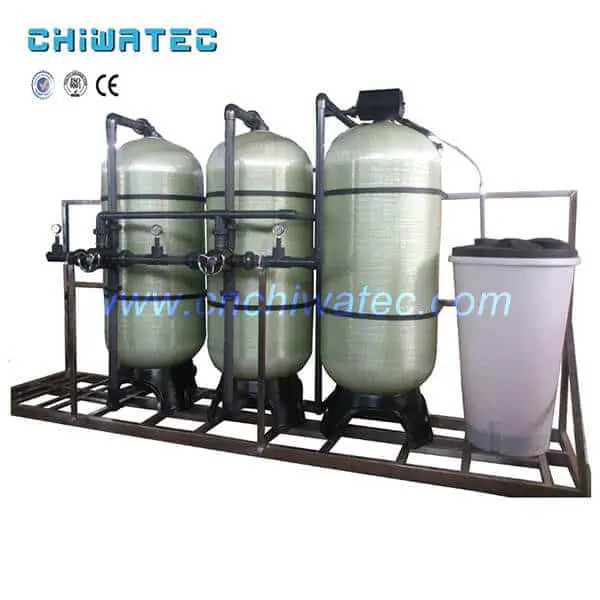
Iron and manganese filter vessels are available in carbon steel with corrosion-resistant internal lining (rubber, epoxy, or glass flake), fiberglass reinforced plastic (FRP), or stainless steel (304/316L). The choice depends on the chemical environment, pressure rating, and budget. Carbon steel is the most common for industrial systems, while FRP is popular for smaller commercial and residential units. Single-flow mechanical filtration equipment removes iron, manganese, and suspended solids. The filter media options include: refined quartz sand, manganese green sand, and anthracite in layered configurations.
Control System
Automatic control valves (time-clock or flow-meter initiated) manage the service and backwash cycles. Key control features include: programmable backwash frequency and duration, automatic valve actuation, pressure differential monitoring for demand-initiated backwash, air scour control (where applicable), and remote monitoring capability for SCADA integration. For systems with chemical feed (chlorine or potassium permanganate), metering pumps with flow-paced control are included.
6. What Is the Role of Aeration in Iron and Manganese Removal?
Forced and Natural Aeration
Aeration introduces atmospheric oxygen into the water to oxidize dissolved iron and manganese. Forced-draft aeration towers can increase dissolved oxygen levels to 90% of saturation, sufficient to oxidize iron at concentrations below 10 mg/L. Natural aeration through spray nozzles or cascade trays provides lower oxygen transfer efficiency (50-70%) but requires no blower or compressor. The aerated water should be held in a reaction tank for 10-20 minutes to allow complete oxidation before filtration.
Limitations of Aeration
Aeration alone is effective for iron removal at concentrations below 5 mg/L but has limited effectiveness for manganese. Manganese oxidation requires a higher oxidation-reduction potential (ORP above 400-500 mV) than aeration can typically provide. For manganese removal, chemical oxidation with chlorine, potassium permanganate, or ozone is generally required unless catalytic media is used.
7. What Is the Role of Chemical Oxidation in Iron and Manganese Removal?
Chlorine Oxidation
Chlorine (as sodium hypochlorite or chlorine gas) rapidly oxidizes both iron and manganese. Typical chlorine dosage is 0.5-2.0 mg/L per mg/L of iron, and 1.0-3.0 mg/L per mg/L of manganese. A contact time of 5-20 minutes after chlorine injection should be provided before the filter. Chlorine also provides disinfection and controls iron bacteria growth. The residual chlorine after filtration should be 0.2-0.5 mg/L to prevent bacterial regrowth in downstream piping.
Potassium Permanganate Oxidation
Potassium permanganate (KMnO4) is particularly effective for manganese oxidation, with a dosage of 1.0-1.5 mg/L per mg/L of manganese. It reacts quickly (contact time of 2-5 minutes) and is effective over a wide pH range. KMnO4 also regenerates the manganese oxide coating on green sand media, extending media life. However, it can cause pink discoloration if overdosed, requiring careful feed control.
8. How to Maintain an Iron and Manganese Filter?
Backwash Scheduling
The most critical maintenance task is proper backwash scheduling. Automatic time-clock controllers should be set to initiate backwash at least every 24-48 hours, even if the pressure differential has not reached the setpoint. Flow-initiated controllers backwash after a preset volume of water has been treated (typically 50-80% of the theoretical capacity between backwashes). For systems without automatic control, manual backwash should be performed weekly or whenever the effluent iron concentration exceeds 0.3 mg/L.
Media Inspection and Replacement
Manganese green sand media should be inspected annually for iron accumulation, media loss (fines generation), and channeling. Media life is typically 3-7 years, depending on iron loading and backwash effectiveness. If the effluent iron concentration increases despite adequate backwashing, or if the backwash expansion rate has decreased, media replacement may be needed. The media bed should be topped up annually, as 5-10% media loss per year is normal due to backwash attrition.
9. Common Problems and Troubleshooting
Iron Breakthrough
If iron appears in the effluent, possible causes include: exhausted filter media (replace media), inadequate backwash frequency (increase backwash frequency or flow rate), insufficient oxidation (check chlorine/KMnO4 dosage and contact time), or channeling in the media bed (redistribute media and check underdrain system).
Manganese Breakthrough
Manganese in the effluent is typically harder to diagnose than iron breakthrough. Common causes include: low oxidation-reduction potential (ORP below 400 mV), insufficient potassium permanganate feed, pH below 6.5 (manganese oxidation is poor at low pH), or biological fouling of the media (sanitize with chlorine or hydrogen peroxide).
High Backwash Water Consumption
If backwash volume exceeds 5% of treated water volume: check that the backwash flow rate is not excessive (should not exceed the design specification), verify that the backwash duration is not longer than necessary (4-6 minutes is standard), and inspect for leaks in backwash valves or piping. For high-turbidity source water, consider installing a sediment pre-filter to reduce the solids load on the iron and manganese filter.
10. How to Choose the Right Iron and Manganese Filter?
Water Quality Assessment
Start with a complete water analysis including: iron concentration (mg/L), manganese concentration (mg/L), pH, alkalinity, hardness, dissolved oxygen, turbidity, and ammonia/nitrogen levels. The ratio of iron to manganese and the presence of organic matter significantly affect the choice of filter media and oxidation method. Iron concentrations below 5 mg/L with minimal manganese can use simple aeration and filtration. Higher concentrations require chemical oxidation.
Flow Rate and Operating Conditions
Select the filter vessel diameter based on the required service flow rate and the recommended filtration velocity (7-10 m3/h-m2 for single-layer media). Include 20-30% safety margin for peak flow conditions. Ensure the available backwash flow rate and pressure are adequate for the selected vessel size. For continuous operation applications, install dual filters in parallel so one can be backwashed while the other remains in service. CHIWATEC provides complete iron and manganese filter system design, from single household units to industrial multi-vessel installations handling flow rates up to 500 m3/h.
Conclusión
Iron and manganese filters are essential water treatment systems for groundwater sources contaminated with dissolved iron and manganese. Understanding the working principle of oxidation, filtration, and adsorption — combined with proper selection of technical parameters, process configurations, and maintenance practices — ensures reliable removal of these common contaminants. Whether through simple aeration and filtration for low iron concentrations or chemical oxidation and two-stage filtration for challenging groundwater, the right iron and manganese filter system protects both health and equipment. Contact Xi’an CHIWATEC today at [email protected] o [email protected] to discuss your iron and manganese removal requirements and system design needs.
Frequently Asked Questions
Q1: What is the maximum iron concentration that can be removed by a manganese green sand filter?
Manganese green sand filters can effectively remove iron at concentrations up to 10 mg/L without continuous chemical feed, provided sufficient dissolved oxygen is present (above 15% of the iron concentration). For iron concentrations above 10 mg/L, chemical oxidation with chlorine or potassium permanganate before filtration is recommended, or a two-stage filtration approach.
Q2: Can an iron and manganese filter remove both contaminants simultaneously?
Yes. Manganese green sand media is effective for simultaneous removal of iron and manganese. However, the removal efficiency depends on the concentrations and ratio. For iron-dominant water (Fe:Mn ratio above 10:1), single-stage filtration is usually sufficient. For manganese-dominant or high-concentration manganese (above 0.5 mg/L), chemical oxidation with potassium permanganate or chlorine is recommended to ensure complete manganese removal.
Q3: How often does the filter media need to be replaced?
Manganese green sand media typically lasts 3-7 years under normal operating conditions. Factors affecting media life include: influent iron and manganese concentrations, backwash effectiveness and frequency, chemical feed rates, and water temperature. Annual inspection and topping up of media (replacing 5-10% media loss) is recommended.
Q4: What is the typical backwash water consumption for iron and manganese filters?
Backwash water consumption is typically 1-5% of the total treated water volume, depending on the influent iron and manganese loading, filter design, and backwash frequency. For a well-designed system with automatic demand-initiated backwash, backwash water use is typically 2-3% of production.
Q5: Can an iron and manganese filter remove iron bacteria?
Iron and manganese filters can physically remove iron bacteria biomass, but the bacteria may colonize the filter media, reducing performance. For systems with known iron bacteria problems, continuous chlorine injection (0.5-1.0 mg/L residual) before the filter is recommended to control bacterial growth. Periodic shock chlorination of the filter media and downstream piping every 3-6 months helps prevent biofilm accumulation.
Related Resources and Further Reading
- Application of Iron and Manganese Removal Water Purifiers in Treating Well and Surface Water
- Iron and Manganese Removal: Safeguarding Health with Advanced Water Purification
- Main Features and Process of Self-Cleaning Iron and Manganese Removal Filter
- Iron and Manganese Removal Filters for Water Treatment
¿Tiene un proyecto de tratamiento de agua con el que podamos ayudar?
* Diseño, mecanizado, instalación, puesta en marcha, personalización y servicio integral






 Spanish
  English
  Portuguese




