What Is the Back Pressure of Reverse Osmosis Water Treatment and the Standard Desalination Rate of RO Membrane Elements?
This article explains the concept of back pressure in reverse osmosis (RO) water treatment systems, why it must be avoided, and how different desalination rates—standard, actual, and system—are calculated and applied in real-world RO system design and evaluation.
1. What Is the Back Pressure of Reverse Osmosis Water Treatment?
In reverse osmosis water treatment, back pressure refers to a condition where the pressure on the permeate (product water) side becomes higher than the pressure on the feed water side. This situation is extremely dangerous for RO membrane elements because their internal structure is designed for one-directional flow only.
How Water Normally Flows Through an RO Membrane
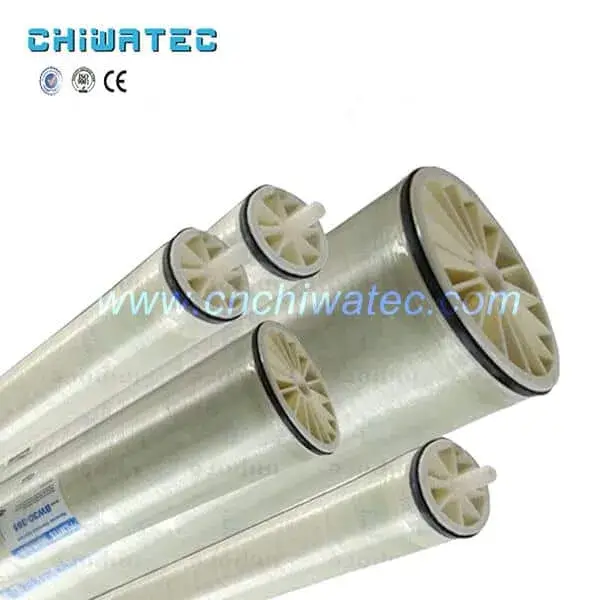
A standard spiral-wound RO membrane element consists of:
- Membrane sheets arranged into an envelope shape
- Three sealed edges, with the fourth edge glued to the permeate collection tube
- A permeate carrier layer that collects purified water
- A feed spacer mesh layer that distributes feed water across the membrane surface
During normal operation:
- Feed water flows across the membrane surface under high pressure.
- Pure water passes through the membrane into the membrane envelope.
- Permeate flows through the fabric carrier layer into the center tube.
- Concentrate (brine) is discharged from the system.
Why Back Pressure is Dangerous
If the pressure on the permeate side exceeds that of the feed side:
- los bonded edges of the membrane envelope may rupture.
- Internal glue lines fail, causing internal bypass.
- Salt passage increases dramatically, and the desalination rate drops sharply.
- The membrane element may become permanently damaged.
Causes of Back Pressure in RO Systems
Back pressure rarely occurs during normal operation but can appear due to:
- Improper opening/closing of downstream valves
- Incorrect system startup or shutdown procedures
- Sudden equipment malfunction
- Drains or permeate lines being accidentally blocked
- Mixing of permeate streams under pressure
To ensure the safety of RO elements, reverse osmosis systems must avoid back pressure under all circumstances.
2. What Are the Standard, Actual, and System Desalination Rates of RO Membrane Elements?
2.1 Standard Desalination Rate
los standard desalination rate is measured by the membrane manufacturer under controlled standard test conditions, usually including:
- Feed solution: 2,000–3,500 mg/L NaCl
- Temperature: 25°C
- Recovery rate: 15%
- Pressure: As specified for the membrane series
Example (Hyde Energy low-pressure series):
- CPA2: Minimum 99.2% (average 99.5%)
- CPA3: Minimum 99.6% (average 99.7%)
This value serves as a baseline performance indicator but does not represent real-world operating conditions.
2.2 Actual Desalination Rate
los actual desalination rate is the rejection rate demonstrated by the membrane during real operation.
It often differs from the standard rating because real-world conditions vary significantly:
Factors affecting actual rejection include:
- Raw water ionic composition (not just NaCl)
- Water temperature
- Feedwater TDS
- Operating pressure and recovery rate
- Membrane fouling or scaling
- Flow distribution within the pressure vessel
In many cases, the actual desalination rate may be lower than the standard value.
2.3 System Desalination Rate
los system desalination rate refers to the overall salt rejection of the entire RO system, not just a single membrane element.
It differs from the actual membrane rejection because:
- Multi-element pressure vessels create different conditions for each element
- Feed salinity increases progressively along the vessel
- Recovery rate varies across stages
- Fouling distribution may be uneven
For systems with multiple membranes in series, the system desalination rate is always different from both the standard and actual membrane ratings.
For systems with only one membrane element, the system desalination rate equals the actual desalination rate.
2.4 How to Predict System Desalination Rate
Manufacturers provide RO design software that allows engineers to calculate expected system performance based on:
- Feed water composition
- La temperatura
- Recovery rate
- Membrane model
- System configuration
This is the most accurate method for predicting system desalination rate during design or evaluation.
3. Why This Distinction Matters
Understanding the differences between standard, actual, and system desalination rates is essential for:
- RO design and engineering
- Performance guarantee specifications
- Acceptance testing
- Membrane element evaluation
- Long-term operational monitoring
System desalination rate—not the standard desalination rate—must be used for performance assessment.
Conclusión
Back pressure is a critical threat to reverse osmosis membrane integrity and must be avoided through proper system operation and valve control. Meanwhile, understanding the differences between standard, actual, and system desalination rates is essential for accurately evaluating RO performance. When designing, testing, or operating an RO system, always base performance expectations on the system desalination rate, not the manufacturer’s standard value.
For advanced RO and pretreatment systems, explore CHIWATEC’s full product range:
👉 CHIWATEC Water Treatment Equipment & Solutions
FAQ
1. What is back pressure in an RO system?
Back pressure occurs when the permeate side experiences higher pressure than the feed side, risking membrane damage and failure.
2. Why is back pressure dangerous for RO membranes?
It can rupture the membrane envelope’s adhesive seams, causing severe salt leakage and loss of desalination performance.
3. What is the standard desalination rate?
It is the salt rejection rate measured by the membrane manufacturer under standard laboratory conditions.
4. Why does the actual desalination rate differ?
Real operating conditions—temperature, water composition, recovery rate—differ significantly from standard test conditions.
5. How is system desalination rate calculated?
It is based on the performance of the entire RO system and is best predicted using membrane manufacturer design software.
Xian CHIWATEC Water Treatment Technology es una empresa de alta tecnología especializada en varios dispositivos de procesamiento de agua. Aparte de estos productos individuales, que cubren una serie de tipos y series, también podemos ayudar con proyectos de ingeniería integrales relacionados. Gracias a nuestro arduo trabajo y dedicación desde nuestra fundación, ahora somos uno de los fabricantes de equipos de tratamiento de agua de más rápido desarrollo en el oeste de China.
Otras lecturas:
SÍGANOS
¿Tiene un proyecto de tratamiento de agua con el que podamos ayudar?
* Diseño, mecanizado, instalación, puesta en marcha, personalización y servicio integral
 Spanish
  English
  Portuguese