Mineral Water Equipment High Pressure Pump Failures: 2026 Complete Troubleshooting Guide
Is your mineral water equipment’s high-pressure pump failing to produce water? High-pressure pump failures are the most common cause of production downtime in mineral water and bottled water facilities. Here is the direct answer: mineral water equipment high pressure pump failures fall into four diagnostic categories — pump runs but no water produced (check valve blockage or pre-filter clogging), pump does not start (solenoid valve or electrical failure), pump loses pressure (worn impeller or mechanical seal leakage), and pump cycles on and off (pressure switch or bladder tank issues). CHIWATEC provides expert guidance on high-pressure pump selection, installation, and maintenance for mineral water and pure water production systems.
Common Mineral Water Equipment High Pressure Pump Failures
When a mineral water equipment system stops producing water, the first diagnostic step is determining whether the high-pressure pump is operating normally. The following troubleshooting steps cover both scenarios:
Symptom 1: High-Pressure Pump Runs but No Water Produced
If the pump motor is running but the system produces little or no water, check these components in order:
- Pre-filter clogging: The most common cause. When the sediment or carbon pre-filter becomes blocked, neither waste water nor pure water is discharged — or only a very small amount of waste water flows. Replace the pre-filter cartridge and monitor the pressure drop across the housing.
- Check valve blockage: If waste water is discharged normally but no pure water flows, the check valve on the permeate line is likely blocked by debris or scale. Disassemble and clean the check valve or replace it if the spring mechanism is corroded.
- Loss of pump pressure: The high-pressure pump itself may have internal wear. Measure the discharge pressure at the pump outlet — for a typical mineral water RO system, this should be 8-12 bar (120-175 psi). If pressure is below 6 bar, the pump impeller or diaphragm may be damaged.
- Solenoid valve failure: The inlet solenoid valve may fail to open, preventing water from entering the pump. Verify 24 VAC/DC at the solenoid coil terminals and listen for an audible click when energized. If the coil is burned out or the plunger is stuck, replace the valve.
Symptom 2: High-Pressure Pump Does Not Start
- Check the low-pressure switch — if feed water pressure is below 0.5 bar, the switch will prevent pump startup. Verify that the feed water supply is adequate and the pre-filter is not restricting flow.
- Inspect the pressure switch adjustment — the cut-in pressure setting may be too high for the system’s operating conditions.
- Test the pump motor capacitor — a failed start capacitor will cause the motor to hum without rotating. Use a multimeter to check capacitance against the rated value on the capacitor label.
- Check for thermal overload trip — if the pump has been running hot, the motor’s internal thermal protector may have tripped. Allow 30 minutes for cooling before resetting.
For a comprehensive understanding of mineral water production system design, see Mineral Water Equipment Process: Complete Guide to Production Systems.
Key Causes of High-Pressure Pump Performance Degradation
Beyond complete failures, high-pressure pumps in mineral water equipment commonly suffer from gradual performance degradation. Understanding these issues helps operators identify problems before they cause production stoppages:
| Failure Mode | Symptoms | Root Cause | Solution |
|---|---|---|---|
| Mechanical seal leakage | Water dripping from pump shaft area, reduced pressure | Worn seal faces from abrasives or dry running | Replace mechanical seal, install dry-run protection |
| Cavitation | Noisy operation (rattling/gravel sound), vibration, low flow | Insufficient NPSH — feed water pressure too low or temperature too high | Increase feed pressure, lower water temperature, or increase suction pipe diameter |
| Impeller wear | Gradual pressure loss over months, increased running time | Abrasive particles in feed water (sand, silica, debris) | Replace impeller, improve pre-filtration to below 5 microns |
| Motor bearing failure | Grinding noise, shaft play, overheating | Normal wear, water ingress, or misalignment | Replace bearings, check shaft alignment and seal integrity |
| Pressure switch drift | Frequent on/off cycling, inconsistent pressure | Diaphragm fatigue or spring corrosion | Recalibrate or replace pressure switch |
For a broader perspective on water production system flow design, refer to Pure Water/Mineral Water Plant Production Process: Complete Guide.
Preventive Maintenance for Mineral Water Equipment Pumps
Regular preventive maintenance dramatically reduces the frequency of high-pressure pump failures and extends pump service life from the typical 2-3 years to 5-8 years:
- Daily checks: Monitor pump discharge pressure, flow rate, and motor current. Record baseline values and flag any deviation exceeding 10% from the baseline. Listen for unusual noises during startup and operation.
- Weekly checks: Inspect mechanical seal area for leaks. Verify that the pre-filter differential pressure is below 1.0 bar. Check the pressure tank (bladder tank) pre-charge pressure — it should be 0.2 bar below the pump cut-in pressure.
- Monthly checks: Clean or replace pre-filter cartridges. Test the low-pressure switch and high-pressure switch operation. Lubricate pump motor bearings according to the manufacturer’s specifications.
- Quarterly checks: Test the solenoid valve operation. Inspect electrical connections for corrosion or loosening. Measure pump efficiency by comparing flow rate vs. power consumption against the pump curve.
- Annual maintenance: Replace mechanical seals as a precautionary measure. Inspect and clean the pump impeller and volute. Replace pressure switches and check valves that show signs of wear.
For water recirculation systems that integrate with mineral water production, see Advanced Water Recirculation and Purification System Technology for pump integration best practices.
Selecting the Right High-Pressure Pump for Mineral Water Equipment
Choosing the correct replacement pump or specifying a pump for a new mineral water system requires careful evaluation of several parameters:
- Flow rate: Match the pump’s rated flow to the system’s design permeate production plus 10-15% margin. For a typical 1,000 L/h mineral water RO system, a pump rated at 1.5-2.0 m3/h at the operating pressure is appropriate.
- Operating pressure: Mineral water RO systems typically require 8-12 bar discharge pressure for brackish water membranes. Select a pump with a shut-off head (maximum pressure) at least 20% above the design operating pressure to account for membrane fouling over time.
- Material compatibility: All wetted parts must be stainless steel (304 or 316 SS) for mineral water applications to prevent corrosion and metallic contamination of the product water. Cast iron pumps are not acceptable for potable water production.
- Motor type: TEFC (Totally Enclosed Fan Cooled) motors are preferred for mineral water environments with high humidity. Verify that the motor’s insulation class (F or H) matches the ambient operating temperature.
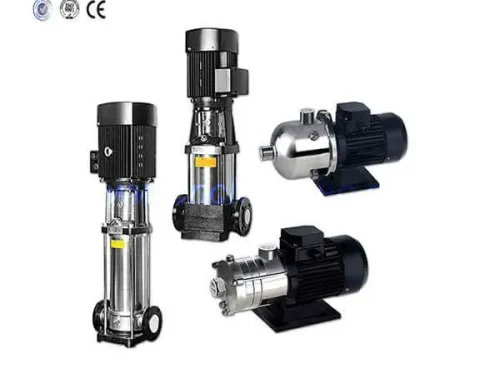
- Pump type: Multi-stage centrifugal pumps (vertical or horizontal) are the industry standard for mineral water RO systems, offering smooth flow, high efficiency, and quiet operation compared to diaphragm or piston pumps.
For beverage industry applications of high-pressure pump systems, see Casos de aplicación de equipos de agua pura para alcohol y bebidas.
Frequently Asked Questions
Q1: Why does my mineral water equipment high-pressure pump run but produce no water?
The most common causes are: (1) pre-filter cartridge is completely blocked — replace the cartridge and check the pressure differential; (2) the check valve on the permeate line is stuck closed — disassemble and clean or replace; (3) the pump impeller is worn or damaged — replace the impeller or the entire pump head if necessary; (4) the inlet solenoid valve is malfunctioning — test the coil voltage and plunger movement. Always start diagnostics with the simplest component (pre-filter) before moving to more complex pump repairs.
Q2: How can I tell if my high-pressure pump has a bad mechanical seal?
A bad mechanical seal typically shows these signs: visible water dripping from the weep hole on the pump motor bracket, reduced discharge pressure (5-15% drop compared to baseline), and in advanced cases, water entering the motor housing (detectable by measuring insulation resistance — readings below 1 MOhm indicate moisture ingress). Immediate replacement is required because leaking seals allow water to reach motor windings, causing short circuits and complete motor failure within days.
Q3: What causes cavitation in mineral water equipment pumps?
Cavitation is caused by insufficient net positive suction head (NPSH) at the pump inlet. This occurs when: feed water pressure is too low (below 0.5 bar), the suction pipe is too long or too narrow for the pump’s flow rate, feed water temperature is above 35 degrees C (increasing vapor pressure), or the pre-filter is partially clogged creating suction-side restriction. Cavitation sounds like gravel rattling inside the pump and causes rapid impeller erosion. Fix by increasing feed pressure, cleaning pre-filters, or lowering feed water temperature.
Q4: How often should the high-pressure pump be replaced in mineral water equipment?
With proper preventive maintenance, a high-pressure pump in mineral water equipment typically lasts 5-8 years. Pumps operating 8-12 hours per day in well-maintained systems with good pre-filtration often reach 8-10 years. Pumps operating 24/7 at maximum pressure without maintenance may fail within 1-2 years. Replacement is indicated when: discharge pressure cannot be maintained within 20% of the rated value, the pump requires more than two mechanical seal replacements per year, or motor bearing noise becomes continuous despite lubrication.
Q5: Can a failing high-pressure pump damage the RO membranes?
Yes, a failing high-pressure pump can cause significant RO membrane damage in two ways: (1) pressure fluctuations from pump surging or cycling cause rapid pressure changes that can delaminate the membrane’s polyamide layer from its support fabric, permanently reducing salt rejection; (2) if the mechanical seal fails and allows water into the motor, the pump may seize, stopping water flow while the system controller may continue applying pressure, causing a condition known as “dead-heading” that can rupture pressure vessels. Install a high-pressure switch that shuts down the system if the pump discharge pressure exceeds 120% of the design maximum.
Conclusion & CTA
Mineral water equipment high pressure pump failures are predictable and preventable with proper diagnostics and maintenance. By understanding the four diagnostic categories — pump runs but no water, pump does not start, pump loses pressure, and pump cycles abnormally — operators can quickly identify the root cause and implement the correct solution. Regular preventive maintenance including daily monitoring of discharge pressure and flow, weekly seal inspections, monthly filter changes, and annual seal replacement will extend pump life from 2-3 years to 5-8 years, reducing unplanned downtime and maintenance costs by 60-80%.
Contact CHIWATEC today at [email protected] o [email protected] (WhatsApp available) for expert consultation on high-pressure pump selection, installation, and maintenance for your mineral water or pure water production system.
Related Resources and Further Reading
¿Tiene un proyecto de tratamiento de agua con el que podamos ayudar?
* Diseño, mecanizado, instalación, puesta en marcha, personalización y servicio integral
 Spanish
  English
  Portuguese