

Soft water and pure water represent two distinct water treatment approaches serving different purposes. This 2026 comprehensive guide explains the characteristics, treatment methods, applications, and selection criteria for soft water (hardness removed via ion exchange) and pure water (all contaminants removed via RO/ultrafiltration), helping homeowners and businesses choose the right water treatment system for their needs.
Understanding Water Quality: Why Treatment Matters in 2026
Water quality directly impacts health, appliance longevity, and daily comfort. The global residential water treatment market reached $32.4 billion in 2025 and is projected to grow at 8.1% CAGR through 2030, driven by increasing contamination awareness, aging infrastructure, and health consciousness.
Three Standards of Healthy Water
- Unpolluted water: Free from harmful contaminants (bacteria, viruses, heavy metals, chemicals)
- Non-degraded water: Maintains natural balance without secondary contamination from pipes or storage
- Physiologically suitable water: Meets human body requirements for hydration and mineral balance
Common tap water issues include: rusty pipes, uncleaned secondary pressurization tanks, chlorine odor, earthy taste, and dissolved contaminants (lead, chromium, mercury, manganese, chloroform) that boiling cannot remove.
Five Household Water Treatment Methods Compared
| Treatment Type | Primary Function | Direct Drinking | Best Application |
|---|---|---|---|
| Central Clean Water | Whole-house sediment/chlorine removal | No (coarse filtration) | Whole-house pre-treatment |
| Central Soft Water | Remove hardness (Ca²⁺, Mg²⁺) | No (high sodium) | Bathing, laundry, appliances |
| Clean Water (UF) | Ultrafiltration (0.01 μm) | Yes (low TDS areas) | Kitchen, drinking, cooking |
| Soft Water | Ion exchange softening | No | Bathroom, water heater protection |
| Pure Water (RO) | Reverse osmosis (0.0001 μm) | Yes (highest purity) | Direct drinking, cooking, medical |
Recommended System Configurations
- Villa/Whole-house: Central water softener + water purifier or RO pure water machine
- High hardness areas: Central softener (pre-treatment) + central purifier + RO machine (may reduce water pressure)
- Medium hardness: Central water purifier + pure water machine (kitchen)
- Low hardness/direct drinking only: Standalone RO pure water machine or under-sink purifier
Soft Water: Characteristics and Applications
Water Softener Working Principle
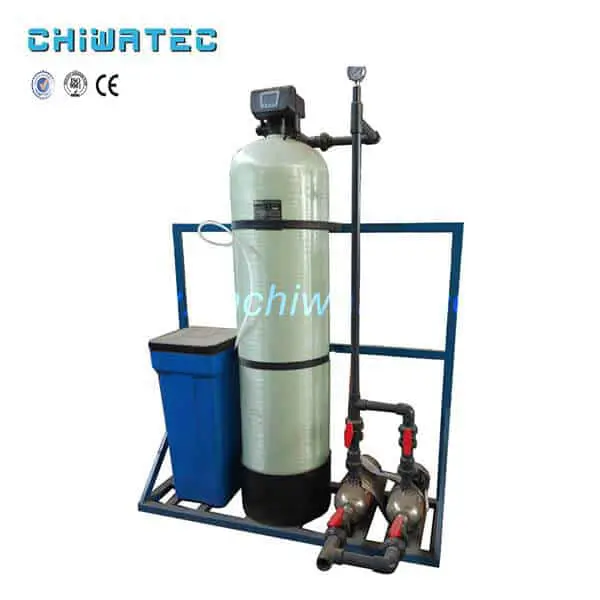
Water softeners use ion exchange technology to replace calcium (Ca²⁺) and magnesium (Mg²⁺) ions with sodium (Na⁺) ions, reducing water hardness to below 70 mg/L (as CaCO₃).
Chemical reaction: 2R-Na + Ca²⁺ → R₂-Ca + 2Na⁺ (where R represents resin matrix)
Advantages of Soft Water
- Scale prevention: Protects water heaters, boilers, central AC systems from limescale buildup
- Enhanced cleaning: Soap lathers better, reduces detergent consumption by 30-50%
- Skin and hair benefits: Softer skin, shinier hair, reduced soap residue
- Appliance protection: Prevents shower head clogging, extends appliance lifespan
- Energy savings: Scale-free heating elements operate 15-20% more efficiently
- Large flow rate: Minimal pressure drop, suitable for whole-house applications
Limitations of Soft Water
- Not for drinking: Elevated sodium content unsuitable for direct consumption (especially for hypertension patients)
- Does not remove contaminants: Bacteria, viruses, organic matter, heavy metals remain in water
- Requires salt: Periodic regeneration consumes salt (typically 1-2 kg per regeneration cycle)
- Wastewater generation: Regeneration produces 50-100 liters of brine wastewater
How to Choose a Water Softener
| Component | Options | Recommendation |
|---|---|---|
| Válvula de control | Time-type, Flow-type, Time-Flow hybrid | Flow-type or hybrid (regenerates based on actual usage) |
| Brand (Imported) | Fleck, Autotrol, Clack, Kinetico | Higher cost, superior reliability (10+ year life) |
| Brand (Domestic CN) | Runxin, Canature, Fulin | Cost-effective, adequate for most applications |
| Resina | Imported vs. Domestic | Imported resin (Dow, Purolite) offers better crush resistance, longer life |
| Tank Material | FRP (fiberglass) vs. Stainless steel | FRP tanks (corrosion-resistant, seamless winding) |
| Safety Features | Overflow protection, Bypass valve | Essential for leak prevention and maintenance |
Pure Water (RO): Characteristics and Applications
RO Pure Water Machine Working Principle
Reverse osmosis (RO) systems use multi-stage filtration (typically 5+ stages) with RO membrane (0.0001 μm pore size) as the core component, removing 95-99% of dissolved solids, bacteria, viruses, and organic contaminants.
Typical RO System Stages
- PP Cotton (5 μm): Removes sediment, rust, suspended particles
- Granular Activated Carbon (GAC): Removes chlorine, taste, odor, organic chemicals
- Carbon Block (CTO): Further chlorine removal, protects RO membrane
- RO Membrane (0.0001 μm): Removes 95-99% TDS, heavy metals, bacteria, viruses
- Post-Carbon (T33): Polishes taste, optional remineralization
Advantages of RO Pure Water
- Highest purity: Removes virtually all contaminants including dissolved salts, heavy metals, microorganisms
- Direct drinking: Safe for consumption without boiling
- Excellent taste: Clean, neutral taste ideal for tea, coffee, cooking
- Medical suitability: Recommended for patients with liver disease, kidney disease, cancer (reduced mineral load)
- Universal application: Effective across all water quality conditions
Limitations of RO Systems
- Limited capacity: Daily production 50-400 GPD (gallons per day), suitable for drinking/cooking only
- Regular maintenance: Pre-filters require replacement every 6-12 months, RO membrane every 2-3 years
- Wastewater ratio: Traditional RO produces 2-4 liters waste per 1 liter pure water (new high-efficiency membranes achieve 1:1 ratio)
- Requires electricity: Pressure pump needs power (typical consumption 30-100W)
How to Choose an RO Pure Water Machine
- Origin verification: Imported units (USA) typically have better build quality and sanitary design
- Pump quality: Imported pumps (low noise, 5+ year life) vs. domestic (louder, shorter lifespan)
- Solenoid valve: Prefer solenoid over mechanical valves (reliable, leak-free operation)
- Filter housing: Thick-walled bottles with reinforced bases (burst-resistant)
- Fittings: Quick-connect fittings (imported) vs. threaded connections (prone to leaks)
- Membrane brand: Dow Filmtec, Hydranautics, Toray (proven performance and longevity)
Ultrafiltration (UF) Water Purifiers: Middle Ground Option
UF Working Principle
Ultrafiltration uses hollow fiber membranes with 0.01 μm pore size to physically separate contaminants through size exclusion, removing sediment, rust, suspended matter, colloids, bacteria, viruses, and macromolecular organic matter.
UF Advantages
- High filtration accuracy: 0.01 μm removes bacteria and viruses
- Mineral retention: Allows beneficial minerals to pass through (close to mineral water quality)
- Direct drinking: Safe for consumption in low-to-medium hardness areas
- Large flow rate: No pressure drop, suitable for whole-kitchen use
- Long filter life: 3-5 years with periodic backwashing
- No electricity: Operates on water pressure alone
- No wastewater: 100% water utilization efficiency
UF Limitations
- Poor scale removal: Does not reduce hardness (Ca²⁺, Mg²⁺ pass through)
- No TDS reduction: Dissolved salts remain in water
- Water quality dependency: Best suited for areas with hardness <250 mg/L and TDS <300 mg/L
2026 Water Treatment Technology Trends
Latest innovations in residential water treatment:
- Smart monitoring: IoT-enabled systems with TDS monitoring, filter life tracking, and leak detection alerts via smartphone apps
- High-efficiency RO membranes: 50-75% recovery rates (vs. traditional 25-35%), reducing wastewater by 50%+
- UV-LED disinfection: Mercury-free, long-life (10,000+ hours) final disinfection stage
- Remineralization cartridges: Add calcium, magnesium, potassium back to RO water for balanced pH and taste
- Modular quick-change filters: Tool-free filter replacement in seconds, reduced service time
- Tankless design: Direct-flow RO systems eliminate storage tank, reducing footprint and bacterial growth risk
Frequently Asked Questions (FAQ)
Can I drink soft water directly?
No, soft water is not recommended for direct drinking. While safe for bathing and cleaning, the ion exchange process adds sodium to water (20-50 mg/L increase), making it unsuitable for people with hypertension, heart disease, or kidney problems. Use RO or UF purifiers for drinking water.
Is RO water too pure? Does it lack beneficial minerals?
RO removes minerals, but you get most minerals from food, not water. A balanced diet provides adequate calcium and magnesium. If concerned, choose RO systems with remineralization cartridges that add beneficial minerals back for pH balance and improved taste.
How much does a whole-house water treatment system cost?
Typical costs: Central softener $500-2,000, whole-house carbon filter $300-1,500, under-sink RO $200-800, installation $200-500. Annual operating costs (filters, salt, electricity) range $100-300. Total 5-year cost typically $1,500-4,000, more economical than bottled water.
How often should I replace filters?
Replacement schedules: PP cotton every 3-6 months, activated carbon 6-12 months, RO membrane 2-3 years, UF membrane 3-5 years, softener resin 5-10 years. Smart systems with filter life indicators provide accurate replacement alerts based on actual usage.
Does boiling water replace the need for purification?
No. Boiling kills bacteria and viruses but does NOT remove heavy metals, dissolved salts, chemicals, pesticides, or pharmaceutical residues. RO or UF purification provides comprehensive contaminant removal that boiling cannot achieve.
What's the wastewater ratio for RO systems?
Traditional RO systems produce 2-4 liters of wastewater per 1 liter of pure water (25-35% recovery). New high-efficiency membranes achieve 50-75% recovery (1:1 to 1:3 waste ratio). Wastewater can be collected for cleaning, mopping, or plant watering.
Can I install a water treatment system myself?
Under-sink RO and UF purifiers are DIY-friendly with basic plumbing skills. Whole-house softeners and central filtration systems require professional installation for proper sizing, plumbing connections, electrical wiring, and drain configuration.
Conclusion: Choosing the Right Water Treatment Solution
Selecting between soft water and pure water depends on your specific needs:
- ✓ For bathing, laundry, appliance protection: Choose water softener (removes hardness, prevents scale)
- ✓ For direct drinking and cooking: Choose RO pure water machine (highest purity, removes all contaminants)
- ✓ For low-hardness areas, mineral retention: Choose UF water purifier (keeps minerals, removes bacteria)
- ✓ For whole-house comprehensive treatment: Combine central softener + RO purifier (best of both worlds)
- ✓ For budget-conscious solutions: Start with under-sink RO for drinking, add softener later if scaling issues arise
Need expert guidance? CHIWATEC provides customized water treatment solutions for residential, commercial, and industrial applications. Our water treatment specialists can assess your water quality, recommend optimal system configurations, and provide comprehensive installation and maintenance support. Contact us for a free consultation and quote.
Related Resources
¿Tiene un proyecto de tratamiento de agua con el que podamos ayudar?
* Diseño, mecanizado, instalación, puesta en marcha, personalización y servicio integral






 Spanish
  English
  Portuguese




