Water Treatment Methods and Principles (1)
Water treatment is the foundation of all industrial, municipal, and medical water systems. Understanding the core principles and mechanisms of each treatment method ensures stable operation of reverse osmosis (RO) systems, prevents membrane fouling, and protects users from health risks.
This article explains the four most widely used water treatment methods—deionization, water softening, activated carbon adsorption, and sediment filtration—based on their scientific principles and engineering applications.
1. Water Treatment Methods and Principles of Deionization (DI)
What is Deionization?
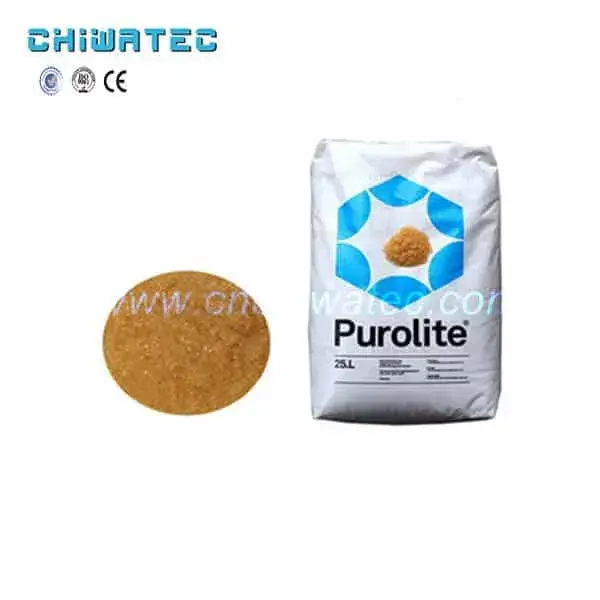
Deionization (DI) removes dissolved inorganic ions from water using resinas de intercambio iónico. Unlike simple filtration, DI eliminates ionic species that pass through physical filters and RO membranes under certain conditions.
How DI Ion Exchange Works
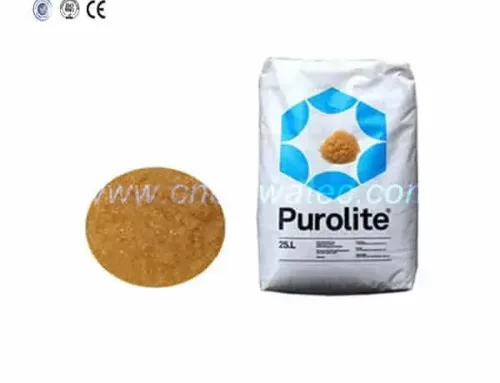
Two specialized resins are used:
- Cation exchange resin (H⁺ type) — exchanges calcium, magnesium, sodium, iron, and other cations with H⁺ ions
- Anion exchange resin (OH⁻ type) — exchanges chloride, nitrate, sulfate, fluoride and other anions with OH⁻ ions
The released H⁺ y OH⁻ ions combine to form pure water:
Cation Exchange Reaction:
Mⁿ⁺ + n(H–Resin) → M–Resinₙ + nH⁺
Anion Exchange Reaction:
Aⁿ⁻ + n(OH–Resin) → A–Resinₙ + nOH⁻
H⁺ + OH⁻ = H₂O
Resin Selectivity (Affinity Strength)
Cation affinity:
Ba²⁺ > Pb²⁺ > Sr²⁺ > Ca²⁺ > Ni²⁺ > Cd²⁺ > Cu²⁺ > Co²⁺ > Zn²⁺ > Mg²⁺ > Ag⁺ > Cs⁺ > K⁺ > NH₄⁺ > Na⁺ > H⁺
Anion affinity:
SO₄²⁻ > I⁻ > NO₃⁻ > NO₂⁻ > Cl⁻ > HCO₃⁻ > OH⁻ > F⁻
This explains why weakly adsorbed ions like fluoride can break through if the resin is exhausted.
Why Regeneration Is Needed
Once the resin is saturated:
- Cation resin must be regenerated using strong acid
- Anion resin must be regenerated using strong alkali
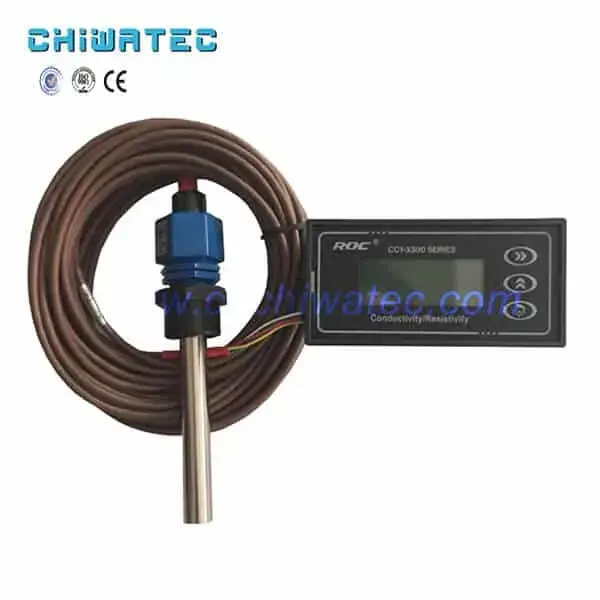
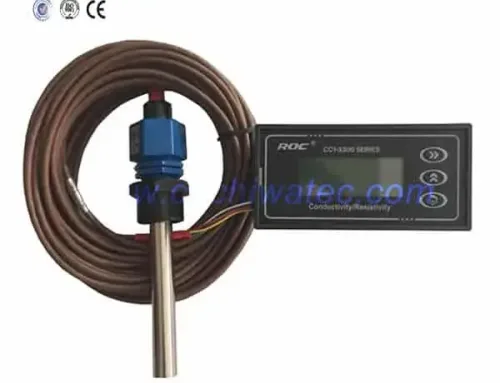
Monitoring is typically done by conductivity or resistivity meters.
Risks of Improper DI Maintenance
If not maintained:
- Fluoride breakthrough → bone disease (rickets, osteoporosis)
- H⁺ breakthrough → acidic water, corrosion
- Biofilm growth inside resin bed → bacteremia risk in medical applications
2. Water Treatment Method and Principle of Hard Water Softening
Hardness in water comes mainly from calcium (Ca²⁺) y magnesium (Mg²⁺) ions. Excessive hardness causes:
- Scaling in boilers and heat exchangers
- Severe fouling on RO membranes
- Hard-water syndrome in medical applications
How Water Softening Works
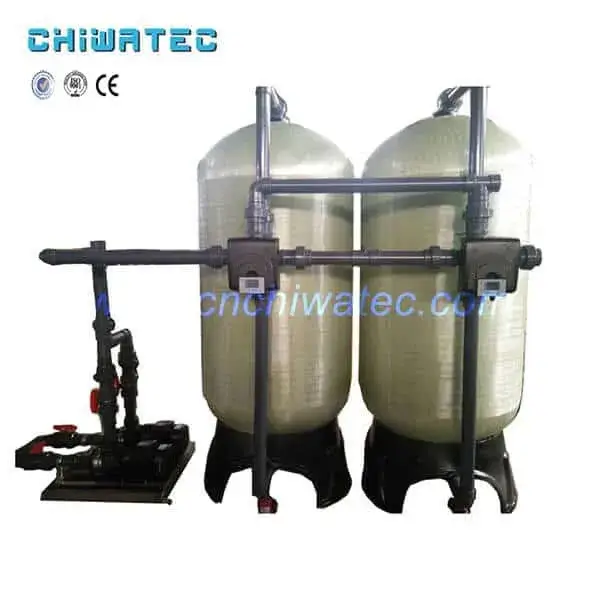
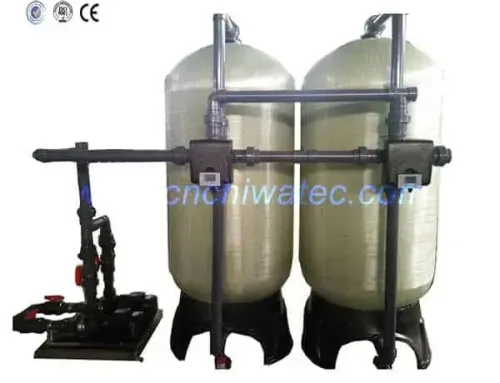
Softening uses cation exchange resins (Na⁺ type) to replace Ca²⁺ and Mg²⁺ ions with Na⁺ ions:
Ca²⁺ + 2Na–Resin → Ca–Resin₂ + 2Na⁺
Mg²⁺ + 2Na–Resin → Mg–Resin₂ + 2Na⁺
Regeneration with Salt (Brine)
When Na⁺ is consumed, resin is regenerated using 10% brine solution:
Ca–Resin₂ + 2Na⁺ → Na–Resin₂ + Ca²⁺
Mg–Resin₂ + 2Na⁺ → Na–Resin₂ + Mg²⁺
Why Softening Is Critical Before RO
Without softening:
- Scaling destroys RO membranes
- Energy consumption increases
- Recovery decreases
- Membrane lifespan shortens
Risks
- Resin bed promotes bacterial growth → requires periodic backwash
- Hypernatremia risk if brine valve malfunctions in medical systems
Without softening:
- Scaling destroys RO membranes
- Energy consumption increases
- Recovery decreases
- Membrane lifespan shortens
Risks
- Resin bed promotes bacterial growth → requires periodic backwash
- Hypernatremia risk if brine valve malfunctions in medical systems
3. Water Treatment Method and Principle of Activated Carbon Filtration
Activated carbon is essential for removing:
- Chlorine and chloramine
- Organic chemicals (MW 60–300 Da)
- Taste, odor, and color-causing compounds
How Activated Carbon Works
Through:
- Physical adsorption (porous structure 700–1400 m²/g)
- Chemical reduction (especially chlorine → chloride)
Why Activated Carbon Is Needed Before RO
Many RO membranes cannot tolerate chlorine. Activated carbon prevents oxidative damage by removing chlorine before RO.
Limitations
- Adsorption saturation → downstream contamination if not replaced
- High bacterial growth potential inside pores
- Limited capacity for removing high-molecular organics → must be paired with RO
When to Replace Carbon
Check:
- TOC removal efficiency
- Chlorine breakthrough
- Bacterial count increase
- Pressure drop
4. Water Treatment Method and Principle of Sediment Filtration
Sediment filtration removes suspended solids, colloid particles, and large impurities that can damage RO membranes.
Common Types of Sediment Filters
- Mesh (screen) filters
- Sand / quartz media filters
- Cartridge filters (PP, melt-blown, pleated)
- Membrane filters (1–5 micron)
How Sediment Filtration Works
Particles larger than the filter pore size are trapped. Dissolved ions, however, cannot be removed.
Maintenance
- Backwash regularly
- Replace cartridges when inlet-outlet pressure difference increases 5×
- Prevent bacterial growth inside filter housing
Sediment filtration is usually the first stage of a complete purification line, protecting carbon filters, softeners, and RO membranes.
Conclusión
Understanding the principles behind water treatment methods—deionization, softening, activated carbon adsorption, and sediment filtration—is essential for designing stable and efficient industrial and medical water systems.
A well-designed multi-stage pretreatment chain prevents RO membrane fouling, improves water purity, reduces operational costs, and extends system lifespan.
For advanced RO and pretreatment systems, explore CHIWATEC’s full product range:
👉 CHIWATEC Water Treatment Equipment & Solutions
FAQ
Q1: What is the difference between deionization and softening?
DI removes all ions, while softening removes only hardness ions (Ca²⁺, Mg²⁺).
Q2: Why is activated carbon necessary before RO?
It removes chlorine, which otherwise causes irreversible damage to polyamide RO membranes.
Q3: How do I know when to replace carbon or resin?
Monitor conductivity, chlorine breakthrough, TOC levels, and pressure drop.
Q4: Is sediment filtration enough for water purification?
No. It removes only large particles; dissolved ions, organics, or chlorine require additional treatment.
Q5: What is the ideal pretreatment sequence before RO?
Typically:
Sediment Filter → Activated Carbon → Softener → Cartridge Filter → RO
Xian CHIWATEC Water Treatment Technology es una empresa de alta tecnología especializada en varios dispositivos de procesamiento de agua. Aparte de estos productos individuales, que cubren una serie de tipos y series, también podemos ayudar con proyectos de ingeniería integrales relacionados. Gracias a nuestro arduo trabajo y dedicación desde nuestra fundación, ahora somos uno de los fabricantes de equipos de tratamiento de agua de más rápido desarrollo en el oeste de China.
Otras lecturas:
SÍGANOS
¿Tiene un proyecto de tratamiento de agua con el que podamos ayudar?
* Diseño, mecanizado, instalación, puesta en marcha, personalización y servicio integral
 Spanish
  English
  Portuguese