FRP Water Treatment Tank: 2026 Complete Guide to Large FRP Tank Structure and Advantages
Is your water treatment system struggling with storage tank corrosion, leakage, or limited capacity? FRP (Fiberglass Reinforced Plastic) large water tanks offer a superior solution for water storage in treatment systems, combining durability with cost-effectiveness. The direct answer is: an FRP water treatment tank provides lightweight, corrosion-resistant, high-strength water storage with a service life of 20–30 years — far exceeding steel tanks (10–15 years) and concrete tanks (15–20 years). The global FRP tank market for water and wastewater applications was valued at USD 3.2 billion in 2024 and is projected to reach USD 5.4 billion by 2034 (Grand View Research), driven by the growing demand for durable, maintenance-free water storage infrastructure in municipal and industrial water treatment. CHIWATEC incorporates high-quality FRP water tanks into complete water treatment system designs, ensuring reliable storage integration for RO, EDI, and wastewater applications.
What Is an FRP Water Treatment Tank?
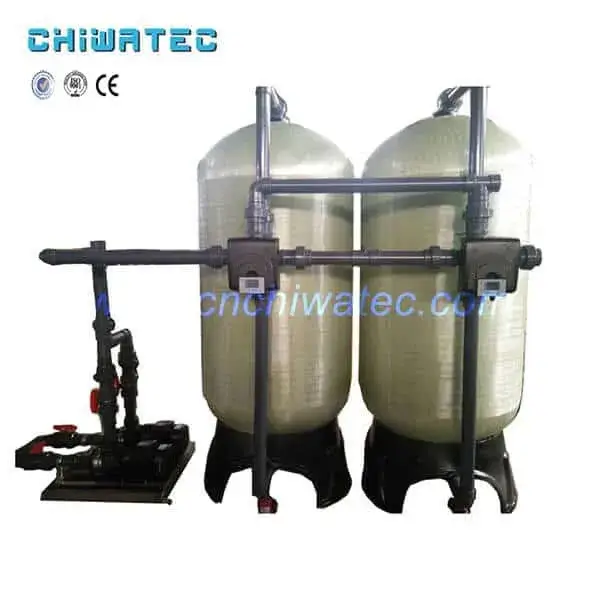
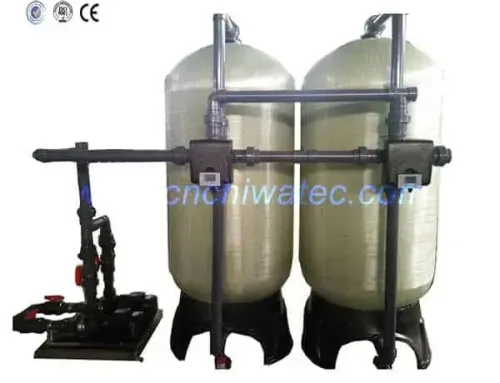
An FRP (Fiberglass Reinforced Plastic) water treatment tank is a large-capacity storage vessel manufactured using fiberglass reinforcement and polyester or vinyl ester resin. These tanks are widely used in water treatment systems for storing raw water, treated water, backwash water, and chemical solutions:
- Material composition — FRP tanks consist of glass fibers (providing tensile strength) embedded in a thermosetting resin matrix (providing chemical resistance and shape). The combination creates a composite material that is stronger than steel on a weight-for-weight basis while being completely immune to rust and electrochemical corrosion.
- Manufacturing process — Large FRP tanks are typically manufactured using filament winding technology, where continuous glass fiber strands are wound under tension around a rotating mandrel and impregnated with resin. This produces a tank wall with exceptional hoop strength and consistent wall thickness. SMC (Sheet Molding Compound) compression molding is used for smaller, standardized tank sections.
- Standard specifications — FRP water treatment tanks range from small pressure vessels (diameter 200–1500 mm for filter housings) to large atmospheric storage tanks (5–500 m³ capacity). Wall thickness is designed per ASME RTP-1 or BS 4994 standards based on the specific gravity and operating temperature of the stored liquid.
Structure Display: Key Components of FRP Large Water Tanks
The structure of a large FRP water treatment tank consists of several engineered components working together to provide reliable water storage:
| Component | Material | Función |
|---|---|---|
| Tank wall (shell) | Filament-wound FRP laminate | Primary structural component; resists internal pressure, wind load, and seismic forces |
| Inner liner / corrosion barrier | C-glass veil + resin-rich layer (2–4 mm) | Prevents chemical attack from stored water; ensures zero leakage and water quality protection |
| Top dome / roof | FRP dome or flat panel with structural ribs | Encloses the tank; dome shape provides optimal pressure distribution for pressurized systems |
| Bottom / base | Flat FRP plate with glass reinforcement | Supports the tank weight; transfers load to foundation |
| Manway / access port | FRP flanged opening with gasketed cover | Provides access for internal inspection, cleaning, and maintenance |
| Nozzles and connections | FRP or stainless steel flanged inserts | Inlet, outlet, overflow, drain, and instrument connections integrated during winding |
| External stiffening ribs | FRP overwrapped or bonded ribs | Increase tank rigidity for large-diameter vessels without increasing wall thickness |
This multi-layer construction gives FRP tanks their characteristic advantages of light weight, high strength, and excellent corrosion resistance.
Advantages of FRP Water Treatment Tanks
FRP water treatment tank systems offer several distinct advantages over traditional construction materials:
- Light weight — FRP tanks weigh approximately 1/4 to 1/3 of equivalent steel tanks and 1/10 of concrete tanks. A typical 50 m³ FRP tank weighs 2–3 tons, compared to 8–10 tons for steel and 20–25 tons for concrete. This significantly reduces foundation requirements and installation crane costs.
- High strength — The specific tensile strength of FRP (strength-to-weight ratio) exceeds that of structural steel. Filament-wound FRP tanks can be designed for pressures up to 10 bar for water treatment applications.
- Corrosion resistance — FRP is completely immune to galvanic corrosion, rust, and chemical attack from potable water, wastewater, and most chemical solutions used in water treatment (pH 1–13 with appropriate resin selection). This eliminates the need for internal coatings or cathodic protection systems required for steel tanks.
- Impact and bending resistance — The fiber reinforcement provides excellent resistance to impact damage and bending loads. FRP tanks can withstand site handling and transportation stresses that would dent or deform steel tanks of equivalent wall thickness.
- Easy installation — The light weight and modular construction of FRP tanks enable rapid installation. Large tanks can be delivered in sections and assembled on-site using adhesive joint systems, reducing installation time by 50–70% compared to field-welded steel tanks.
- Low maintenance — FRP tanks require no painting, no internal coatings, and no cathodic protection. The smooth internal surface resists biofilm growth and scale deposition, reducing cleaning frequency. For maintenance best practices, see the instruction manual for purified water production equipment for general water system care.
- No leakage — The monolithic construction (no welded seams) of filament-wound FRP tanks eliminates leakage paths. When properly installed, FRP tanks exhibit zero leakage over their entire service life.
Applications of FRP Tanks in Water Treatment Systems
Large FRP water tanks serve multiple critical roles in water treatment processes:
- Raw water storage — Holding untreated source water (groundwater, surface water, municipal supply) before treatment. FRP tanks prevent iron and manganese precipitation that can occur in steel tanks from corrosion byproducts.
- Treated water storage — Storing purified water (RO permeate, EDI product water) before distribution. The inert FRP surface maintains water quality without leaching metal ions.
- Backwash water tanks — Storing water for filter backwashing in multi-media filtration systems. FRP tanks handle the cyclic loading from frequent filling and emptying without fatigue failure.
- Chemical storage — Holding treatment chemicals (antiscalants, coagulants, acids, bases, sodium hypochlorite) for chemical dosing systems. Proper resin selection ensures compatibility with aggressive chemicals. For more on chemical treatment, see what KDF is used for in water treatment.
- Brackish water and desalination — FRP tanks are widely used in brackish water RO and desalination systems for concentrate storage and feed water equalization. See desalination methods for brackish water: reverse osmosis method for process details.
- Mineral water production — In bottled water and mineral water plants, FRP tanks provide sanitary storage that meets food-grade requirements. Refer to key hygiene issues in mineral water production for quality standards.
Installation and Foundation Requirements
Proper installation is critical for maximizing the service life of FRP water treatment tank systems:
- Foundation — The tank must be installed on a level, reinforced concrete foundation capable of supporting the full operating weight (tank + water). A typical 50 m³ FRP tank requires a foundation of 150–200 mm reinforced concrete with a smooth trowel finish.
- Anchoring — In seismic zones or high-wind areas, FRP tanks must be anchored to the foundation using FRP hold-down straps or stainless steel anchor bolts with large bearing plates to distribute the load without damaging the tank bottom.
- Pipe connections — Flexible couplings or expansion joints should be used at all tank connections to accommodate thermal expansion and minor settlement without transferring stress to the tank wall.
- Overflow and venting — Atmospheric FRP tanks require properly sized overflow lines and vent openings to prevent vacuum collapse during draining or pressure buildup during filling.
- Insulation (optional) — In cold climates, FRP tanks can be insulated with closed-cell foam and a weatherproof jacket. The low thermal conductivity of FRP (0.2–0.3 W/m·K) means less insulation is needed compared to steel tanks.
For a comparison of different desalination methods where FRP tanks are commonly deployed, see desalination methods for brackish water: distillation and electrodialysis.
FRP Tank Maintenance and Inspection
While FRP water treatment tanks require significantly less maintenance than steel or concrete alternatives, regular inspection is essential:
- Visual inspection — Annually inspect the exterior for signs of impact damage, UV degradation (chalking, discoloration), or stress cracking. Pay particular attention to nozzle areas and support points where stress concentration is highest.
- Internal inspection — Every 3–5 years, drain the tank and perform an internal visual inspection of the corrosion barrier and liner. Look for blistering, cracking, or delamination. Minor surface blisters can be repaired by grinding and applying a resin patch.
- Water quality monitoring — Sample stored water quarterly for taste, odor, color, and bacteriological parameters. Any unexplained deterioration in water quality may indicate a failing internal liner that requires repair.
- UV protection — If the tank is installed outdoors without UV-resistant gel coat, apply a UV-protective coating every 5–7 years to prevent fiber bloom (exposed fibers on the surface due to resin degradation from sunlight).
- Leak testing — If leakage is suspected, perform a hydrostatic test at 1.2 times the design pressure. FRP tanks rarely develop leaks unless physically damaged.
For safe drinking water applications, also see combating arsenic contamination: advanced technologies for safe drinking water, which FRP tanks can help address through corrosion-free storage.
Frequently Asked Questions (FAQ)
How long does an FRP water treatment tank last?
With proper installation and regular inspection, FRP water treatment tanks have a service life of 20–30 years. Some installations have operated for over 40 years with only minor cosmetic maintenance. This significantly exceeds the 10–15 year lifespan of coated steel tanks in water treatment service.
Can FRP tanks be repaired if damaged?
Yes. FRP tanks can be repaired on-site by grinding out the damaged area and applying a patch laminate using the same resin system. Small cracks, impact damage, and localized delamination are all repairable. Repair costs are typically 10–20% of replacement cost.
Are FRP water tanks safe for drinking water storage?
Yes. FRP tanks manufactured with FDA-approved resin systems and food-grade inner liners comply with NSF/ANSI 61 and AS/NZS 4020 standards for potable water contact. The inert FRP surface does not leach metals or chemicals into the stored water.
What is the maximum size of an FRP water treatment tank?
FRP tanks can be manufactured in sizes from small pressure vessels (50 liters) to large atmospheric storage tanks of 500 m³ or more. Tanks above 100 m³ are typically field-assembled from modular sections using adhesive-bonded joints.
How does the cost of FRP tanks compare to steel or concrete?
For tanks up to 100 m³, FRP tanks are generally 10–20% more expensive than coated carbon steel but 30–50% less expensive than stainless steel. When factoring in the longer service life and zero maintenance costs of FRP, the lifecycle cost is typically 20–30% lower than steel tanks. For comprehensive water treatment system design, CHIWATEC provides integrated tank and treatment equipment packages.
Conclusion & Call to Action
An FRP water treatment tank offers the optimal combination of light weight, corrosion resistance, high strength, and long service life for water storage in municipal and industrial water treatment systems. With careful consideration of structural design, material selection, installation requirements, and maintenance protocols, FRP tanks provide reliable, cost-effective water storage for decades.
For expert guidance on selecting, sizing, and integrating FRP water treatment tanks into your water treatment system, contact CHIWATEC today at [email protected] o [email protected].
Related Resources and Further Reading
- Desalination Methods for Brackish Water (2): Reverse Osmosis Method
- Desalination Methods for Brackish Water (1): Distillation and Electrodialysis
- Key Hygiene Issues in Mineral Water Production
- Manual de Instrucciones para Equipos de Producción de Agua Purificada
- RO Water Treatment System Product Range 2026 » CHIWATEC
¿Tiene un proyecto de tratamiento de agua con el que podamos ayudar?
* Diseño, mecanizado, instalación, puesta en marcha, personalización y servicio integral

 Spanish
  English
  Portuguese