

PP Filter Cartridge: Complete Guide to Polypropylene Sediment Filters for Water Treatment
Discover everything about PP filter cartridges — the most widely used sediment filtration solution for residential, commercial, and industrial water treatment applications.
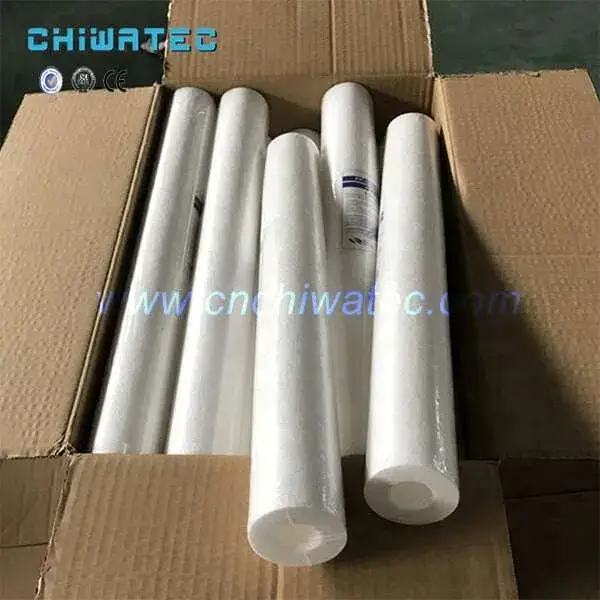
PP filter
los PP filter cartridge (polypropylene sediment filter) is one of the most fundamental and widely used filtration components in water treatment systems worldwide. The global sediment filter market, dominated by PP filters, was valued at approximately USD 3.2 billion in 2023 and is projected to reach USD 5.1 billion by 2032, growing at a CAGR of 5.3% (Market Research Future, 2024).
PP filter cartridges are manufactured from non-toxic, odorless polypropylene resin through a melt-blown process: polypropylene is heated to its melting point, extruded through precision spinnerets, and blown by high-velocity hot air onto a rotating collection core. This process creates a graded-density (depth) filtration structure with progressively finer pores from the outer surface to the inner core:
- Outer layer: Coarser pores (20–100 µm) — traps larger particles first
- Middle layer: Transitional pores (5–20 µm) — captures medium particles
- Inner/core layer: Fine pores (1–5 µm) — final polishing for small particles
This graded-density design maximizes dirt-holding capacity by distributing particle capture throughout the filter depth rather than only on the surface. PP filters effectively remove: suspended solids, sediment, sand, silt, rust particles, pipe scale, and other insoluble impurities from water.
Features of PP filter element:
Key Features of PP Filter Cartridges
- High filtration efficiency (≥98%): The graded pore structure bridges particles smaller than the rated pore size, achieving >98% removal efficiency at the rated micron rating. The dense outer-to-inner structure provides depth filtration for maximum dirt-holding capacity.
- Excellent chemical purity: Made from FDA-grade polypropylene with no binders, adhesives, or surfactants. PP filters are non-toxic and non-polluting to water quality, meeting NSF/ANSI 42 certification requirements for sediment reduction.
- Broad chemical compatibility: Resistant to acids, alkalis, and organic solvents across a pH range of 1–14. Compatible with most water treatment chemicals including chlorine, ozone, and antiscalants.
- High mechanical strength: The melt-blown structure provides excellent structural integrity. PP cartridges withstand differential pressures up to 0.4 MPa (4 bar, 58 psi) without deformation or collapse.
- Long service life: The depth filtration design provides 2–3× higher dirt-holding capacity than surface-type filters of equivalent micron rating, reducing replacement frequency.
- Thermal stability: Continuous operating temperature up to 60°C (140°F), with peak tolerance to 80°C (176°F) for short durations.
PP Filter Cartridge Specifications and Standard Sizes
PP filter cartridges are manufactured in standardized dimensions for compatibility with virtually all commercial filter housings:
| Parámetro | Common Options |
|---|---|
| Longitud | 10″ (254 mm), 20″ (508 mm), 30″ (762 mm), 40″ (1016 mm) |
| Outer diameter | 2.5″ (63 mm) standard, 4.5″ (115 mm) big blue |
| Inner diameter | 1.0″ (28 mm) standard, 0.75″ (19 mm) for smaller housings |
| Micron ratings | 1, 5, 10, 20, 50, 100 µm (5 µm and 10 µm most common) |
| Max operating temp | 60°C continuous / 80°C peak |
| Max differential pressure | 0.4 MPa (4 bar / 58 psi) |
| Max flow rate (10″) | 5–10 LPM (1.3–2.6 GPM) depending on micron rating |
| Certifications | NSF/ANSI 42, FDA CFR Title 21 compliance |
Types of PP Filter Cartridges
Melt-Blown PP Filters (Standard)
The most common type, manufactured by the melt-blowing process described above. Available in 1–100 µm ratings. Best for general-purpose sediment removal in residential and commercial water filtration systems.
String-Wound PP Filters
Made by winding polypropylene yarn around a central core in a diamond or crisscross pattern. Provides depth filtration with high dirt-holding capacity but higher pressure drop. Ideal for high-turbidity applications and as pre-filters before finer cartridges.
Pleated PP Filters
Pleated polypropylene microfiber media provides 3–5× greater surface area than equivalent melt-blown filters, resulting in higher flow rates and longer service life. Available in finer ratings (0.5–5 µm). Used in pharmaceutical, food & beverage, and high-purity applications.
Applications of PP Filter Cartridges in Water Treatment
Residential Water Filtration
PP filters are the first stage in most under-sink and whole-house filtration systems, removing sediment, rust, and sand before carbon filters or RO membranes. A standard 10″ × 2.5″ PP filter can treat 15,000–30,000 gallons before replacement (depending on feed water quality).
Commercial and Industrial Pretreatment
In restaurants, hotels, hospitals, and manufacturing facilities, PP filter cartridges protect downstream equipment (boilers, cooling towers, RO systems, dishwashers) from particulate damage. Industrial applications use 20″ and 40″ cartridges in multi-housing arrays for high-flow applications.
RO System Pretreatment
PP sediment filters are the critical first line of defense for RO systems, typically installed as a 5 µm pre-filter to protect RO membranes from particulate fouling. Replacing PP filters on schedule is the single most effective way to extend RO membrane life.
Chemical and Process Filtration
Due to their broad chemical compatibility (pH 1–14), PP filters are widely used in chemical processing, electroplating, and pharmaceutical manufacturing for filtering acids, alkalis, solvents, and process water.
PP Filter vs. Other Filter Cartridge Types
| Feature | PP Filter | Activated Carbon | String-Wound |
|---|---|---|---|
| Primary function | Sediment removal | Chemical adsorption | Deep sediment removal |
| Micron range | 1–100 µm | 5–50 µm | 1–100 µm |
| Chemical compatibility | Excellent (pH 1–14) | Good (pH 2–12) | Good (pH 2–12) |
| Dirt-holding capacity | High (depth) | Moderate (surface + adsorption) | Very high (depth) |
| Cost | Low | Medium | Low–Medium |
| Best for | General sediment, RO pretreat | Chlorine, taste, odor removal | High-turbidity water |
Frequently Asked Questions About PP Filter Cartridges
What is the difference between 1 µm, 5 µm, and 10 µm PP filters?
The micron rating indicates the particle size that the filter can retain. A 5 µm filter captures particles ≥5 µm in size (visible only under microscope). 1 µm provides finer filtration but may clog faster. 10 µm is coarser with higher flow rate. For RO pretreatment, 5 µm is the standard recommendation.
How often should PP filter cartridges be replaced?
Replacement frequency depends on feed water quality and usage. Typical intervals: 3–6 months for residential systems, 1–3 months for commercial applications with high sediment loads. Replace when the pressure differential across the filter reaches 0.15–0.2 MPa (15–30 psi) or at the first sign of flow reduction.
Can PP filters be cleaned and reused?
PP melt-blown filters are designed for single use and disposal — they cannot be effectively cleaned due to their depth-filtration structure. However, pre-rinse or string-wound filters can sometimes be partially cleaned by backflushing. Replacement is always the recommended practice for consistent water quality.
Are PP filter cartridges safe for drinking water?
Yes. High-quality PP filter cartridges are manufactured from FDA-grade polypropylene and are NSF/ANSI 42 certified for drinking water applications. They contain no binders, adhesives, or leaching additives that could contaminate water.
What is the correct direction of flow for a PP filter?
PP filters are directional — water should flow from outside to inside. The outer surface has coarser pores (pre-filtration), and the inner core has finer pores (final polishing). Installing backwards drastically reduces filter life and efficiency.
Further Reading
Explore these related articles for more information on filtration technology:
- Overview and Characteristics of PP Cotton Filter Element — Detailed technical overview of PP filter specifications and performance
- Ultrafiltration Water Treatment Systems — UF membrane technology for advanced particle and pathogen removal
- Bottled Water RO Treatment Systems — Complete RO systems that use PP filters as pretreatment
- Complete Guide to RO System Operation and Maintenance — RO system maintenance including filter replacement schedules
¿Tiene un proyecto de tratamiento de agua con el que podamos ayudar?
* Diseño, mecanizado, instalación, puesta en marcha, personalización y servicio integral






 Spanish
  English
  Portuguese




