Automatic Water Softener Systems: Complete Guide to Water Softening Equipment — FLECK, AUTOTROL & Kinetico Technology
Discover the world of automatic water softening equipment — from market-leading FLECK, AUTOTROL, and Kinetico multi-way valves to complete system design for residential, commercial, and industrial applications.
Water hardness affects more than 85% of households in North America and significant portions of Europe and Asia, with hard water regions experiencing calcium carbonate concentrations exceeding 200 mg/L (12+ gpg). The global water softener market was valued at approximately USD 12.8 billion in 2023 and is projected to reach USD 23.5 billion by 2032, growing at a CAGR of 7.0% (Grand View Research, 2024).
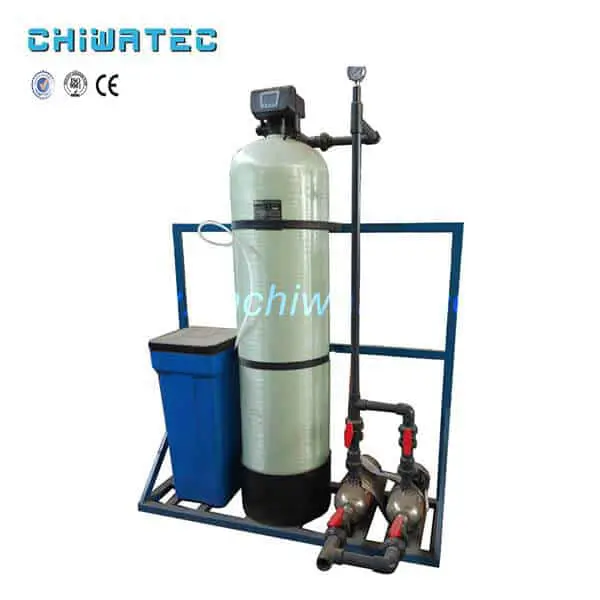
At the heart of this market are automatic water softening systems — complete sets of equipment controlled by advanced multi-valve systems from leading manufacturers including FLECK (Fuleck, USA), AUTOTROL (Atuzu, USA), and Kinetico (Concord, USA), alongside self-developed multi-valve control solutions. These automatic softeners deliver key advantages: convenient operation, cost savings, stable output water quality, and a high degree of automation that minimizes human intervention while maximizing system reliability.
US FLECK Multi-Way Valve — Industry Standard for Reliability
FLECK multi-way valves are the most widely adopted automatic control valves in the water softening industry. Key technical features include:
- Piston-type valve core design — superior hydraulic performance with exceptional strength, wear resistance, and corrosion resistance, rated for over 500,000 cycles
- Lead-free brass valve body — non-toxic, NSF/ANSI 61 certified for potable water contact, ensuring long service life and safety compliance
- Control modes: Time-controlled (meter delay regeneration) and flow-controlled (immediate or delayed regeneration based on actual water usage)
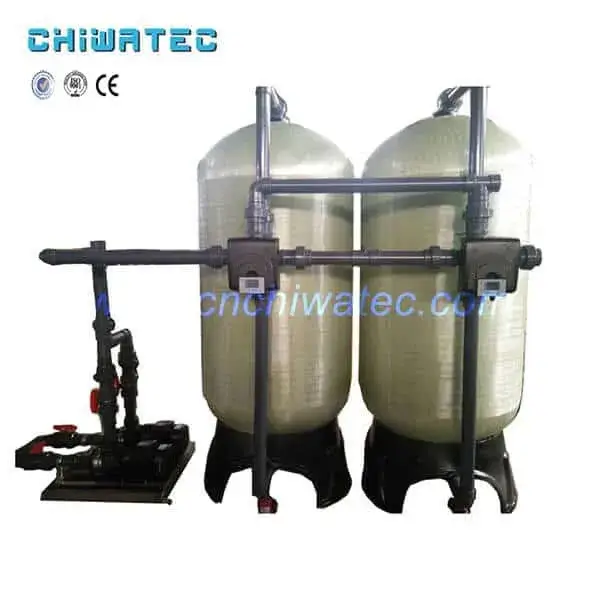
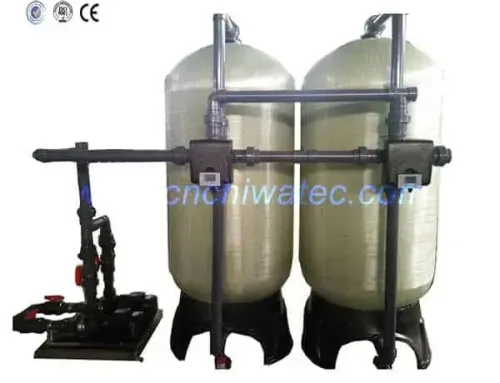
- System configurations: Single valve / single tank, single valve / twin tank (continuous water), twin valve / twin tank parallel, and large multi-valve / multi-tank series configurations
- Flow rate range: Capacities from 0.5 to 200+ tons/hour, serving residential, commercial, and industrial applications
FLECK controllers support meter-initiated regeneration with built-in bypass, making them ideal for applications where water usage varies significantly by season or production schedule.
US AUTOTROL Multi-Way Valve — Microprocessor Precision Control
AUTOTROL multi-way valves feature advanced microprocessor-based control for precision water softening management. The system operates through a sensor flowmeter installed on the outlet pipe that continuously monitors output water volume. Key operational features include:
- Real-time data collection: The flowmeter feeds water usage data to the embedded microprocessor, which calculates remaining capacity and predicts regeneration timing
- Intelligent servo control: The computer sends commands to the multi-way servo valve or solenoid valve for precise sequence control — backwashing, brine draw, slow rinse, fast rinse, and brine tank refill
- User-configurable parameters: Periodic water output settings, remaining volume display, hourly flow rate, per-cycle salt consumption, regeneration time, and current operating mode — all displayed on the interface
- Manual override capability: Fully automatic operation can be manually switched to manual regeneration at any time, providing flexibility for maintenance or emergency situations
- Adaptive optimization: The microcomputer can be field-programmed to optimize regeneration frequency based on actual water usage patterns, reducing salt and water consumption
AUTOTROL controls are particularly well-suited for commercial and industrial applications where precise tracking of water usage and chemical consumption is required for operational budgeting and compliance reporting.
Kinetico Multi-Way Valve — Non-Electric, Dual-Tank Continuous Operation
Kinetico multi-way valves occupy a unique position in the water softening market with their non-electric, hydraulic-powered operation. Key advantages include:
- No power supply required — eliminates electrical system failures, power outages, and simplifies installation. Ideal for remote locations and off-grid applications.
- Truly automatic operation — no programming, no setup. Users simply maintain the salt level in the brine tank. The system is genuinely “set and forget.”
- Dual-tank design — one tank in service while the other stands ready. This enables 24/7 continuous softened water supply with zero downtime during regeneration cycles.
- Flow-initiated regeneration — regeneration is triggered by actual water usage, not a timer, ensuring economical operation that adapts to consumption patterns automatically.
- Countercurrent (upflow) regeneration — uses softened water for the regeneration process, achieving lower salt consumption, reduced water usage, and higher quality effluent compared to co-current designs.
- Minimal maintenance — the simple mechanical design has an exceptionally low failure rate, with many units operating reliably for 15–20+ years without major service.
Kinetico systems are particularly recommended for residential and light commercial applications where simplicity, reliability, and continuous water availability are top priorities.
Automatic Water Softener Capacity Range and System Sizing
Automatic water softening equipment is available in a broad capacity range to suit diverse application needs:
- Small residential: 0.5–2.0 tons/hour (single tank, suitable for 1–6 person households)
- Large residential / small commercial: 2.0–10 tons/hour (restaurants, small hotels, laundromats)
- Commercial / light industrial: 10–50 tons/hour (apartment complexes, hospitals, schools)
- Industrial: 50–200+ tons/hour (power plants, boiler feed, food & beverage, pharmaceutical manufacturing)
Proper system sizing requires analysis of feed water hardness (measured in mg/L or gpg), peak flow rate (GPM or m³/h), and daily water consumption. Oversizing leads to inefficient regeneration; undersizing causes hardness breakthrough. CHIWATEC engineers provide custom sizing calculations for every installation.
Water Softener Market Overview: Why Automatic Systems Are Essential
Hard water is a global challenge with tangible economic and operational impacts:
- Scale buildup in pipes and appliances reduces heating efficiency by up to 48% and shortens equipment lifespan by 30–50% (Water Quality Association, 2024)
- US households with hard water spend an estimated $600–800/year extra on energy, detergent, and premature appliance replacement
- The global water softener market is projected to grow from USD 12.8B (2023) to USD 23.5B (2032), CAGR 7.0% — driven by rising awareness of water quality issues and industrial efficiency requirements
- Automatic softeners represent over 65% of new installations in commercial and industrial sectors, replacing manual and semi-automatic systems
Automatic water softening eliminates the need for manual regeneration scheduling, reduces chemical waste by optimizing salt usage, and provides consistent water quality regardless of fluctuations in raw water hardness.
Key Applications of Automatic Water Softening Equipment
Residential Water Softening
Automatic water softeners protect home plumbing systems, water heaters, dishwashers, and washing machines from scale accumulation. Softened water reduces soap consumption by 50–70% and improves bathing and laundry results.
Commercial Applications
Hotels, restaurants, hospitals, laundromats, and car washes rely on automatic softeners for scale-free operation of boilers, dishwashers, steamers, and laundry equipment. A medium hotel can save $5,000–15,000/year in reduced maintenance and energy costs.
Industrial Process Water
Manufacturing facilities, power plants, pharmaceutical producers, and food & beverage processors require softened water for boiler feed, cooling towers, process water, and product quality. Automatic softeners with twin-tank configurations ensure uninterrupted supply in 24/7 production environments.
Latest Trends in Automatic Water Softening (2024–2025)
Smart, Connected Water Softeners
IoT-enabled automatic softeners with Wi-Fi connectivity and mobile apps allow users to monitor salt levels, water usage, and regeneration cycles remotely. Predictive alerts notify operators when salt refills or maintenance are due, reducing service calls by up to 25%.
High-Efficiency Regeneration Technology
Next-generation softeners use metered, demand-initiated regeneration with countercurrent flow, reducing salt consumption by 30–40% and water waste by 20–30% compared to timed systems. Some models achieve efficiency ratings as high as 4,000+ grains per pound of salt.
Salt-Free Alternatives and Hybrid Systems
While traditional ion-exchange remains dominant, template-assisted crystallization (TAC) y electromagnetic descalers are gaining traction for applications where sodium addition is undesirable. Hybrid systems that combine automatic softening with TAC or RO pretreatment are increasingly popular in the food & beverage and pharmaceutical industries.
NSF/ANSI 44 and 372 Certification Compliance
All major manufacturers now comply with NSF/ANSI 44 (performance) and NSF/ANSI 372 (low-lead) standards. The trend toward stricter water efficiency regulations in California, the EU, and China is driving adoption of high-efficiency (HE) rated softeners.
Frequently Asked Questions About Automatic Water Softeners
How often does an automatic water softener regenerate?
Frequency depends on water hardness, system capacity, and water usage. Typically, residential systems regenerate every 3–7 days. Metered (demand-initiated) systems regenerate only when needed, optimizing salt and water consumption.
What type of salt should I use in my automatic softener?
Use evaporated salt pellets (99.6%+ purity) or solar salt. Rock salt contains insoluble impurities that can clog the brine tank. For detailed guidance, see our article on The Role of Specialized Salt in Water Softening Equipment.
Can I install an automatic water softener myself?
Basic plumbing skills are sufficient for simple single-tank installations. However, twin-tank, commercial, and industrial systems require professional sizing and installation to ensure proper bypass plumbing, drain routing, and compliance with local plumbing codes. See our Technical Specifications and Installation Guide.
What is the difference between time-controlled and flow-controlled softeners?
Time-controlled softeners regenerate at preset intervals (e.g., every 3 days at 2 AM), regardless of actual water usage. Flow-controlled (metered) softeners track actual water consumption and regenerate only when capacity is depleted, typically saving 20–40% on salt and water.
How long does an automatic water softening system last?
A well-maintained automatic water softener has a service life of 10–15 years. Resin beads typically need replacement every 8–12 years, while the control valve assembly can last 15–20+ years with regular maintenance.
Further Reading
Explore these related articles for deeper insights into water softening technology and applications:
- Ion Exchange Method in Water Softening: Principles and Technology — Understand the chemical process behind resin-based water softening
- Water Softening Techniques: Types, Methods, and Benefits — Comprehensive overview of all water softening methods and their applications
- Optimizing Parameters for Fully Automatic Water Softening Equipment — Technical guide to system parameter optimization for peak performance
- The Role of Specialized Salt in Water Softening Equipment — Salt type, purity, and storage best practices
- Traditional vs. Automatic Water Softeners: A Comparison — Key differences to help you choose the right system
¿Tiene un proyecto de tratamiento de agua con el que podamos ayudar?
* Diseño, mecanizado, instalación, puesta en marcha, personalización y servicio integral

 Spanish
  English
  Portuguese