

UF CEB Cleaning System: Complete Guide to Chemically Enhanced Backwash for Ultrafiltration 2026
Looking for effective ultrafiltration membrane cleaning solutions to maintain performance and extend membrane life? This comprehensive guide covers the Chemically Enhanced Backwash (CEB) dispersed cleaning system for hollow fiber ultrafiltration membranes. Learn how chemical agents applied on the raw water side effectively remove fouling from membrane outer surfaces through circulation, soaking, and periodic cleaning protocols. Featuring operational parameters, chemical selection guidelines, and maintenance best practices for 2026.
*Last Updated: May 2026 | Industry-Verified Technical Data*
Why This Guide Matters
The global ultrafiltration membrane market was valued at approximately USD 2.6 billion in 2024 and is projected to reach USD 4.8 billion by 2032, growing at a CAGR of 8.1%. With UF systems operating in over 100,000 installations worldwide, effective cleaning — particularly CEB (Chemically Enhanced Backwash) — is critical for maintaining design flux rates and achieving membrane lifespans of 5-10 years. CHIWATEC specializes in ultrafiltration water purification equipment with integrated CEB cleaning systems that reduce chemical consumption by 20-30% while improving cleaning effectiveness. Understanding CEB principles and optimizing cleaning protocols directly impacts membrane performance and operating costs.
Key Industry Trends (2026 Update)
- CEB automation advances — Over 70% of new UF installations in 2025-2026 feature fully automated CEB systems with programmable chemical dosing sequences, reducing manual intervention by 80% compared to manual cleaning approaches.
- Chemical optimization through data analytics — AI-driven CEB scheduling based on real-time transmembrane pressure (TMP) monitoring has reduced chemical consumption by 25-35% while maintaining membrane cleanliness in utility-scale UF plants.
- Green cleaning chemistry — Biodegradable and environmentally benign cleaning agents are replacing traditional chlorine-based and acid cleaners, with 40% of new European UF installations adopting sustainable CEB chemical programs in 2025.
- CEB frequency reduction through advanced pretreatment — Improved coagulation and pre-filtration upstream of UF systems have reduced required CEB frequency from daily to 2-3 times per week in municipal drinking water plants, cutting annual chemical costs by 50-60%.
1. What Is a CEB (Chemically Enhanced Backwash) Dispersed Cleaning System?
Definition and Operating Principle
The CEB dispersed cleaning system is a method that involves adding chemical agents with specific concentrations and targeted effects to the outside of hollow fiber membrane filaments — specifically on the raw water (feed) side. The chemicals wash away fouling deposits formed on the outer membrane surface during the filtration process through a combination of circulation, soaking, and flushing mechanisms. Unlike intensive clean-in-place (CIP) procedures performed every 1-3 months, CEB is conducted at higher frequency (daily to weekly) with lower chemical concentrations and shorter contact times, maintaining membrane performance between major cleaning events.
CEB vs. Conventional Backwash
Conventional hydraulic backwash uses only water to reverse flow through membrane pores, effectively removing loose cake layers but ineffective against adherent organic, biological, or inorganic fouling. The CEB process enhances backwash effectiveness by incorporating chemical agents that: (1) dissolve or dislodge organic foulants through oxidation or caustic hydrolysis, (2) remove inorganic scales through acid dissolution, (3) inactivate biofilm-forming microorganisms through disinfection, and (4) break down polysaccharide and protein-based gel layers that resist hydraulic cleaning alone.
2. What Chemicals Are Used in CEB Cleaning of UF Membranes?
Primary Chemical Agents
The choice of CEB chemicals depends on the dominant fouling type present in the specific application. For organic fouling (natural organic matter, proteins, polysaccharides), sodium hypochlorite (NaClO) at 100-500 mg/L as free chlorine, combined with sodium hydroxide (NaOH) at pH 10-12, is the most common CEB formulation. For inorganic scaling (calcium carbonate, metal hydroxides), citric acid or hydrochloric acid at pH 2-3 is used. For biological fouling, chlorinated CEB with 200-500 mg/L free chlorine residual and 20-60 minutes contact time is standard for municipal UF applications.
Chemical Sequence and Dosing
Typical CEB sequences follow a programmed cycle: (1) feed water flush to remove loose solids, (2) chemical injection at controlled concentration and temperature, (3) recirculation for 5-15 minutes to ensure uniform chemical distribution across all membrane fibers, (4) static soaking for 10-30 minutes (optimized based on fouling severity), (5) chemical flush with feed water, and (6) final hydraulic backwash to remove dissolved and loosened foulants. Sistema de limpieza química por ultrafiltración provides detailed chemical selection guidelines and dosage recommendations for different fouling scenarios.
3. What Are the Key Design Parameters of a CEB Dispersed Cleaning System?
System Components
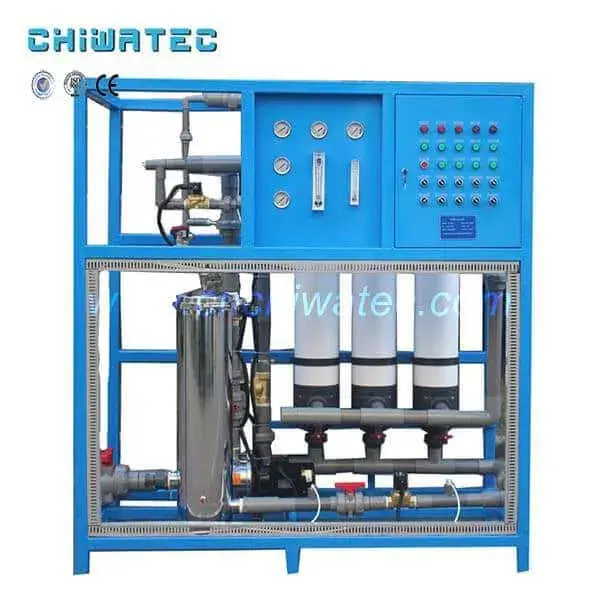
A properly designed CEB system includes: chemical storage tanks (typically separate tanks for alkali/oxidant and acid to prevent hazardous reactions), chemical metering pumps with variable speed control for precise dosing, in-line static mixers to ensure uniform chemical distribution, recirculation pumps sized for 1.5-2.0 times the design permeate flow rate, and automated control valves with PLC-based sequence programming. For UF water purification equipment, the CEB system is typically integrated into the main control system with pre-programmed cleaning recipes for different water quality conditions.
Design Flow Rates and Contact Times
CEB chemical injection rates typically range from 1-5% of the design permeate flow rate, depending on target chemical concentration. Recirculation flow during CEB should be sufficient to maintain a cross-flow velocity of 0.5-1.5 m/s across membrane fibers, ensuring uniform chemical distribution. Total CEB cycle time ranges from 30-90 minutes depending on chemical type, concentration, temperature, and fouling severity. Optimal temperature for CEB is 20-35 degrees C — higher temperatures improve reaction kinetics but may damage membrane polymers above 40 degrees C for PVDF membranes. Optimizing water treatment: design and application of ultrafiltration equipment provides comprehensive system design parameters for UF installations with CEB capability.
4. How Does CEB Cleaning Remove External Fouling from Hollow Fiber Membranes?
Fouling Types on Hollow Fiber Outer Surfaces
In immersed or pressurized hollow fiber UF systems operated in outside-in flow configuration, foulants accumulate on the outer surface of membrane fibers. Common foulant categories include: (1) particulate fouling — clay, silt, and suspended solids forming a cake layer, (2) organic fouling — humic substances, polysaccharides, and proteins from natural water sources, (3) biological fouling — biofilm formation by bacteria and extracellular polymeric substances (EPS), and (4) inorganic scaling — calcium, magnesium, iron, and manganese precipitates.
CEB Cleaning Mechanism
The CEB dispersed cleaning system targets these external foulants specifically. Chemical agents are introduced on the raw water side (outside the fibers) where they contact the fouling layer directly. Circulation of the chemical solution ensures fresh reagent continuously contacts the membrane surface, while the soaking phase allows chemicals to penetrate and dissolve adherent foulants. The subsequent flushing step removes the dissolved material from the system before normal filtration resumes. For insights into how backwash systems complement CEB, see ultrafiltration system backwash.
5. What Is the Optimal CEB Frequency for Different Applications?
Frequency Guidelines by Application
Application — Recommended CEB Frequency — Typical Fouling Rate
Municipal drinking water (surface water) — Every 1-3 days — Moderate (high NOM)
Municipal drinking water (groundwater) — Every 3-7 days — Low
Industrial process water — Every 2-5 days — Variable
Wastewater reuse (MBR effluent) — Every 12-24 hours — High (organic + biological)
Seawater RO pretreatment — Every 1-2 weeks — Low to moderate
Industrial wastewater — Every 6-24 hours — High (variable composition)
TMP-Based Trigger Criteria
Rather than fixed schedules, CEB should be triggered when transmembrane pressure (TMP) increases by 15-20% above baseline after a complete hydraulic backwash. This performance-based approach optimizes chemical usage by initiating cleaning only when needed, reducing annual chemical consumption by 20-40% compared to fixed-interval CEB programs. Temperature-corrected specific flux monitoring provides the most reliable trigger for CEB initiation. Influencing factors of ultrafiltration flux explains the relationship between TMP, flux, and fouling that drives CEB scheduling decisions.
6. What Is the Difference Between CEB and CIP Cleaning?
Scope and Intensity Comparison
Parameter — CEB — CIP (Clean-in-Place)
Frequency — Daily to weekly — Monthly to quarterly
Duration — 30-90 minutes — 2-6 hours
Chemical concentration — Lower (100-500 mg/L Cl2) — Higher (1000-5000 mg/L Cl2)
Temperature — Ambient to 35 degrees C — 30-45 degrees C
Full automation — Typical — Typical
Membrane removal required — No — No
Complementary Roles
CEB and CIP serve complementary roles in UF membrane maintenance. CEB addresses reversible and lightly adherent fouling through frequent, shorter-duration cleaning with lower chemical intensity. CIP targets accumulated, stubborn fouling that persists despite regular CEB, using higher chemical concentrations, extended contact times, and often elevated temperatures. A well-designed UF maintenance program requires both CEB and CIP — CEB extends the intervals between CIP events (from monthly to quarterly), while periodic CIP restores membrane performance to near-new conditions. Instrucciones de funcionamiento del sistema de ultrafiltración y ventajas técnicas provides protocol details for both cleaning approaches.
7. How Does Pre-Treatment Affect CEB Efficiency?
Coagulation Impact
Effective pretreatment upstream of UF membranes directly reduces CEB frequency and chemical consumption. In-line coagulation before UF membranes can reduce natural organic matter (NOM) loading by 50-70%, significantly slowing organic fouling accumulation on membrane surfaces. Plants with optimized coagulation pretreatment typically require CEB every 3-5 days for surface water treatment, compared to daily CEB without coagulation. Coagulant type and dosage must be carefully controlled to avoid carryover that could cause membrane fouling rather than preventing it.
Pre-Filtration Benefits
Installing 100-500 micron strainers or self-cleaning filters upstream of UF systems removes coarse particulates that would otherwise contribute to rapid cake layer formation and increased CEB demand. Media filtration (sand or dual-media) ahead of UF further reduces solids loading, extending CEB intervals and reducing chemical costs by 30-50%. For challenging water sources, dissolved air flotation (DAF) as pretreatment can reduce algae and oil/grease loading, preventing the most difficult-to-clean fouling types. Análisis técnico de procesos de equipos de ultrafiltración discusses pretreatment integration for optimal UF system performance.
8. What Safety Considerations Apply to CEB Chemical Handling?
Chemical Storage and Handling
CEB chemicals — particularly sodium hypochlorite (oxidizer) and acids — require careful storage and handling. Sodium hypochlorite should be stored in opaque, ventilated containers at temperatures below 25 degrees C to minimize decomposition. Acids (citric, hydrochloric, sulfuric) require acid-resistant storage tanks and piping. Alkali solutions (sodium hydroxide) require carbon steel or polypropylene storage. Chemical storage areas must include secondary containment, eyewash stations, and emergency showers per OSHA and local safety regulations.
Mixing and Neutralization
CEB chemicals must NEVER be mixed directly — particularly chlorine-based oxidizers with acids, which can generate toxic chlorine gas. Separate injection points and dedicated piping for alkali/oxidant and acid CEB steps are essential. After CEB, the spent chemical solution must be neutralized before discharge: chlorine residual should be reduced below 1 mg/L using sodium bisulfite or dechlorination agents; acidic or alkaline waste should be neutralized to pH 6-9 before sewer discharge. CHIWATEC provides complete CEB system designs incorporating all required safety features for compliant operation.
9. How to Monitor CEB Effectiveness?
Key Performance Indicators
CEB effectiveness should be monitored using multiple indicators: (1) TMP recovery — measured as the percentage reduction in TMP after CEB compared to pre-CEB TMP, with effective cleaning achieving 80-95% recovery, (2) specific flux recovery — the normalized permeate flux at standard temperature (typically 20 degrees C) before and after CEB, (3) permeate water quality — turbidity and SDI (Silt Density Index) measurements confirming membrane integrity post-CEB, and (4) chemical consumption tracking — actual chemical usage per CEB event versus design dosage, with significant deviations indicating system issues.
Troubleshooting Poor CEB Results
If CEB does not restore TMP to expected levels, investigate: insufficient chemical concentration (verify dosing pump calibration), inadequate contact time (extend soak phase), wrong chemical selection (conduct fouling analysis to identify dominant foulant type), low temperature (verify heating system operation), or chemical degradation (test reagent strength, especially for sodium hypochlorite which decomposes over time). Tracking these metrics over multiple CEB cycles reveals trends that help optimize cleaning protocols. Aplicación de la ultrafiltración en el tratamiento de agua potable provides case study data on CEB effectiveness monitoring in full-scale plants.
10. What Future Developments Will Shape CEB Technology?
Smart CEB with Real-Time Optimization
The next generation of CEB systems incorporates machine learning algorithms that analyze real-time TMP trends, feed water quality data, and historical cleaning effectiveness to dynamically adjust chemical dosing, contact time, and CEB frequency. Early adopters of adaptive CEB control report 30-45% reductions in annual chemical consumption while maintaining consistent membrane performance. These systems can also predict when CIP will be needed weeks in advance, enabling better maintenance planning.
Sustainable Chemistry Innovations
Research into bio-based cleaning agents — including enzymatic cleaners (proteases, lipases, amylases) that target specific foulant types without aggressive chemicals — is progressing rapidly. Commercial enzymatic CEB formulations are now available for municipal UF applications, demonstrating 85-95% TMP recovery with biodegradable, non-toxic chemistry. Combined with advanced oxidation processes (AOP) that generate hydroxyl radicals in-situ, these innovations promise to further reduce the environmental footprint of UF membrane cleaning while maintaining or improving cleaning effectiveness. CHIWATEC offers CEB system upgrades incorporating advanced automation and sustainable chemistry options for existing UF installations.
Conclusión
The CEB (Chemically Enhanced Backwash) dispersed cleaning system is an essential component of modern ultrafiltration plant operation, enabling consistent membrane performance, extended membrane lifespan, and optimized operating costs. With CEB frequencies ranging from daily to weekly depending on application and feed water quality, and chemical dosages tailored to specific fouling types, a well-designed CEB program is the most cost-effective approach to UF membrane maintenance between major CIP events. Advances in automated CEB control, data-driven optimization, and sustainable cleaning chemistry continue to improve the efficiency and environmental performance of UF systems worldwide. Contact CHIWATEC today to discuss your ultrafiltration system requirements and CEB cleaning optimization. Our engineering team specializes in designing integrated UF systems with advanced CEB capability for municipal and industrial applications. Reach us at [email protected] o [email protected], or via WhatsApp at 008618292684865.
Frequently Asked Questions
Q1: How often should CEB be performed on UF membranes?
CEB frequency depends on feed water quality and fouling rate. For surface water treatment, CEB is typically performed every 1-3 days; for groundwater, every 3-7 days; for wastewater reuse applications, every 12-24 hours. The optimal approach is TMP-triggered CEB initiated when TMP increases 15-20% above baseline after backwash.
Q2: What chemicals are most commonly used in CEB?
The most common CEB chemicals are sodium hypochlorite (NaClO, 100-500 mg/L as free chlorine) combined with sodium hydroxide (pH 10-12) for organic and biological fouling removal, and citric or hydrochloric acid (pH 2-3) for inorganic scale removal. Chemical selection should be based on site-specific fouling analysis.
Q3: Can CEB damage UF membranes?
When properly designed with correct chemical concentrations, contact times, and temperature limits, CEB does not damage UF membranes. The key risk factors are: excessive chlorine concentration (above 1000 mg/L for PVDF), high temperature (above 40 degrees C), and extreme pH (below 1 or above 13). Following manufacturer guidelines ensures membrane integrity over the system lifespan.
Q4: What is the cost difference between CEB and CIP?
CEB is significantly more cost-effective on a per-event basis — typically costing 10-20% of a full CIP event in chemical consumption. However, CEB is performed more frequently. Annual chemical costs for a well-optimized CEB program typically range from USD 0.01-0.05 per cubic meter of treated water, representing 5-15% of total UF operating costs.
Q5: How does CEB affect overall UF system energy consumption?
CEB itself consumes minimal energy (primarily for chemical metering and recirculation pumps, typically 0.01-0.03 kWh per cubic meter treated). However, effective CEB maintains low TMP between CIP events, reducing energy consumption during normal filtration by 15-25% compared to systems with inadequate cleaning. The net energy impact of a well-optimized CEB program is therefore positive.
Related Resources and Further Reading
- Sistema de limpieza química por ultrafiltración
- Retrolavado del sistema de ultrafiltración
- Optimizing water treatment: design and application of ultrafiltration equipment
- Instrucciones de funcionamiento del sistema de ultrafiltración y ventajas técnicas
- UF water purification equipment — CHIWATEC ultrafiltration systems






 Spanish
  English
  Portuguese




