

Internal Pressure Hollow Fiber Ultrafiltration: Complete Guide to Characteristics, Advantages and Applications 2026
Looking for a reliable internal pressure UF membrane system? Internal pressure hollow fiber ultrafiltration uses a capillary membrane structure with inside-out flow configuration, where raw water enters the fiber lumen under pressure and permeate exits through the membrane wall. This design offers superior clogging resistance, high water recovery rates up to 95%, and simple maintenance — making it the preferred choice for RO pretreatment, drinking water purification, and industrial process water treatment. CHIWATEC supplies high-performance internal pressure hollow fiber UF membrane modules and complete system solutions for municipal, industrial, and commercial applications worldwide.
What Is Internal Pressure Hollow Fiber Ultrafiltration?
Internal pressure hollow fiber ultrafiltration is a membrane separation technology where the feed water flows through the lumen (inner channel) of hollow fiber membranes, and the permeate passes radially from inside to outside through the membrane wall. The hollow fibers typically have an inner diameter of 0.6-6 mm (classified as capillary UF membranes), which provides a larger flow channel that resists clogging from suspended particles.
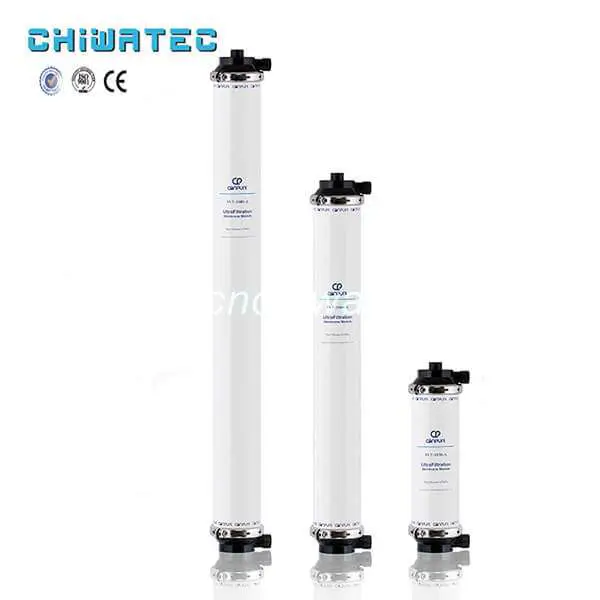
The module consists of hundreds to thousands of hollow fiber filaments housed in a cylindrical membrane shell. Epoxy end seals at both ends separate the feed side from the permeate side, ensuring that raw water must pass through the membrane wall to reach the permeate collection space. This design is fundamentally different from external pressure UF where feed water enters the shell side and permeates inward.
Key Characteristics of Internal Pressure Hollow Fiber UF
los internal pressure hollow fiber ultrafiltration design offers several distinct technical advantages that drive its widespread adoption across water treatment applications.
| Characteristic | Description | Benefit |
|---|---|---|
| Capillary membrane structure | Inner diameter 0.6-6 mm | Large flow channel resists clogging |
| Cross-flow filtration | Vertical turbulent flow across membrane surface | Self-cleaning effect reduces fouling |
| High water recovery | Recovery rate up to 95% | Minimal wastewater generation |
| Low-pressure operation | Operating pressure 0.1-0.3 MPa | Low energy consumption, simple maintenance |
| Room temperature separation | No phase change or heating required | Suitable for heat-sensitive materials |
| Thorough flushing | Clean water mutual flushing method | Fast flux recovery, low water attenuation |
los ultrafiltration membrane filtration principle forms the scientific basis for these performance characteristics, explaining how pore size and pressure differential work together to achieve effective separation.
Working Principle of Internal Pressure UF
In an internal pressure UF system, the feed water is pumped into the hollow fiber lumens under controlled pressure. The flow path follows a specific sequence that maximizes filtration efficiency and membrane longevity.
- Feed water entry: Raw water enters the hollow fiber from one end of the module, flowing through the fiber lumen under applied pressure (0.1-0.3 MPa)
- Radial permeation: Driven by the pressure differential, water penetrates the membrane wall from inside to outside in the radial direction. The membrane pore size (0.01-0.1 μm) allows water and dissolved solids to pass while blocking particles, bacteria, and colloids
- Permeate collection: The filtered water (permeate) exits the membrane wall and is collected in the shell-side space, flowing out through the permeate port
- Concentrate discharge: Retained contaminants and a portion of the feed water (typically 5-10%) exit from the opposite end of the fiber lumen as concentrated liquid (retentate), maintaining continuous cross-flow that prevents particle accumulation
- Periodic flushing: Automatic clean water mutual flushing cycles reverse or accelerate the flow to dislodge any accumulated particles from the fiber walls, restoring flux without chemical cleaning
This continuous flow design ensures that the membrane surface is constantly swept clean by turbulent flow, reducing fouling rates and extending operational life between chemical cleanings.
Advantages of Internal Pressure Hollow Fiber UF
Compared to external pressure UF and other membrane configurations, internal pressure hollow fiber UF offers several specific advantages:
- Excellent clogging resistance: The larger inner diameter (0.6-6 mm) of capillary membranes accommodates larger suspended particles without blocking, reducing the need for fine pretreatment
- Thorough cleaning capability: Forward flushing flows directly through the fiber lumens where most fouling occurs, providing more effective cleaning than backwashing in external pressure systems
- Low water attenuation rate: The clean water mutual flushing method rapidly restores permeate flux — typically recovering above 95% of initial flux after each flushing cycle
- Simple installation: Modules can be installed vertically or horizontally with minimal support structure. The household ultrafiltration membrane guide provides practical installation guidance for residential applications
- High recovery rate (95%): The cross-flow design and efficient flushing minimize the wastewater stream, making internal pressure UF more water-efficient than many alternative technologies
- Low operating cost: Operation at room temperature and low pressure (0.1-0.3 MPa) with no phase change translates to minimal energy consumption and simple maintenance requirements
Application Scope of Internal Pressure Hollow Fiber UF
Internal pressure hollow fiber ultrafiltration technology serves a wide range of applications across municipal, industrial, and commercial sectors. The versatility of the technology derives from its robust clogging resistance and high recovery rate.
RO Pretreatment
Internal pressure UF is widely used as a pretreatment stage for reverse osmosis systems, including seawater desalination, surface water treatment, and well water purification. By removing suspended solids, colloids, and microorganisms down to 0.01 μm, UF reduces the silt density index (SDI) to below 3, protecting RO membranes from fouling and extending their service life by 30-50%.
Pure and Ultrapure Water Production
In pure water and ultrapure water systems, internal pressure UF serves as a post-treatment stage after EDI or mixed bed deionization, providing final sterilization and removal of fine sediment particles. It is also used in industrial water treatment for sterilization, pyrogen removal, and elimination of colloidal and suspended impurities.
Drinking Water Purification
Internal pressure UF is the primary filtration technology in many mineral water and drinking water purification systems, including municipal tap water treatment and domestic water purification. The technology reliably removes bacteria, viruses, and fine particulates while maintaining natural mineral content.
Industrial Process Water
In the food and beverage industry, internal pressure UF is used for concentration, purification, and clarification in fermentation, enzyme preparation, and pharmaceutical production. It is also employed for wine clarification (removing turbidity from fruit wine and rice wine), and for water purification in medical and electronic manufacturing processes.
Wastewater and Reclaimed Water
Internal pressure UF systems are used in industrial wastewater, domestic wastewater, and reclaimed water treatment applications. The high recovery rate (95%) minimizes the volume of wastewater concentrate, reducing disposal costs. Applications include cooling water reuse, condensate water recovery, and tertiary treatment for water recycling.
Otras aplicaciones
- Aquaculture water purification — removing suspended solids and pathogens from recirculating aquaculture systems
- Municipal tap water advanced treatment — for villages, enterprises, hotels, and public facilities
- Beverage industry — turbidity removal from liquor, sterilization of fruit wine, wine, and rice wine
For more details on the principles and characteristics of membrane separation, refer to our comprehensive guide covering MF, UF, NF and RO membrane technologies.
Maintenance and Operation of Internal Pressure UF Systems
Proper maintenance ensures that internal pressure UF systems maintain their high performance and long service life:
- Forward flushing: Perform automatic flushing for 30-60 seconds every 1-4 hours of operation. The clean water mutual flushing method uses permeate water to backwash the fibers, dislodging accumulated particles
- Chemical cleaning frequency: When normalized permeate flux drops by 20-30%, perform chemical cleaning. Alkaline cleaning (NaOH, pH 11-12) removes organic foulants; acid cleaning (citric acid, pH 2-3) removes inorganic scale
- Membrane service life: With proper maintenance, internal pressure hollow fiber UF membranes typically last 3-5 years before replacement is needed
- Pre-filter protection: Install a 50-100 μm strainer or self-cleaning filter before the UF module to protect the fibers from large debris damage
- Freeze protection: UF modules should be stored above 5°C — freezing can permanently damage the hollow fiber structure
Complete guidelines for the hollow fiber UF membrane element cleaning method provide step-by-step procedures for both forward flushing and chemical cleaning.
Frequently Asked Questions
Q1: What is the typical pore size of internal pressure hollow fiber UF membranes?
Internal pressure UF membranes have pore sizes ranging from 0.01 to 0.1 μm (10-100 nanometers). This is approximately 1,000 times smaller than the diameter of a human hair. The pore size determines what contaminants are removed — bacteria (0.3-5 μm) and most viruses (0.02-0.1 μm) are effectively retained, while dissolved salts and minerals pass through freely.
Q2: What is the difference between internal pressure and external pressure UF?
In internal pressure UF, raw water flows inside the hollow fiber lumen and permeate exits outward. In external pressure UF, raw water enters the shell side and permeates inward into the fiber lumen. Internal pressure offers better clogging resistance (larger inner diameter 0.6-6 mm vs. 0.2-1 mm), higher recovery rates, and easier cleaning. External pressure offers higher packing density and is better suited for very low-turbidity feed water.
Q3: Can internal pressure UF handle high-turbidity feed water?
Yes. The capillary membrane design (inner diameter 0.6-6 mm) provides a large flow channel that can handle feed water with turbidity up to 50-100 NTU without clogging. This makes internal pressure UF particularly suitable for surface water treatment where turbidity fluctuates seasonally. For turbidity above 100 NTU, a sedimentation or sand filtration pretreatment stage is recommended.
Q4: How much wastewater does an internal pressure UF system produce?
Internal pressure UF systems achieve recovery rates of up to 95%, meaning only 5% of the feed water is discharged as wastewater (concentrate). This is significantly better than external pressure UF (typically 85-90% recovery) and far superior to RO systems (typically 50-75% recovery). The low wastewater volume makes internal pressure UF an environmentally attractive option.
Q5: Can internal pressure UF membranes be repaired if damaged?
Individual damaged hollow fibers can be identified through a bubble test or pressure hold test. Small numbers of broken fibers (less than 1% of total fibers) can be sealed by potting the damaged fiber ends. However, if more than 5% of fibers are damaged, the entire membrane module should be replaced, as significant fiber breakage compromises effluent quality and system performance.
Conclusion and Call to Action
Internal pressure hollow fiber ultrafiltration technology offers a robust, reliable, and cost-effective solution for a wide range of water treatment applications. With its capillary membrane design providing excellent clogging resistance, high water recovery rates up to 95%, low-pressure operation, and simple maintenance, internal pressure UF stands as a versatile choice for RO pretreatment, drinking water purification, industrial process water, and wastewater treatment. Understanding the working principle, key characteristics, and application scope enables informed system selection and optimal operational performance.
CHIWATEC supplies a comprehensive range of internal pressure hollow fiber UF membrane modules, pretreatment systems, and complete water treatment solutions. Contact us at [email protected] o [email protected] (WhatsApp available) for expert guidance on selecting and integrating internal pressure UF technology into your water treatment system.
Related Resources and Further Reading
- Ultrafiltration Membrane Filtration Principle: A Complete Guide to UF Membrane Technology
- Household Ultrafiltration Membrane: Complete Guide to Filtration Principles, Types and Characteristics
- Hollow Fiber UF Membrane Cleaning: Complete Guide to Membrane Element Cleaning Methods
- Membrane Separation Principles and Characteristics: Complete Guide to MF, UF, NF, and RO Membranes
- UF Membrane Product Line
¿Tiene un proyecto de tratamiento de agua con el que podamos ayudar?
* Diseño, mecanizado, instalación, puesta en marcha, personalización y servicio integral






 Spanish
  English
  Portuguese




