EDI Electric Desalination Advantages: Top 10 Benefits of Electrodeionization Systems 2026
What makes EDI electric desalination superior to traditional ion exchange? Electrodeionization (EDI) has revolutionized ultrapure water production by combining ion exchange membranes with continuous electrochemical regeneration. This comprehensive guide explores the top 10 advantages of EDI systems — from simplified installation and stable water quality to eliminating acid-base regeneration and reducing operating costs. CHIWATEC has been engineering EDI ultrapure water systems for over a decade, delivering reliable solutions for pharmaceutical, electronics, and power generation applications worldwide.
*Last Updated: March 2026 | Industry-Verified Technical Data*
Why This Guide Matters
The global electrodeionization (EDI) market was valued at approximately USD 1.8 billion in 2025 and is projected to reach USD 3.6 billion by 2034, growing at a CAGR of 8.0% (Allied Market Research, 2025). EDI technology has become the preferred polishing step for RO permeate in pharmaceutical, semiconductor, and power generation applications, replacing traditional mixed-bed ion exchange in over 60% of new ultrapure water installations. The key drivers are EDI’s ability to produce consistent 18.2 Mohm-cm resistivity water without the hazardous chemical handling, storage, and disposal requirements of conventional ion exchange. Understanding the advantages of EDI is essential for anyone designing, operating, or specifying ultrapure water treatment systems.
Key Industry Trends (2026 Update)
- High-flux EDI modules: Next-generation EDI stacks with improved ion-exchange membrane conductivity and optimized flow distribution now achieve 30-50% higher throughput per module compared to 2020-era designs, reducing system footprint and capital costs.
- Integrated RO-EDI skids: Fully integrated reverse osmosis + electrodeionization packaged systems are increasingly common, offering single-source responsibility for ultrapure water production from tap water to 18.2 Mohm-cm quality.
- Smart EDI monitoring: Real-time voltage, current, and resistivity monitoring with automated报警and predictive maintenance algorithms help operators optimize EDI performance and proactively identify membrane stack degradation.
- Expansion into new applications: EDI technology is expanding beyond traditional pharmaceutical and electronics markets into lithium battery production, green hydrogen electrolysis feedwater, and carbon capture utilization systems where ultra-high-purity water is critical.
1. Simple Installation Conditions: Minimal Space and Height Requirements
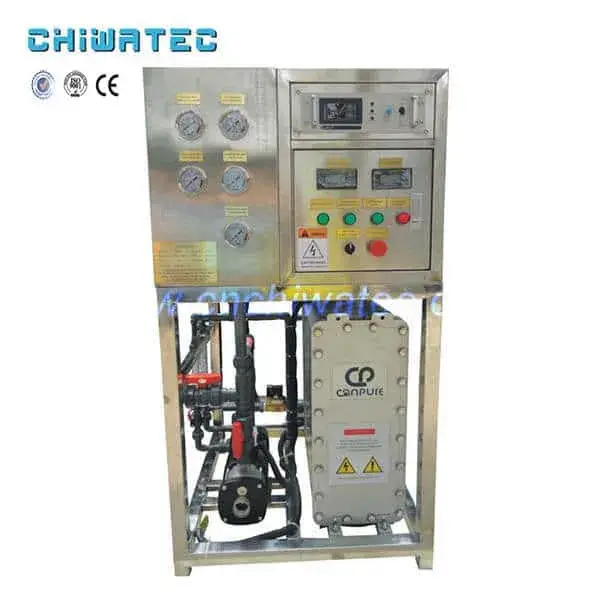
EDI systems offer significant installation advantages over traditional mixed-bed ion exchange systems. The compact modular design of EDI stacks requires 60-70% less floor space than equivalent mixed-bed systems for the same flow rate. Unlike mixed-bed vessels that require overhead clearance for resin loading and removal (typically 3-4 meters), EDI stacks can be installed in workshops with standard ceiling heights of 2.5-3 meters. The lower workshop height requirement is particularly advantageous for retrofit projects in existing buildings where headroom is limited. EDI modules arrive pre-assembled and factory-tested, reducing on-site installation time from days to hours. For a typical 50 m3/hr ultrapure water system, EDI installation requires approximately 8-12 square meters of floor space compared to 25-35 square meters for a mixed-bed system with regeneration equipment.
2. Simple System Design: Modular Configuration for Scalable Capacity
The modular design of electric desalination systems is one of their most powerful advantages. Each EDI module is a self-contained unit with integrated ion-exchange membranes, resin compartments, and electrodes. Multiple modules can be arranged in parallel for higher flow rates or in series for higher product water quality. This modular architecture easily accommodates flow rates from 1 m3/hr to over 450 m3/hr using standard 2-4 module configurations. System expansion is straightforward — adding capacity requires only installing additional EDI modules and adjusting the control system parameters, without the need for new pressure vessels, piping manifolds, or regeneration equipment that would be required for mixed-bed expansion. The standardized module design also simplifies spare parts inventory management, as a single module type can serve systems ranging from small laboratory units to large industrial installations.
3. Easy Installation and Maintenance: Hot-Swap Capability for Continuous Operation
One of the most operationally valuable features of EDI systems is the ability to perform maintenance without shutting down the entire system. When a single membrane stack requires service, the flow can be redistributed among the remaining stacks while the affected stack is isolated, removed, and replaced. This hot-swap capability is impossible with mixed-bed systems, where the entire vessel must be taken offline for resin replacement or regeneration. The EDI module design also simplifies routine maintenance — there are no moving parts within the module itself, eliminating mechanical wear issues. Most manufacturers recommend annual inspection of electrode connections and gasket integrity, with membrane stack replacement typically required every 3-5 years depending on feedwater quality and operating conditions. The modular design also means that individual stacks can be replaced rather than the entire system, reducing maintenance costs by 40-60% compared to mixed-bed systems.
4. Stable and Consistent Water Quality: Continuous 18.2 Mohm-cm Output
EDI systems deliver exceptionally stable product water quality that is unmatched by traditional ion exchange. Unlike mixed beds, which experience water quality degradation as the resin approaches exhaustion between regenerations, EDI systems maintain consistent product water resistivity throughout the entire operating cycle. Typical EDI product water quality: resistivity 16-18.2 Mohm-cm (at 25 degrees C), silica removal to below 1 ppb, TOC reduction to below 5 ppb, and sodium removal to below 0.1 ppb. This consistent output is achieved because the electrochemical regeneration process operates continuously, maintaining the ion-exchange resin in a highly regenerated state. For pharmaceutical applications requiring USP purified water (<1.3 microS/cm at 25 degrees C), EDI consistently exceeds requirements by a factor of 10-100, providing a substantial safety margin for compliance.
5. Standard Design: Building-Block Configuration for Custom Requirements
EDI systems employ a standardized unit design that allows them to be configured like building blocks to meet diverse user requirements. Each standard EDI module has a rated capacity (typically 2-10 m3/hr per module depending on the manufacturer and model), and modules can be combined in arrays to achieve virtually any desired system capacity. This standardized approach offers several practical benefits: (1) shorter lead times since modules are manufactured in volume rather than custom-built, (2) lower engineering costs since system design is based on proven configurations, (3) easier future expansion since adding capacity requires only additional standard modules, and (4) simplified operator training since all modules share the same operating parameters and control interface. For users with variable water demand, systems can be designed with duty/standby or lead/lag configurations that automatically adjust to flow requirements.
6. No Need for Acid-Base Regeneration: Safe Operation and Simplified Wastewater Treatment
Perhaps the most significant advantage of EDI over mixed-bed ion exchange is the elimination of hazardous chemical regeneration. Mixed-bed systems require periodic regeneration with concentrated hydrochloric acid (30-35%) and sodium hydroxide (30-50%), which presents multiple operational challenges: chemical storage tanks require secondary containment and safety showers, chemical handling requires PPE and training, and the regeneration process generates acidic and alkaline wastewater that requires neutralization before discharge. EDI systems operate entirely on electrical power — the regeneration process is driven by the applied DC voltage across the membrane stack. This eliminates: chemical storage and handling costs (saving USD 5,000-15,000 per year for a typical 50 m3/hr system), safety risks associated with concentrated acid and caustic, and the capital cost of the neutralization system (typically USD 20,000-50,000 for a mixed-bed installation).
7. Low Operating Cost: Competitive Economics vs. Mixed-Bed Ion Exchange
Compared with various mixed-bed configurations, the EDI electric desalination system is highly competitive in total operating cost. A comprehensive cost analysis for a 50 m3/hr ultrapure water system operating 8,000 hours per year reveals:
- EDI operating cost: Approximately USD 0.08-0.15 per m3 of product water, including electricity (0.3-0.7 kWh/m3), module replacement amortization, and routine maintenance.
- Mixed-bed operating cost: Approximately USD 0.20-0.40 per m3, including regeneration chemicals (HCl and NaOH), neutralization chemicals, resin replacement (5-10% annual loss), labor for regeneration operations, and waste disposal.
- Break-even point: Despite higher capital cost (typically 15-30% premium over mixed-bed), EDI total life-cycle cost is lower for systems operating more than 3,000 hours per year, with payback periods of 1-3 years.
The cost advantage increases over time as chemical and waste disposal costs rise, while EDI operating costs remain relatively stable with only electricity and module amortization components.
8. Practical Design: Easy Capacity Adjustment and System Modification
EDI systems offer unparalleled flexibility for capacity modification. The modular design makes it straightforward to increase or decrease equipment capacity as water demand changes. When production requirements increase, additional EDI modules can be added to the existing array without disrupting ongoing operations. Conversely, if demand decreases, modules can be removed or placed in standby mode to optimize energy consumption. This flexibility is particularly valuable for facilities experiencing phased capacity expansions or seasonal demand variations. The EDI control system automatically adjusts the DC current and flow distribution parameters when modules are added or removed, maintaining optimal performance across the modified array. The modular design also facilitates system relocation — a complete EDI system can be disassembled, moved, and recommissioned at a new location within 2-4 weeks, compared to 2-3 months for a mixed-bed system requiring new vessel fabrication and resin installation.
9. Continuous Production: No Regeneration Downtime
EDI systems operate 24/7 continuous production, eliminating the regeneration downtime that is inherent in mixed-bed ion exchange systems. A typical mixed-bed system requires 2-4 hours of regeneration every 24-72 hours (depending on feedwater quality and system loading), during which the system either must be taken offline (requiring a duplicate standby vessel) or produce lower-quality water. EDI systems have no such limitation — product water is produced continuously at consistent quality as long as feedwater quality remains within specifications and DC power is applied. For critical applications (pharmaceutical production, semiconductor fabrication, power generation), this continuous operation eliminates the risk of product water quality excursions during regeneration transitions and ensures uninterrupted supply to downstream processes. For a typical facility, eliminating regeneration downtime can recover the equivalent of 5-10 additional days of production capacity per year.
10. No Waste Acid and Alkali Disposal: Environmental and Regulatory Advantage
The elimination of waste acid and alkali is one of the most compelling advantages of EDI technology, particularly in regions with stringent environmental regulations. Mixed-bed systems generate large volumes of acidic and alkaline regeneration wastewater that requires: (1) neutralization tank installation (capital cost: USD 15,000-40,000), (2) continuous pH monitoring and chemical dosing for neutralization (operating cost: USD 3,000-8,000 per year), and (3) compliance with discharge permits and reporting requirements. EDI systems generate only a concentrated brine stream (typically 5-10% of product flow) containing the ions removed from the feedwater, with a conductivity of 50-500 microS/cm and pH of 6-8 — this stream can often be discharged directly to sanitary sewer without treatment. The environmental benefits translate directly to regulatory compliance simplicity: no hazardous waste manifests, no chemical storage inspections, no spill prevention plans, and no air emission permits for acid fume scrubbers. In environmentally sensitive areas or facilities seeking ISO 14001 certification, these advantages can be decisive in the technology selection process.
For custom-designed EDI ultrapure water systems optimized for your specific application requirements, CHIWATEC provides complete engineering, manufacturing, and commissioning services for industrial and commercial electrodeionization systems worldwide.
Conclusión
EDI electric desalination technology offers ten compelling advantages over traditional mixed-bed ion exchange: simple installation, modular design, easy maintenance, stable water quality, standardized configuration, chemical-free operation, low operating cost, capacity flexibility, continuous production, and environmental compliance. These advantages have made EDI the preferred polishing technology for ultrapure water production in pharmaceutical, semiconductor, power generation, and industrial applications worldwide. As EDI module technology continues to advance toward higher flux rates, lower energy consumption, and broader feedwater tolerance, the technology is expected to capture an even larger share of the growing global ultrapure water market, projected to reach USD 3.6 billion by 2034.
Contact CHIWATEC today at [email protected] o [email protected] (WhatsApp: +86 18292684865) for professional guidance on EDI system design, equipment selection, and integration with RO pretreatment for your ultrapure water requirements.
Frequently Asked Questions
Q1: What is the difference between EDI and mixed-bed ion exchange?
EDI (electrodeionization) uses a DC electrical field to continuously regenerate ion-exchange resins within the module, eliminating the need for chemical regeneration. Mixed-bed ion exchange uses separate cation and anion resins in a single vessel; when the resin reaches exhaustion, the vessel must be taken offline and regenerated with hydrochloric acid and sodium hydroxide. EDI provides continuous operation with consistent water quality, while mixed-bed systems have cyclical quality variations and require chemical handling. EDI capital cost is typically 15-30% higher, but operating cost is 40-60% lower over the system lifetime.
Q2: What feedwater quality does an EDI system require?
EDI systems require high-quality feedwater, typically RO permeate with: conductivity below 40 microS/cm (ideally below 20 microS/cm), TOC below 0.5 ppm, silica below 0.5 ppm, hardness below 1 ppm as CaCO3, chlorine below 0.02 ppm, and CO2 below 10 ppm. The most critical parameters are feedwater conductivity and hardness — high conductivity increases DC power consumption and can cause premature module fouling, while hardness can cause irreversible scaling of the EDI membrane stack. Proper RO pretreatment is essential for reliable EDI operation.
Q3: How long do EDI membrane stacks last?
EDI membrane stack life depends on feedwater quality, operating conditions, and maintenance practices. Under optimal conditions with well-maintained RO pretreatment, EDI stacks typically last 3-5 years before requiring replacement. Factors that reduce stack life include: inadequate RO pretreatment (allowing hardness, silica, or organic fouling into the EDI), high feedwater CO2 levels (above 10 ppm), frequent start-stop cycling that causes pressure and thermal stress on the membranes, and operation at excessive DC voltage or current that accelerates membrane degradation. Most manufacturers provide a 1-3 year warranty on EDI stacks with replacement costs of USD 2,000-6,000 per module depending on capacity.
Q4: Can EDI systems achieve 18.2 Mohm-cm water quality?
Yes, EDI systems can consistently achieve 18.2 Mohm-cm resistivity (at 25 degrees C) when properly designed and operated with appropriate feedwater quality. A standard single-pass EDI system following RO typically produces water with 16-18.2 Mohm-cm resistivity. To consistently achieve the theoretical maximum of 18.2 Mohm-cm (which represents the theoretical limit of pure water), the EDI may need to be operated at slightly higher DC power or with a second-pass configuration. For critical semiconductor applications requiring absolute maximum resistivity, EDI is typically followed by UV oxidation (for TOC removal), mixed-bed polishing (for trace ion removal), and final filtration. The key to achieving maximum resistivity is maintaining low feedwater CO2 levels (below 5 ppm) and optimizing the DC current density.
Q5: What is the energy consumption of an EDI system?
EDI energy consumption consists of DC power for the electrochemical process (0.3-0.7 kWh/m3) and auxiliary power for feedwater pumping (negligible as EDI operates at low pressure, typically 15-60 psi). Total EDI energy consumption is approximately 0.3-0.8 kWh per cubic meter of product water, depending on feedwater conductivity, target resistivity, and module design. By comparison, mixed-bed ion exchange has no direct electrical energy consumption but requires significant embedded energy for chemical manufacturing, transportation, and neutralization. On a total life-cycle energy basis, EDI is approximately 40-50% more energy-efficient than mixed-bed ion exchange when accounting for the full supply chain of regeneration chemicals.
Related Resources and Further Reading
- EDI Principle and Its Application in Pure Water Clean Production — Fundamental principles of electrodeionization and its role in clean water production systems
- One-Stage Reverse Osmosis + EDI Ultrapure Water Equipment Scheme — Complete RO-EDI system design for ultrapure water production from tap water
- Advantages of EDI Technology Compared with Hybrid Ion Exchange Technology — Detailed comparison of EDI vs. mixed-bed ion exchange performance and economics
- EDI Replaces Mixed Bed Technology — Case studies and technical analysis of mixed-bed to EDI conversion projects
- EDI Ultrapure Water Equipment Problems and Solutions — Troubleshooting guide for common EDI operational issues and corrective actions
¿Tiene un proyecto de tratamiento de agua con el que podamos ayudar?
* Diseño, mecanizado, instalación, puesta en marcha, personalización y servicio integral
 Spanish
  English
  Portuguese