Industrial Water Softening Equipment: Complete Technical Guide to Ion Exchange Softening Systems 2026
How does industrial water softening equipment remove hardness, and what technology is most commonly used? Industrial operations — particularly boiler feed water systems, cooling towers, and process water applications — require water with hardness below 0.03 mmol/L to prevent scale formation. The global water softening equipment market was valued at USD 8.2 billion in 2024, with industrial applications accounting for over 55% of demand. The direct answer: industrial water softening equipment primarily uses the sodium ion exchange method, in which a strong acid cation (SAC) resin exchanges sodium ions (Na+) for calcium (Ca2+) and magnesium (Mg2+) ions in the raw water, reducing hardness by 95-99% and producing softened water suitable for boiler feed, cooling, and process applications. CHIWATEC designs and manufactures industrial water softening equipment for applications ranging from small boiler systems to large-scale industrial water treatment plants.
How Industrial Water Softening Equipment Works
Industrial water softening equipment operates on the principle of ion exchange. The equipment contains a bed of strong acid cation (SAC) ion exchange resin in the sodium (Na+) form. As hard water passes through the resin bed, calcium and magnesium ions are exchanged for sodium ions, effectively removing the hardness from the water. The exchange process follows these chemical reactions:
Carbonate Hardness (Temporary Hardness) Removal
Ca(HCO3)2 + 2NaR → CaR2 + 2NaHCO3
Mg(HCO3)2 + 2NaR → MgR2 + 2NaHCO3
Non-Carbonate Hardness (Permanent Hardness) Removal
CaSO4 + 2NaR → CaR2 + Na2SO4
CaCl2 + 2NaR → CaR2 + 2NaCl
MgSO4 + 2NaR → MgR2 + Na2SO4
MgCl2 + 2NaR → MgR2 + 2NaCl
In ionic form, the overall reaction simplifies to:
Ca2+ + 2NaR → CaR2 + 2Na+
Mg2+ + 2NaR → MgR2 + 2Na+
The resin continues to exchange ions until its sodium sites are depleted, at which point the resin must be regenerated. A typical industrial water softening system processes water at a linear velocity of 20-30 m/h through the resin bed, achieving effluent hardness consistently below 0.03 mmol/L.
Key Components of Industrial Water Softening Equipment
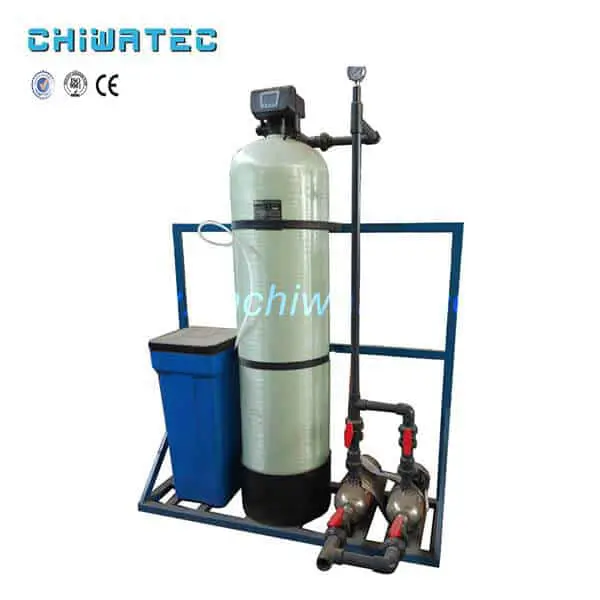
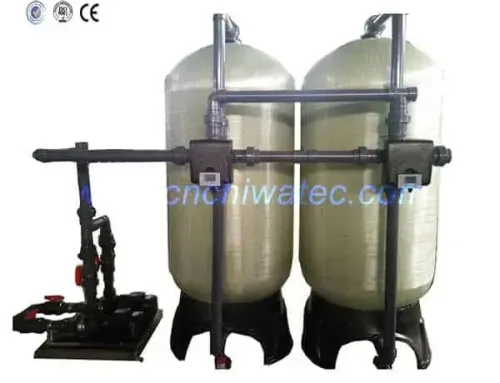
Industrial water softening equipment consists of several integrated components that work together to deliver consistent water quality:
| Component | Función | Material/Selection Criteria |
|---|---|---|
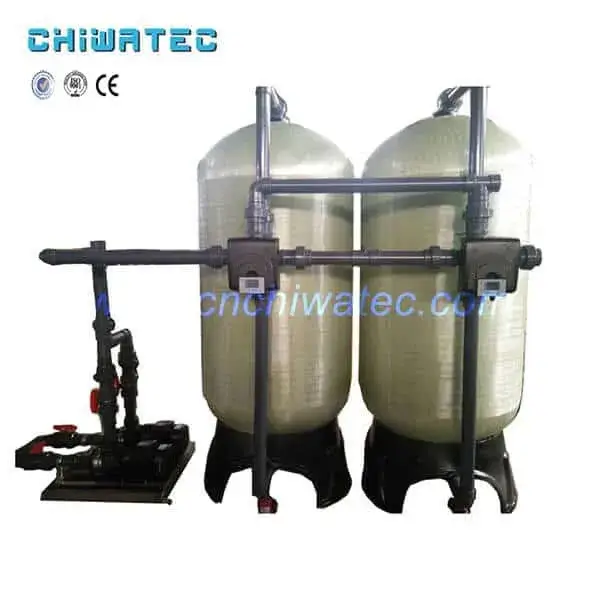
| Resin vessel | Houses the ion exchange resin bed | FRP or rubber-lined steel, rated for 6-10 bar |
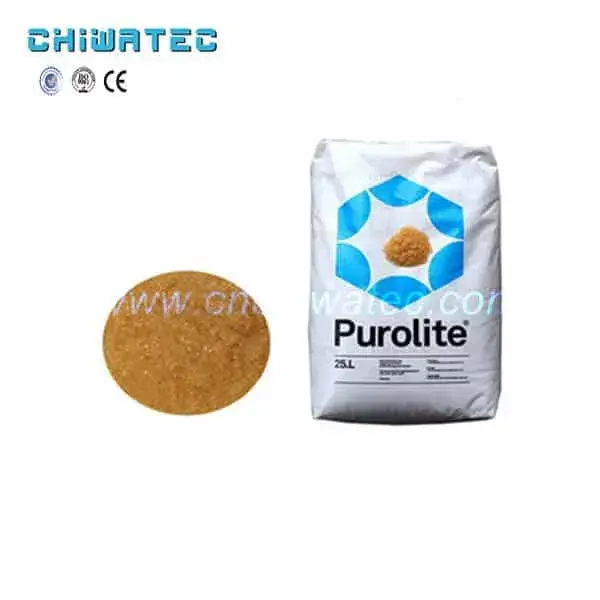
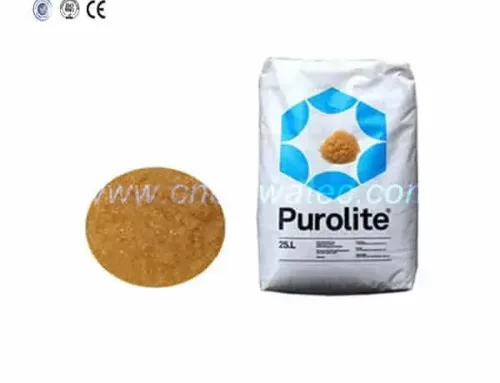
| Ion exchange resin | Removes Ca2+ and Mg2+ via Na+ exchange | SAC gel-type resin, capacity 1.8-2.2 eq/L |
| Control valve | Manages service, backwash, regeneration, rinse | Automatic multi-port valve, timer or meter-initiated |
| Tanque de salmuera | Stores saturated NaCl solution for regeneration | PE or LLDPE, sized for 2-3 regenerations |
| Distribution system | Ensures even water flow through resin bed | PVC or stainless steel laterals with strainers |
The Regeneration Process
When the ion exchange resin in industrial water softening equipment reaches the end of its service cycle — detected by hardness breakthrough in the effluent — the resin must be regenerated to restore its sodium form. The regeneration process uses a sodium chloride (NaCl) solution, typically at 8-10% concentration. The chemical reactions during regeneration are:
CaR2 + 2NaCl → 2NaR + CaCl2
MgR2 + 2NaCl → 2NaR + MgCl2
The regeneration cycle follows a precise sequence of steps:
- Backwash: Upward water flow at 10-15 m/h for 10-15 minutes to loosen the resin bed and remove accumulated suspended solids
- Brine draw: Saturated 8-10% NaCl solution is drawn through the resin bed at 3-6 m/h for 30-60 minutes — the total contact time between regenerant and resin should be at least 45 minutes for standard 7% crosslinked SAC resin
- Slow rinse: Water at the same flow rate as brine draw displaces spent regenerant over 15-30 minutes
- Fast rinse: Water at service flow rate (20-30 m/h) rinses residual chloride from the bed for 10-20 minutes until effluent conductivity stabilizes
Industrial salt (NaCl with minimum 99.5% purity) is used as the regenerant. A clarified 8-10% salt solution is recommended, and the hardness of the brine should not exceed 40 mmol/L with suspended solids below 2%. The guidelines for the use of softened water equipment provide detailed operational parameters for each regeneration step.
Applications of Industrial Water Softening Equipment
Industrial water softening equipment is essential across numerous sectors. The sodium ion exchange method is the most common water treatment method for industrial boiler feed water, with applications including:
- Boiler feed water treatment: Preventing scale formation in high-pressure boilers — hardness must be reduced below 0.03 mmol/L to prevent calcium carbonate scale deposits that reduce heat transfer efficiency by 15-30%
- Cooling tower make-up water: Preventing scale in cooling circuits — softened water reduces blowdown frequency and chemical treatment costs
- Process water for manufacturing: Textile, chemical, and food processing industries require soft water for consistent product quality
- HVAC and district heating: Protecting heat exchangers and piping from scale accumulation
- Reverse osmosis pre-treatment: Softening protects RO membranes from hardness scaling, extending membrane life by 30-50%
los fully automatic water softening equipment with meter-initiated regeneration is the standard configuration for industrial applications requiring consistent operation with minimal operator intervention.
Performance Parameters and Sizing
Proper sizing of industrial water softening equipment requires accurate data on feed water hardness, flow rate, and operating schedule:
- Exchange capacity: Standard SAC resin provides 60,000-90,000 grains of hardness removal per cubic foot of resin per regeneration cycle
- Service flow rate: 20-30 m/h linear velocity through the resin bed (8-12 gpm/ft2)
- Resin bed depth: Minimum 1.2 m (4 ft), with 1.5 m (5 ft) recommended for consistent effluent quality
- Regeneration salt dosage: 120-240 grams of NaCl per liter of resin, depending on desired resin regeneration level
- Water consumption per regeneration: Approximately 5-10% of the treated water volume between regenerations for backwash, rinse, and brine displacement
For performance verification, the water softening system performance guide provides detailed specifications and acceptance criteria.
Maintenance of Industrial Water Softening Equipment
Regular maintenance is essential for reliable operation and maximum resin life. The weekly, monthly, and yearly water softener maintenance schedule provides comprehensive procedures. Key maintenance tasks include:
- Daily: Check brine tank salt level (maintain at least 50% full), verify effluent hardness with simple test kit, and inspect for leaks
- Weekly: Clean brine tank salt grid, check brine line for air locks, and verify regeneration cycle completion
- Monthly: Test resin sample for exchange capacity, iron fouling, and physical degradation; clean or replace injector and strainers
- Quarterly: Perform resin bed deep cleaning with acid solution (citric acid pH 2-3) to remove accumulated iron and manganese fouling
- Annual: Replace 5-10% of resin volume to compensate for attrition; rebuild control valve; replace O-rings and seals
Frequently Asked Questions
Q1: What is the difference between industrial and residential water softening equipment?
Industrial water softening equipment operates at higher flow rates (typically 5-100+ m3/h vs 1-2 m3/h for residential), uses larger resin vessels (diameters of 0.5-2.5 m vs 0.2-0.3 m), and features automatic control systems with meter-initiated regeneration. Industrial systems also include duplex or twin-alternating configurations to provide continuous soft water supply during regeneration cycles. Additionally, industrial equipment uses corrosion-resistant materials such as rubber-lined steel or stainless steel, compared to FRP vessels common in residential systems.
Q2: What salt is recommended for industrial water softener regeneration?
Industrial-grade evaporated salt or solar salt with minimum 99.5% NaCl purity is recommended. The salt solution should be clarified before use, with hardness below 40 mmol/L and suspended solids below 2%. Avoid iodized salt, rock salt with high insoluble content, or salt containing anti-caking additives, as these impurities can foul the resin bed and reduce exchange capacity over time.
Q3: How often should industrial water softening equipment regenerate?
Regeneration frequency depends on feed water hardness, water consumption, and resin volume. For a typical industrial system treating 100 m3/day at 300 mg/L hardness with 500 L of SAC resin, regeneration is typically required every 2-4 days. Meter-initiated (demand) controllers automatically trigger regeneration based on actual water volume treated, optimizing salt efficiency and minimizing water waste. Timer-initiated systems regenerate on a fixed schedule, typically daily for industrial applications.
Q4: What causes hardness breakthrough in an industrial softener?
Hardness breakthrough can result from: (1) exhausted resin reaching the end of its service cycle — normal and addressed by regeneration; (2) channeling in the resin bed caused by fouling or improper backwash flow distribution; (3) iron fouling of the resin, which reduces effective exchange capacity; (4) insufficient regenerant salt dosage or contact time; (5) brine tank salt depletion; or (6) incorrect control valve programming. Systematic troubleshooting using effluent hardness and flow data identifies the root cause.
Q5: Can industrial water softening equipment remove iron from water?
Standard sodium ion exchange resin can remove dissolved ferrous iron (Fe2+) up to approximately 0.3 mg/L. For higher iron concentrations, specialized resin types or pre-treatment (such as BIRM media filtration or chemical oxidation followed by media filtration) is required. Iron fouling of the resin — indicated by reddish-brown resin beads and reduced exchange capacity — can be cleaned with a mild acid solution (citric acid pH 2-3) as part of quarterly maintenance.
Conclusion & CTA
Industrial water softening equipment using the sodium ion exchange method is the most widely adopted technology for hardness removal in industrial applications, achieving 95-99% hardness reduction with proven reliability. Understanding the exchange process, regeneration cycle, component specifications, and maintenance requirements is essential for selecting, operating, and maintaining a system that delivers consistent soft water quality while minimizing operating costs and maximizing resin life. CHIWATEC engineers custom industrial water softening systems for boiler feed water, cooling, process water, and RO pre-treatment applications. Contact our team at [email protected] o [email protected] (WhatsApp available) for expert consultation on industrial water softening equipment selection and system design.
Related Resources and Further Reading
- Introduction to the Working Principle of Softened Water Equipment
- Guidelines for the Use of Softened Water Equipment
- Fully Automatic Water Softening Equipment: Standard Work Flow and Performance
- Water Softener Maintenance Schedule (Weekly, Monthly, Yearly)
- Water Softening Systems – Browse Our Product Range
¿Tiene un proyecto de tratamiento de agua con el que podamos ayudar?
* Diseño, mecanizado, instalación, puesta en marcha, personalización y servicio integral
 Spanish
  English
  Portuguese