

RO Water Treatment System Components: Complete Guide to Equipment, Process Flow, and Specifications
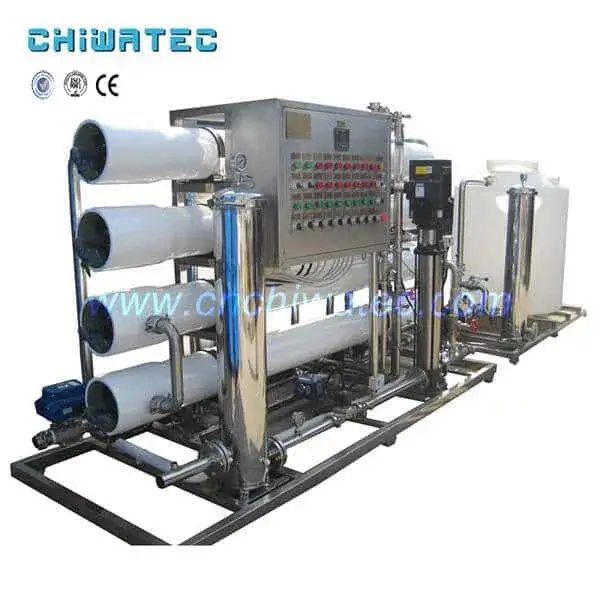
What are the essential components of an RO water treatment system, and how does each part contribute to water quality? A standard reverse osmosis water treatment system consists of eight key components working in sequence: raw water tank, booster pump, mechanical filter, activated carbon filter, water softener or antiscalant dosing, precision filter, high-pressure pump, and the RO membrane assembly. The global RO water treatment equipment market was valued at USD 12.4 billion in 2024 and is projected to reach USD 22.8 billion by 2034 (CAGR 6.3%). The direct answer: understanding RO water treatment system components and their specific functions — from the raw water tank that stabilizes supply to the RO membrane that achieves 99.5% salt rejection — is essential for designing, operating, and maintaining a reliable system. CHIWATEC engineers complete reverse osmosis water treatment systems with optimized component selection for industrial, commercial, and municipal applications.
Application Scope of RO Water Treatment Systems
Reverse osmosis pure water treatment is widely used across industries for the preparation of pure water and ultrapure water:
- Electronics industry: Production of high-purity rinse water for semiconductor and PCB manufacturing
- Pharmaceutical industry: Preparation of purified water and water-for-injection per USP and EP standards
- Food and beverage: Purification and preparation of process water, brewing water, and ingredient water
- Power generation: Pre-desalination of high-pressure boiler feed water in thermal and nuclear power plants
- Chemical processing: Purification of process water, concentration and recovery of aqueous solutions
- Desalination: Brackish water and seawater desalination for municipal and industrial water supply
For a complete system design overview, refer to the reverse osmosis water treatment system design guide.
Water Quality Requirements for Reverse Osmosis Feed Water
To ensure reliable RO membrane operation and prevent fouling, the feed water must meet the following quality specifications:
| Parámetro | Maximum Allowable | Impact of Exceeding Limit |
|---|---|---|
| Silt Density Index (SDI 15 min) | < 5 | Causes particulate fouling of membrane surface |
| Turbiedad | < 1.0 NTU | Indicates suspended solids that block flow channels |
| Free chlorine | <0,1ppm | Oxidizes and destroys polyamide membrane |
| La temperatura | < 45 degrees C | High temperature degrades membrane polymer structure |
| Iron (Fe) | < 0.05 ppm | Causes catalytic fouling and membrane scaling |
RO Water Treatment System Components: Complete Process Flow
The standard RO water treatment system process flow follows this sequence: Raw water tank → Booster pump → Mechanical filter → Activated carbon filter → Water softener or antiscalant dosing → Precision filter → High-pressure pump → Reverse osmosis device. Each component serves a specific function in protecting the RO membrane and ensuring consistent water quality. The following sections describe each RO water treatment system component in detail.
Raw Water Tank
Función: The raw water tank overcomes the instability of the municipal water supply, ensuring stable and continuous water supply to the entire system. It also provides a buffer volume for consistent operation of downstream equipment.
Selección: The tank is typically constructed from PE (polyethylene) or stainless steel 304/316L, with a capacity sized to provide 1-2 hours of system operating volume as a buffer.
Control: The tank is equipped with a high-water level float valve and a low-water level switch. When the water level reaches a high level, the float valve closes to stop water inflow. When the water level drops to a low level, the float valve opens and the low-water level switch triggers the booster pump to stop, protecting the pump from dry running.
Booster Pump
Función: The booster pump provides the necessary working pressure for the pre-treatment equipment. It ensures adequate flow through the mechanical filter, carbon filter, and softener before water reaches the high-pressure pump.
Selección: The pump working pressure is determined by the cumulative pressure drop of each pre-treatment device (typically 0.05 MPa maximum pressure drop per filter). The pressure before the high-pressure pump must be maintained above 0.05 MPa (0.5 kg/cm2) to prevent cavitation.
Control: A regulating valve after the pump adjusts the pressure and flow rate to match system requirements.
Mechanical Filter (Multi-Media Filter)
Función: Raw water first passes through a mechanical filter containing 12-24 mesh fine quartz sand. Flocs, rust particles, and other suspended impurities are physically intercepted in the filter bed. Regular backwashing is essential to prevent clogging and maintain filtration efficiency.
Selección: The filter vessel is constructed from FRP (fiber-reinforced plastic) with a corrosion-resistant interior lining. The vessel diameter is sized for a filtration velocity of 8-12 m/h.
Control: Backwash operation uses a manual or automatic controller. The filter should be backwashed at least once daily for 10-20 minutes, or when the differential pressure exceeds 0.05 MPa.
Filtro de carbón activado
Función: The activated carbon filter is a critical pre-treatment component for RO system protection. It serves two primary functions: (1) adsorption of organic compounds with approximately 60% removal efficiency, and (2) removal of residual chlorine through chemical reaction — chlorine reacts with carbon to form carbon dioxide and chloride ions. Activated carbon also removes color, odor, and taste compounds, improving water clarity. The activated carbon structure contains micropores with an average diameter of 20-50 angstroms, providing a surface area of 500-2000 m2/g for adsorption.
Selección: The filter vessel uses FRP construction with 40% expansion space for backwash. The empty bed contact time (EBCT) should be 10-20 minutes for effective adsorption.
Control: Manual or automatic controller. Daily backwashing for 15-30 minutes removes accumulated particles. The carbon media requires replacement every 12-24 months depending on feed water chlorine concentration and organic loading.
For a comparison of pre-treatment options, see the reverse osmosis water treatment equipment program process introduction.
Water Softener or Antiscalant Dosing System
Función: The water softener removes hardness ions (Ca2+ and Mg2+) through ion exchange with 001×7 strong acid Na-type cation resin. This prevents calcium carbonate and calcium sulfate scaling on the RO membrane surface, extending membrane life and maintaining treatment efficiency. The target effluent hardness is below 0.03 mmol/L. Alternatively, antiscalant dosing can be used instead of a softener for some feed water chemistries.
Selección: The softener vessel uses FRP construction. Resin volume is calculated based on feed water hardness and system flow rate, with a typical linear velocity of 20-30 m/h during service.
Control: An automatic control valve (American-made, time or flow-initiated) manages the regeneration sequence: backwash → brine draw → slow rinse → fast rinse → service. The brine tank should be checked daily for salt level, and only evaporated salt or solar salt (99.5%+ NaCl) should be used — iodized salt or salt with additives is prohibited.
Precision Filter (Security Filter)
Función: The precision filter, also called a security filter, is the final barrier before water enters the RO membrane. It uses PP (polypropylene) melt-blown filter elements with 5 um or 1 um pore size to trap any remaining particles that could damage the high-pressure pump or RO membrane. The filter combines surface filtration and depth filtration mechanisms for high dirt-holding capacity.
Selección: The housing is constructed from stainless steel 304 or 316L. Cartridge configuration (10-inch, 20-inch, or 40-inch) depends on system flow rate.
Control: Filter elements must be replaced when the differential pressure reaches 0.05-0.1 MPa, or on a scheduled basis every 3-6 months.
High-Pressure Pump
Función: The high-pressure pump provides the operating pressure required by the reverse osmosis membranes — typically 10-15 bar for brackish water RO and 55-70 bar for seawater RO. This pressure drives water through the semi-permeable membrane against the osmotic pressure gradient.
Selección: Grundfos vertical multi-stage centrifugal pumps are standard for brackish water RO systems. The pump is selected to deliver the required flow at the design pressure with a safety margin of 10-15%.
Control: A low-pressure protection switch stops the pump when inlet pressure falls below 0.1 MPa (1 kg/cm2) to prevent cavitation damage. The system starts water production when the raw water pressure gauge reaches 0.2 MPa (2 kg/cm2).
Reverse Osmosis Membrane Assembly
Función: The RO membrane assembly is the core of the water treatment system. It uses spiral-wound thin-film composite (TFC) polyamide membrane elements — typically ESPA (Energy Saving Polyamide) series brackish water membranes with a salt rejection rate of 99.5%. These elements achieve high water flux at low operating pressure, reducing energy consumption. The RO device removes 95-99.5% of dissolved salts, organic compounds, bacteria, and viruses in a single pass.
Configuration: Membrane elements (standard 4-inch or 8-inch diameter, 40-inch length) are arranged in series within pressure vessels. System configuration (number of vessels per stage, number of stages) is determined by feed water quality, target water quality, and recovery rate requirements.
Control: The RO system includes automatic membrane flushing on startup and shutdown, conductivity monitoring of permeate quality, and flow control valves for permeate and concentrate streams.
For more information on advanced RO system configurations, refer to the one-stage RO + EDI ultrapure water equipment scheme and the main process flow description of reverse osmosis pure water equipment.
RO Water Treatment System Components: Operation and Maintenance Guidelines
Proper operation and regular maintenance of each RO water treatment system component is essential for long-term reliability. The operating rules for pure water production equipment provide comprehensive protocols. Key operational guidelines include:
- Daily checks: Monitor feed water pressure, permeate flow rate, permeate conductivity, and differential pressure across each stage
- Pre-treatment maintenance: Backwash mechanical filter and carbon filter daily; check brine tank salt level in softener; replace precision filter elements quarterly
- RO membrane protection: Never operate without adequate pre-treatment; maintain chlorine-free feed water; flush membrane on system shutdown
- Data recording: Maintain a daily log of all operating parameters to identify trends before they become problems
- Periodic cleaning: Clean RO membranes when normalized permeate flow drops 15% or differential pressure increases 15% above baseline
Frequently Asked Questions
Q1: What is the most critical component in an RO water treatment system?
The RO membrane assembly is the most critical component, but it is entirely dependent on proper pre-treatment. The raw water tank, booster pump, mechanical filter, carbon filter, softener, and precision filter all work together to protect the membranes. Neglecting any pre-treatment component will result in premature membrane fouling, reduced water quality, and increased operating costs. A well-designed system balances all components for optimal performance and membrane life of 3-7 years.
Q2: Why is an activated carbon filter necessary before RO membranes?
The activated carbon filter serves two essential purposes: it removes residual chlorine that would oxidize and destroy polyamide RO membranes, and it adsorbs organic compounds that would foul the membrane surface. Without carbon filtration, chlorine exposure can destroy a membrane element in days. The carbon filter’s dechlorination capability is particularly important because municipal water supplies commonly maintain chlorine residuals of 0.5-2.0 ppm for disinfection.
Q3: Can I use a water softener instead of antiscalant dosing?
Yes, both methods prevent membrane scaling, and the choice depends on feed water chemistry and operating conditions. Water softeners (cation exchange) remove calcium and magnesium ions entirely, providing complete protection against hardness scaling. Antiscalant dosing does not remove hardness but prevents crystal formation and precipitation. Softeners are preferred for feed water with high hardness (> 200 mg/L) and for systems where operator attention is limited, while antiscalant dosing has lower capital cost and no regeneration chemical requirement.
Q4: How often should the precision filter cartridges be replaced?
Precision filter cartridges should be replaced when the differential pressure reaches 0.05-0.1 MPa (0.5-1.0 kg/cm2) or every 3-6 months, whichever comes first. A rapidly clogging precision filter indicates a problem with the upstream pre-treatment — the mechanical filter or carbon filter may require more frequent backwashing, or the feed water quality may have deteriorated.
Q5: What water quality can a standard RO system produce?
A standard single-pass brackish water RO system with proper pre-treatment produces permeate with 95-99% salt rejection, resulting in TDS of 10-50 mg/L from feed water of 500-2000 mg/L TDS. Permeate conductivity typically ranges from 5-50 uS/cm depending on feed water salinity. For higher purity requirements, a two-pass RO system or RO + EDI configuration produces water with resistivity up to 18.2 MOhm-cm.
Conclusion & CTA
Each RO water treatment system component plays a vital role in producing consistent, high-quality purified water. From the raw water tank that ensures stable supply to the RO membrane assembly that achieves 99.5% salt rejection, understanding the function, selection criteria, and control requirements of each component is essential for system design, operation, and troubleshooting. Proper pre-treatment — mechanical filtration, carbon adsorption, softening, and precision filtration — protects the RO membranes and extends their service life to 3-7 years. CHIWATEC engineers complete reverse osmosis water treatment systems with carefully selected components matched to each application’s feed water quality and production requirements. Contact our team at [email protected] o [email protected] (WhatsApp available) for expert assistance in designing your RO water treatment system.
Related Resources and Further Reading
- Reverse Osmosis Water Treatment System Design: Complete RO Equipment Program Guide 2026
- Main Process Flow Description of Reverse Osmosis Pure Water Equipment
- One-Stage Reverse Osmosis + EDI Ultrapure Water Equipment Scheme
- Operating Rules for Pure Water Production Equipment
- RO Water Treatment Systems – Browse Our Product Range
¿Tiene un proyecto de tratamiento de agua con el que podamos ayudar?
* Diseño, mecanizado, instalación, puesta en marcha, personalización y servicio integral






 Spanish
  English
  Portuguese




