

Reverse Osmosis Equipment Working Principle: Complete Guide to RO Systems 2026
How does reverse osmosis equipment actually work? Understanding the RO reverse osmosis working principle is essential for anyone involved in water treatment — from plant operators to system designers. This comprehensive guide covers the fundamental principles of reverse osmosis, the semi-permeable membrane mechanism, system components, and key operational parameters. CHIWATEC has been engineering industrial RO water treatment systems for over a decade, delivering reliable pure water solutions worldwide.
*Last Updated: March 2026 | Industry-Verified Technical Data*
Why This Guide Matters
The global reverse osmosis (RO) membrane market was valued at approximately USD 6.8 billion in 2025 and is projected to reach USD 14.2 billion by 2034, growing at a CAGR of 8.5% (Grand View Research, 2025). RO technology is now the dominant desalination and water purification method worldwide, accounting for over 65% of installed desalination capacity globally. From municipal drinking water treatment to pharmaceutical pure water systems and industrial process water, understanding the working principles of RO equipment is fundamental knowledge for water treatment professionals across every sector.
Key Industry Trends (2026 Update)
- High-efficiency RO membranes: Next-generation thin-film composite (TFC) membranes with boron rejection rates exceeding 95% and salt rejection above 99.7% are becoming the industry standard, driven by stricter water quality regulations.
- Energy recovery integration: Modern RO systems are achieving energy consumption as low as 2.5-3.0 kWh per cubic meter of permeate (for seawater applications) through advanced energy recovery devices (ERDs) like pressure exchangers and turbochargers.
- Smart RO system monitoring: IoT-enabled RO systems with real-time performance dashboards, automated normalization calculations, and predictive maintenance algorithms are transforming how operators manage membrane performance.
- Zero-liquid discharge (ZLD) drivers: Increasing environmental regulations are pushing industrial RO systems toward higher recovery rates (90-95%) integrated with brine concentrators and crystallizers for minimal wastewater generation.
1. What Is the Basic Working Principle of Reverse Osmosis Equipment?
The Osmotic Process Explained
Reverse osmosis is a membrane separation technology that uses semi-permeable membranes to remove dissolved ions, molecules, and larger particles from water. The principle is best understood by first examining natural osmosis: when two solutions of different concentrations are separated by a semi-permeable membrane, water naturally flows from the low-concentration side to the high-concentration side, attempting to equalize concentrations. This natural flow creates osmotic pressure — the pressure that would be required to stop this flow.
How Reverse Osmosis Reverses Nature
Reverse osmosis works by applying external pressure greater than the natural osmotic pressure to the concentrated (feed) side, forcing water molecules to flow in the opposite direction — from the concentrated side through the membrane to the purified (permeate) side. The dissolved salts, minerals, and contaminants are left behind and concentrated in the reject (concentrate) stream. For brackish water RO systems, applied pressure typically ranges from 150-400 psi (10-28 bar), while seawater RO systems require 800-1,200 psi (55-83 bar) due to the higher osmotic pressure of seawater (approximately 350-400 psi).
According to the solution-diffusion model, water transport through the RO membrane is driven by the difference in chemical potential across the membrane, with water molecules dissolving into the membrane polymer, diffusing through it, and emerging on the permeate side. This is fundamentally different from filtration, where particles are physically sieved by pores.
2. What Are the Core Components of an RO Reverse Osmosis System?
Essential System Components
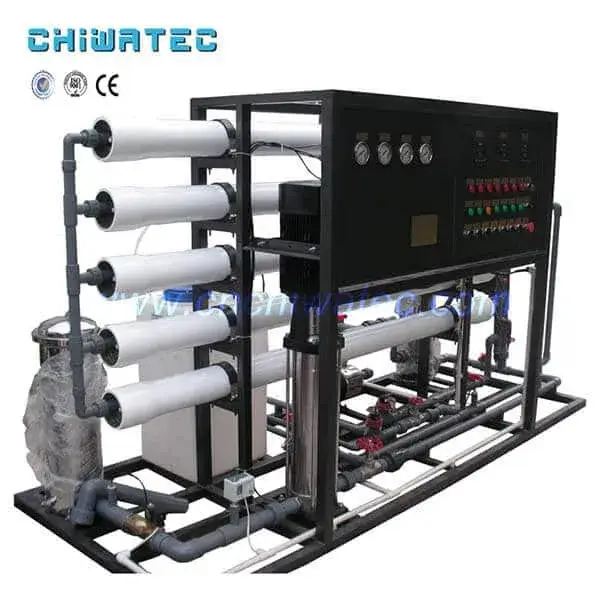
A complete RO reverse osmosis system consists of several key components working together to achieve effective water purification:
- Feedwater pump: Provides the required operating pressure. For brackish water systems, high-pressure pumps rated at 150-400 psi. For seawater systems, multistage centrifugal pumps capable of 800-1,200 psi.
- Pre-filtration system: Multi-media filters (for suspended solids removal down to 20-50 micron), cartridge filters (5 micron for membrane protection), and optionally ultrafiltration (UF) for high-SDI feedwaters.
- Antiscalant dosing system: Chemical injection system that prevents mineral scaling on membrane surfaces by inhibiting crystal formation.
- Membrane pressure vessels: Typically constructed from fiberglass-reinforced plastic (FRP) or stainless steel, rated for operating pressures up to 1,200 psi. Each vessel houses 1-7 spiral-wound membrane elements.
- RO membrane elements: The heart of the system — spiral-wound thin-film composite (TFC) polyamide membranes, typically 4-inch or 8-inch diameter, 40 inches long.
- Flow control valves: Concentrate (reject) control valve for adjusting system recovery rate, and permeate backpressure valve for maintaining stable operation.
- Instrumentation: Pressure gauges (feed, interstage, concentrate, permeate), flow meters (permeate and concentrate), conductivity/TDS meters (feed and permeate), and pH/ORP sensors.
- Control system: PLC-based controller with HMI interface for automatic operation, including start-up/flush sequences, cleaning triggers, and alarm management.
For a detailed visual breakdown of system components, see our guide on main process flow description of reverse osmosis pure water equipment.
3. How Does the RO Membrane Work at the Molecular Level?
The Semi-Permeable Membrane Structure
The RO membrane is a thin-film composite (TFC) structure, first developed by John Cadotte in the 1980s and now the industry standard. A modern TFC membrane consists of three layers:
- Polyamide active layer (0.1-0.2 micron): An ultra-thin cross-linked aromatic polyamide skin layer applied via interfacial polymerization. This layer provides the actual salt rejection function. The cross-linking density and surface charge determine the membrane selectivity.
- Polysulfone support layer (40-50 micron): A porous support that provides mechanical strength while offering minimal resistance to water flow. The pore size and porosity of this layer affect overall membrane flux.
- Polyester non-woven backing (100-150 micron): A structural backing that provides dimensional stability and allows the membrane to be rolled into spiral-wound elements.
Rejection Mechanism
Salt rejection occurs through a combination of size exclusion and electrostatic repulsion. Water molecules (2.75 Angstroms) pass through the polymer matrix via hydrogen bonding with amide groups, while hydrated ions like Na+ (7.2 Angstroms) and Cl- (6.6 Angstroms) are too large to pass through the polymer free volume. Additionally, the negative surface charge of the polyamide layer repels anions (Donnan exclusion effect), further enhancing rejection. Typical salt rejection for modern RO membranes is 99.0-99.8% for single-pass systems.
The CSM reverse osmosis membrane (manufactured by CSM, now part of Toray Industries) was developed in the 1960s and has undergone continuous refinement, achieving today’s high-performance standards with rejection rates exceeding 99.5% and stable operation across a wide pH range (2-11) and temperature range (5-45 degrees C).
4. What Is the Difference Between Osmosis and Reverse Osmosis?
Natural Osmosis vs. Reverse Osmosis
Understanding the distinction between these two processes is fundamental to grasping RO technology:
- Natural Osmosis: A spontaneous process where water molecules move from a low-solute-concentration region to a high-solute-concentration region across a semi-permeable membrane. This is a passive, naturally occurring phenomenon — no external energy is required. The driving force is the concentration gradient. Osmosis reaches equilibrium when the hydrostatic pressure on the concentrated side equals the osmotic pressure difference.
- Reverse Osmosis: A forced process where external pressure is applied to overcome natural osmotic pressure, reversing the direction of water flow. This is an active process requiring continuous energy input (pump operation). The driving force is the applied pressure minus the osmotic pressure difference.
Key Parameter: Osmotic Pressure
Osmotic pressure is directly proportional to the concentration of dissolved solutes. For a solution containing multiple ionic species, osmotic pressure can be approximated using the van Hoff equation:
Pi = iCRT
where Pi is osmotic pressure, i is the van Hoff factor (number of ions per molecule), C is molar concentration, R is the universal gas constant, and T is absolute temperature.
Practical examples: freshwater with 500 ppm TDS has an osmotic pressure of approximately 5 psi (0.3 bar); brackish water with 5,000 ppm TDS has approximately 50 psi (3.4 bar); and seawater with 35,000 ppm TDS has approximately 390 psi (27 bar).
5. What Are the Key Performance Parameters of RO Equipment?
Three Critical Operating Parameters
RO system performance is defined by three interrelated parameters that operators must monitor continuously:
- Permeate flow rate (flux): The volume of purified water produced per unit membrane area per unit time, typically expressed in gallons per square foot per day (GFD) or liters per square meter per hour (LMH). Standard design flux: 10-15 GFD (17-25 LMH) for brackish water, 8-12 GFD (14-20 LMH) for seawater. Higher flux rates increase productivity but accelerate fouling.
- Salt rejection (%): The percentage of dissolved solids removed by the membrane. Calculated as (1 – permeate TDS / feed TDS) x 100%. Modern TFC membranes achieve 99.0-99.8% rejection for single-pass systems. Salt passage (the complement) is a more sensitive indicator of membrane integrity.
- Recovery rate (%): The percentage of feedwater converted to permeate. Calculated as (permeate flow / feed flow) x 100%. Higher recovery reduces concentrate disposal volume but increases scaling potential. Typical recovery: 75-85% for brackish water, 40-50% for seawater single-pass.
Standard Operating Conditions
RO membranes are designed to operate within specific parameter ranges: feedwater pH 2-11 (continuous), 6.5-8.5 (optimal); feedwater temperature 5-45 degrees C, 20-28 degrees C (optimal); maximum feedwater SDI 5.0, recommended below 3.0; maximum free chlorine exposure 0.1 ppm (for polyamide membranes); and maximum operating pressure 600 psi (42 bar) for brackish water elements, 1,200 psi (83 bar) for seawater elements.
6. What Are the Different Types of RO Systems and Configurations?
System Configurations by Application
- Single-pass RO: Water passes through one membrane array. Achieves 95-99% salt rejection. Suitable for most industrial and commercial applications where feedwater TDS is below 5,000 ppm and product water TDS below 100 ppm is acceptable.
- Double-pass RO: Permeate from the first pass becomes feedwater for the second pass. Achieves 99.5-99.9% total rejection. Used for pharmaceutical water (USP purified water), electronics-grade water, and boiler feedwater where ultra-high purity is required.
- Two-stage RO: Concentrate from the first stage feeds a second stage with higher-pressure elements. Increases overall system recovery to 85-90% for brackish water. Common in high-recovery industrial applications.
- Seawater RO (SWRO): Single-pass or double-pass with high-pressure pumps (800-1,200 psi), energy recovery devices, and specialized seawater membrane elements. Typical recovery: 40-50%.
- Portable / containerized RO: Self-contained RO units in shipping containers or skids for emergency water supply, military applications, and remote installations.
For more information on equipment selection, refer to our guide on advanced water purification system process principles and flow diagram.
7. What Pretreatment Is Required Before RO Equipment?
Pretreatment Objectives
Proper pretreatment is the most critical factor for reliable RO system operation. The primary goals are to remove or reduce foulants that would otherwise damage the membranes or accelerate fouling:
- Suspended solids removal: Multi-media filtration removes particles down to 20-50 micron. Cartridge or bag filtration (5 micron absolute) provides final protection. For high-turbidity feedwater, dissolved air flotation (DAF) or clarification may be needed upstream.
- Colloidal removal: Coagulation and flocculation followed by media filtration or ultrafiltration. Target SDI below 3.0 for reliable RO operation.
- Scale prevention: Antiscalant dosing (2-5 ppm) or acid injection for pH adjustment. For high-hardness feedwater, lime softening or ion exchange softening may be required upstream.
- Chlorine removal: Activated carbon filtration or sodium bisulfite injection to protect polyamide membranes from oxidation. Free chlorine residual must be reduced to below 0.1 ppm.
- Iron and manganese removal: Greensand filtration, aeration followed by media filtration, or ion exchange for concentrations above 0.3 ppm (iron) or 0.05 ppm (manganese).
- Organic removal: Coagulation, activated carbon, or ultrafiltration for feedwater with high TOC or NOM content.
8. How Is RO System Performance Monitored and Maintained?
Performance Monitoring Best Practices
Continuous performance monitoring is essential for maximizing RO equipment service life. Key monitoring practices include:
- Normalized data tracking: All operating data must be normalized to standard conditions (typically 25 degrees C) to account for temperature variations. A 1 degree C increase in feedwater temperature increases permeate flow by approximately 3%.
- Daily log parameters: Feed, permeate, and concentrate flow rates; feed and permeate conductivity/TDS; feed, interstage, and concentrate pressures; feedwater temperature, pH, and SDI.
- Cleaning triggers: Normalized permeate flow decrease of 10-15% from baseline; normalized salt passage increase of 10-15%; normalized differential pressure increase of 15-20%.
- Preventive maintenance: Calibrate instruments quarterly, replace cartridge filters when dp exceeds 10-15 psi, inspect high-pressure piping for corrosion annually, and verify antiscalant dosing accuracy monthly.
9. What Applications Use RO Reverse Osmosis Equipment?
Major Application Sectors
RO equipment is used across virtually every industry that requires purified water:
- Drinking water production: Municipal water treatment plants use RO for brackish water desalination, fluoride/nitrate/arsenic removal, and taste/odor improvement. RO is particularly valuable in water-stressed regions.
- Seawater desalination: SWRO plants now provide over 100 million cubic meters of fresh water per day globally, with the largest plants producing 500,000-600,000 m3/day.
- Pharmaceutical and biotechnology: RO is the first stage in USP purified water and WFI (water for injection) production systems, typically followed by electrodeionization (EDI) and distillation.
- Food and beverage: Process water for brewing, soft drinks, bottled water, juice concentration, dairy processing, and sugar refining.
- Electronics and semiconductor: Ultra-pure water (18.2 Mohm-cm resistivity) for wafer cleaning and rinsing, typically using double-pass RO with EDI and UV treatment.
- Power generation: Boiler feedwater treatment for high-pressure steam generators, where feedwater conductivity must be below 0.1 microS/cm to prevent tube scaling and corrosion.
- Oil and gas: Produced water treatment, injection water for enhanced oil recovery, and process water for refining operations.
10. What Factors Affect the Cost and Efficiency of RO Systems?
Cost Drivers in RO System Operation
The total cost of operating RO equipment includes capital costs (equipment, installation) and operating costs (energy, chemicals, membranes, labor):
- Energy consumption: The largest operating cost component, accounting for 30-50% of total operating costs. Brackish water RO: 0.5-1.5 kWh/m3 of permeate. Seawater RO without ERD: 4-6 kWh/m3. Seawater RO with ERD: 2.5-3.5 kWh/m3.
- Membrane replacement: Typically 10-20% of annual operating costs. Membrane life: 5-7 years for well-maintained systems, 2-4 years for systems with poor pretreatment. Replacement cost: USD 30-80 per 8-inch element depending on specification.
- Chemical costs: Antiscalants (USD 2-5 per kg), cleaning chemicals (USD 3-10 per kg), and pretreatment chemicals (coagulants, chlorine, dechlorinating agents). Annual chemical cost typically represents 5-10% of total operating costs.
- Labor and maintenance: Regular monitoring, cleaning operations, and instrument calibration. Typically 15-25% of operating costs.
Efficiency Optimization Strategies
Key strategies for reducing RO operating costs include: (1) installing energy recovery devices for seawater systems (reduces energy consumption by 40-60%), (2) optimizing recovery rate within scaling limits (every 5% increase in recovery reduces concentrate disposal volume by 15-25%), (3) implementing demand-based cleaning schedules using normalized performance data rather than fixed calendars, and (4) selecting the right membrane type for the specific feedwater composition to minimize fouling and maximize rejection efficiency.
For custom-designed RO systems optimized for your specific application and feedwater conditions, CHIWATEC provides complete engineering, manufacturing, and commissioning services for industrial and commercial RO equipment worldwide.
Conclusión
Reverse osmosis equipment represents the most advanced and widely used membrane-based water purification technology available today. By applying external pressure greater than natural osmotic pressure, RO systems force water molecules through semi-permeable membranes, achieving 99.0-99.8% removal of dissolved salts, minerals, and contaminants. Understanding the working principles — from the thin-film composite membrane structure to the three critical performance parameters (flux, rejection, recovery) — is essential for effective system operation, maintenance, and troubleshooting. As membrane technology continues to advance toward higher rejection, lower energy consumption, and greater fouling resistance, RO will remain the cornerstone of modern water treatment for decades to come.
Contact CHIWATEC today at [email protected] o [email protected] (WhatsApp: +86 18292684865) for professional guidance on RO system design, equipment selection, and operational optimization tailored to your specific water treatment requirements.
Frequently Asked Questions
Q1: What is the difference between RO and UF membranes?
RO (reverse osmosis) and UF (ultrafiltration) are both membrane filtration technologies, but they differ fundamentally in pore size and separation capability. RO membranes have a dense non-porous active layer (pore size approximately 0.0001 micron, essentially molecular-level) that removes dissolved salts, ions, and small organic molecules. UF membranes have physical pores (0.01-0.1 micron) that remove suspended solids, colloids, bacteria, and viruses but allow dissolved salts to pass through. RO operates at high pressure (150-1,200 psi) while UF operates at low pressure (15-50 psi). RO is used for desalination and high-purity water, while UF is used for pretreatment, wastewater treatment, and specific industrial separations.
Q2: How long do RO membranes typically last?
Under optimal operating conditions with proper pretreatment, monitoring, and cleaning, RO membranes typically last 5-7 years for brackish water applications and 3-5 years for seawater applications. Factors that reduce membrane life include: inadequate pretreatment (the most common cause), infrequent or ineffective cleaning, chlorine or oxidant exposure, operating at elevated temperature (>40 degrees C) or extreme pH (<2 or >12), and frequent start-stop cycling that causes pressure fluctuations.
Q3: Can RO equipment remove all contaminants from water?
RO membranes are highly effective but do not remove 100% of all contaminants. Typical rejection rates: dissolved salts (99.0-99.8%), bacteria and viruses (99.9%+), organic compounds (90-99% depending on molecular weight), heavy metals (95-99%), and pesticides/herbicides (90-99%). However, some low-molecular-weight organic compounds (e.g., certain solvents with molecular weight below 50 Da) and dissolved gases (CO2, H2S, NH3) can pass through RO membranes with lower rejection. Boron rejection is typically 70-90% at standard pH, requiring double-pass or high-pH operation for stringent boron limits.
Q4: What is the ideal feedwater temperature for RO operation?
The ideal operating temperature for most RO systems is 20-28 degrees C. Within this range, membranes achieve their rated performance (flow and rejection). At higher temperatures (above 30 degrees C), permeate flow increases (approximately 3% per degree C) but salt passage also increases, and the risk of biological fouling accelerates. At lower temperatures (below 15 degrees C), water viscosity increases, reducing permeate flow by approximately 1.5-2% per degree C below 25 degrees C, and the system may require higher operating pressure to maintain design production rates.
Q5: Do RO systems require regular maintenance?
Yes, regular maintenance is essential for reliable RO system operation. Key maintenance tasks include: daily logging of operating parameters (flow, pressure, conductivity, temperature); weekly SDI measurement and antiscalant tank level check; monthly calibration of conductivity and pH instruments, inspection of high-pressure piping and fittings; quarterly replacement of cartridge filters, verification of antiscalant dosing accuracy; annually membrane autopsy of a representative element (for systems with fouling history), overhaul of high-pressure pumps; and as needed membrane cleaning when normalized performance triggers are reached.
Related Resources and Further Reading
- Main Process Flow Description of Reverse Osmosis Pure Water Equipment — Detailed breakdown of RO system process flow, from feedwater intake to permeate output
- Advanced Water Purification System: Process Principles and Flow Diagram — Comprehensive analysis of advanced water purification technology and system design
- Essential Conditions and Procedures for Installing Reverse Osmosis Systems — Installation requirements, site preparation, and commissioning procedures for RO equipment
- The Dangers of Reverse Osmosis Concentration Polarization and How to Eliminate — Understanding concentration polarization and its impact on RO membrane performance
- Best Practices for Antiscalant Treatment and Dosing in Reverse Osmosis Systems — Antiscalant selection, dosing calculations, and monitoring for RO scale prevention
¿Tiene un proyecto de tratamiento de agua con el que podamos ayudar?
* Diseño, mecanizado, instalación, puesta en marcha, personalización y servicio integral






 Spanish
  English
  Portuguese




