

Reverse Osmosis Separation Mechanism: Understanding RO Membrane Desalination Principles and Mass Transfer Models
Explore the scientific reverse osmosis separation mechanism — from dissolution-diffusion to hydrogen bond theory — and understand how these RO membrane desalination principles enable efficient water purification worldwide.
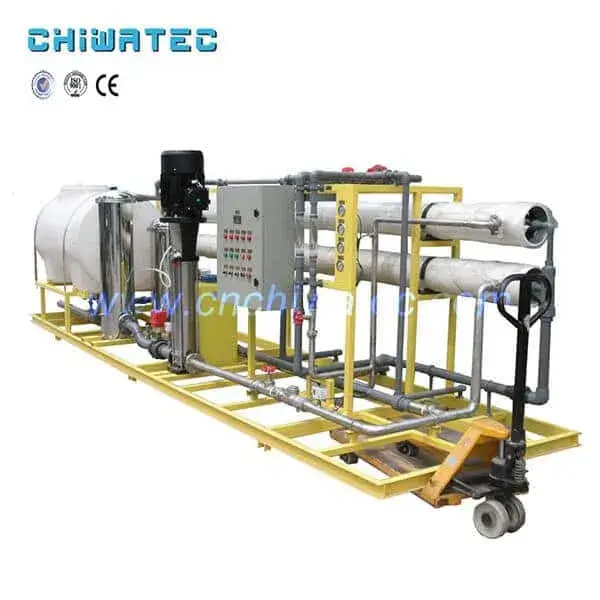
Principios básicos de los equipos de ósmosis inversa
los reverse osmosis separation mechanism is grounded in a fundamental natural phenomenon: osmosis. When pure water and a saline solution are separated by an ideal semi-permeable membrane — a barrier that permits only water molecules to pass while blocking dissolved salts — water spontaneously flows from the pure water side to the saline side. This natural process is called osmosis.
If external pressure is applied to the saline side, the spontaneous water flow slows and eventually stops. The pressure at which net water flow reaches zero is defined as the osmotic pressure of the solution — a parameter directly proportional to the concentration of dissolved salts. When the applied pressure exceeds the osmotic pressure, the direction of water flow reverses: water molecules now migrate from the saline side to the pure water side, leaving dissolved salts behind. This reversal — reverse osmosis (RO) — is the fundamental operating principle behind every Sistema de tratamiento de agua por ósmosis inversa worldwide.
The practical significance of this mechanism is immense. The global reverse osmosis membrane market was valued at approximately USD 11.2 billion in 2024 and is projected to reach USD 19.8 billion by 2032, growing at a CAGR of 7.4% (Grand View Research, 2024). This growth is driven by the fundamental efficiency of the RO separation mechanism, which achieves salt rejection rates of 95-99.7% while consuming only 3-6 kWh per 1,000 gallons of purified water — a fraction of the energy required by thermal desalination methods.
Three Core Theories of the Reverse Osmosis Separation Mechanism
Over decades of membrane research, three principal RO membrane separation theories have emerged to explain how reverse osmosis membranes achieve molecular-level separation. These models — the dissolution-diffusion model, the preferential sorption-capillary flow theory, and the hydrogen bond theory — each provide unique insights into the RO membrane desalination principle at different scales of analysis.
1. Modelo de disolución-difusión
los dissolution-diffusion model, proposed by Lonsdale, Merten, and Riley in 1965, is the most widely accepted theory for describing the reverse osmosis separation mechanism in dense polymeric membranes. This model treats the active skin layer of the RO membrane as a homogeneous, non-porous film — a critical distinction from porous filtration membranes such as UF or MF.
The model assumes that both solute and solvent dissolve into the membrane material at the feed-side interface and then diffuse through the membrane under a chemical potential gradient (driven by concentration and pressure differences). The separation occurs because of differences in the solubility and diffusivity of water and salt molecules within the membrane polymer matrix. Water molecules, being smaller and more polar, exhibit significantly higher solubility and diffusion rates in the hydrophilic membrane material compared to hydrated salt ions.
The transport process follows three sequential steps:
- Sorption: Solute and water molecules are adsorbed and dissolved into the membrane surface on the feed (high-pressure) side
- Diffusion: Molecules diffuse through the membrane active layer driven by their respective chemical potential gradients — water diffuses rapidly, while ions diffuse slowly
- Desorption: Molecules leave the membrane at the permeate (low-pressure) side
The model assumes that the first and third steps occur rapidly, meaning the diffusion step (step 2) is rate-determining. The selectivity of the membrane is therefore governed by the ratio of water-to-salt diffusivity and solubility in the membrane material — a key insight for membrane material design and optimization.
En el proceso anterior de penetración de soluto y disolvente en la membrana, generalmente se supone que los pasos primero y tercero se llevan a cabo muy rápidamente. En este momento, la velocidad de permeación depende del segundo paso, es decir, el soluto y el solvente son impulsados por el medio de difusión molecular a través de la membrana. debido a
The selectivity of “membrane” enables the separation of gas mixture or liquid mixture. The permeability of a substance depends not only on the diffusion coefficient, but also on its solubility in the membrane.
2. Adsorción prioritaria: teoría del flujo capilar
When different kinds of substances are dissolved in the liquid, the surface tension will change differently. For example, organic substances such as alcohols, acids, aldehydes, and fats dissolved in water can reduce the surface tension, but the dissolution of certain inorganic salts will increase the surface tension slightly. This is because the solute dispersion is uneven That is, the concentration of the solute in the surface layer of the solution is different from the concentration inside the solution. This is the surface adsorption phenomenon of the solution. When the aqueous solution is in contact with the polymer porous membrane, if the membrane’s chemical properties make the membrane negatively adsorb solutes and preferentially adsorb water, a layer of pure water with a certain thickness will be formed on the interface between the membrane and the solution. . Under the action of external pressure, it will pass through the capillary pores on the membrane surface to obtain pure water.
3. Teoría del enlace de hidrógeno
los hydrogen bond theory provides a molecular-level explanation of the RO membrane desalination principle, particularly for cellulose acetate membranes — the first commercially successful RO membrane material. In cellulose acetate, polymer chains are organized into two distinct regions:
- Crystalline phase regions: Polymer chains are firmly bonded and arranged in parallel — water and solutes cannot enter these regions
- Amorphous phase regions: Polymer chains are disordered, creating spaces where water and solutes can interact with the membrane material
Near the cellulose acetate molecule, water molecules form hydrogen bonds with oxygen atoms on the carbonyl group (-C=O) of the cellulose acetate, creating a layer of structured (bound) water. This first adsorbed layer exhibits significantly reduced molecular mobility — approaching an ice-like structure with greatly reduced entropy. Within the amorphous regions, the bound water occupancy is low, leaving space for bulk (unstructured) water in the pore centers.
Under applied pressure, water molecules engage in a sequential hydrogen bonding and dissociation process: a water molecule forms a hydrogen bond with an activation site (the carbonyl oxygen) on the cellulose acetate chain, while simultaneously breaking its prior hydrogen bond. The molecule then moves to the next activation site, forms a new hydrogen bond, and the cycle repeats. Through this continuous formation-breaking-reformation sequence, water molecules migrate through the dense active layer of the membrane and into the porous support layer below.
Once in the porous support layer — which contains abundant capillary water — water molecules flow freely to the permeate side. Ions and molecules that cannot form hydrogen bonds with the membrane material (such as Na+ and Cl-) are effectively excluded from this transport mechanism and remain on the feed side. The hydrogen bond theory elegantly explains the high water permeability of cellulose acetate RO membranes despite their dense, non-porous active layer structure — water moves through the membrane not through physical pores, but through a dynamic network of continuously forming and breaking hydrogen bonds.
RO Membrane Separation Performance Metrics
The effectiveness of the reverse osmosis separation mechanism is quantified through several key performance parameters used throughout the desalination industry:
Salt Rejection Rate
Defined as the percentage of dissolved solids removed from feed water: Salt Rejection (%) = (1 – Cp/Cf) x 100, where Cp is permeate concentration and Cf is feed concentration. Commercial RO membranes achieve 95-99.7% salt rejection, with high-rejection seawater RO membranes reaching 99.8%+ for NaCl.
Water Flux
The volume of permeate produced per unit membrane area per unit time, typically expressed in L/m2/h (LMH) o GFD (gallons/ft2/day). Typical RO flux ranges: seawater RO 8-15 LMH, brackish water RO 15-30 LMH. Flux is directly proportional to net driving pressure (applied pressure minus osmotic pressure) and membrane permeability.
Recovery Rate
The percentage of feed water converted to permeate: typically 35-50% for single-pass seawater RO, 65-85% for brackish water RO, and up to 90-95% for multi-stage systems. Recovery is limited by the osmotic pressure of the concentrated brine stream — as recovery increases, the brine osmotic pressure approaches the applied pressure, reducing the net driving force for separation.
Specific Energy Consumption
Modern RO systems with energy recovery devices consume 2.5-4.0 kWh/m3 for seawater desalination and 0.5-1.0 kWh/m3 for brackish water — a dramatic improvement from the 8-10 kWh/m3 of first-generation RO plants in the 1970s.
From Theory to Practice: How the RO Separation Mechanism Drives System Design
Understanding the reverse osmosis separation mechanism has direct implications for practical RO system design and operation:
Membrane Material Selection
The dissolution-diffusion model explains why thin-film composite (TFC) polyamide membranes dominate the market — they offer an optimal balance of water solubility, salt diffusivity, and mechanical strength. TFC membranes achieve 2-3x higher flux than earlier cellulose acetate membranes while maintaining equivalent or better salt rejection.
Operating Pressure Optimization
The model predicts that increasing feed pressure improves both water production and permeate quality — but also increases energy costs. Modern plants optimize pressure using variable frequency drives (VFDs) to balance productivity against specific energy consumption.
Membrane Fouling and Scaling Management
Any deposit on the membrane surface disrupts the sorption-diffusion-desorption sequence, reducing effective membrane area and altering the preferential sorption layer. This is why pretreatment (UF, cartridge filtration, antiscalant dosing) is critical — it preserves the integrity of the RO separation mechanism by preventing foulants from reaching the membrane surface.
Multi-Stage Array Configuration
Understanding the relationship between osmotic pressure, applied pressure, and recovery rate guides the design of multi-stage RO arrays — staging concentrate streams through successive membrane banks increases overall recovery while maintaining adequate net driving pressure in each stage.
Conclusion: The Evolving Understanding of RO Separation
los reverse osmosis separation mechanism continues to be refined as membrane science advances. While the dissolution-diffusion model remains the industry standard, modern research is revealing additional complexities — including molecular dynamics simulations that model water and ion transport at the atomic scale, and advanced characterization techniques (positron annihilation spectroscopy, neutron reflectometry) that probe membrane structure at unprecedented resolution.
Emerging membrane materials — from graphene oxide membranes with water transport channels to biomimetic aquaporin-based membranes — may challenge our current theoretical frameworks while opening new frontiers in desalination efficiency. The RO separation mechanism, first described in the 1960s, remains an active area of scientific inquiry more than six decades later — a testament to both the elegance of the original models and the continuing importance of understanding water transport at the molecular scale.
Frequently Asked Questions About the Reverse Osmosis Separation Mechanism
Is reverse osmosis a physical or chemical separation process?
RO separation is primarily a physical process driven by pressure and molecular diffusion, not chemical reaction. However, the transport involves physicochemical interactions (hydrogen bonding, van der Waals forces, electrostatic repulsion) between water molecules, salt ions, and the membrane polymer — making it a physicochemical separation at the molecular scale.
Why does RO remove salt but UF does not?
RO membranes are dense, non-porous at the active layer — separation occurs via dissolution and diffusion, not physical sieving. UF membranes have measurable pores (0.01-0.1 µm) that physically block particles but allow dissolved ions to pass freely. This fundamental difference in separation mechanism explains why RO achieves >99% salt rejection while UF rejects <5%.
What limits the maximum salt rejection of RO membranes?
Theoretical salt rejection is limited by the intrinsic selectivity of the membrane material — the ratio of water-to-salt solubility and diffusivity in the polymer matrix. In practice, rejection is also affected by concentration polarization (elevated salt concentration at the membrane surface), membrane imperfections, and operating conditions (pressure, temperature, feed salinity).
How does temperature affect the RO separation mechanism?
Higher feed water temperature increases both water and salt diffusion rates through the membrane. Water flux increases by approximately 3% per C (due to reduced water viscosity and increased diffusivity), but salt passage also increases. The net effect is that salt rejection slightly decreases at elevated temperatures — a critical consideration for RO systems treating warm industrial effluent or seawater in tropical climates.
Can the dissolution-diffusion model predict RO membrane performance for all water chemistries?
The model performs well for simple NaCl solutions but has limitations for complex feed waters containing organic compounds, colloidal silica, or mixed electrolytes. Modern solution-diffusion-electromigration models extend the framework to account for electrostatic effects, ion coupling, and charge interactions — providing more accurate predictions for challenging industrial and municipal water sources.
Further Reading
Explore these related articles for deeper insights into reverse osmosis technology and membrane science:
- Complete Guide to Reverse Osmosis (RO) System Operation and Maintenance — Practical RO operation and troubleshooting guidance
- Pollution Control Methods for Reverse Osmosis (RO) Systems — Understanding and mitigating membrane fouling in RO systems
- Best Practices for Antiscalant Treatment in RO Systems — Chemical pretreatment strategies informed by RO separation theory
- Advanced Water Purification System: Process Principles and Flow Diagram — Process flow and design principles for multi-stage purification
- Essential Conditions and Procedures for Installing Reverse Osmosis Systems — Installation requirements based on RO system design principles
¿Tiene un proyecto de tratamiento de agua con el que podamos ayudar?
* Diseño, mecanizado, instalación, puesta en marcha, personalización y servicio integral






 Spanish
  English
  Portuguese




