

Principle and Application of the Reverse Osmosis Process: Advanced Water Purification Technology Explained
1. What is Reverse Osmosis Technology?
Reverse osmosis (RO) is one of the most advanced and energy-efficient separation technologies available today. The principle behind reverse osmosis is based on selective permeability — where a semipermeable membrane allows only water molecules to pass through while rejecting dissolved salts, organics, and other impurities.
When pressure greater than the natural osmotic pressure is applied to a contaminated solution, pure water flows through the membrane, leaving behind a concentrated solution of impurities. This process effectively removes:
- Dissolved salts and minerals (TDS)
- Colloids and suspended solids
- Materia orgánica
- Bacteria and microorganisms
Key Advantages of Reverse Osmosis Systems:
- Low energy consumption
- Chemical-free and pollution-free operation
- Compact system design
- Easy operation and low maintenance
- Reliable, high-quality water output
Reverse osmosis has become a cornerstone of modern water purification, widely used in industrial, commercial, and residential applications.
2. Application Status of Reverse Osmosis Membranes
In recent years, tecnología de ósmosis inversa has become the fastest-growing membrane separation technology in China and globally. It dominates the market due to its high purification efficiency and versatility across industries.
Major Application Fields:
- Industrial and Boiler Feed Water:
Large-scale industries rely on RO systems to produce ultra-pure water for boiler feed, chemical processing, and cooling systems, ensuring equipment longevity and efficiency. - Drinking Water Production:
RO membranes are widely used for domestic and municipal water purification, removing hardness, bacteria, and contaminants from tap or groundwater sources. - Electronics and Semiconductor Manufacturing:
High-purity water is crucial for cleaning integrated circuits, wafers, and displays, ensuring product quality and reliability. - Pharmaceutical and Medical Applications:
Used in producing injections, infusions, and biochemical solutions, where water quality directly affects safety and effectiveness. - Food and Beverage Industry:
RO systems ensure consistent purity for beverages, beer, liquor, and health products, removing unwanted minerals and improving flavor. - Environmental and Metallurgical Applications:
For wastewater recycling, heavy metal recovery, and acid mine drainage treatment. - Desalination and Reuse Projects:
RO technology is central to seawater and brackish water desalination, supplying freshwater to islands, offshore platforms, and coastal cities.

3. Latest Developments and Trends in Reverse Osmosis Membrane Technology
As industrial water demands increase, new innovations are shaping the future of RO membrane performance:
a. Ultra-Low Pressure (ULP) Membranes
Introduced since 1996, ULP membranes operate at lower pressures, reducing energy consumption y mechanical wear while maintaining high salt rejection rates. They are ideal for small to medium-sized treatment plants using 4-inch or 8-inch membrane modules.
b. Low-Fouling Membranes
Membrane fouling is one of the major challenges in RO applications, leading to reduced efficiency and increased maintenance costs.
Modern low-fouling membranes offer:
- Strong anti-pollution performance
- Longer service life
- Less frequent cleaning cycles
- Easier chemical cleaning and system recovery
c. Positively Charged RO Membranes
Most conventional membranes are negatively charged. Newly developed positively charged membranes improve the removal of silica, colloids, and organic compounds, making them suitable for ultra-pure and high-resistivity water systems used in the electronics and pharmaceutical industries.
d. High-Temperature and Food-Grade RO Membranes
Standard RO membranes typically operate between 0°C and 45°C.
However, for special applications requiring sterilization at 90°C or above, high-temperature-resistant RO membranes are now available.
Additionally, food-grade and sanitary-grade membranes are increasingly adopted in food processing, beverage, and dairy industries, ensuring hygienic and safe water purification.
4. Application Areas of Reverse Osmosis Equipment
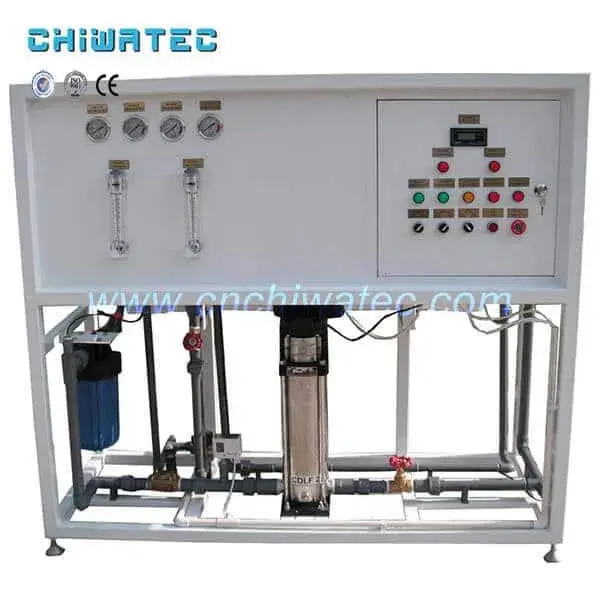
CHIWATEC’s advanced RO systems are widely applied across multiple sectors, including:
| Industry | Application Examples |
|---|---|
| Electronics | Integrated circuits, display tubes, electrode foils, semiconductor rinsing |
| Farmacéutico | Injections, large infusions, tablets, medical cleaning systems |
| Chemical Industry | Chemical process water, circulating cooling water, fertilizer manufacturing |
| Power Generation | Boiler feed water, power plant condensate polishing |
| Food & Beverage | Bottled water, beverages, beer, liquor, health products |
| Seawater & Brackish Water | Desalination for islands, ships, offshore platforms |
| Residential & Commercial | Drinking water systems, residential RO units, hotel and resort applications |
| Other Industries | Automotive coating, glass processing, cosmetics, textiles, printing, and dyeing |
Each application benefits from custom-engineered RO systems designed to meet precise water quality standards and operational demands.
Conclusión
los reverse osmosis process is at the heart of modern water purification — delivering safe, reliable, and sustainable solutions for industries and communities worldwide.
Through continuous innovation in membrane design, energy efficiency, and system integration, CHIWATEC remains a leader in providing high-performance RO water treatment systems.
Whether for industrial process water, wastewater recycling, or seawater desalination, reverse osmosis technology continues to shape the future of clean water production y environmental protection.
FAQ
Q1: What is the main principle behind the reverse osmosis process?
A: Reverse osmosis works by applying pressure to push water through a semipermeable membrane, allowing pure water to pass while rejecting salts, organics, and other contaminants.
Q2: What are the advantages of using reverse osmosis systems?
A: RO systems offer high purification efficiency, low energy use, minimal chemical requirements, and easy operation — making them ideal for industrial and domestic use.
Q3: What industries use reverse osmosis technology?
A: Major industries include pharmaceuticals, electronics, power generation, food & beverage, and desalination sectors.
Q4: What causes RO membrane fouling and how can it be prevented?
A: Fouling occurs when suspended solids or organic matter accumulate on the membrane surface. Using pre-filtration systems y low-fouling membranes helps extend membrane life.
Q5: Can reverse osmosis treat seawater or brackish water?
A: Yes. Reverse osmosis is the most effective technology for seawater desalination, providing fresh, potable water from saline sources.
Xian CHIWATEC Water Treatment Technology es una empresa de alta tecnología especializada en varios dispositivos de procesamiento de agua. Aparte de estos productos individuales, que cubren una serie de tipos y series, también podemos ayudar con proyectos de ingeniería integrales relacionados. Gracias a nuestro arduo trabajo y dedicación desde nuestra fundación, ahora somos uno de los fabricantes de equipos de tratamiento de agua de más rápido desarrollo en el oeste de China.
Otras lecturas:
- Fundamentos de la tecnología de ósmosis inversa
- Equipo de ósmosis inversa Chiwatec RO: Introducción a la tecnología de ósmosis inversa
- What is the importance of reverse osmosis technology
- Introducción del sistema de tratamiento de agua por ósmosis inversa: equipo de ósmosis inversa, tecnología de ósmosis inversa, sistema de agua pura por ósmosis inversa
¿Tiene un proyecto de tratamiento de agua con el que podamos ayudar?
* Diseño, mecanizado, instalación, puesta en marcha, personalización y servicio integral






 Spanish
  English
  Portuguese




