

Pharmaceutical Purified Water System: GMP Certified Equipment Guide 2026
Introduction to Pharmaceutical Water Treatment Systems
Pharmaceutical purified water systems are critical infrastructure for drug manufacturing, ensuring water quality meets stringent pharmacopoeia standards and GMP (Good Manufacturing Practice) regulations. According to the Pharmaceutical Engineering 2026 report, the global pharmaceutical water treatment market is valued at USD 12.8 billion, with a projected CAGR of 7.2% through 2031, driven by increasing regulatory requirements and expanded pharmaceutical production capacity worldwide.
A compliant pharmaceutical purified water system must consistently produce water meeting resistivity ≥0.5MΩ·CM (conductivity ≤2μS), with strict limits on ammonia (≤0.3μg/ml), nitrate (≤0.06μg/ml), and heavy metals (≤0.5μg/ml). This comprehensive guide covers GMP certification requirements, water quality standards, treatment processes, and 2026 industry best practices.
GMP Certification Requirements for Pharmaceutical Water Equipment
GMP certified purified water equipment in the pharmaceutical industry must satisfy three core compliance criteria:
Water Quality Compliance
All systems must consistently meet the 2000 edition pharmacopoeia standards and GMP regulations. This includes continuous monitoring of conductivity, TOC (Total Organic Carbon), microbial counts, and endotoxin levels. Modern systems incorporate real-time sensors with automated alerts and data logging for regulatory audits.
Automated Operation and Control
Equipment must feature fully automatic operation with conditional automated processing procedures including:
- Backwashing: Automatic filter cleaning based on pressure differential or timed intervals
- Regeneration: Automated resin regeneration for ion exchange systems
- Pickling: CIP (Clean-in-Place) acid cleaning for scale removal
- Disinfection: Automated thermal or chemical disinfection cycles to control microbial growth
GMP-Compliant Materials and Construction
Monomer and piping equipment must meet GMP requirements:
- Post-treatment Equipment: Sterilizers, membrane filters, terminal water tanks, and pipelines constructed from 316L stainless steel with electropolished interiors (Ra ≤0.6μm)
- Pretreatment Equipment: UPVC (unplasticized polyvinyl chloride) pipes for corrosion resistance and contamination prevention
- Sanitary Design: Zero dead-leg piping, orbital welds, and drainable configurations to prevent microbial harborage
Pharmaceutical Purified Water Quality Standards
Water quality parameters for pharmaceutical purified water systems include:
- Resistivity: ≥0.5MΩ·CM at 25°C
- Conductivity: ≤2μS/cm (microsiemens per centimeter)
- Ammonia (NH₃): ≤0.3μg/ml
- Nitrate (NO₃⁻): ≤0.06μg/ml
- Heavy Metals: ≤0.5μg/ml (as Pb)
- TOC: ≤500 ppb (per USP <643>)
- Microbial Count: ≤100 CFU/ml (action level)
- Endotoxin: ≤0.25 EU/ml (for Water for Injection)
These standards align with USP (United States Pharmacopeia), EP (European Pharmacopoeia), and ChP (Chinese Pharmacopoeia) requirements, ensuring global regulatory compliance.
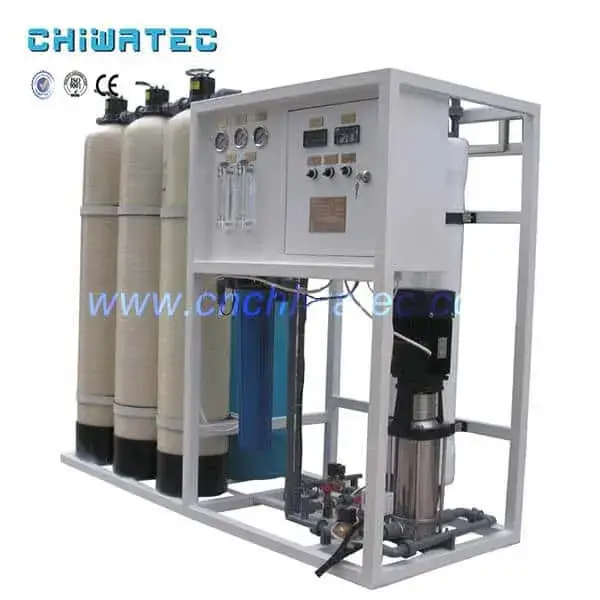
Typical Pharmaceutical Pure Water Preparation Processes
Three primary process configurations are used in pharmaceutical water treatment, each offering distinct advantages based on feed water quality and production requirements:
Process 1: Dual-Stage RO with UV and Final Filtration (New Technology)
Flow Path: Raw water → Raw water pressurization pump → Multi-media filter → Activated carbon filter → Water softener → Precision filter → First stage reverse osmosis → PH adjustment → Intermediate water tank → Second stage reverse osmosis → Purified water tank → Pure water pump → Ultraviolet sterilization → Microporous filter → Use points
Advantages: This modern configuration eliminates chemical regeneration, offers consistent water quality, and requires minimal operator intervention. Recommended for new installations seeking reduced operational costs and environmental compliance.
Process 2: RO with Ion Exchange Polishing (Traditional Technology)
Flow Path: Raw water → Raw water pressurizing pump → Multi-media filter → Activated carbon filter → Water softener → Precision filter → Primary reverse osmosis equipment → Intermediate water tank → Intermediate water pump → Ion exchanger → Purified water tank → Pure water pump → Ultraviolet sterilizer → Microporous filter → Use points
Advantages: Proven technology with lower initial capital cost. Suitable for facilities with existing ion exchange infrastructure or specific water quality requirements.
Process 3: RO with EDI System (Advanced Technology)
Flow Path: Raw water → Raw water pressurizing pump → Multi-media filter → Activated carbon filter → Water softener → Precision filter → First-stage reverse osmosis machine → Intermediate water tank → Intermediate water pump → EDI system → Purified water tank → Pure water pump → Ultraviolet sterilizer → Microporous filter → Use points
Advantages: EDI (Electrodeionization) combines ion exchange resins with ion-selective membranes and DC electrical current for continuous deionization without chemical regeneration. This represents the latest technology for pharmaceutical water systems, offering consistent high-purity water production with minimal environmental impact.
Reverse Osmosis Technology in Pharmaceutical Water Systems
Historical Development and Regulatory Acceptance
Reverse osmosis (RO) technology for pure water production was developed in the 1960s and has become the cornerstone of pharmaceutical water treatment. The “United States Pharmacopoeia” (USP) began including RO as a legal method for preparing water for injection from the 19th edition, recognizing its efficacy and reliability.
RO Mechanism and Operation
Reverse osmosis is the reverse process of natural osmosis. It forces the solvent component (water) through a semi-permeable membrane using applied pressure, retaining solute components (dissolved salts, organics, microorganisms). The process achieves:
- Salt Removal: 95-99%+ rejection of dissolved ions
- Organic Removal: >99% removal of molecules >200 Daltons
- Microbial Control: Complete removal of bacteria, viruses, and pyrogens
- Operational Efficiency: Simple operation process with relatively economical energy consumption
2026 RO Technology Advances
Modern pharmaceutical RO systems feature:
- Low-Fouling Membranes: Enhanced surface chemistry reduces biofouling and scaling
- Energy Recovery Devices: Reduce energy consumption by 40-60%
- Smart Monitoring: IoT-enabled sensors for real-time performance tracking and predictive maintenance
- Validated Sanitization: Hot water sanitization (80-85°C) or ozone sanitization for microbial control
2026 Industry Trends and Regulatory Updates
Key Market Drivers
- Stricter Regulatory Standards: Updated pharmacopoeia requirements for TOC, endotoxin, and microbial monitoring
- Biopharmaceutical Growth: Expanded capacity for biologics manufacturing requiring WFI (Water for Injection)
- Sustainability Initiatives: Water reuse, zero liquid discharge (ZLD), and energy optimization
- Digital Transformation: PAT (Process Analytical Technology) implementation for real-time quality assurance
Performance Benchmarks (2025-2026)
- Typical system recovery rates: 75-85% for RO systems
- Energy consumption: 2.5-4.5 kWh per cubic meter of purified water
- Microbial action levels: ≤10 CFU/ml for purified water (internal standards)
- System availability: >98% uptime with redundant configurations
Emerging Technologies
- Continuous EDI: Next-generation electrodeionization with improved current efficiency
- Ultrafiltration for WFI: Alternative to distillation per USP <1231>
- Ozone Sanitization: Chemical-free microbial control for distribution loops
- Single-Pass RO: Advanced membranes enabling single-pass configurations for specific applications
Conclusion: Selecting the Right Pharmaceutical Water System
Pharmaceutical purified water system selection requires careful evaluation of feed water quality, production capacity, regulatory requirements, and lifecycle costs. While traditional ion exchange systems offer lower initial costs, modern RO+EDI configurations provide superior operational efficiency, consistent water quality, and reduced environmental impact—making them the preferred choice for new GMP-certified facilities in 2026.
Key considerations include:
- Regulatory Compliance: Ensure system design meets current pharmacopoeia and GMP requirements
- Validation Support: Comprehensive documentation for IQ/OQ/PQ (Installation/Operational/Performance Qualification)
- Scalability: Modular designs accommodating future capacity expansion
- Service and Support: Reliable technical support for ongoing maintenance and regulatory audits
Xi’an CHIWATEC Water Treatment Technology is a high-tech enterprise specialized in various water processing devices and comprehensive pharmaceutical water treatment engineering projects. We provide GMP-compliant solutions from pretreatment through distribution, ensuring your facility meets the highest quality and regulatory standards.
Further Reading
¿Tiene un proyecto de tratamiento de agua con el que podamos ayudar?
* Diseño, mecanizado, instalación, puesta en marcha, personalización y servicio integral






 Spanish
  English
  Portuguese




