

EDI Ultrapure Water Equipment: Complete Guide to Electrodeionization Systems 2026
Meta Description: Complete guide to EDI (Electrodeionization) ultrapure water equipment in 2026. Learn how EDI systems produce 18.2 MΩ·cm resistivity water without chemical regeneration for pharmaceutical, electronics, and power generation applications.
Introduction: EDI Technology in 2026
EDI (Electrodeionization), also known as continuous electro-deionization, represents the most advanced ultrapure water production technology available in 2026. This innovative process combines mixed ion exchange resins with ion exchange membranes y direct current voltage to continuously remove anions and cations from water—achieving resistivity up to 18.2 MΩ·cm without the need for acid/alkali chemical regeneration.
According to 2026 industry data, the global EDI equipment market reached $2.1 billion, growing at 8.5% CAGR, driven by:
- Industria farmacéutica – USP/EP compliant purified water and WFI pretreatment
- Microelectronics industry – 18.2 MΩ·cm ultrapure water for semiconductor fabrication
- Power generation – Boiler feedwater for supercritical units (≥16 MΩ·cm)
- Laboratories – Type I reagent-grade water for analytical instruments
- Surface cleaning & coating – High-purity rinse water for precision manufacturing
- Electrolysis & chemical industry – Process water for sensitive reactions
This comprehensive guide examines EDI ultrapure water equipment working principles, system configurations, and 2026 technology advancements—enabling informed decisions for industrial water treatment investments.
What is EDI (Electrodeionization) Equipment?
EDI equipment is a water treatment system that fills resina de intercambio iónico between anion/cation exchange membranes to form EDI units. Multiple EDI units are separated by mesh nets to create concentrated water chambers, with cathode and anode electrodes positioned at both ends of the unit assembly.
Key Performance Specifications (2026 Standards)
- Product water resistivity: 15-18.2 MΩ·cm (25°C)
- Feedwater requirement: RO permeate with 40-2 μS/cm conductivity (25°C)
- TOC (Total Organic Carbon): <50 ppb
- Salts removal rate: 99% or higher
- Continuous operation: 24/7 without regeneration downtime
- Recovery rate: 90-95% (significantly higher than traditional IX)
- Applicable resistivity range: 1-18.2 MΩ·cm (25°C) depending on application requirements
EDI technology has become the industry standard for ultrapure water production, replacing traditional ion exchange devices that require periodic chemical regeneration with acids and bases.
EDI Working Principle: Step-by-Step Process
1. Ion Exchange Resin Adsorption
The EDI process begins with mixed ion exchange resins adsorbing anions and cations present in the feedwater:
- Cation exchange resin exchanges H⁺ ions for cations (Na⁺, Ca²⁺, Mg²⁺)
- Anion exchange resin exchanges OH⁻ ions for anions (Cl⁻, NO₃⁻, HCO₃⁻)
- Exchange reactions: R-H + Na⁺ → R-Na + H⁺ y R-OH + Cl⁻ → R-Cl + OH⁻
This initial ion exchange stage is identical to traditional mixed bed demineralization, but EDI adds a crucial enhancement—continuous electrical regeneration.
2. Electrical Migration Through Exchange Membranes
Under the action of direct current (DC) voltage applied between cathode and anode electrodes, adsorbed ions migrate through selective ion exchange membranes:
- Anions (Cl⁻, OH⁻, NO₃⁻) migrate toward the anode (+), passing through anion exchange membranes into concentrated water chambers
- Cations (Na⁺, Ca²⁺, H⁺) migrate toward the cathode (-), passing through cation exchange membranes into adjacent concentrated water chambers
- Selective membranes allow only specific ion types to pass—anion membranes block cations, cation membranes block anions
This electromigration process continuously removes ions from the fresh water (dilute) chambers, producing high-purity water while concentrating impurities in separate chambers.
3. Continuous Resin Regeneration via Water Splitting
The breakthrough feature of EDI technology is continuous electrical regeneration of ion exchange resins—eliminating the need for chemical regeneration with acids and bases:
Water Splitting Reaction:
In high-potential zones within the resin bed, water molecules undergo electrochemical decomposition:
H₂O → H⁺ + OH⁻
Resin Regeneration:
These continuously generated H⁺ and OH⁻ ions regenerate the exhausted ion exchange resins in situ:
R-Na + H⁺ → R-H + Na⁺
R-Cl + OH⁻ → R-OH + Cl⁻
The displaced Na⁺ and Cl⁻ ions then migrate into the concentrate stream under the electric field. This self-regenerating mechanism keeps the resin in optimal condition indefinitely, enabling continuous operation without chemical regeneration downtime.
4. Concentrated Water Removal
The concentrated water stream serves multiple critical functions:
- Ion removal – Carries away accumulated ions from concentrated water chambers
- Cooling – Removes heat generated by electrical resistance
- Flow dynamics – Maintains proper hydraulic conditions within EDI module
Typically, 5-10% of feedwater becomes concentrated water discharge, while 90-95% becomes purified product water.
EDI System Configuration and Components
Core Module Structure
- EDI units (cells) – Individual purification chambers filled with mixed bed resin
- Anion exchange membranes – Permeable only to negatively charged anions
- Cation exchange membranes – Permeable only to positively charged cations
- Concentrate chambers – Separated by mesh nets, collect removed ions
- Electrodes (anode/cathode) – Apply DC electric field (200-600V) across the stack
- End plates and tie rods – Compress module assembly, maintain seal integrity
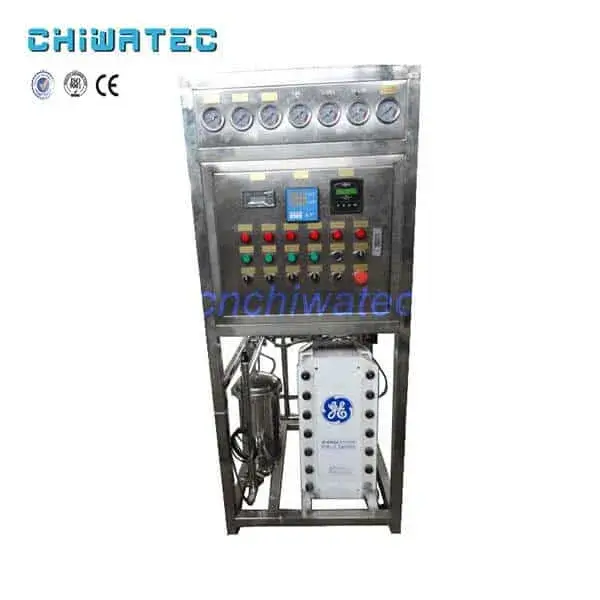
Complete System Components
- EDI module stack – Multiple cell pairs for required capacity (from 0.5 to 100+ m³/h)
- DC power supply (rectifier) – Provides 0-600V DC, 0-10A with current control
- Flow control valves – Regulate product, concentrate, and recirculation flow rates
- Instrumentation – Resistivity/conductivity meters, flow meters, pressure gauges, ammeters, voltmeters
- PLC control panel – Automated operation with alarm functions and data logging
- Pretreatment system – RO + degasification for optimal EDI feedwater quality
EDI Feedwater Requirements (Critical for Performance)
Proper pretreatment is essential for EDI reliability and longevity. Poor feedwater quality causes scaling, fouling, and premature module failure. EDI equipment generally uses reverse osmosis (RO) pure water as feedwater.
Standard Feedwater Specifications
| Parámetro | Acceptable Range | Optimal Range |
|---|---|---|
| Conductivity | <40 μS/cm | 10-30 μS/cm |
| Hardness (as CaCO₃) | <1.0 ppm | <0.5 ppm |
| Silica (SiO₂) | <1.0 ppm | <0.5 ppm |
| TOC | <500 ppb | <200 ppb |
| Free Chlorine | <0.05 ppm | Non-detectable |
| Iron/Manganese | <0.01 ppm | Non-detectable |
| pH | 6.0-9.0 | 7.0-8.5 |
| CO₂ | <10 ppm | <5 ppm |
Recommended Pretreatment Configuration
Multimedia Filter → Activated Carbon → Water Softener → 5μm Security Filter → Reverse Osmosis → Degasification (optional for CO₂ removal) → EDI → Polishing Mixed Bed (optional for 18.2 MΩ·cm)
For applications requiring ultra-low TOC (<10 ppb), add UV oxidation (185nm) after EDI.
Main Features and Advantages of EDI Systems
Operational Benefits
- Calidad de agua estable – Consistent 15-18 MΩ·cm resistivity with minimal fluctuation
- Control totalmente automático fácil de realizar – PLC-based automation with touchscreen HMI interface
- Sin apagado debido a la regeneración – Continuous 24/7 water production without downtime
- Sin necesidad de regeneración química – Eliminates acid/base storage, handling, and disposal
- Simple operation – Minimal operator training required
- Low maintenance – No moving parts in EDI module, annual inspection sufficient
Economic Advantages
- Bajo costo operativo – 40-60% reduction vs. traditional mixed bed (¥8-12/m³ vs. ¥15-25/m³)
- Reduced maintenance costs – No resin replacement for 5-7 years
- No acid-base logistics – Eliminate transportation and storage expenses
- Compact plant area – Modular stacking design saves 50-70% floor space vs. traditional IX
- High water recovery – 90-95% vs. 70-80% for conventional ion exchange
- Energy efficient – Power consumption 0.3-0.8 kWh/m³ depending on feedwater quality
Environmental Benefits
- Sin descarga de aguas residuales – No chemical waste streams from regeneration
- Reduced wastewater volume – Higher recovery means less blowdown
- Lower carbon footprint – Reduced chemical manufacturing and transport
- LEED certification support – Contributes to green building credits
- Safer workplace – No hazardous chemical handling risks
2026 Industry Applications
1. Pharmaceutical Industry
EDI serves as pretreatment for Water for Injection (WFI) generation and purified water production:
- USP/EP/ChP compliant purified water systems
- Consistent quality meeting pharmacopeia requirements
- Validated systems with 21 CFR Part 11 compliance
- Sanitary design with orbital welding and electropolishing
2. Microelectronics & Semiconductor
Chip fabrication demands ultrapure water with 18.2 MΩ·cm resistivity and ultra-low TOC:
- Wafer rinsing and cleaning processes (7nm and below nodes)
- Photolithography operations
- Integration with UV oxidation for TOC reduction (<10 ppb)
- Zero particle contamination requirements
3. Power Generation
Supercritical and ultra-supercritical boiler units require feedwater conductivity <0.15 μS/cm:
- Continuous high-purity water for 600-1000 MW units
- Condensate polishing applications
- Zero chemical handling in power plant environment
4. Laboratories & Research
Type I reagent-grade water for sensitive instruments:
- HPLC, GC-MS, ICP-MS feedwater
- Cell culture and molecular biology applications
- Research laboratory centralized purification systems
5. Surface Cleaning & Coating
High-purity rinse water for precision manufacturing:
- Automotive parts cleaning
- Metal plating and anodizing rinse
- Optical lens cleaning
- Precision component manufacturing
6. Electrolysis & Chemical Industry
Process water for sensitive chemical reactions:
- Battery manufacturing (lithium-ion production)
- Electroplating solutions
- Chemical synthesis requiring low-ionic water
2026 Technology Advancements
Smart Monitoring & IoT Integration
- Real-time resistivity monitoring with data logging and trend analysis
- Predictive maintenance alerts based on performance degradation patterns
- Remote diagnostics via cloud-connected controllers and mobile apps
- Energy optimization through adaptive voltage and current control
- SCADA integration – Seamless connection to plant-wide control systems
Enhanced Module Design
- Higher current density – Improved ion removal efficiency
- Advanced membrane materials – Better chemical resistance and selectivity
- Modular scalability – Easy capacity expansion without system redesign
- Extended service life – 7-10 year module lifespan (up from 5-7 years)
- Low-fouling resin formulations – Better resistance to organic and biological fouling
EDI vs. Traditional Mixed Bed: Comparison
| Parámetro | Sistema EDI | Mixed Bed IX |
|---|---|---|
| Water Quality | Continuous 15-18 MΩ·cm | Variable (declines between regenerations) |
| Modo de operación | Continuous, no downtime | Batch (requires regeneration shutdown) |
| Chemical Usage | None | HCl + NaOH for regeneration |
| Operating Cost | ¥8-12/m³ | ¥15-25/m³ |
| Labor Requirement | Minimal (automated) | Regular (manual regeneration) |
| Waste Generation | Low (concentrate only) | High (acid/base waste) |
| Module Life | 5-7 years (up to 10 years) | Resin 2-3 years |
| Footprint | Compact (modular) | Large (regeneration tanks required) |
Installation and Maintenance
Installation Requirements
- Feedwater pressure: 3-6 bar (boost pump may be required)
- Electrical supply: 220-480V AC, 50/60Hz for rectifier and controls
- Drain access: For concentrate and electrode flush discharge
- Space: Modular skid-mounted design, typical footprint 2-10 m² depending on capacity
- Ambient temperature: 5-40°C (optimal: 15-30°C)
Maintenance Schedule
| Task | Frequency | Estimated Cost |
|---|---|---|
| Visual inspection | Daily/Weekly | Included |
| Calibration check (meters) | Quarterly | ¥500-1000 |
| Module cleaning (CIP) | Every 6-12 months | ¥1000-3000 |
| Membrane inspection | Annually | Included in service |
| Module replacement | Every 5-7 years | ¥20000-100000+ |
Conclusión
EDI (Electrodeionization) ultrapure water equipment has matured into the industry standard for continuous ultrapure water production in 2026, offering unmatched advantages over traditional ion exchange systems. By combining continuous operation, chemical-free regeneration, and consistent high-purity output (15-18.2 MΩ·cm), EDI delivers both economic and environmental benefits across pharmaceutical, microelectronics, power generation, laboratory, surface cleaning, and chemical industry applications.
Key success factors for EDI implementation include:
- Proper pretreatment – RO permeate meeting EDI feedwater specifications (conductivity <40 μS/cm, hardness <0.5 ppm, silica <0.5 ppm, free chlorine non-detectable)
- Consistent operation – Avoid frequent start/stop cycles that stress membranes and resins
- Regular monitoring – Track resistivity, flow rates, pressure differentials, voltage, and current
- Preventive maintenance – Annual inspection, periodic cleaning, and component replacement as needed
As industries face increasing pressure to reduce chemical usage, minimize wastewater, and improve water quality consistency, EDI electrodeionization systems will continue gaining market share. The technology’s proven reliability, declining capital costs, and strong ROI (typically 18-36 month payback) make it the optimal choice for new installations and traditional mixed bed replacements worldwide.
FAQ: EDI Ultrapure Water Equipment
1. What is the typical lifespan of an EDI module?
Modern EDI modules last 5-7 years with proper operation and feedwater quality. Premium systems with enhanced membrane materials can achieve 7-10 years. Module replacement is indicated when resistivity consistently falls below specifications despite optimal operating conditions, or when pressure drop increases significantly due to fouling.
2. Does EDI require chemical cleaning?
Yes, periodic cleaning (every 6-12 months) removes accumulated scale and organic fouling. Cleaning solutions are typically mild acids (citric acid 1-2%), bases (NaOH 0.1-0.5%), or specialized EDI cleaning agents—significantly less hazardous than mixed bed regeneration chemicals. Cleaning is performed in-place (CIP) without module disassembly.
3. What happens during EDI startup and shutdown?
Startup: Flush module with feedwater for 15-30 minutes to remove air and debris, then gradually apply voltage over 5-10 minutes to prevent hydraulic and electrical shock. Shutdown: Reduce voltage gradually, flush with product water for 10 minutes, and drain if freezing conditions are possible. For short shutdowns (<48 hours), maintain low flow to prevent stagnation.
4. Can EDI remove silica and boron effectively?
EDI removes 90-95% of silica and boron at neutral pH. For higher removal rates (>99%), adjust feedwater pH to 8.5-9.0 using caustic injection, converting silica and boron to ionized forms that migrate more readily under the electric field. Membrane degasification before EDI also improves silica rejection by removing CO₂.
5. What is the power consumption of EDI systems?
Typical power consumption ranges from 0.3-0.8 kWh/m³ depending on feedwater conductivity and product water requirements. For RO permeate at 20 μS/cm producing 16 MΩ·cm water, expect approximately 0.5 kWh/m³. Power consumption increases with higher feedwater TDS and higher product water resistivity requirements.
6. Is EDI suitable for seawater desalination?
No. EDI requires low-conductivity feedwater (<40 μS/cm). For seawater (≈50,000 μS/cm), use osmosis inversa o multi-stage flash distillation as primary desalination, with EDI as a polishing step for ultrapure applications. EDI is designed for polishing, not primary desalination.
7. How does EDI compare to polishing mixed bed for final purification?
EDI provides continuous operation without regeneration downtime, while polishing mixed beds offer slightly higher initial quality (18.2 MΩ·cm) but decline between regenerations. Many critical applications use EDI as primary purification with optional polishing mixed bed for final 18.2 MΩ·cm requirement—combining continuous operation with ultimate water quality.
8. What causes EDI module failure?
Common failure modes include: scaling from hardness or silica exceeding limits, organic fouling from high TOC feedwater, chlorine damage to ion exchange membranes, mechanical damage from water hammer or over-pressure, and electrical issues from rectifier malfunction. Proper pretreatment and operating procedures prevent most failures.
Further Reading
- Electrodeionization (EDI) in Clean Water Production – EDI applications in pharmaceutical and clean water systems
- Operating Instructions for EDI Equipment – Complete operational procedures and maintenance guidelines
- EDI Replaces Mixed Bed Technology – Cost-benefit analysis of EDI vs. traditional mixed bed systems
¿Tiene un proyecto de tratamiento de agua con el que podamos ayudar?
* Diseño, mecanizado, instalación, puesta en marcha, personalización y servicio integral






 Spanish
  English
  Portuguese




