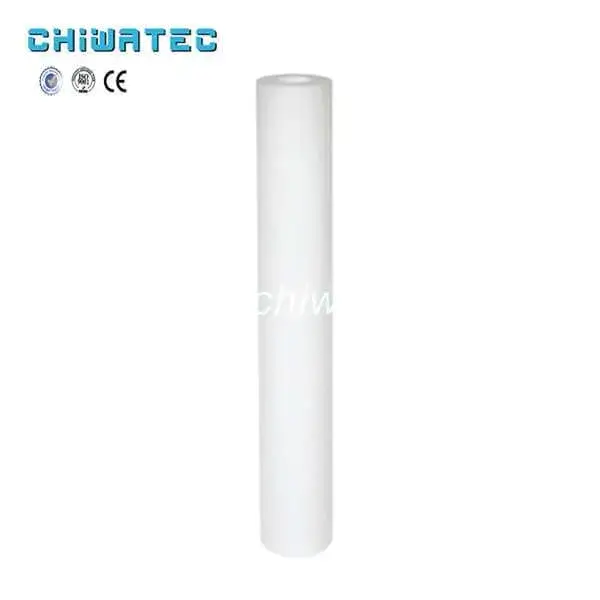
PP Cotton Filter Element: 2026 Complete Guide to Characteristics, Filtration Accuracy, and Applications
Is your water treatment system suffering from frequent pre-filter clogging or inconsistent filtration performance? The PP cotton filter element (polypropylene melt-blown filter cartridge) is the most widely used sediment pre-filter in water treatment, offering a cost-effective solution for removing suspended particles down to 1 micron. Here is the direct answer: the Elemento filtrante de algodón PP features a gradient pore structure — coarse outer layer, fine inner layer — enabling deep filtration with 98%+ efficiency, high dirt-holding capacity, low pressure drop, and resistance to acids, alkalis, and organic solvents, making it the first-line defense in RO pretreatment and general water filtration systems. CHIWATEC supplies high-quality PP melt-blown filter cartridges suitable for industrial, commercial, and residential water treatment applications.
What Is a PP Cotton Filter Element?
The PP cotton filter element, also known as a polypropylene melt-blown filter cartridge, is manufactured from polypropylene resin through a melt-blowing process. The raw material is heated to approximately 230-280 degrees C and extruded through fine spinnerets to create microfibers, which are then wound and bonded together by the fibers’ own thermal fusion — no chemical binders or adhesives are required.
The distinctive structure of the PP melt-blown filter element is its gradient density design: the outer layer consists of coarse fibers with larger pores (20-50 microns) for trapping larger particles, while the inner layer has progressively finer fibers and tighter pores (1-10 microns) for precision filtration. This graduated configuration creates a three-dimensional deep filtration effect, maximizing dirt-holding capacity while maintaining high flow rates. For a comprehensive overview of PP filter technology, refer to PP Filter Cartridge: Complete Guide to Polypropylene Sediment Filtration.
Key Characteristics of PP Cotton Filter Elements
PP cotton filter elements offer a unique combination of properties that make them the preferred choice for sediment filtration in water treatment systems:
| Characteristic | Especificación | Benefit |
|---|---|---|
| Filtration efficiency | Above 98% for rated particle size | Even particles smaller than nominal pore size are captured through bridging effects within the fiber matrix |
| Pore size uniformity | Dense, uniform distribution | Consistent filtration performance across the entire element; no channeling or bypass |
| Chemical resistance | Resistant to acids (pH 1-14), alkalis, and most organic solvents | Suitable for aggressive chemical environments; no degradation or leaching of contaminants |
| Mechanical strength | No deformation at differential pressure up to 0.4 MPa (4 bar) | Maintains structural integrity under high flow and pressure surge conditions |
| Cleanliness | No additives, binders, or surfactants in the manufacturing process | Zero contamination of product water; meets food-grade and potable water standards |
| Gradient pore structure | Thick outer fiber, thin inner fiber; loose outer layer, tight inner layer | 3D deep filtration effect — 3-5 times higher dirt-holding capacity than surface filters |
| Tasa de flujo | High flow capacity due to high porosity (70-85%) | Lower pressure drop per unit flow rate — energy-efficient operation |
Filtration Accuracy: Absolute vs. Nominal
Understanding the difference between absolute and nominal filtration ratings is essential for selecting the correct PP cotton filter element for your application:
Absolute Filtration Accuracy
Absolute filtration accuracy refers to the pore size at which 100% of particles of that size or larger are retained by the filter element. For PP cotton filter elements, absolute ratings are determined through standardized bubble-point testing or particle challenge tests (typically using ASTM F795 or ISO 16889 protocols). A filter rated at 10 microns absolute will capture all particles 10 microns and above. Absolute-rated filters are critical for applications where downstream equipment cannot tolerate any particles above a certain size — such as protecting RO membranes or precision valves.
Nominal Filtration Accuracy
Nominal filtration accuracy describes a filter’s ability to retain a specified percentage (typically 85-95%) of particles of a given size. For example, a nominally rated 5-micron PP filter will remove 90% of 5-micron particles but may allow some 5-micron particles to pass. Nominal ratings are the most common specification for general-purpose water filtration applications where absolute particle retention is not required. Common nominal ratings for PP cotton filter elements include: 1, 5, 10, 20, 50, and 100 microns.
| Filtration Rating | Escribe | Common Application |
|---|---|---|
| 1 micron | Nominal/Absolute | RO membrane protection, pharmaceutical water, fine polishing |
| 5 micron | Nominal | Standard RO pretreatment, drinking water, general industrial |
| 10 micron | Nominal | Residential water filtration, irrigation, cooling water |
| 20-50 micron | Nominal | Coarse pre-filtration, well water, high-turbidity raw water |
| 100 micron | Nominal | Heavy sediment removal, construction site water, mining |
Applications of PP Cotton Filter Elements in Water Treatment
PP cotton filter elements serve as the primary sediment filtration stage across a wide range of water treatment applications:
- Reverse osmosis (RO) pretreatment: As the final barrier before RO membranes, 5-micron PP filters remove suspended particles that could foul or abrade membrane surfaces. The filter housing is typically placed immediately before the high-pressure pump to protect both the pump and the membrane elements.
- Residential water filtration: PP sediment filters are the standard first stage in under-sink and whole-house filtration systems, removing rust, sand, silt, and other visible particles from municipal or well water supplies.
- Industrial process water: Used in cooling tower make-up water, boiler feed water pretreatment, and general process water systems where suspended solids must be controlled below 50 microns.
- Food and beverage production: PP melt-blown filters meet FDA and NSF/ANSI 42 standards for potable water contact, making them suitable for bottled water, beverage blending, and food processing water systems.
- Wastewater treatment: Tertiary filtration or final polishing of treated effluent before discharge or reuse in non-potable applications.
- Swimming pool and spa: Pre-filtration ahead of sand filters or cartridge filters to reduce particulate loading and extend main filter cleaning intervals.
Selection and Maintenance Guidelines
To maximize the performance and service life of PP cotton filter elements, consider the following guidelines:
- Select the correct micron rating: For RO pretreatment, 5-micron nominal is the standard recommendation. Use 1-micron for high-purity applications where membrane protection is critical, but note that finer ratings reduce dirt-holding capacity and require more frequent replacement.
- Monitor differential pressure: Install a differential pressure gauge across the filter housing. Replace the element when the pressure differential reaches 1.0-1.5 bar (15-22 psi). Operating beyond this point risks collapsing the filter element or bypassing unfiltered water through the housing seal.
- Establish a replacement schedule: Even if the pressure differential has not reached the replacement threshold, replace PP filter elements every 3-6 months to prevent bacterial growth on the accumulated debris within the filter media.
- Consider prefiltration: If raw water turbidity exceeds 50 NTU, install a coarse pre-filter (50-100 micron) ahead of the PP element to extend its service life 2-3 times.
- Inspect housing seals: O-rings and housing seals should be inspected and lubricated with food-grade silicone grease at each filter change to prevent bypass leakage.
The standard PP cotton filter element is designed for single use only — it is not cleanable or reusable. For applications requiring washable media, consider stainless steel mesh filters or pleated cartridge filters as alternatives.
Frequently Asked Questions
Q1: What is the difference between PP cotton and pleated filter elements?
PP cotton (melt-blown) filter elements have a gradient depth structure that traps particles throughout the media thickness, offering higher dirt-holding capacity and lower cost. Pleated filter elements have a larger surface area from the folded media design, providing higher flow rates and lower initial pressure drop, but they are typically surface filters that capture particles only on the outer surface. PP cotton is preferred for high-dirt-load applications; pleated filters are better for high-flow, low-maintenance applications.
Q2: Can PP cotton filter elements be washed and reused?
No, PP melt-blown filter elements are designed for single use and disposal. The deep filtration structure traps particles within the fiber matrix — washing only removes surface debris and does not restore filtration performance. Attempting to wash and reuse PP filters can also introduce bacteria into the clean water side. Replace the element when the pressure differential reaches 1.0-1.5 bar or every 3-6 months, whichever comes first.
Q3: What micron rating should I use for RO membrane protection?
The standard recommendation for RO membrane protection is a 5-micron nominal PP cotton filter element. This rating captures 95%+ of particles 5 microns and larger — sufficient to prevent membrane abrasion and channel blocking — while maintaining an acceptable balance between dirt-holding capacity and replacement frequency. For feed water with high bioload or in pharmaceutical applications, a 1-micron absolute filter may be specified, but this requires more frequent replacement.
Q4: Are all PP cotton filter elements the same quality?
No, significant quality differences exist between manufacturers. Key quality indicators include: (1) pure polypropylene resin without recycled content or filler materials; (2) consistent fiber diameter and uniform pore distribution verified by bubble-point testing; (3) manufacturer-declared beta ratio (filtration efficiency) from certified laboratory tests; (4) NSF/ANSI 42 or FDA compliance for potable water contact; and (5) documented pressure-flow curves showing predictable performance. CHIWATEC PP filter elements meet all these quality criteria for reliable, repeatable performance.
Q5: How often should PP filter elements be replaced in an RO system?
In a typical RO pretreatment system, PP cotton filter elements should be replaced every 1-3 months, depending on feed water quality and system usage. The primary replacement indicator is a 1.0-1.5 bar increase in differential pressure across the filter housing. For systems with good water quality (SDI below 3), replacement every 3 months is typical. For well water or high-turbidity sources, monthly replacement may be necessary. Always replace the element when the system is serviced — DO NOT wait for visible contamination or pressure rise alone, as biological growth in the filter media can occur even at low pressure drops.
Conclusion & CTA
los Elemento filtrante de algodón PP is the most widely used and cost-effective sediment filtration solution in water treatment, offering 98%+ filtration efficiency, gradient deep filtration for extended service life, excellent chemical resistance, and zero contamination of product water. Available in ratings from 1 to 100 microns, PP melt-blown filter cartridges serve as the essential first line of defense in RO pretreatment, residential filtration, industrial process water, and countless other applications. With proper selection, monitoring, and timely replacement, PP filter elements protect downstream equipment, reduce maintenance costs, and ensure consistent water quality.
Contact CHIWATEC today at [email protected] o [email protected] (WhatsApp available) for high-quality PP cotton filter elements, custom micron ratings, and filtration system design support for your specific water treatment requirements.
Related Resources and Further Reading
¿Tiene un proyecto de tratamiento de agua con el que podamos ayudar?
* Diseño, mecanizado, instalación, puesta en marcha, personalización y servicio integral
 Spanish
  English
  Portuguese