Pure Water Quality Standards: Complete Guide to Water Purity Categories and Applications 2026
What pure water quality standard does your industry require — and how do you select the right water purification system to meet it? This comprehensive guide explains the conductivity and resistivity classifications for pure water, ultrapure water, and high-purity water, mapping each category to its specific industrial, pharmaceutical, laboratory, and manufacturing applications. Understanding these pure water quality standards is essential for specifying the correct water treatment equipment and ensuring regulatory compliance.
*Last Updated: May 2026 | Industry-Verified Reference Data
Why This Guide Matters
The global pure water and ultrapure water market was valued at approximately USD 12.8 billion in 2024 and is projected to reach USD 22.5 billion by 2034, driven by expanding demand from semiconductor manufacturing, pharmaceutical production, power generation, and advanced materials processing. Selecting the correct pure water quality standard for each application has direct implications on product quality, manufacturing yield, equipment lifespan, and operating costs. Over-specifying water purity wastes capital and energy; under-specifying risks product rejection and regulatory non-compliance. This guide provides the complete reference framework for matching water quality classifications to industry requirements.
Key Industry Trends (2026 Update)
- Semiconductor-grade ultrapure water demand surging — The global semiconductor water market is growing at 7.2% CAGR, driven by advanced node fabrication requiring 18.2 Mohm-cm water with TOC below 1 ppb and dissolved oxygen below 1 ppb.
- Pharmaceutical USP Purified Water and WFI standards evolving — Revised USP <1231> guidelines emphasize continuous monitoring and real-time conductivity measurement over batch testing, driving adoption of RO-EDI systems with online analytical instrumentation.
- Battery and energy storage water quality requirements tightening — Lithium-ion battery production demands resistivity above 17 Mohm-cm with controlled silica levels, a segment projected to grow 18% annually through 2030.
- Laboratory reagent water standards becoming more stringent — ASTM D1193-91 Type I water (18.2 Mohm-cm, TOC below 50 ppb, bacteria below 1 CFU/mL) is increasingly the default requirement for analytical and research laboratories worldwide.
1. What Are the Standard Water Quality Classifications for Pure Water Systems?
Conductivity and Resistivity as Key Metrics
Water purity is quantified by two inversely related parameters: conductivity (measured in microsiemens per cm, or microsiemens/cm) measures the water’s ability to conduct electrical current — higher conductivity indicates more dissolved ionic impurities. Resistivity (measured in megohm-cm, or Mohm-cm) is the reciprocal of conductivity and increases as water becomes purer. The theoretical maximum resistivity for absolutely pure water at 25 degrees C is 18.24 Mohm-cm, representing the intrinsic dissociation of water molecules into H+ and OH- ions. In practice, purified water systems target resistivity ranges from 0.1 Mohm-cm (basic deionized water) to 18.2 Mohm-cm (ultrapure water).
Five Standard Purity Levels
The water treatment industry recognizes five standard purity levels for process water applications: (1) Primary Treated Water — softened or dechlorinated tap water, conductivity typically 200-500 microsiemens/cm; (2) Purified Water — conductivity below 10 microsiemens/cm, suitable for general industrial and pharmaceutical use; (3) High-Purity Water — resistivity 5-15 Mohm-cm, produced by two-pass RO or RO-EDI systems; (4) Ultrapure Water — resistivity 15-18 Mohm-cm, requiring RO plus EDI or ion exchange polishing; and (5) Electronic-Grade Ultrapure Water — 18.2 Mohm-cm with sub-ppb TOC, particle, and bacterial specifications, required for semiconductor fabrication. For a broader understanding of water purification technologies, refer to our dedicated guide.
2. What Conductivity Below 10 Microsiemens/cm Water Is Used For?
Applications of Conductivity ≤10 microsiemens/cm Pure Water
Water with conductivity at or below 10 microsiemens/cm represents the entry-level pure water quality standard suitable for numerous commercial and light industrial applications. This purity level is typically achieved through single-pass reverse osmosis (RO) or single-stage ion exchange deionization. Specific applications include: animal drinking water for pharmaceutical research and veterinary medicine, common chemical raw material ingredient water where ionic contaminants would interfere with reactions or product consistency, food industry ingredient water for processing and washing, deionized water for general electroplating industry washing and rinsing operations, de-hardened and desalted pure water for textile printing and dyeing processes, polyester chip manufacturing pure water for synthetic fiber production, fine chemical manufacturing process water, civil drinking purified water meeting national bottled drinking water standards, and general rinsing and washing applications across multiple industries. For a detailed comparison of water treatment options, see our guide on pure water machine versus water purifier.
3. What Conductivity Below 5 Microsiemens/cm Water Is Used For?
Higher-Purity Requirements for Regulated Industries
Water with conductivity at or below 5 microsiemens/cm represents an intermediate purity level requiring more sophisticated treatment — typically dual-pass RO or RO followed by mixed-bed ion exchange polishing. Applications demanding this grade include: electroplating chemical production water where trace ionic contamination affects bath chemistry and deposit quality, surfactant production water in the chemical industry where surface tension properties must be precisely controlled, purified water for medical and pharmaceutical use per USP Purified Water monographs, purified water for liquor production including baijiu, whiskey, vodka, and other distilled spirits where water quality directly impacts taste profile, purified water for beer and beverage production consistent with brewing industry standards, civilian drinking purified water for premium bottled water products, and hemodialysis water machine feed water meeting AAMI/ISO 23500 standards for patient safety. Xi’an CHIWATEC engineers design RO systems targeting specific effluent conductivity requirements for each of these regulated applications.
4. What Resistivity 5-10 Mohm-cm Water Is Used For?
High-Purity Applications in Electronics and Power
Water with resistivity in the 5-10 Mohm-cm range (conductivity approximately 0.1-0.2 microsiemens/cm) is classified as high-purity water. This level is typically produced by RO-EDI hybrid systems or RO followed by mixed-bed ion exchange, achieving over 99.9% salt rejection from typical tap water feed. Key applications include: lithium battery production water where trace metal ions would degrade battery performance and cycle life, battery production water for lead-acid, nickel-cadmium, and other battery chemistries requiring low-conductivity electrolyte makeup, cosmetics production water for premium skincare and personal care products where ionic content affects formulation stability, pure water for power plant boiler feed to prevent scale formation and corrosion in steam generation systems, and chemical plant ingredient water for manufacturing processes sensitive to ionic contamination. For a comprehensive comparison of purity levels, refer to our analysis of pure water versus ultrapure water.
5. What Resistivity 10-15 Mohm-cm Water Is Used For?
Specialized High-Purity Applications
Water in the 10-15 Mohm-cm resistivity range requires advanced treatment processes including two-pass RO with EDI or single-pass RO with primary and polishing mixed-bed ion exchange. This purity level meets stringent requirements for: animal laboratory water used in biological research, toxicity testing, and preclinical studies where water quality directly impacts experimental outcomes and must meet AAALAC guidelines, glass bulb coating washing water for incandescent, fluorescent, and LED bulb manufacturing where water spots or ionic residues would compromise coating adhesion and optical clarity, pure water for electroplating of precision components including connectors, circuit traces, and decorative finishes where bath purity affects deposit uniformity and corrosion resistance, water for coating glass used in architectural, automotive, and display glass manufacturing, and specialized laboratory and pilot-plant applications requiring consistent high-purity water quality. CHIWATEC provides tailored RO-EDI system designs to meet these application-specific resistivity targets.
6. What Resistivity ≥15 Mohm-cm Water Is Used For?
Ultrapure Water for Critical Manufacturing
Water with resistivity at or above 15 Mohm-cm enters the ultrapure water classification, demanding RO-EDI or RO-ion exchange hybrid systems with comprehensive recirculation loops, point-of-use polishing, and continuous online monitoring. This stringent pure water quality standard serves: sterile water for pharmaceutical production and injectable preparations per USP WFI monographs, water for oral liquid medications and suspensions where microbial and endotoxin control is critical, deionized water for advanced cosmetics production including serums, injectable dermal fillers, and preservation-free formulations, water for electronic component coating processes where ionic residues cause corrosion and leakage currents, water for cleaning optical materials including lenses, mirrors, and fiber optic components where particle-free and residue-free rinsing is essential, pure water for the electronic ceramic industry where sub-ppm contaminants affect dielectric properties and sintering behavior, and pure water for cutting-edge magnetic materials including rare-earth magnets and magnetic recording media. Our mineral water equipment process guide provides additional context on ultrapure water production for the beverage and food processing industries.
7. What Resistivity ≥17 Mohm-cm Water Is Used For?
Advanced Ultrapure Applications in Emerging Industries
Water at or above 17 Mohm-cm resistivity requires state-of-the-art treatment systems with multiple purification stages, UV oxidation for TOC reduction, degasification for dissolved oxygen and CO2 removal, sub-micron filtration, and continuous resistivity monitoring with automatic diversion of out-of-spec water. This high-purity grade is essential for: demineralized water for magnetic material boilers where even trace minerals cause scaling and efficiency loss, water for sensitive new materials research and production including graphene, quantum dots, and advanced polymers, semiconductor material production water for wafer cleaning, etching rinse, and chemical mechanical planarization (CMP) post-clean steps, advanced metal materials manufacturing including titanium alloys, superalloys, and shape-memory alloys, laboratory water for anti-aging and biomaterials research requiring ultra-low impurity backgrounds, non-ferrous metal smelting and precious metal refining where water purity affects recovery efficiency and product grade, nano-grade new materials production where particle contamination at the nanometer scale ruins product quality, and new aviation material production water meeting aerospace industry standards for critical component manufacturing. For a comprehensive overview, see our article on basic knowledge of water and its purification requirements.
8. What Resistivity ≥18 Mohm-cm Water Is Used For?
Electronic-Grade Ultrapure Water in High-Tech Manufacturing
Water at or above 18 Mohm-cm resistivity (practically 18.2 Mohm-cm at 25 degrees C) represents the highest commercial pure water quality standard, achievable only through complete multi-stage treatment trains. These systems typically combine pretreatment, RO, EDI, UV (185 nm and 254 nm) for TOC reduction and bacterial control, membrane degasification, mixed-bed ion exchange polishing, and 0.04-micron (40 nm) point-of-use ultrafiltration. Critical applications include: ITO (indium tin oxide) conductive glass manufacturing water where trace metals cause pixel defects in displays, advanced laboratory water for PCR, HPLC, ICP-MS, and other ultra-sensitive analytical techniques requiring ASTM Type I water specifications (18.2 Mohm-cm, TOC below 5 ppb, bacteria below 1 CFU/mL), and electronic-grade cleanroom consumables production water for cleanroom wipes, swabs, and garments used in ISO Class 1-5 environments.
Additional High-End Applications
The semiconductor industry — including mono-crystalline and poly-crystalline silicon wafer production, integrated circuit fabrication at nodes below 7 nm, solar photovoltaic cell manufacturing, flat-panel display (LCD, OLED) production, glass bulb coating, optoelectronics and fiber optic component cleaning — consumes ultrapure water at volumes up to 1,500-2,000 gallons per 300 mm wafer per fabrication layer. Additional users include PCB and FPC (flexible printed circuit) process water requiring ionic cleanliness for solderability and reliability, battery and lithium electroplating production processes, automotive and appliance surface coating pretreatment where water spots cause paint defects, and hardware industry precision cleaning water for medical devices, aerospace components, and optical instruments. Xi’an CHIWATEC provides complete ultrapure water system designs for these demanding applications.
9. How to Select the Right Pure Water Quality Standard for Your Application?
Application-Driven Selection Framework
Selecting the appropriate water purity level follows a systematic process: first, identify the governing regulation or industry standard for your specific application (USP, ASTM, SEMI, EP, or national GB standards). Second, determine the critical water quality parameters — conductivity and resistivity are primary, but TOC, silica, bacteria, endotoxin, dissolved oxygen, particle counts, and specific ion limits may be equally important depending on the application. Third, conduct a feed water analysis to establish baseline quality and identify the treatment gap. Fourth, specify the treatment train — typically a single-pass RO for conductivity below 10 microsiemens/cm, two-pass RO with EDI for resistivity 5-15 Mohm-cm, and complete RO-EDI-UV-polishing train for 18.2 Mohm-cm ultrapure water.
Cost-Quality Optimization
The capital and operating cost of a pure water system increases exponentially with target purity. Systems producing conductivity below 10 microsiemens/cm cost approximately USD 10,000-50,000 for 1-5 m3/h capacity, while 18.2 Mohm-cm ultrapure water systems for the same capacity range from USD 100,000-500,000. Annual operating costs follow a similar gradient, with the polishing stage (EDI or mixed bed) representing 30-50% of total life-cycle cost for ultrapure systems. Over-specifying purity by one or two grades can double or triple total cost of ownership without corresponding quality benefit. For a practical perspective on water quality differences, see our comparison of purified water, pure water, and soft water.
10. How Does Pure Water Quality Affect Manufacturing Yield and Product Quality?
Semiconductor and Electronics Manufacturing
In semiconductor fabrication, a single ppb of sodium or potassium contamination can reduce device yield by 5-15% by altering threshold voltages in MOS transistors. Ultrapure water systems for 7 nm and smaller node fabs require resistivity maintained above 18.15 Mohm-cm, TOC below 1 ppb, dissolved oxygen below 1 ppb, particles above 0.05 micron below 100 counts per liter, and bacteria below 0.1 CFU per 100 mL. Any deviation from these specifications triggers automatic water diversion and system alarm — demonstrating why pure water quality standards are directly tied to manufacturing economics. For a discussion of water quality limits and their impact, refer to our article on fouling limits in water purification.
Pharmaceutical and Biotechnology Impact
For pharmaceutical manufacturers, water quality compliance with USP Purified Water and WFI standards is mandatory — non-compliance can result in batch rejection, regulatory actions, and product recalls. The financial impact of a single bioreactor or injectable product batch loss due to water quality issues can exceed USD 1-5 million. Real-time conductivity monitoring combined with resistivity trending provides early warning of system degradation, enabling corrective action before product quality is affected.
Conclusión
Understanding pure water quality standards — from conductivity below 10 microsiemens/cm for general industrial use to 18.2 Mohm-cm ultrapure water for semiconductor and pharmaceutical applications — is essential for selecting, operating, and maintaining the right water purification system. Each purity level serves specific industries and applications, and the cost of water treatment increases substantially with each step up the purity ladder. Proper selection requires balancing application requirements, regulatory compliance, capital budget, and operating cost considerations. For expert guidance in specifying a pure water system that meets your exact quality requirements, contact Xi’an CHIWATEC today at [email protected] o [email protected], or reach us via WhatsApp.
Frequently Asked Questions
Q1: What is the difference between conductivity and resistivity in water quality measurement?
Conductivity and resistivity are inverse measurements of the same property — ionic impurity concentration. Conductivity (microsiemens/cm) measures how easily electrical current passes through water; higher conductivity means more dissolved ions. Resistivity (Mohm-cm) measures the water’s resistance to current flow; higher resistivity means fewer ions. The relationship is: Resistivity (Mohm-cm) = 1 divided by Conductivity (microsiemens/cm), with the approximation that 1 microsiemens/cm equals approximately 1 Mohm-cm. The theoretical maximum is 18.24 Mohm-cm for absolutely pure water at 25 degrees C.
Q2: What is the minimum water quality for pharmaceutical use?
The USP <1231> standard specifies Purified Water as having conductivity below 1.3 microsiemens/cm (approximately 0.77 Mohm-cm) at 25 degrees C, with a TOC limit of 500 ppb. Water for Injection (WFI) must meet the same conductivity and TOC limits plus an endotoxin limit of below 0.25 EU/mL. Modern pharmaceutical systems typically operate well below these limits, with Purified Water systems producing water at 0.5-1.0 microsiemens/cm and WFI systems operating at 0.1-0.5 microsiemens/cm.
Q3: Can a single RO system produce ultrapure water at 18.2 Mohm-cm?
No — a single-pass RO system typically produces water with conductivity of 5-30 microsiemens/cm (approximately 0.03-0.2 Mohm-cm), depending on feed water quality and system design. Achieving 18.2 Mohm-cm ultrapure water requires a multi-stage treatment train including pretreatment, RO, electrodeionization (EDI) or mixed-bed ion exchange, UV oxidation, membrane degasification, and point-of-use polishing with 0.04-micron ultrafiltration. Two-pass RO can achieve 1-10 Mohm-cm, but the final polishing to 18.2 Mohm-cm requires EDI or mixed-bed deionization.
Q4: What industries require 18.2 Mohm-cm ultrapure water?
Industries requiring the highest grade of ultrapure water include: semiconductor and microelectronics fabrication (wafer cleaning, etching rinse, CMP post-clean), advanced flat-panel display and OLED manufacturing, pharmaceutical WFI production (though conductivity limits are less stringent than 18.2 Mohm-cm, the target purity often approaches this level), analytical and research laboratories for HPLC, ICP-MS, and PCR applications, precision optics and fiber optic cleaning, advanced materials research including graphene and quantum dot synthesis, and critical medical device manufacturing and cleaning.
Q5: How often should pure water system water quality be monitored?
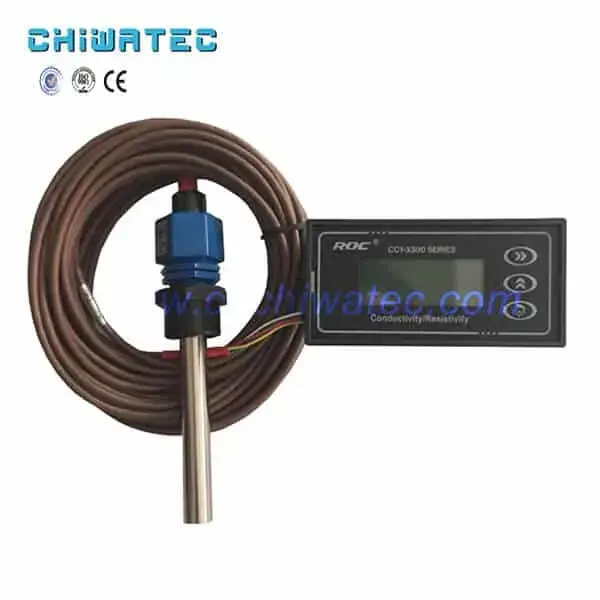
For critical applications (pharmaceutical, semiconductor, laboratory), conductivity or resistivity should be monitored continuously with online instrumentation that records and trends data in real time. For less critical industrial applications, daily or shift-based manual measurement using a calibrated handheld conductivity meter is typically sufficient. All monitoring instruments should be calibrated annually against NIST-traceable or equivalent standards. Online monitoring with automated diversion of out-of-spec water is recommended for any application where water quality deviations could result in product loss.
Related Resources and Further Reading
¿Tiene un proyecto de tratamiento de agua con el que podamos ayudar?
* Diseño, mecanizado, instalación, puesta en marcha, personalización y servicio integral
 Spanish
  English
  Portuguese