Ultrafiltration Membrane Filtration Principle: A Complete Guide to UF Membrane Technology, Process, and Applications (2026 Updated)
Ultrafiltration (UF) membrane filtration is a pressure-driven membrane separation process that uses a semi-permeable membrane with pore sizes of 0.01-0.1 microns to remove suspended solids, bacteria, viruses, colloids, and macromolecular organic compounds from water. Operating at low pressure (0.1-0.3 MPa / 15-45 psi), UF membranes provide an effective barrier against microorganisms while allowing dissolved minerals to pass through, making them ideal for both drinking water purification and industrial process applications. Xi’an CHIWATEC manufactures high-quality ultrafiltration membrane systems for residential, commercial, and industrial water treatment worldwide.
*Last Updated: March 2026
Why This Guide Matters
The global ultrafiltration membrane market was valued at approximately USD 5.6 billion in 2025 and is projected to reach USD 10.2 billion by 2035, growing at a CAGR of 6.1% (Grand View Research, 2025). UF membrane technology has become the preferred filtration method for removing pathogens without chemical disinfection, with applications spanning municipal drinking water treatment, wastewater reuse, food and beverage processing, pharmaceutical manufacturing, and industrial process water. Unlike reverse osmosis, UF membranes retain beneficial minerals while achieving 99.99% removal of bacteria and viruses. Understanding the filtration principle, membrane configurations, operational parameters, and maintenance requirements of UF membrane systems is essential for water treatment professionals and facility managers.
Key Industry Trends (2026 Update)
- Low-energy UF membranes: New-generation UF membranes operate at 0.05-0.15 MPa (7-22 psi) with 30-40% lower energy consumption than conventional designs, making gravity-fed and solar-powered UF systems viable for off-grid applications.
- Anti-fouling membrane surface modification: Hydrophilic surface coatings and zwitterionic modifications reduce protein and organic fouling by 50-70%, extending chemical cleaning intervals from 3-6 months to 9-12 months.
- UF-RO integrated systems: Pre-engineered UF-RO skids with automatic backwash and chemical clean-in-place (CIP) systems reduce installation costs by 25-35% and eliminate integration risks between pretreatment and desalination stages.
- Smart UF monitoring: Real-time membrane integrity testing using pressure decay tests (PDT) and turbidity monitoring enables immediate detection of fiber breakage, ensuring continuous pathogen removal verification — critical for municipal and pharmaceutical applications.
1. What Is Ultrafiltration Membrane Filtration?
Definition and Separation Mechanism
Ultrafiltration is a screening process that uses membrane separation technology. The pressure difference between the two sides of the membrane is the driving force, and the ultrafiltration membrane serves as the filter medium. Under a certain pressure, when the feed water flows across the membrane surface, the numerous tiny pores on the membrane surface (0.01-0.1 microns) allow only water molecules and small solutes to pass through as permeate, while particles larger than the membrane pore size are retained on the feed side as concentrate. This achieves purification, separation, and concentration in a single operation.
Position in the Membrane Filtration Spectrum
UF occupies the middle range of the pressure-driven membrane filtration spectrum: microfiltration (MF, 0.1-10 microns) removes suspended particles and bacteria; ultrafiltration (UF, 0.01-0.1 microns) removes bacteria, viruses, colloids, and macromolecules; nanofiltration (NF, 0.001-0.01 microns) removes divalent ions and small organic molecules; reverse osmosis (RO, below 0.001 microns) removes all dissolved salts. UF provides the best balance of pathogen removal and flow rate for most water purification applications.
2. How Does an Ultrafiltration Membrane Work?
The Screening Process
Approximately 6 billion micropores with diameters of 0.01 microns exist on the wall of each meter-long hollow fiber UF membrane. These pores allow water molecules, beneficial minerals, and trace elements to pass through while rejecting particles larger than 0.01 microns. The smallest bacteria have volumes above 0.02 microns, meaning they are effectively intercepted by the UF membrane. Suspended solids, rust particles, colloidal matter, silt, and macromolecular organic compounds — all much larger than bacteria — are also retained, achieving comprehensive purification.
Water Production Process
Feed water enters the ultrafiltration membrane module under operating pressure. Inside the hollow fibers, the densely packed pores on the membrane surface allow only water molecules, beneficial minerals, and trace elements to penetrate as purified water. Bacteria, rust, colloids, silt, suspended matter, and macromolecular organic substances are trapped inside the hollow fiber lumens and are periodically flushed out during backwash cycles. This continuous cross-flow or dead-end filtration process produces consistent-quality permeate.
3. What Are the Different Types of Ultrafiltration Membranes?
Membranas UF de fibra hueca
Hollow fiber membranes are the most common UF configuration, consisting of hundreds to thousands of tiny hollow fiber filaments bundled together. Each fiber has an inner diameter of 0.6-6 mm, classifying them as capillary ultrafiltration membranes. The larger inner diameter of capillary membranes makes them less prone to clogging by large particles compared to finer hollow fibers. The membranes can operate in either inside-out (internal pressure) or outside-in (external pressure) flow configuration.
Internal Pressure vs. External Pressure Configuration
In internal pressure (inside-out) configuration, feed water flows through the lumen (inside) of the hollow fibers, and permeate is collected from the outside. This configuration is more common for drinking water applications as it allows easy flushing of accumulated particles from the fiber lumens. In external pressure (outside-in) configuration, feed water flows around the outside of the fibers, and permeate is collected from the inside. This configuration handles higher suspended solids loads and is preferred for wastewater and industrial applications. CHIWATEC supplies both configurations based on application requirements.
4. What Is the Structure of a UF Membrane Filter Element?
Filter Element Components
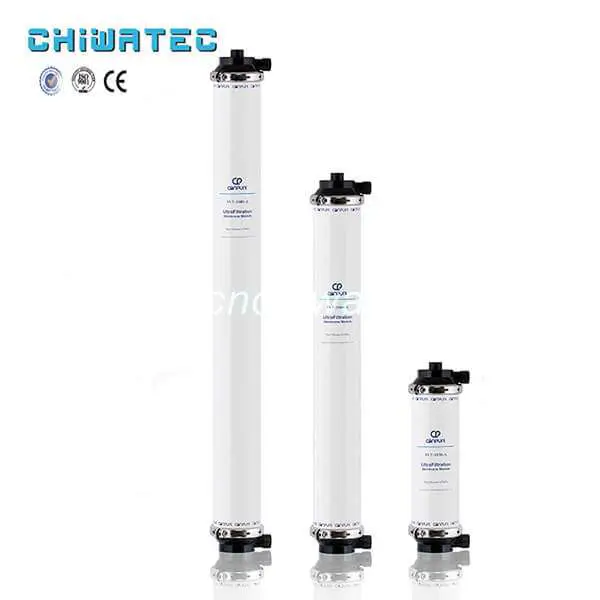
A bundled UF membrane filter element consists of: an ABS or PVC outer shell that provides mechanical protection and contains the feed water, epoxy resin potting at both ends of the shell that seals the gap between individual membrane filaments and separates feed water from permeate, and the bundle of hollow fiber UF membrane filaments that performs the actual filtration. The epoxy heads create a leak-tight separation — feed water must pass through the membrane pores to become permeate, preventing any direct bypass of unfiltered water.
Membrane Area Calculation
Under conditions where water production per unit membrane area remains constant, the total water production of a filter element is directly proportional to the effective membrane area packed into the module. The total surface area is calculated as: S(inner) = pi * d * L * n (for internal surface area, where d = inner diameter, L = fiber length, n = number of fibers) and S(outer) = pi * D * L * n (for external surface area, where D = outer diameter). UF modules are designed with the maximum practical fiber packing density to achieve the highest flow rate within the given module dimensions.
5. What Is the UF Membrane Flushing and Cleaning Process?
Regular Flushing
After a period of operation, trapped bacteria, rust, colloids, suspended solids, and macromolecular organic substances accumulate on the inner surface of UF membrane fibers, causing the permeate production rate to gradually decline. This is especially pronounced when feed water quality is poor. Regular forward flushing or backwashing effectively removes accumulated particles and restores membrane productivity. Automatic backwash systems initiate flushes at preset intervals (typically every 30-60 minutes of operation) or based on transmembrane pressure (TMP) increase.
Chemical Cleaning (CIP)
Periodic chemical cleaning is required to remove fouling that cannot be eliminated by hydraulic flushing alone. Standard cleaning agents include: citric acid (1-2% solution, pH 2-3) for inorganic scale and metal oxide fouling, sodium hydroxide (0.1-0.5% solution, pH 11-12) for organic and biological fouling, and sodium hypochlorite (50-200 ppm free chlorine) for disinfection and biofilm control. Chemical cleaning-in-place (CIP) is typically performed every 3-12 months, depending on feed water quality and operating conditions.
6. What Are the Key Operational Parameters of UF Membranes?
Performance Parameters
| Parámetro | Typical Range |
|---|---|
| Pore size | 0.01-0.1 microns |
| Operating pressure (TMP) | 0.05-0.3 MPa (7-45 psi) |
| Permeate flux | 30-150 L/m2-h |
| Maximum feed turbidity | 50-100 NTU (with pretreatment) |
| Operating temperature | 5-40 degrees C (41-104 degrees F) |
| Operating pH range | 2-11 (standard), 1-13 (cleaning) |
| Backwash frequency | Every 30-60 minutes |
| Recovery rate | 90-99% (depends on feed quality) |
Factors Affecting UF Performance
Key factors that influence UF membrane performance include: feed water turbidity and suspended solids concentration (higher loads require more frequent backwashing and shorter chemical cleaning intervals), temperature (flux increases approximately 2-3% per degree C temperature rise), transmembrane pressure (higher TMP increases flux but accelerates fouling), cross-flow velocity (higher velocity reduces concentration polarization but increases energy consumption), and membrane material properties (hydrophilicity, surface charge, and pore size distribution).
7. What Contaminants Can UF Membranes Remove?
Microorganisms
UF membranes achieve 4-6 log removal (99.99-99.9999%) of bacteria including Escherichia coli, Salmonella, and Legionella, and 3-4 log removal (99.9-99.99%) of viruses including enterovirus and rotavirus. This makes UF an effective physical disinfection barrier without chemical addition, unlike chlorine or ozone disinfection which can form disinfection byproducts. For regulatory compliance, UF systems used for pathogen removal must include continuous integrity monitoring.
Particles and Colloids
UF completely removes suspended solids, silt, rust particles, and colloidal matter. Effluent turbidity consistently falls below 0.1 NTU regardless of influent turbidity (up to the design limit of 50-100 NTU). The silt density index (SDI) of UF permeate is typically below 1-2, making it excellent feed water for downstream RO systems.
Macromolecular Organics
UF effectively removes natural organic matter (NOM), proteins, polysaccharides, and humic/fulvic acids with molecular weights above 10,000-100,000 Daltons. However, UF does not remove dissolved salts, low-molecular-weight organic compounds, pesticides, or emerging contaminants such as PFAS — these require NF or RO membranes for effective removal.
8. What Are the Main Applications of UF Membranes?
Drinking Water Purification
UF membrane systems are widely used for municipal and household drinking water treatment, providing reliable removal of pathogens and particles without removing beneficial minerals. In municipal water treatment, UF has largely replaced conventional coagulation, sedimentation, and sand filtration for new plant designs due to its smaller footprint, automated operation, and superior effluent quality.
Industrial Process Water and Wastewater Reuse
UF is used as pretreatment for RO systems in industrial applications, protecting RO membranes from particulate and colloidal fouling and extending RO membrane life by 2-3 times. UF is also the core technology in membrane bioreactors (MBRs) for wastewater treatment, combining biological treatment with membrane filtration for high-quality effluent suitable for reuse.
Food and Beverage Processing
UF membranes are used for juice clarification (removing pectin and suspended solids while preserving flavor and nutrients), wine and beer processing (sterile filtration without heat treatment), dairy processing (protein concentration and fractionation), and edible oil processing.
Pharmaceutical and Biotechnology
UF is used for protein concentration and buffer exchange, virus removal in biopharmaceutical manufacturing, fermentation broth clarification, and production of water for injection (WFI) as an alternative to distillation.
9. How to Maintain UF Membrane Systems?
Daily and Weekly Maintenance
Daily tasks: monitor permeate flow rate, transmembrane pressure, feed water turbidity, and effluent turbidity. Log operating parameters and compare with baseline values. Weekly tasks: perform manual integrity test (pressure hold test) if automatic integrity monitoring is not installed, inspect chemical dosing levels for cleaning agents, and check valve and pump operation.
Periodic Maintenance
Chemical cleaning (CIP) should be performed when TMP increases by 30-50% above the initial clean value, or when permeate flux decreases by 20-30% at constant pressure. Typical CIP frequency is every 3-12 months. Membrane replacement is typically required every 5-10 years for well-maintained systems, depending on feed water quality and cleaning practices. Fiber breakage or irreversible fouling are the primary reasons for module replacement.
10. How to Select the Right UF Membrane System?
Feed Water Quality Assessment
Analyze feed water for: turbidity, TSS (total suspended solids), TOC (total organic carbon), bacteria count, iron and manganese concentration, and hardness. High turbidity or organic content requires adequate pretreatment (strainers, media filtration, or coagulation) before the UF system. Iron and manganese may cause scaling on membrane surfaces and require removal or chelation.
System Configuration and Sizing
Select the UF membrane configuration based on feed water quality and application: internal pressure hollow fiber for drinking water and low-turbidity applications, external pressure hollow fiber for higher solids loads and wastewater applications, and submerged UF for MBR applications. Size the system based on peak flow plus 20-30% safety margin, considering temperature variations (flux decreases in cold water) and periodic backwash downtime. CHIWATEC provides complete UF system design, from point-of-use units to industrial-scale installations handling flow rates up to 500 m3/h.
Conclusión
Ultrafiltration (UF) membrane filtration is a versatile and reliable water treatment technology that provides effective removal of bacteria, viruses, suspended solids, and macromolecular organic compounds while preserving beneficial minerals. Understanding the filtration principle, membrane configurations, operational parameters, and maintenance requirements covered in this guide enables water treatment professionals to design, operate, and maintain UF systems that deliver consistent, high-quality water for a wide range of applications. Whether for municipal drinking water, industrial process water, or specialized pharmaceutical applications, UF membrane technology offers an efficient, cost-effective, and environmentally sustainable filtration solution. Contact Xi’an CHIWATEC today at [email protected] o [email protected] to discuss your ultrafiltration membrane system requirements and design specifications.
Frequently Asked Questions
Q1: What is the difference between ultrafiltration and reverse osmosis?
UF membranes have pore sizes of 0.01-0.1 microns and operate at low pressure (0.1-0.3 MPa), removing particles, bacteria, and viruses but allowing dissolved minerals and salts to pass through. RO membranes have pore sizes below 0.001 microns and operate at higher pressure (0.5-1.5 MPa), removing 95-99% of dissolved salts and producing demineralized water. UF is used where mineral content should be preserved; RO is used where demineralized water is required.
Q2: How long do UF membrane modules last?
With proper pretreatment and regular cleaning, UF membrane modules typically last 5-10 years. Factors affecting lifespan include: feed water quality (turbidity, organic content, iron), operating conditions (TMP, flux rate, temperature), cleaning frequency and effectiveness, and the number of backwash cycles. Regular integrity testing helps detect fiber breakage early, preventing pathogen breakthrough.
Q3: Do UF membranes remove chemicals and dissolved salts from water?
No. UF membranes have pore sizes of 0.01-0.1 microns, which are far larger than dissolved ions and small organic molecules. UF removes particles, colloids, bacteria, and viruses based on size exclusion, but does not remove dissolved salts, heavy metals, pesticides, PFAS, or other low-molecular-weight chemicals. For chemical and dissolved solids removal, NF or RO membranes are required.
Q4: What is the typical water recovery rate of a UF system?
UF systems typically achieve 90-99% water recovery, meaning only 1-10% of the feed water is discharged as backwash waste or concentrate. This is significantly higher than RO systems (50-80% recovery). The exact recovery depends on feed water quality, backwash frequency, and whether the UF system operates in dead-end or cross-flow mode.
Q5: Can UF membranes be cleaned and reused?
Yes. UF membranes can be cleaned and reused multiple times over their 5-10 year lifespan. Hydraulic backwashing removes loosely attached particles on a daily basis. Chemical cleaning (CIP) using acid (citric acid) for scale removal and caustic (sodium hydroxide) for organic fouling removal restores membrane performance. With proper cleaning, UF membranes can maintain 80-100% of their initial flux throughout their service life.
Related Resources and Further Reading
¿Tiene un proyecto de tratamiento de agua con el que podamos ayudar?
* Diseño, mecanizado, instalación, puesta en marcha, personalización y servicio integral
 Spanish
  English
  Portuguese