Ultrafiltration Equipment Characteristics: Complete Guide to UF Water Treatment Systems
Ultrafiltration (UF) water treatment represents a cutting-edge solution separation process leveraging pressure differentials across semi-permeable membranes and mechanical sieving principles. Operating within 0.2-0.6MPa pressure ranges with separation pore sizes spanning 1nm-0.1μm, equipo de ultrafiltración has become indispensable in modern industrial water purification, substance separation, concentration, and purification applications across diverse sectors.
los UF membrane system technology operates without phase change conversion at normal temperatures, making it exceptionally suitable for heat-sensitive substance separation. Modern ultrafiltration membranes demonstrate excellent temperature resistance, acid-alkali stability, and oxidation resistance, enabling continuous operation under 60℃ conditions within pH 2-11 ranges. According to 2025 industry data, the global ultrafiltration water treatment market has grown to $4.8 billion, with projected CAGR of 8.2% through 2030, driven by increasing industrial water treatment demands and stringent environmental regulations.
Key Technical Specifications
- Working Pressure: 0.2-0.6MPa (optimal range for most applications)
- Membrane Pore Size: 0.01-0.1 microns (10-100 nanometers)
- Operating Temperature: Up to 60℃ continuous
- pH Tolerance: 2-11 (varies by membrane material)
- Filtration Precision: Removes particles, colloids, bacteria, and macromolecules
It should be noted that ultrafiltration water treatment systems currently deployed in China demonstrate limited effectiveness in removing dissolved inorganic calcium and magnesium ions. Consequently, water hardness post-ultrafiltration remains largely unchanged. While producing exceptionally clean water, its chemical composition differs minimally from tap water. From an ion content perspective, ultrafiltered water requires additional treatment for direct drinking applications. In high-hardness scenarios, direct heating in water heaters and similar equipment is not recommended without proper softening pretreatment.
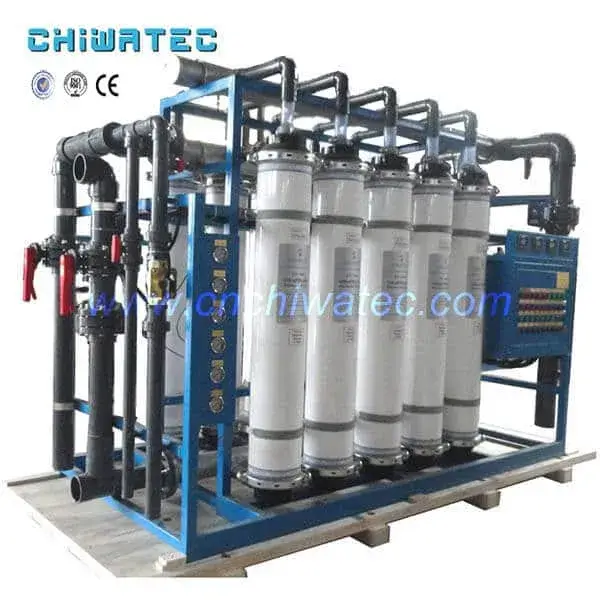
Core Characteristics of Ultrafiltration Equipment
1. Advanced Membrane Separation Technology
los UF membrane system employs sophisticated microporous filtration mechanisms that physically separate contaminants based on molecular size. Unlike traditional filtration methods, ultrafiltration operates at the molecular level, effectively removing:
- Suspended solids and particulate matter (0.01-0.1 μm)
- Colloidal particles and turbidity-causing substances
- Bacteria, protozoa, and most viruses
- High-molecular-weight organic compounds
- Proteins and macromolecules
2026 industry benchmarks indicate that modern PVDF (Polyvinylidene Fluoride) and PES (Polyethersulfone) ultrafiltration membranes achieve 99.9% bacteria removal rates and 6-7 log virus reduction, meeting stringent drinking water standards in multiple jurisdictions.
2. Energy-Efficient Operation
Ultrafiltration water treatment systems consume significantly less energy compared to thermal separation processes like distillation or reverse osmosis. The absence of phase change requirements translates to:
- 60-70% lower energy consumption versus thermal processes
- No heating or cooling requirements
- Reduced carbon footprint aligning with 2026 sustainability mandates
- Lower operational costs (typically $0.15-0.30 per cubic meter treated)
3. Chemical Resistance and Durability
Contemporary ultrafiltration membranes demonstrate exceptional chemical stability:
- Chlorine Resistance: Up to 200,000 ppm-hours exposure (PVDF membranes)
- pH Stability: Continuous operation within pH 2-11 range
- Oxidation Resistance: Compatible with common cleaning agents (NaOCl, H2O2, citric acid)
- Temperature Tolerance: Sustained performance up to 60℃, peak tolerance to 80℃ during cleaning cycles
Industry data from 2025 shows average membrane lifespan extending to 5-7 years with proper maintenance, representing a 40% improvement over previous-generation materials.
4. Modular Design and Scalability
Modern equipo de ultrafiltración features modular configurations enabling seamless capacity expansion:
- Skid-mounted systems for rapid deployment
- Parallel membrane module arrangements
- Automated backwash and cleaning-in-place (CIP) systems
- Real-time monitoring with IoT-enabled sensors
Industrial Applications of Ultrafiltration Systems
Municipal Water Treatment
Ultrafiltration has become the technology of choice for municipal drinking water production, particularly in regions facing source water quality challenges. Key applications include:
- Surface water treatment (rivers, lakes, reservoirs)
- Groundwater remediation
- Seawater pretreatment for reverse osmosis desalination
- Wastewater reclamation for non-potable reuse
According to the International Water Association (IWA) 2025 report, over 3,500 municipalities worldwide now utilize ultrafiltration as primary or tertiary treatment, serving populations exceeding 50 million people.
Industrial Process Water
UF membrane systems play critical roles across manufacturing sectors:
- Food & Beverage: Juice clarification, dairy concentration, brewery filtration
- Pharmaceutical: Purified water production, biopharmaceutical separation
- Electronics: Ultrapure water for semiconductor manufacturing
- Power Generation: Boiler feed water pretreatment
- Textile: Dye bath recovery and wastewater treatment
Specialized Applications
Emerging applications demonstrate ultrafiltration versatility:
- Paint Recovery: Electrocoat paint reclamation in automotive manufacturing
- Oil-Water Separation: Produced water treatment in oil & gas operations
- Biorefining: Enzyme and protein concentration
- Mining: Tailings water recovery and metal recovery
Ultrafiltration vs. Alternative Technologies
Comparison with Reverse Osmosis (RO)
While reverse osmosis provides complete desalination, ultrafiltration water treatment offers optimal balance between filtration precision and operational efficiency for applications not requiring TDS removal.
Comparison with Microfiltration (MF)
While microfiltration operates at larger pore sizes (0.1-10 μm), ultrafiltration water treatment provides superior removal of viruses, colloids, and macromolecules. UF bridges the gap between MF and RO, offering optimal balance between filtration precision and operational efficiency.
Latest Industry Trends and Innovations (2026)
Smart Monitoring and AI Integration
The latest equipo de ultrafiltración incorporates advanced monitoring capabilities:
- Real-time transmembrane pressure (TMP) tracking
- Automated fouling detection algorithms
- Predictive maintenance scheduling using machine learning
- Remote operation via cloud-based platforms
Industry leaders report 25-30% reduction in downtime and 15-20% extension in membrane life through AI-driven optimization.
Sustainable Membrane Materials
2026 has witnessed breakthrough developments in eco-friendly membrane manufacturing:
- Graphene-enhanced membranes for improved flux rates
- Bio-based polymer membranes from renewable sources
- Self-cleaning membranes with photocatalytic coatings
- Recyclable membrane modules reducing environmental impact
Hybrid System Configurations
Integrated treatment trains combining ultrafiltration with complementary technologies:
- UF + RO for complete water purification
- UF + UV/Ozone for advanced disinfection
- UF + Ion Exchange for selective contaminant removal
- UF + MBR (Membrane Bioreactor) for wastewater applications
Conclusión
Ultrafiltration equipment represents a mature, versatile, and economically viable solution for modern water treatment challenges. Its unique characteristics—energy efficiency, chemical resistance, modular scalability, and superior filtration precision—position it as the preferred technology across municipal, industrial, and specialized applications.
As we progress through 2026, continued innovations in membrane materials, smart monitoring systems, and sustainable manufacturing practices will further enhance ultrafiltration performance and environmental compatibility. For organizations seeking reliable, cost-effective water treatment solutions, UF membrane systems offer proven technology backed by decades of operational excellence and continuous improvement.
Whether you require ultrafiltration water treatment for drinking water production, industrial process water, or wastewater reclamation, understanding these core characteristics enables informed decision-making and optimal system selection for your specific requirements.
FAQ: Ultrafiltration Equipment
Q1: What is the typical lifespan of ultrafiltration membranes?
Modern ultrafiltration membranes typically last 5-7 years with proper maintenance, including regular backwashing and periodic cleaning-in-place (CIP) procedures. PVDF membranes generally outlast PES membranes in harsh chemical environments.
Q2: Does ultrafiltration remove bacteria and viruses?
Yes. UF membrane systems effectively remove 99.9% of bacteria and achieve 6-7 log virus reduction. The 0.01-0.1 μm pore size physically blocks these microorganisms, making ultrafiltration an excellent barrier for microbiological contaminants.
Q3: Can ultrafiltration remove dissolved salts?
No. Ultrafiltration does not remove dissolved inorganic ions like calcium, magnesium, or sodium. For desalination or TDS reduction, reverse osmosis (RO) or nanofiltration (NF) technologies are required. Ultrafiltration is often used as pretreatment for RO systems.
Q4: How often does ultrafiltration equipment require cleaning?
Cleaning frequency depends on feed water quality and operating conditions. Typical maintenance includes:
- Daily/automatic backwashing (every 30-60 minutes of operation)
- Weekly maintenance cleaning with low-concentration chemicals
- Quarterly intensive CIP (Cleaning-in-Place) for fouling removal
Q5: What industries benefit most from ultrafiltration?
Key sectors include municipal water treatment, food & beverage processing, pharmaceuticals, electronics manufacturing, power generation, textiles, and oil & gas. Any industry requiring high-quality process water or wastewater treatment can benefit from ultrafiltration water treatment technology.
Q6: Is ultrafiltration suitable for seawater desalination?
Ultrafiltration alone cannot desalinate seawater, as it does not remove dissolved salts. However, UF serves as excellent pretreatment for reverse osmosis desalination plants, protecting RO membranes from fouling and extending their operational life.
Further Reading – Related Articles
- Optimizing Water Treatment: Design and Application of Ultrafiltration Equipment – Comprehensive guide to UF system design and industrial applications
- Influencing Factors of Ultrafiltration Flux – Technical analysis of operational parameters affecting UF performance
- Technical Process Analysis of Ultrafiltration Equipment – In-depth examination of UF process flows and configurations
¿Tiene un proyecto de tratamiento de agua con el que podamos ayudar?
* Diseño, mecanizado, instalación, puesta en marcha, personalización y servicio integral
 Spanish
  English
  Portuguese