Multimedia Filter in Water Treatment: Complete Guide to Mechanical Filtration for RO Pretreatment
The global multimedia filter market for water treatment was valued at approximately USD 3.8 billion in 2024 and is projected to reach USD 6.2 billion by 2034, driven by increasing demand for effective pretreatment solutions in reverse osmosis systems, industrial water treatment, and municipal water purification (Grand View Research). A multi-media filter, also called a mechanical filter, is a critical component in water treatment systems whose main function is to remove suspended matter and solid particles from water. This comprehensive guide explores the principles, applications, media types, and operational best practices for multimedia filtration systems.
What Is a Multimedia Filter?
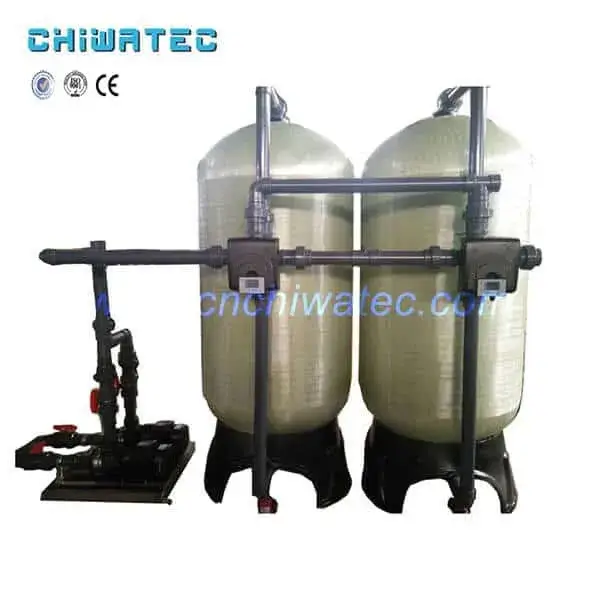
A multi-media filter is also called a mechanical filter. Its primary function is to remove suspended matter and solid particles in water. Suspended solids are non-colloidal solid substances that do not dissolve in water and can settle when conditions are appropriate. The filter is used to intercept these suspended solids, and the weight difference before and after the filter medium intercepts the suspended solids serves as the basis for measuring the filter’s performance and efficiency.
The filter medium generally employs filter materials with a particle diameter of D = 0.5 to 1.0 mm. Based on the impurity composition in the feed water, different filtration configurations can be employed: single-layer filtration, dual-layer filtration (dual media), and multi-layer filtration (multi-media). The layering principle relies on the different specific gravities of the filter materials – lighter media (anthracite) settle on top while heavier media (garnet, magnetite) remain at the bottom, creating a graduated filtration bed that captures particles of varying sizes throughout the depth of the filter.
Filter Media Types and Selection
The performance of a multimedia filter depends heavily on the selection and arrangement of filter media. Each media type offers specific advantages for different water quality challenges.
Quartz Sand Media
Quartz sand is the most common filter media, used alone in single-layer filters or as the primary layer in multi-media configurations. Quartz sand effectively removes suspended solids, silt, and particulate matter. High-quality silica sand with a SiO2 content above 96% is recommended for optimal performance and durability.
Anthracite Coal Media
Anthracite coal serves as the upper layer in dual-media and multi-media filters due to its lower specific gravity. Its angular particle shape creates additional surface area for particle capture, and it effectively removes organic matter and fine suspended solids that can pass through single-layer sand filters.
Activated Carbon Media
The function of the activated carbon filter is to remove organic matter, heavy metal ions, color (chroma), residual chlorine, and other contaminants from water. It also provides a certain removal effect on some pathogens and microorganisms. Its characteristics include excellent treatment effectiveness and the ability to regenerate the activated carbon media for reuse. The adsorption mechanism of activated carbon involves the removal of solutes from water through the repulsion of water to hydrophobic solutes combined with the affinity of activated carbon to these solutes.
Activated carbon plays a particularly important role in protecting downstream reverse osmosis membranes and ion exchange resins. Organic colloidal substances and soluble polymer materials, which are often negatively charged, can adsorb onto anion resin particles and diffuse into the resin network structure, interfering with ion exchange functional groups and eventually causing resin fouling and failure. In RO systems, organic matter can block membrane surfaces or cause irreversible fouling. Therefore, installing an activated carbon filter before RO or ion exchange systems is essential for protecting these sensitive downstream processes.
Manganese Sand Media
The manganese sand filter is primarily used to remove iron from water, particularly iron trioxide (Fe2O3) found in groundwater wells, and it also effectively removes manganese oxide. Manganese sand works through catalytic oxidation, converting dissolved ferrous iron (Fe2+) to insoluble ferric iron (Fe3+), which is then filtered out mechanically. This media is especially important for applications where groundwater with high iron content is used as the feed water source.
Additional Filter Media
Other specialized filter media include magnetite (for high-density lower layers), diatomaceous earth (for fine filtration in food and beverage applications), and garnet sand (for the bottom support layer in multi-media filters). The selection of appropriate media depends on feed water quality analysis, target effluent quality, and the specific requirements of downstream treatment processes.
Role of Multimedia Filters in Water Treatment Systems
Multi-media filters are generally used as pretreatment equipment for advanced water treatment systems in water treatment processes, and they can also be used alone as standalone filtration equipment for applications where water quality requirements are not exceptionally stringent.
Pretreatment for Reverse Osmosis Systems
In reverse osmosis (RO) systems, multimedia filtration serves as the first stage of pretreatment, removing suspended solids and colloidal materials that would otherwise foul the RO membranes. The Silt Density Index (SDI) of RO feed water should be below 5 for proper membrane operation, and well-designed multimedia filtration can reduce SDI from 10-20 to below 3. This pretreatment extends RO membrane life by 2-3 times compared to systems without adequate prefiltration.
Standalone Filtration Applications
For applications with moderate water quality requirements – such as cooling tower makeup water, irrigation systems, and certain industrial process water – multimedia filters can serve as standalone treatment equipment. In these applications, the filters remove particulate matter to acceptable levels without the need for additional membrane or ion exchange treatment.
Operation and Maintenance of Multimedia Filters
The use and operation method of the multi-media filter is straightforward, though proper procedures must be followed to maintain performance. During normal operation, water flows downward through the filter bed, with progressively finer filtration occurring through the media layers. As suspended solids accumulate, the pressure differential across the filter increases, indicating the need for backwashing.
Backwashing Procedure
When the pressure differential reaches a predetermined set point (typically 0.5-1.0 bar or when the effluent quality begins to decline), the filter must be backwashed. Backwashing involves reversing the flow direction to fluidize the filter bed and release trapped particles. The backwash flow rate must be sufficient to expand the filter bed by 20-40% for effective cleaning. Backwash water is typically used at a rate of 10-20 m/h for sand filters and 15-25 m/h for multi-media filters. The backwash cycle generally lasts 10-20 minutes, followed by a brief rinse period before returning to service.
Filter Media Replacement
Filter media gradually degrades over time through attrition, chemical attack, and fouling. Media should be inspected annually and replaced every 3-5 years for most applications, or when effluent quality cannot be maintained despite proper backwashing. Farsighted users should pay close attention to the role of activated carbon filters when selecting water treatment processes or equipment, as neglecting carbon filter maintenance can compromise the entire treatment train.
Latest Trends in Pretreatment Filtration Technology (2024-2025)
The pretreatment filtration industry is evolving with innovations that improve efficiency and reduce operational costs. Automatic backwash control systems with real-time pressure and flow monitoring now optimize backwash frequency based on actual fouling conditions rather than fixed timers, reducing water consumption for backwashing by 25-40%. New generation multi-media filter designs incorporate underdrain systems with improved flow distribution, eliminating dead zones and increasing effective filtration capacity by 15-20%.
The integration of multimedia filtration with advanced oxidation processes (AOP) for removing emerging contaminants is gaining attention, particularly for pharmaceutical and personal care product removal in water reuse applications. Additionally, smart filtration systems with IoT connectivity enable remote monitoring of filter performance, predictive maintenance scheduling, and automated reporting for regulatory compliance – features that are becoming standard requirements in municipal and industrial water treatment projects.
Conclusión
Multimedia filters play an essential role in water treatment systems, serving as the first line of defense against suspended solids and particulate matter that can damage downstream equipment. By selecting the appropriate combination of filter media – quartz sand, anthracite, activated carbon, manganese sand, and others – and implementing proper operation and backwashing procedures, water treatment professionals can ensure consistent effluent quality, protect RO membranes and ion exchange resins, and maximize the service life of the entire treatment system. As water quality standards become more stringent and treatment systems become more complex, the importance of effective multimedia filtration as a pretreatment technology continues to grow.
Frequently Asked Questions (FAQ)
What is the difference between a multimedia filter and a sand filter?
A sand filter uses a single layer of quartz sand as the filter medium. A multimedia filter uses two or more layers of different media (typically anthracite on top, sand in the middle, and garnet or magnetite at the bottom) for depth filtration with higher efficiency and longer run times between backwashes.
What filter media are used in multimedia filters?
Common filter media include quartz sand, anthracite coal, activated carbon, manganese sand (for iron removal), magnetite, garnet, and diatomaceous earth. The specific selection depends on the feed water quality and treatment objectives.
How often should a multimedia filter be backwashed?
Backwashing is typically triggered when the pressure differential reaches 0.5-1.0 bar, which usually occurs every 24-72 hours depending on feed water turbidity. Automatic systems optimize backwash frequency based on real-time pressure monitoring.
Why is activated carbon filtration important before RO systems?
Activated carbon removes organic matter, residual chlorine, and other contaminants that can foul or degrade RO membranes. Without activated carbon pretreatment, organic fouling can reduce RO membrane life by 50% or more.
Can a multimedia filter remove dissolved salts?
No. Multimedia filters remove suspended solids, colloidal particles, and particulate matter but do not remove dissolved salts or ions. Dissolved salt removal requires reverse osmosis, nanofiltration, or ion exchange processes downstream of the multimedia filter.
What is the typical flow rate for a multimedia filter?
Typical design filtration rates range from 5-15 m/h (2-6 gpm/ft2) depending on the application. Higher rates may be used for roughing filtration, while lower rates are recommended for applications requiring high effluent quality.
Further Reading
For more information on water treatment filtration and related topics, explore these resources:
¿Tiene un proyecto de tratamiento de agua con el que podamos ayudar?
* Diseño, mecanizado, instalación, puesta en marcha, personalización y servicio integral
 Spanish
  English
  Portuguese