

Industrial Water Purifier: Complete Guide to Industrial Water Treatment Equipment (2025)
An industrial water purifier is a high-capacity water treatment system designed to meet the stringent water quality requirements of manufacturing, processing, and commercial operations across diverse industries including electronics, pharmaceuticals, chemicals, power generation, and food and beverage production. Unlike residential or laboratory systems, industrial water treatment equipment must handle significantly higher flow rates (typically 1–500 m³/hour), operate continuously for extended periods, and consistently produce water meeting specific quality standards for each industrial application. The global industrial water purifier market was valued at approximately USD 18.5 billion in 2024 and is projected to reach USD 32.1 billion by 2032, growing at a CAGR of 7.2% (Grand View Research). Products in this category include industrial pure water systems, ultrapure water equipment, reverse osmosis (RO) water purifiers, and EDI (electrodeionization) systems — each engineered for specific purity requirements and operational conditions.
The evolution of industrial water purification technology has been remarkable. Traditional treatment trains consisting of cation exchangers, decarbonators, anion exchangers, and mixed-bed exchangers have been largely superseded by RO + EDI integrated systems that deliver up to 18.2 MΩ·cm ultrapure water without chemical regeneration — a paradigm shift driven by the semiconductor industry’s demand for increasingly pure water for wafer fabrication processes. The State Economic Commission has designated RO + EDI complete equipment technology as a nationally recommended technology, offering preferential policies to adopting enterprises, accelerating the adoption of advanced commercial water purification solutions across Chinese industrial sectors.
What Is an Industrial Water Purifier?
An industrial water purifier is a specialized water treatment system engineered to remove dissolved solids, organic compounds, microorganisms, and particulate matter from feed water at industrial scale. These systems are deployed across diverse industrial sectors — electronics manufacturing, pharmaceutical production, chemical processing, power generation, and food and beverage — each with unique water quality specifications. Industrial water treatment equipment typically integrates multiple purification stages: pre-filtration (multimedia and activated carbon), reverse osmosis (RO) for primary desalination, electrodeionization (EDI) or mixed-bed ion exchange for polishing, and UV sterilization for microbiological control. The output water quality is precisely controlled to meet application-specific standards, ranging from 1–10 μS/cm for general industrial process water to 18.2 MΩ·cm (theoretical maximum purity) for semiconductor and pharmaceutical applications.
The key distinction between industrial and commercial water purification systems lies in scale, automation, and reliability requirements. Industrial systems operate 24/7 with minimal operator intervention, incorporate redundant components for critical applications, and include comprehensive monitoring and control systems to ensure consistent water quality. They are typically designed for a service life of 15–20 years with proper maintenance, representing a significant capital investment that demands careful technology selection and system engineering.
Key Technologies in Industrial Water Purification
Reverse Osmosis (RO) Technology for Industrial Applications
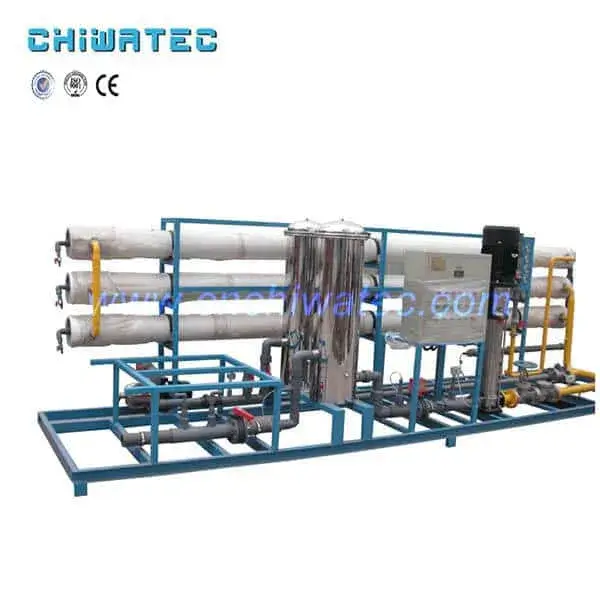
RO membrane technology, commercialized in the 1950s and now the foundation of most industrial water treatment equipment, operates by applying pressure (typically 6–30 bar, depending on feed water TDS) to force water molecules through a semi-permeable membrane while rejecting dissolved salts and other contaminants. Industrial RO membranes — typically 8-inch diameter spiral-wound elements arranged in series-parallel arrays — achieve 95–99.5% salt rejection and can process up to 40 m³/hour per pressure vessel. Industrial RO systems are widely deployed across multiple sectors: pharmaceutical manufacturing, semiconductor fabrication, power generation boiler feed water, and chemical processing. The technology is also fundamental to seawater desalination (SWRO), with large-scale plants producing over 600,000 m³/day of potable water. For drinking water applications in areas with insufficient or unstable municipal water pressure (below the required 2.8 kg/cm²), industrial-grade commercial water purification systems incorporate booster pumps that deliver operating pressure of 6–9 kg/cm², ensuring consistent water production of approximately 130 L/hour for small commercial installations up to 500 m³/hour for large industrial facilities.
Electrodeionization (EDI) Technology
EDI technology represents a revolutionary advancement in industrial ultrapure water production. Unlike conventional mixed-bed ion exchange that requires periodic chemical regeneration — generating hazardous acid and caustic waste — EDI continuously regenerates its ion-exchange resins using an applied electric field. An EDI stack consists of alternating diluting and concentrating compartments separated by ion-exchange membranes, with mixed-bed resin filling the diluting compartments. Under the influence of a DC electric field (typically 100–600 V), ions are continuously transported from the diluting stream to the concentrating stream, while water molecules split at the resin-membrane interfaces to regenerate the resin. EDI technology consistently produces water with resistivity of 16–18.2 MΩ·cm and silica removal below 5 ppb, making it the preferred polishing technology for industrial pure water systems in semiconductor, pharmaceutical, and power generation applications. The elimination of chemical regeneration reduces operating labor by up to 90%, eliminates hazardous waste disposal costs, and enables fully automated, continuous ultrapure water production.
Mixed-Bed Ion Exchange
While EDI is increasingly preferred for new installations, mixed-bed ion exchange remains widely used in existing industrial water treatment equipment and for applications with intermittent or variable demand. Mixed-bed vessels contain a homogeneous mixture of cation and anion exchange resins that remove residual ions from RO permeate to achieve resistivity up to 18.2 MΩ·cm. The resins require periodic in-situ regeneration with hydrochloric acid and sodium hydroxide, generating wastewater that must be neutralized before disposal. Modern mixed-bed systems incorporate conductivity-based automatic regeneration control, extending resin life and minimizing chemical consumption compared to older timer-based regeneration systems.
Industrial Applications by Sector
Electronics and Semiconductor Manufacturing
The semiconductor industry requires the highest purity water of any industrial sector — ultrapure water with resistivity ≥18.2 MΩ·cm, TOC <1 ppb, dissolved oxygen <1 ppb, and particle counts <1 particle/mL at 0.05 μm. Industrial ultrapure water systems for fabs typically incorporate RO, EDI, UV oxidation, degasification membranes, and final polishing mixed beds in sequence, with continuous recirculation loops maintaining water quality at each point of use. A typical 300 mm wafer fab consumes 4,000–6,000 m³ of ultrapure water per day, making water treatment a critical utility for semiconductor manufacturing operations.
Pharmaceutical and Biotechnology
Pharmaceutical manufacturers use industrial pure water systems to produce USP Purified Water and Water for Injection (WFI). These systems must comply with cGMP requirements, including validated performance, documented sanitization procedures, and comprehensive monitoring. RO + EDI systems have become the industry standard for PW production, while WFI is typically produced by distillation or multi-effect distillation from RO/EDI pre-treated water. The global pharmaceutical water treatment market is projected to reach USD 5.2 billion by 2030, driven by increasing biopharmaceutical manufacturing capacity.
Power Generation
Thermal power plants (coal, gas, nuclear) depend on industrial water treatment equipment to produce high-purity boiler feed water that prevents scale formation, corrosion, and turbine blade deposits. A typical 1,000 MW coal-fired power plant requires 200–300 m³/hour of demineralized water. RO + mixed-bed or RO + EDI systems have largely replaced traditional lime softening and ion exchange pre-treatment in modern power plants, reducing chemical consumption by 80% and maintenance costs by 60%.
Chemical and Petrochemical Processing
Chemical processing facilities use industrial water purifiers for process water, cooling tower makeup, and wastewater recycling applications. The water quality requirements vary widely by application — from low-conductivity process water for specialty chemical synthesis to high-purity water for catalyst preparation and analytical laboratory support. Industrial RO systems with appropriate pre-treatment are typically configured to handle the specific challenges of chemical plant feed water, which may contain elevated silica, organics, or variable TDS levels.
Operating Parameters and System Design Considerations
The normal operation of an industrial water purifier depends on maintaining appropriate operating pressure, typically 6–30 bar depending on the membrane configuration and feed water TDS. The required pressure must exceed the membrane’s osmotic pressure — for brackish water RO systems, this is approximately 2.8 kg/cm² minimum, while seawater RO systems require 55–80 bar. In areas with insufficient or fluctuating feed water pressure, industrial-grade booster pumps delivering 6–9 kg/cm² ensure consistent water production regardless of municipal supply variations. Key design parameters for industrial water treatment equipment include feed water quality analysis (TDS, hardness, silica, TOC, SDI), required permeate quality and flow rate, recovery rate optimization (typically 70–85% for brackish water, 40–50% for seawater), membrane array configuration, and energy recovery system selection. A well-designed system achieves daily water production of up to 500 m³/hour for large industrial installations, with automated monitoring and control ensuring consistent performance across varying feed water conditions and production demand cycles.
Latest Trends in Industrial Water Purification (2024–2025)
los industrial water purifier industry is undergoing rapid transformation driven by sustainability imperatives and technological innovation. Energy recovery devices (ERDs) for SWRO systems now capture up to 60% of concentrate stream pressure energy, reducing specific energy consumption to 2.5–3.5 kWh/m³ — a 75% reduction from thermal desalination processes. AI-powered predictive maintenance platforms analyze real-time operating data to forecast membrane fouling, optimize cleaning schedules, and reduce unplanned downtime by up to 35%. The adoption of smart industrial water treatment equipment with Industry 4.0 connectivity enables centralized monitoring of distributed water treatment assets, reducing operator requirements by 40–60% in multi-facility operations. Low-energy membrane elements certified for ultra-low-pressure operation (4–6 bar) are expanding the application range of industrial RO systems into commercial and light industrial applications with constrained energy budgets. Water reuse and zero-liquid discharge (ZLD) systems incorporating RO + brine concentrators + crystallizers are becoming standard in water-stressed industrial regions, achieving 95–98% water recovery rates and eliminating liquid discharge. The tightening of industrial wastewater discharge regulations globally — particularly the revised China National Industrial Wastewater Standards (GB 8978-2024) and EU Industrial Emissions Directive updates — is accelerating investment in advanced industrial water purification and recycling systems across manufacturing sectors.
Conclusión
Industrial water purifiers are essential infrastructure for modern manufacturing, enabling the high-purity water production that underpins semiconductor fabrication, pharmaceutical manufacturing, power generation, and countless other industrial processes. From RO + EDI integrated systems delivering 18.2 MΩ·cm ultrapure water to large-scale SWRO plants addressing global water scarcity, industrial water treatment equipment continues to evolve toward higher efficiency, lower energy consumption, and greater automation. As regulatory pressures on water quality and discharge intensify, and as industries increasingly prioritize water sustainability and circular economy principles, investment in advanced industrial water purification technology is not merely an operational requirement but a strategic competitive advantage. Selecting the right commercial water purification system — properly sized, correctly configured, and professionally maintained — ensures consistent production water quality, regulatory compliance, and optimized total cost of ownership over the system’s 15–20 year service life.
Frequently Asked Questions (FAQ)
What is the difference between an industrial water purifier and a residential one?
Industrial water purifiers operate at significantly higher capacities (1–500 m³/hour vs. 10–50 L/hour for residential systems), use larger and more robust components (8-inch diameter industrial RO membranes vs. 2–4 inch residential membranes), incorporate advanced automation and monitoring systems, and are designed for continuous 24/7 operation with minimal operator intervention. Industrial systems also feature redundant components and comprehensive pre-treatment trains to handle variable feed water quality and protect downstream equipment.
What industries need industrial water treatment equipment?
Key industries requiring industrial water treatment equipment include electronics and semiconductor manufacturing (requiring 18.2 MΩ·cm ultrapure water), pharmaceutical and biotechnology (USP Purified Water and WFI), power generation (boiler feed water), chemical and petrochemical processing, food and beverage manufacturing (process water), and seawater desalination for municipal water supply. Each sector has specific water quality standards that must be consistently met.
How often should industrial RO membranes be replaced?
Industrial RO membranes typically require replacement every 3–7 years, depending on feed water quality, pre-treatment effectiveness, and operating conditions. Key indicators that membrane replacement is needed include: decreased permeate flow rate (15–20% below baseline), increased permeate conductivity (10–15% above baseline), increased differential pressure across membrane vessels, and irreversible fouling that cannot be corrected by chemical cleaning. Regular monitoring of membrane performance metrics enables proactive replacement planning.
What is the total cost of ownership for an industrial water purification system?
The TCO of an industrial water purifier includes capital equipment costs (typically USD 50,000–2,000,000 depending on capacity and complexity), installation and commissioning (10–20% of equipment cost), energy consumption (USD 0.10–0.50/m³ for RO systems), chemical and consumable costs (pre-filters, antiscalants, membrane cleaning chemicals), membrane replacement (every 3–7 years at 20–30% of initial membrane cost), and maintenance labor. Modern RO + EDI systems typically achieve a total operating cost of USD 0.30–1.20/m³ of product water, significantly lower than traditional ion exchange systems.
Can industrial water purifiers be used for wastewater recycling?
Yes, industrial water treatment equipment is increasingly deployed for wastewater recycling and reuse applications. Industrial RO systems combined with appropriate pre-treatment (clarification, media filtration, ultrafiltration) can recover 70–85% of industrial wastewater as high-quality process water. Advanced systems incorporating RO + brine concentrators + crystallizers achieve zero-liquid discharge (ZLD), recovering up to 98% of wastewater and eliminating liquid effluent — a technology that is becoming standard in water-stressed industrial regions worldwide.
Further Reading
For more detailed information about industrial water treatment technologies and applications, explore these related articles:
- Main Process Flow of Reverse Osmosis Pure Water Equipment — A detailed breakdown of industrial RO system components, process stages, and design parameters.
- Advanced Water Purification System: Process Principles and Flow Diagram — Technical overview of industrial-scale water purification systems and multi-stage treatment processes.
- Pure Water/Mineral Water Plant Production Process — Insights into high-purity water production systems used in industrial beverage and pharmaceutical applications.
¿Tiene un proyecto de tratamiento de agua con el que podamos ayudar?
* Diseño, mecanizado, instalación, puesta en marcha, personalización y servicio integral






 Spanish
  English
  Portuguese




