

Resin Selection for Boiler Water Softening: 2026 Complete Guide to Choosing the Right Ion Exchange Resin
Choosing the wrong resin for boiler water softening can lead to scale formation, boiler tube failures, and costly unplanned shutdowns. The right resin selection is the single most important decision in designing an effective boiler water treatment system. Here is the direct answer: resin selection for boiler water softening prioritizes strong acid cation exchange resins (SAC) with a total exchange capacity of 1.8-2.0 eq/L, selecting between domestic grade (001×7 type) for general applications and premium brands such as Purolite, Amberlyst, or Dowex for high-pressure boilers requiring effluent hardness below 0.03 mg/L as CaCO3. CHIWATEC provides comprehensive boiler water softening system design guidance, including resin selection, sizing, and regeneration optimization.
Importancia de la selección de resinas para equipos de ablandamiento de agua de calderas
Boiler water softening removes hardness ions (calcium and magnesium) that would otherwise precipitate as scale on boiler heat exchange surfaces. Even 1 mm of scale increases fuel consumption by approximately 5-10%, and thicker deposits can cause localized overheating leading to tube rupture and boiler explosions. The ion exchange resin is the heart of the softening process — its performance directly determines the effluent water quality, operating cost, and system reliability.
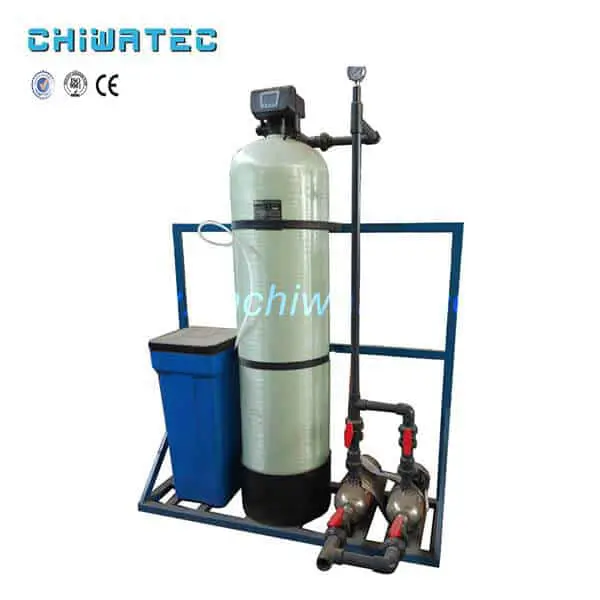
The water softening equipment achieves hardness removal through the substitution effect of ion exchange resin, where sodium ions on the resin are exchanged for calcium and magnesium ions in the feed water. When selecting resin, five critical factors must be evaluated: resin type (cation vs. anion), exchange capacity, physical stability, cost-effectiveness for the application, and regeneration requirements. For a deep dive into the mechanism, see Ion Exchange Method in Water Softening: Principles and Technology.
Key Criteria for Choosing Boiler Water Softening Resin
The following criteria should guide resin selection for boiler water softening in any application, from low-pressure heating boilers to high-pressure industrial steam generators:
| Selection Criterion | General Boiler | High-Pressure Boiler |
|---|---|---|
| Resin type | Strong acid cation (SAC), 001×7 type | SAC, premium grade (Purolite C100, Amberjet 1200Na) |
| Exchange capacity | 1.8-1.9 eq/L | 2.0-2.4 eq/L (higher crosslinking) |
| Effluent hardness target | Below 2.0 mg/L as CaCO3 | Below 0.03 mg/L as CaCO3 |
| Bead size | 0.3-1.2 mm (standard) | 0.4-0.8 mm (uniform particle size) |
| Operating temperature | Up to 40 degrees C (standard) | Up to 60 degrees C (high-temp grade) |
| Regenerant | Industrial salt (NaCl), 8-10% solution | High-purity salt (NaCl), 10-12% solution |
| Typical resin volume | 60-80% of tank volume | 60-80% of tank volume |
For low-pressure boilers with less stringent softened water quality requirements, domestic grade 001×7 resin is an economical choice. However, for steam boilers operating above 10 bar or for boiler make-up water feeding deionization or reverse osmosis systems, premium brand resins (Purolite, Rohm and Haas, Dow) are strongly recommended. For additional selection guidance, see Cómo funciona el agua descalcificada de la caldera.
Types of Ion Exchange Resins for Boiler Softening
While strong acid cation resins are the standard choice for boiler water softening, understanding the full landscape of available resin types helps optimize both performance and cost:
- Strong acid cation (SAC) resin: The default choice for boiler water softening. SAC resins contain sulfonic acid functional groups (-SO3H in hydrogen form, -SO3Na in sodium form) that exchange sodium ions for calcium and magnesium across the full pH range. The 001×7 gel-type SAC resin is the most widely used grade in China for general boiler applications.
- Weak acid cation (WAC) resin: Contains carboxylic acid functional groups (-COOH) and is effective only in the pH range 5-14. WAC resins have higher exchange capacity (3.0-4.0 eq/L) than SAC resins but are less commonly used for primary softening. They are sometimes employed as a first-stage polisher ahead of SAC resin to handle high-alkalinity or high-hardness waters.
- Anion exchange resin: Although typically not required for simple hardness removal, anion resins can be used in a two-bed deionization configuration following softening for boilers requiring extremely low conductivity feed water. However, the additional cost and regeneration complexity make this configuration suitable only for high-pressure boilers with strict water quality specifications.
- Macroporous vs. gel-type resin: Macroporous resins have a sponge-like structure with higher physical strength and better resistance to osmotic shock, making them suitable for applications with frequent regeneration cycles or variable water quality. Gel-type resins offer higher exchange capacity per unit volume and are more cost-effective for stable operating conditions.
For a comprehensive comparison of ion exchange technologies, refer to Ion Exchange Resin Regeneration and Storage: Complete Guide to Methods and Preservation.
Resin Regeneration and Maintenance for Boiler Systems
Proper regeneration and ongoing maintenance are essential to maximize resin lifespan and maintain consistent softened water quality:
- Regeneration frequency: Typically every 1-3 days for continuous boiler operation, triggered either by time clock or by the total volume of water treated since the last regeneration cycle. The resin should be regenerated before hardness breakthrough, which is detected by monitoring effluent hardness above 2.0 mg/L.
- Regeneration procedure: Backwash (10-15 minutes at 8-12 m/h flow rate to remove suspended solids and reclassify the resin bed) → Brine injection (8-10% NaCl solution at 4-6 m/h for 30-45 minutes) → Slow rinse (at brine flow rate for 15-20 minutes to displace spent brine) → Fast rinse (at service flow rate for 10-15 minutes until effluent conductivity drops below 50 µS/cm).
- Salt consumption: Typically 120-240 grams of NaCl per liter of resin per regeneration cycle. Using specialized water softening salt pellets (99.5%+ purity) prevents insoluble residue accumulation on the resin bed. For detailed guidance on regeneration media, see Analysis on the reasons of soft water hardness exceeding the standard in boiler softening water equipment.
- Resin lifespan: Under normal operating conditions with proper regeneration, SAC resin typically lasts 5-8 years. Signs of resin degradation include: increasing hardness leakage, longer rinse times after regeneration, and physical bead breakage visible in the backwash effluent.
- Resin fouling prevention: Iron fouling is the most common cause of resin performance degradation in boiler applications. Periodic treatment with 5-10% hydrochloric acid (HCl) solution can remove accumulated iron oxides. Organic fouling can be addressed with 10% NaCl + 2% NaOH warm solution cleaning every 6-12 months.
Frequently Asked Questions
Q1: Which resin is best for boiler water softening?
Strong acid cation (SAC) resin, specifically the 001×7 gel type (domestic) or premium grade such as Purolite C100 or Amberjet 1200Na (international), is the best choice for boiler water softening. For low-pressure boilers (below 10 bar) with moderate hardness requirements, domestic 001×7 resin offers the best cost-to-performance ratio. For high-pressure boilers requiring effluent hardness below 0.03 mg/L, premium grade SAC resin with uniform particle size distribution is essential.
Q2: How much resin does a boiler water softener need?
The resin volume is typically 60-80% of the tank body volume. For a standard softener configuration, this means a 0.5 m3 tank holds approximately 300-400 liters of resin. The exact volume should be calculated based on the feed water hardness, desired service cycle length (typically 24-72 hours between regenerations), and the resin’s exchange capacity. Under-sizing the resin reduces service run time; over-sizing wastes resin and increases regeneration costs.
Q3: Can anion resin be used for boiler water softening?
While cation resin is the standard choice for hardness removal, anion resin can theoretically be used in a water softening configuration. However, anion resins target different contaminants — primarily silica, chloride, and sulfate — rather than calcium and magnesium hardness ions. The cost of anion resin is typically 2-3 times higher than SAC resin, making it economically impractical for primary softening. Cation resin remains the correct and most cost-effective choice for boiler water hardness removal.
Q4: How often should boiler softening resin be regenerated?
For continuous boiler operation, resin regeneration is typically required every 1-3 days, depending on the feed water hardness and system size. For example, a system treating water with 200 mg/L hardness at a flow rate of 10 m3/h, using 300 L of SAC resin with 1.9 eq/L capacity, will require regeneration approximately every 24 hours. Regeneration can be triggered by a flow meter (based on total treated volume), a time clock controller, or by hardness breakthrough monitoring.
Q5: What causes high hardness in softened boiler water even after regeneration?
High hardness after regeneration is typically caused by: (1) exhausted resin nearing the end of its service life (resin replacement needed every 5-8 years), (2) iron fouling of the resin beads (clean with 5-10% HCl solution), (3) insufficient brine concentration or contact time during regeneration (verify salt saturation and injection flow rate), (4) channeling or improper flow distribution in the resin bed (check underbedding and distributor integrity), or (5) raw water quality changes exceeding the system design capacity (re-evaluate feed water analysis). For a troubleshooting guide, see Industrial Water Softening Equipment: Complete Technical Guide.
Conclusion & CTA
Proper resin selection for boiler water softening is a critical decision that directly impacts boiler efficiency, safety, and operating costs. By choosing between domestic 001×7 SAC resin for general applications and premium grade resins for high-pressure systems, matching the resin exchange capacity to the feed water hardness and service flow requirements, and implementing a disciplined regeneration and maintenance schedule, operators can achieve consistent softened water quality below 2.0 mg/L hardness, extend boiler tube life by 5-10 years, and reduce energy consumption by 5-15% compared to systems operating with inadequate or incorrect resin selections.
Contact CHIWATEC today at [email protected] o [email protected] (WhatsApp available) for expert guidance on resin selection, boiler water softening system design, and customized treatment solutions for your specific boiler operating conditions.
Related Resources and Further Reading
- Ion Exchange Resin Regeneration and Storage: Complete Guide to Methods and Preservation
- Ion Exchange Method in Water Softening: Principles and Technology
- Cómo funciona el agua descalcificada de la caldera
- Analysis on the reasons of soft water hardness exceeding the standard in boiler softening water equipment
- Water Softening System — CHIWATEC
¿Tiene un proyecto de tratamiento de agua con el que podamos ayudar?
* Diseño, mecanizado, instalación, puesta en marcha, personalización y servicio integral






 Spanish
  English
  Portuguese




