

Buried Sewage Treatment Equipment: 2026 Complete Guide to Operation, Process, and Maintenance
Are you struggling with the startup, operation, or daily maintenance of your buried sewage treatment equipment? Improper operation is the leading cause of biofilm failure, effluent non-compliance, and premature equipment wear. Here is the direct answer: buried sewage treatment equipment operates through a biofilm-based process combining anaerobic filtration and biological contact oxidation, with proper startup requiring 72 hours of initial aeration and gradual biofilm cultivation before full-load operation. CHIWATEC provides engineered buried sewage treatment systems designed for reliable, low-maintenance operation across residential, commercial, and industrial applications.
What Is Buried Sewage Treatment Equipment?
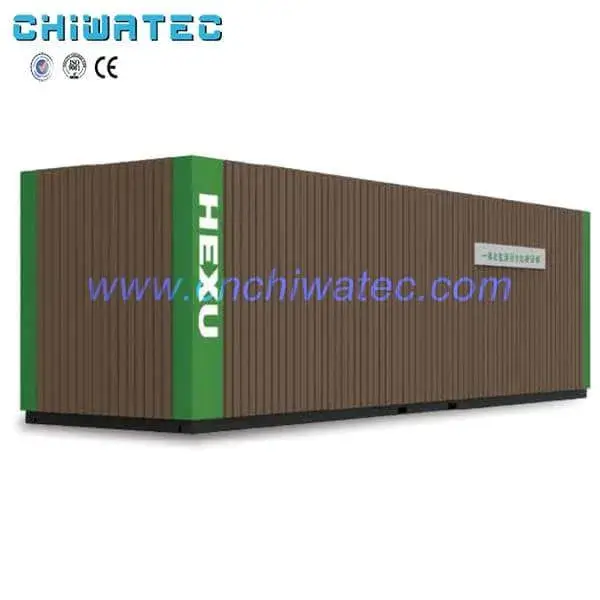
Buried sewage treatment equipment is a modular, high-efficiency wastewater treatment system installed below ground level. It treats and purifies sewage through biofilm processes, fully utilizing the functions of anaerobic biological filters and biological contact oxidation beds. The equipment features high biological density, strong pollution resistance, and stable operation, making it an ideal solution for decentralized wastewater treatment where surface space is limited or aesthetic considerations are important.
Unlike conventional above-ground treatment plants, buried systems offer several distinct advantages: they require no dedicated building, produce minimal noise and odor, and can be installed underneath parking lots, gardens, or public spaces. The treatment capacity typically ranges from 1 to 500 m3/day, covering small communities, hotels, hospitals, residential compounds, and rural developments. For a comparison of compact treatment options, see ¿Cómo funciona el equipo de tratamiento de aguas residuales integrado de FRP?
Operating Principle of Buried Sewage Treatment Equipment
The buried sewage treatment system combines multiple treatment stages within a compact underground structure:
- Primary treatment: Sewage enters the primary sedimentation tank where large solids settle and floating materials are removed by a mechanical bar screen or manual screening
- Anaerobic treatment: The screened effluent flows into the anaerobic biofilter, where anaerobic microorganisms break down complex organic compounds into simpler molecules, reducing COD by 40-60%
- Biological contact oxidation: The partially treated wastewater enters the aerobic contact oxidation tank, where biofilm on submerged filler media degrades dissolved organic matter — this stage removes 80-90% of the remaining BOD
- Secondary sedimentation: Detached biofilm particles settle in the secondary sedimentation tank, producing clarified effluent with suspended solids below 30 mg/L
- Disinfection: The clarified water passes through a disinfection chamber where chlorine-based or UV disinfection achieves pathogen reduction of 99.9%
- Clean water storage: Treated water is stored in the clean water tank before discharge or reuse for irrigation and toilet flushing
The entire process operates without sludge return, using natural biofilm sloughing and gravity sedimentation for solids management. For sedimentation tank maintenance guidance, refer to Integrated Sewage Treatment Sedimentation Tank: 2026 Complete Guide.
Step-by-Step Operation Process for Buried Sewage Treatment Equipment
Proper startup and daily operation are critical for establishing and maintaining a healthy biofilm. Follow these steps for reliable buried sewage treatment equipment operation:
Initial Startup and Commissioning
- Open the water inlet valve and outlet valve. Start the water inlet lifting pump to transfer sewage from the regulating tank to the treatment equipment.
- When the water level reaches one-half of the equipment height, stop pumping. Open the fan inlet valve, start the fan, slowly open the fan outlet valve, and begin aeration in the biological contact oxidation tank.
- Aerate continuously for 48 hours to establish initial microbial activity in the biofilm.
- Restart the water inlet lifting pump to add sewage until it reaches three-quarters of the equipment height.
- Continue aeration for an additional 24 hours, allowing aerobic bacteria to colonize the filler media.
Biofilm Cultivation Verification
- Touch the filler media with your hand — a healthy biofilm produces a slimy, sticky sensation on the surface.
- Observe the water body for signs of microbial growth: slight turbidity, fine bubbles from biological activity, and gradual color change from clear to light brown.
- Only after visible biofilm growth is confirmed should full sewage flow be introduced to the equipment.
- Gradually increase the water volume from 25% to 50% to 75% to 100% of the design capacity over 5-7 days, monitoring effluent quality at each step.
- Regularly observe the growth of microorganisms in the water. If any abnormalities are detected (excessive turbidity, foul odors, or biofilm detachment), immediately reduce the water intake and adjust aeration rates.
Daily Operation and Monitoring
- Observe the flow pattern in the secondary sedimentation tank — the effluent weir must collect water evenly across its entire length to prevent short-circuiting.
- Discharge sludge every 24 hours by opening the sludge discharge solenoid valve. The sludge from the secondary sedimentation tank is lifted to the sludge holding tank for periodic removal.
- Add disinfectant to the disinfection tank as needed. The water from the secondary sedimentation tank passes through the disinfectant dosing tank, where the chemical is partially dissolved to achieve the target residual chlorine level of 0.5-2.0 mg/L after 30 minutes of contact time.
- After disinfection, treated water stays in the clean water tank for approximately 30 minutes before discharge. Verify that the effluent meets local discharge standards.
- After the equipment is debugged and operating normally, switch the system to automatic operation mode — the water pump and fan controls can be set to automatic on-site.
- Check effluent quality parameters (COD, BOD, SS, pH, and residual chlorine) periodically to ensure continuous compliance. Maintain a daily log of all readings.
For efficient solids handling, the Centrifugal Dehydrator Sewage Treatment: 2026 Guide provides detailed guidance on sludge dewatering and disposal.
Key Design and Performance Parameters
| Parámetro | Typical Range | Notes |
|---|---|---|
| Treatment capacity | 1-500 m3/day | Modular design scales with number of treatment units |
| HRT (total) | 8-24 hours | 4-8 hr anaerobic + 4-8 hr aerobic + 2-4 hr sedimentation |
| COD removal rate | 85-95% | Combined anaerobic-aerobic treatment |
| BOD removal rate | 90-98% | Primary target parameter for biofilm systems |
| Effluent SS | Below 30 mg/L | After secondary sedimentation |
| Aeration rate | 15-25 m3 air/m3 wastewater | Maintain DO at 2-4 mg/L in aerobic zone |
| Sludge discharge | Every 24 hours | 2-3 minutes per discharge cycle |
| Operating temperature | 10-35 degrees C | Below 10 degrees C, extend aeration time by 30-50% |
Maintenance and Troubleshooting
Regular maintenance ensures the long-term reliability of buried sewage treatment equipment:
- Daily checks: Inspect the fan operation, pump pressure, and effluent clarity. Listen for unusual noises from mechanical components and check for leaks at pipe connections.
- Weekly checks: Test dissolved oxygen levels in the aerobic tank (target 2-4 mg/L), verify disinfectant residual, and observe biofilm thickness on filler media.
- Monthly checks: Clean the bar screen and manual filter. Inspect the distributor system for clogging. Check sludge accumulation in the holding tank.
- Quarterly checks: Drain and clean the clean water tank. Inspect and clean aeration diffusers. Test all pumps and valves for proper function.
- Annual maintenance: Complete system inspection including structural integrity check of the buried tank. Replace worn aeration diffusers and damaged filler media (typically 5-10% annual replacement). Recalibrate DO sensors and flow meters.
Common operational issues include: insufficient aeration (check fan V-belt tension and filter), sludge accumulation in the secondary sedimentation tank (increase discharge frequency), and biofilm detachment due to toxic shock (temporarily reduce inflow and increase recirculation). For compliance guidance, see Sewage Treatment Standards: Complete Guide to Wastewater Treatment Standards.
Frequently Asked Questions
Q1: How long does it take to start up buried sewage treatment equipment?
Initial startup requires approximately 4-7 days. The process begins with 48 hours of aeration at half water level, followed by 24 hours of aeration after filling to three-quarters level. Biofilm cultivation verification adds another 1-2 days. After visible biofilm growth is confirmed, the system needs 5-7 days of gradual load increase to reach full design capacity. Total time from first water entry to stable full-load operation is typically 10-14 days.
Q2: What is the lifespan of buried sewage treatment equipment?
Well-maintained buried sewage treatment equipment typically lasts 15-25 years for the tank structure (steel or FRP), with mechanical components (pumps, fans, valves) requiring replacement every 5-8 years. Filler media needs 5-10% annual replacement, and aeration diffusers should be replaced every 3-5 years. The lifespan depends heavily on proper operation, regular maintenance, and the corrosiveness of the wastewater being treated.
Q3: How often should sludge be discharged from buried sewage treatment equipment?
Under normal operating conditions, sludge should be discharged every 24 hours. Each discharge cycle lasts 2-3 minutes, during which the sludge discharge solenoid valve opens and the secondary sedimentation tank sludge is lifted to the sludge holding tank. Excessive sludge buildup reduces treatment efficiency by occupying tank volume and causing anaerobic conditions in the sedimentation zone.
Q4: Can buried sewage treatment equipment handle fluctuating flow rates?
Yes, buried sewage treatment equipment is designed to handle significant flow fluctuations through the regulating tank (equalization basin) upstream of the treatment unit. The regulating tank should have at least 6-8 hours of capacity at average flow to dampen peak flows. The biological contact oxidation process itself tolerates shock loads well due to the high biomass concentration on the filler media, making buried systems suitable for applications with seasonal or weekly peak loads such as tourist resorts and school campuses.
Q5: What effluent quality can buried sewage treatment equipment achieve?
Properly operated buried sewage treatment equipment achieves effluent quality meeting or exceeding most discharge standards: COD below 60 mg/L, BOD below 20 mg/L, SS below 20 mg/L, and fecal coliform below 500 MPN/L after disinfection. This corresponds to China’s Grade 1A discharge standard (GB 18918-2002) and is suitable for direct discharge to surface waters or reuse for irrigation and landscape applications. For specific regulatory requirements in your region, consult local environmental protection agency guidelines.
Conclusion & CTA
Buried sewage treatment equipment offers a reliable, space-efficient, and low-maintenance solution for decentralized wastewater treatment. With proper startup procedures, daily operation protocols, and regular maintenance, these systems consistently achieve 85-95% COD removal and produce effluent meeting strict discharge standards. By combining anaerobic filtration, biological contact oxidation, and final disinfection in a compact underground package, buried systems provide cost-effective treatment for residential communities, hotels, hospitals, and industrial facilities where surface space is at a premium.
Contact CHIWATEC today at [email protected] o [email protected] (WhatsApp available) for customized buried sewage treatment equipment designs, installation support, and operation training for your specific project requirements.
Related Resources and Further Reading
- ¿Cómo funciona el equipo de tratamiento de aguas residuales integrado de FRP?
- Integrated Sewage Treatment Sedimentation Tank: 2026 Complete Guide
- Centrifugal Dehydrator Sewage Treatment: 2026 Guide to Function and Maintenance
- Sewage Treatment Standards: Complete Guide to Wastewater Treatment Standards
- Wastewater Treatment System — CHIWATEC
¿Tiene un proyecto de tratamiento de agua con el que podamos ayudar?
* Diseño, mecanizado, instalación, puesta en marcha, personalización y servicio integral






 Spanish
  English
  Portuguese




