

Electrodialysis Working Principle: How ED Membrane Technology Desalinates Water 2026
los electrodialysis working principle relies on the selective migration of dissolved ions through ion-exchange membranes under the influence of a direct current (DC) electric field. Electrodialysis (ED) is a membrane separation technology that uses cation-exchange membranes (CEM) and anion-exchange membranes (AEM) arranged alternately in a stack. When a DC voltage is applied, cations migrate toward the cathode and pass through the CEM, while anions migrate toward the anode through the AEM, creating alternating dilute (desalinated) and concentrate (brine) compartments. This guide explains how the electrodialysis working principle enables efficient desalination without high-pressure pumps or phase changes, making ED an energy-efficient choice for brackish water desalination, industrial water treatment, and ultrapure water pre-treatment applications.
Electrodialysis Working Principle: Ion Migration Under DC Electric Field
los electrodialysis working principle is fundamentally different from pressure-driven membrane processes like reverse osmosis. In an electrodialysis stack, hundreds of alternating cation-exchange and anion-exchange membranes are sandwiched between two electrodes — a cathode (negative) and an anode (positive). When feed water flows through the compartments between the membranes and a DC voltage is applied, dissolved ions respond to the electric field:
- Cations (Na⁺, Ca²⁺, Mg²⁺) migrate toward the negatively charged cathode. They pass through the cation-exchange membrane but are blocked by the adjacent anion-exchange membrane, becoming trapped in the concentrate compartment.
- Anions (Cl⁻, SO₄²⁻, HCO₃⁻) migrate toward the positively charged anode. They pass through the anion-exchange membrane but are blocked by the adjacent cation-exchange membrane, also becoming trapped in the concentrate compartment.
The result is a series of alternating dilute compartments (purified water) and concentrate compartments (brine). The dilute streams are collected to produce product water, while the concentrate streams are discharged or further processed. The cation-exchange membrane selectively allows cations to pass while blocking anions, and the anion-exchange membrane does the opposite — this selective permeability is the key to the electrodialysis working principle.
Key Characteristics and Advantages of Electrodialysis
Electrodialysis offers several distinct advantages over other membrane desalination technologies:
| Characteristic | ED | RO | Ion Exchange |
| Salt removal range | 30-99% | 95-99.7% | >99% |
| Energy consumption (1,000 mg/L feed) | ~0.25 kWh/m³ | ~0.5-1.0 kWh/m³ | Regeneration chemicals |
| Presión operacional | Low (0.2-0.5 MPa) | High (0.8-7.0 MPa) | Low |
| Chemical regeneration | Not required | Not required (cleaning only) | Required regularly |
| Environmental impact | Minimal | Brine discharge | Acid/alkali wastewater |
| Noise level | Low (no high-pressure pump) | Moderate (high-pressure pump) | Low |
- Arbitrary salt removal rate — The desalination level can be selected from 30% to 99% by adjusting the number of stages, voltage, and flow rate, offering flexibility unmatched by fixed-rejection RO membranes.
- Low energy consumption — For brackish water with 1,000 mg/L TDS at 80% desalination, a medium-sized electrodialyzer consumes only ~0.25 kWh/m³ of DC power with inlet pressure of 0.2 MPa — making ED one of the most energy-efficient technologies for low-salinity feed water.
- No chemical regeneration — Unlike ion exchange, ED does not suffer from saturation failure and requires no periodic acid-base regeneration. No additional chemicals are needed during normal operation.
- Environmentally friendly — Essentially pollution-free operation. Compared with RO, there is no high-pressure pump noise, and no chemical regeneration wastewater is produced.
- Flexible design and long service life — ED stacks can be designed in modular configurations with long membrane life and straightforward operation and maintenance.
Applications of Electrodialysis Technology
Electrodialysis devices are widely used across electric power, chemical, electronics, environmental protection, pharmaceutical, textile, and food processing industries. Specific applications include:
- Seawater and brackish water desalination — ED is particularly economical for brackish water with TDS below 5,000 mg/L, producing drinking water at lower energy cost than RO in this salinity range.
- Beverage and pure water preparation — Beer, soda, and purified water production benefit from ED’s ability to selectively remove specific ions while preserving desirable mineral content.
- Low-pressure boiler feed water — ED provides effective desalination for boiler make-up water at significantly lower energy consumption than thermal or high-pressure membrane processes.
- Ultrapure water pre-treatment — Combined use of electrodialysis and ion exchange produces distilled water, high-purity water, and ultrapure water while saving 80-90% of acid and alkali consumption compared to ion exchange alone. This hybrid approach avoids frequent resin regeneration and substantially reduces water production costs.
- Industrial process water — ED integrates with other treatment units to produce higher-grade water for electronics, pharmaceutical, food, and chemical manufacturing.
- Metal recovery and wastewater reuse — ED effectively recovers precious metals such as gold, silver, and copper from electroplating and electronics industry wastewater, enabling simultaneous water recycling.
ED vs EDI: Understanding the Difference
While electrodialysis (ED) and electrodeionization (EDI) both use ion-exchange membranes and DC electric fields, they differ in a critical way: EDI incorporates mixed-bed ion-exchange resin beads between the membranes. The resin beads enhance ion transport, allowing EDI to achieve much higher purity levels (resistivity up to 18.2 MΩ·cm) than ED alone. ED is typically used for primary desalination (500-5,000 µS/cm effluent), while EDI serves as a final polishing step (0.05-0.5 µS/cm effluent) following RO in ultrapure water systems.
Frequently Asked Questions
Q1: How does electrodialysis work?
Electrodialysis uses a DC electric field to drive dissolved ions through selective ion-exchange membranes. Cations migrate toward the cathode through cation-exchange membranes, while anions migrate toward the anode through anion-exchange membranes, creating alternating desalinated and concentrated water streams.
Q2: What is the difference between ED and EDI?
EDI (electrodeionization) is an enhanced version of ED that fills the dilute compartments with mixed-bed ion-exchange resin beads. The resin increases ion transport efficiency, enabling EDI to produce ultrapure water (18.2 MΩ·cm) while ED alone is limited to 500-5,000 µS/cm effluent.
Q3: What are the main advantages of electrodialysis?
Key advantages include adjustable salt removal (30-99%), low energy consumption (~0.25 kWh/m³ for brackish water), no chemical regeneration requirements, minimal environmental impact, low operating pressure, flexible modular design, and long membrane service life.
Q4: What applications use electrodialysis technology?
ED is used for brackish water desalination, beverage water preparation, boiler feed water treatment, industrial process water, ultrapure water pre-treatment in combination with ion exchange, and precious metal recovery from industrial wastewater.
Q5: Is electrodialysis more energy-efficient than reverse osmosis?
For low-salinity feed water (<5,000 mg/L TDS), ED typically consumes less energy than RO because it only removes dissolved ions rather than forcing all water through a tight membrane. At higher salinities, RO becomes more energy-efficient due to higher water recovery rates.
Conclusion and Call to Action
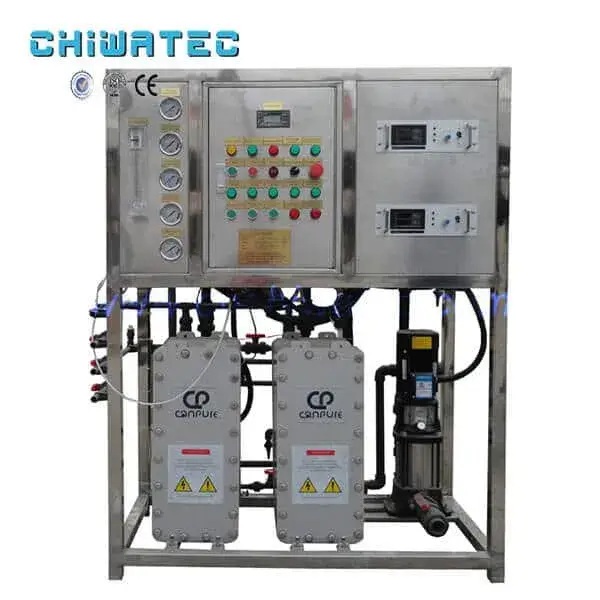
los electrodialysis working principle — selective ion migration through ion-exchange membranes under a DC electric field — offers a versatile and energy-efficient alternative to pressure-driven membrane processes for brackish water desalination, industrial water treatment, and ultrapure water pre-treatment. With adjustable desalination rates, low operating pressure, no chemical regeneration requirements, and minimal environmental impact, ED technology continues to serve power generation, chemical processing, electronics manufacturing, pharmaceutical production, and food and beverage industries worldwide. CHIWATEC provides complete electrodialysis and electrodeionization system design, membrane stack supply, and installation services. Contact our engineering team at [email protected] o [email protected] for a customized ED or EDI solution tailored to your water quality requirements.
Related Resources and Further Reading
- EDI Ultrapure Water Equipment Maintenance: Complete Guide to EDI System Care
- EDI System Guide 2026: How Electrodeionization Works and Benefits
- EDI Electrodeionization Equipment Working Principle 2026: Complete Guide
- EDI Ultrapure Water Equipment 2026: Complete Guide to Electrodeionization
- CHIWATEC Ultrapure Water Purification Systems
¿Tiene un proyecto de tratamiento de agua con el que podamos ayudar?
* Diseño, mecanizado, instalación, puesta en marcha, personalización y servicio integral






 Spanish
  English
  Portuguese




