Fundamentals of Reverse Osmosis Technology
The principle of reverse osmosis membrane
Osmosis is a physical phenomenon. When two solutions containing different salt concentrations are separated by a semi-permeable membrane, it will be found that the solvent on the side with less salt content will spontaneously flow to the side with high salt content. This process is called infiltration. The infiltration stops when the liquid level difference (ie the pressure difference) on both sides reaches a certain value, and the pressure difference at this time is called the osmotic pressure. The osmotic pressure is only related to the type of solution, salt concentration and temperature, but not to the semipermeable membrane. In general, the higher the salt concentration, the higher the osmotic pressure. In osmotic equilibrium, if a pressure is applied on the concentrated solution side, the solvent on the concentrated side will infiltrate to the fresh water side under the action of pressure. This infiltration is the opposite of natural infiltration, so it is called reverse osmosis (Reverse Osmosis). Using reverse osmosis technology, we can use pressure to separate the solute from the solvent.
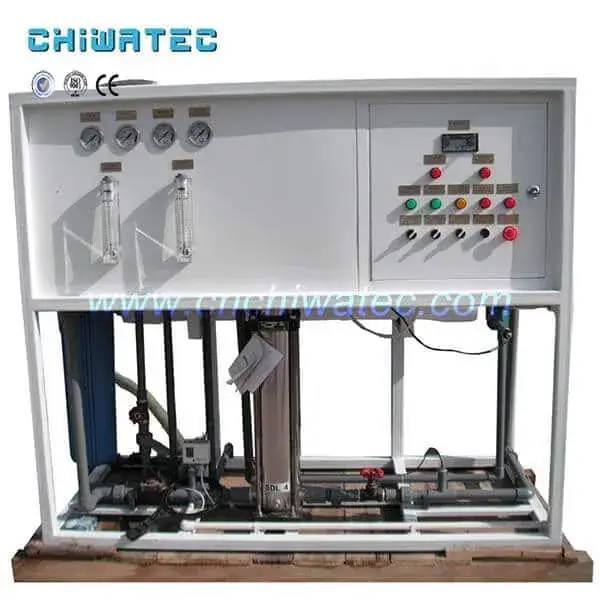
membrana de osmosis inversa
The reverse osmosis water purification process refers to the process in which water molecules pass through the reverse osmosis membrane under pressure to separate them from impurities. Reverse osmosis membrane is the core of reverse osmosis technology.
The reverse osmosis membrane has the following three special functions:
- Electric repulsion function: The electric property of the surface of the semipermeable membrane can repel the positively and negatively charged ions dissolved in water, so that the uncharged water molecules can pass through under the action of pressure. Therefore, the pure water produced by reverse osmosis does not contain various metal ions such as lead, arsenic, cadmium, mercury, chromium, calcium, magnesium, sodium and other cations and other cations, and does not contain fluorine, chlorine, nitrate, nitrite and sulfate. and other anions. Calcium, magnesium salts (commonly known as water alkalis) and salts that make water bitter and salty can be removed.
- Ultrafine filtration function: There are many pores in the semipermeable membrane for water molecules to pass through. The diameter of these pores is 0.0005 microns, which is comparable to the diameter of water molecules. The smallest bacteria and viruses have diameters of 0.2 and 0.02 microns, respectively. Insecticide 666 is approximately 0.0015 microns in diameter. Therefore, these pollutants and other biological pollutants and many organic pollutants cannot pass through this semi-permeable membrane and are separated from pure water.
Salts exist in water in the form of hydrated ions, and the volume of these hydrated ions is generally 10-25 times larger than that of water molecules. Therefore, in addition to the above-mentioned electrorepulsion function, reverse osmosis membranes can also be filtered through its ultra-fine filtration. Function to remove dissolved salts. - Self-cleaning function: While the general water filter removes pollutants, it also leaves these pollutants in the water filter. After that, the filtered water will pass through these pollutants, thereby re-contaminating the water. At the same time, bacteria will also multiply in the water filter, and the water will be re-contaminated by microorganisms. In contrast, the semi-permeable membrane leaves all the pollutants in the concentrated water to be eliminated during the water purification process, so as to realize the self-cleaning function. As a result, the resulting purified water is more reliable and the life of the water purification device is longer.
The pure water output of reverse osmosis equipment is related to the temperature and salinity of the source water. Generally speaking, for every 1°C drop in temperature, yield drops by 3-4%, and for every 100ppm increase in salinity, yield drops by 0.5-1%.
Xian CHIWATEC Water Treatment Technology es una empresa de alta tecnología especializada en varios dispositivos de procesamiento de agua. Aparte de estos productos individuales, que cubren una serie de tipos y series, también podemos ayudar con proyectos de ingeniería integrales relacionados. Gracias a nuestro arduo trabajo y dedicación desde nuestra fundación, ahora somos uno de los fabricantes de equipos de tratamiento de agua de más rápido desarrollo en el oeste de China.
Otras lecturas:
SÍGANOS
¿Tiene un proyecto de tratamiento de agua con el que podamos ayudar?
* Diseño, mecanizado, instalación, puesta en marcha, personalización y servicio integral
 Spanish
  English
  Portuguese