

EDI Ultrapure Water System: Working Principle, Technology, and Advantages Guide (2026 Updated)
Electrodeionization (EDI) is a revolutionary water purification technology that combines electrodialysis and ion exchange to produce high-purity water without chemical regeneration. By continuously removing dissolved ions from feed water using ion exchange resins, selective ion membranes, and a direct electric field, EDI systems consistently produce water with resistivity above 15 MOhm-cm. Xi’an CHIWATEC specializes in designing and manufacturing EDI ultrapure water systems for industries requiring consistent high-purity water.
*Last Updated: March 2026
Why This Guide Matters
The global electrodeionization (EDI) market was valued at approximately USD 1.8 billion in 2025 and is projected to reach USD 3.5 billion by 2035, expanding at a CAGR of 6.8% (Grand View Research, 2025). The pharmaceutical, semiconductor, and power generation sectors drive this growth as they demand increasingly stringent water quality standards. EDI technology has largely replaced traditional mixed-bed ion exchange in new installations due to its continuous operation, zero chemical handling, and lower lifecycle costs. Understanding the working principle and technology of EDI ultrapure water systems is essential for plant engineers, water treatment professionals, and facility managers seeking reliable, environmentally responsible ultrapure water solutions.
Key Industry Trends (2026 Update)
- Ultrapure water demand in semiconductor fabs: The global semiconductor industry’s water consumption exceeded 1.2 trillion gallons in 2025, with each wafer fabrication facility requiring 4-8 million gallons of ultrapure water daily. EDI systems are now the standard technology for achieving the resistivity requirements of 18.2 MOhm-cm specified by ASTM D5127.
- PFAS-conscious purification: New EDI module designs incorporate ion-selective membranes optimized for removing charged PFAS compounds, addressing EPA Stage 1 PFAS regulations (2024-2026) that set MCLs at 4 ppt for PFOA and PFOS.
- Energy-efficient EDI modules: Third-generation EDI modules consume 20-30% less DC power per cubic meter of product water compared to 2020-era designs, reducing operating costs to approximately USD 0.15-0.30 per cubic meter.
- IoT-enabled EDI monitoring: Real-time resistivity monitoring, module voltage tracking, and predictive maintenance alerts now allow EDI system operators to anticipate module fouling and optimize cleaning schedules, reducing unplanned downtime by up to 45%.
1. What Is an EDI Ultrapure Water System?
Definition and Core Technology
EDI (Electrodeionization) is a water treatment technology that combines electrodialysis and ion exchange to continuously remove ionized species from water without chemical regeneration. The EDI process uses ion exchange resins to capture dissolved ions, ion-selective membranes to direct ion movement, and a direct current (DC) electric field to drive ions toward the appropriate electrodes. Unlike conventional mixed-bed ion exchange, EDI regenerates its resins continuously using the electric field — no acid or caustic chemicals are required.
Role in the Water Treatment Train
A typical EDI ultrapure water system follows this treatment sequence: raw water to pretreatment to reverse osmosis (RO) to EDI module to storage. The RO system removes 95-98% of dissolved ions, organic compounds, and particulates, producing water with conductivity below 20 microSiemens/cm. The EDI module then polishes this RO permeate to achieve ultrapure water quality with resistivity of 10-18.2 MOhm-cm. This RO-EDI configuration has become the industry standard, replacing the older RO-mixed bed deionization (RO-MB-DI) approach.
2. How Does an EDI Ultrapure Water System Work?
Step-by-Step Working Principle
The EDI working principle follows a continuous seven-step process:
- Feed water (RO permeate) enters the EDI module and flows into the dilute compartment containing ion exchange resin beads.
- The mixed-bed resin beads trap dissolved ions (cations and anions) from the water passing through.
- A DC electric field applied across the module electrodes drives trapped cations toward the cathode and anions toward the anode.
- Cations migrate through the cation-permeable membrane into the concentrate compartment on the cathode side.
- Anions migrate through the anion-permeable membrane into the concentrate compartment on the anode side.
- Concentrated ions in the concentrate compartments are flushed out through the waste stream (reject water, typically 5-15% of feed flow).
- Deionized, high-purity water exits the dilute compartment with resistivity above 15 MOhm-cm.
Continuous Electric Regeneration
The key innovation of EDI technology is that the DC electric field continuously regenerates the ion exchange resin beads. Hydrogen and hydroxide ions, generated by water splitting at resin bead surfaces under the high electric field gradient, constantly restore the resin to its active form. This eliminates the need for periodic chemical regeneration shutdowns and the associated acid/caustic chemical handling, storage, and neutralization systems.
3. What Are the Key Components of an EDI System?
EDI Module Stack
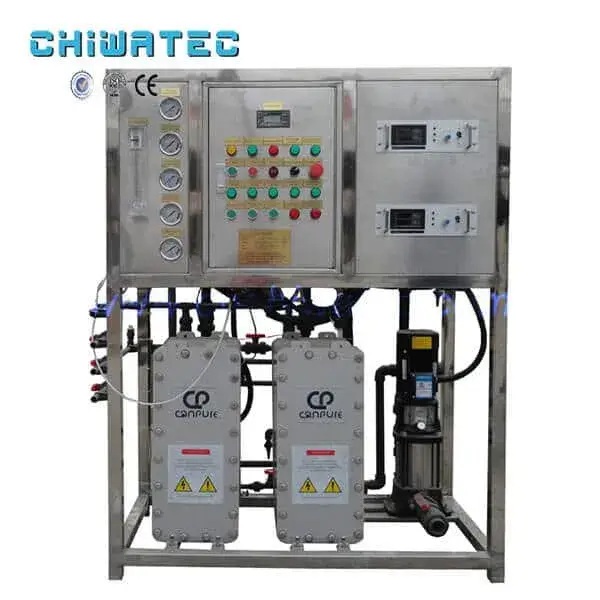
The EDI module consists of alternating dilute and concentrate compartments separated by ion-selective membranes. Each module contains hundreds of cell pairs arranged in a plate-and-frame or spiral-wound configuration. The dilute compartments are filled with mixed-bed ion exchange resin beads that facilitate ion transport and enable electric regeneration. The concentrate compartments may contain ion exchange resin or may operate as resin-free flow channels.
Electrode System
Electrodes (anode and cathode) are located at the ends of the module stack. They are typically made of titanium coated with mixed metal oxides (MMO) for corrosion resistance and catalytic efficiency. The electrodes receive DC power from a rectifier, with typical operating voltages of 100-600 V DC and current densities of 20-100 amps per module. Electrode rinse streams are required to remove gas bubbles (oxygen at the anode, hydrogen at the cathode) and maintain electrical conductivity.
Power Supply and Controls
A DC rectifier converts AC power to the required DC voltage and current for EDI operation. Modern EDI systems include resistivity sensors, flow meters, pressure transducers, and programmable logic controllers (PLCs) that automatically adjust operating parameters to maintain consistent product water quality.
4. EDI vs. Mixed-Bed Ion Exchange: Key Differences
Process Comparison
| Parámetro | EDI Technology | Mixed-Bed Ion Exchange |
|---|---|---|
| Regeneration | Continuous (electric) | Periodic (chemical acid/caustic) |
| Chemicals required | None | HCl, H2SO4, NaOH |
| Operating cost | Low (electricity only) | High (chemicals + disposal) |
| Water quality | 10-18.2 MOhm-cm stable | 10-18.2 MOhm-cm variable |
| Continuous operation | Yes (no regeneration shutdown) | No (requires offline regeneration) |
| Automation | Completamente automatico | Requires manual or semi-automatic |
| Floor space | Compact | Large (regeneration tanks + chemical storage) |
| Waste discharge | Minimal (5-15% reject) | Chemical neutralization effluent |
Why EDI Has Replaced Mixed-Bed Systems
The shift from mixed-bed to EDI technology is driven by several compelling advantages: stable water quality without quality variations between regeneration cycles, no shutdown for regeneration, no need for chemical storage and handling, significantly lower operating costs, smaller plant footprint (EDI eliminates regeneration tanks, chemical storage, and neutralization basins), and zero chemical wastewater discharge. These factors make EDI the preferred technology for new ultrapure water installations and retrofits worldwide.
5. What Is the Development History of High-Purity Water Treatment?
Three Generations of Technology
The evolution of high-purity water treatment can be summarized in three stages:
- Stage 1 (Pre-1980s): Pretreatment followed by positive bed, negative bed, and mixed-bed ion exchange. This required extensive chemical handling, produced large volumes of acidic and alkaline wastewater, and suffered from inconsistent water quality between regenerations.
- Stage 2 (1980s-2000): Pretreatment followed by reverse osmosis (RO) and mixed-bed deionization. RO reduced the ion load on the mixed bed, extending regeneration intervals and reducing chemical consumption by 80-90%. However, chemical regeneration and waste neutralization were still required.
- Stage 3 (2000-Present): Pretreatment followed by reverse osmosis (RO) and EDI. This configuration eliminates chemical regeneration entirely while consistently producing ultrapure water at 10-18.2 MOhm-cm. The RO-EDI combination is now the global standard for pharmaceutical (USP <1231>), semiconductor (ASTM D5127 Type E-1.2), and power generation applications.
6. What Water Quality Can EDI Systems Achieve?
Typical EDI Product Water Specifications
Well-designed and properly operated EDI systems consistently achieve: resistivity of 10-18.2 MOhm-cm at 25 degrees C, conductivity below 0.1 microSiemens/cm, silica removal to below 5 ppb (parts per billion), sodium removal to below 0.1 ppb, chloride removal to below 0.1 ppb, and total organic carbon (TOC) below 10 ppb (with proper RO pretreatment). These specifications meet or exceed USP <1231> requirements for pharmaceutical purified water and ASTM D5127 Type E-1.2 standards for semiconductor-grade water.
Factors Affecting Product Water Quality
Feed water quality to the EDI module is the most critical factor. Typical feed water requirements include: conductivity below 20 microSiemens/cm, hardness below 0.5 ppm as CaCO3, TOC below 0.5 ppm, silica below 0.5 ppm, and chlorine below 0.02 ppm. Carbon dioxide in the feed water also affects EDI performance — it must be effectively removed by the RO system or a degasifier to prevent conductivity interference. CHIWATEC engineers carefully design each EDI system based on the specific feed water analysis and target product water quality.
7. What Are the Advantages of EDI Over Traditional Methods?
Operational Benefits
- Stable and consistent water quality: EDI produces constant water quality regardless of operating time since regeneration, unlike mixed beds where quality degrades between regenerations.
- No chemical regeneration: Eliminates the cost, safety hazards, and environmental impact of handling acid (HCl, H2SO4) and caustic (NaOH) chemicals.
- Continuous operation: EDI modules operate 24/7 without regeneration shutdowns, maximizing production uptime.
- Fully automatic control: EDI systems are easily integrated with PLC-based controls and SCADA systems for unattended operation.
- Small footprint: EDI modules require less floor space than equivalent mixed-bed systems with regeneration equipment and chemical storage.
- No wastewater from regeneration: The only wastewater is the EDI concentrate stream (5-15% of feed flow), which requires no neutralization before discharge.
- Lower operating cost: Total operating cost for EDI (electricity + membrane replacement) is typically 30-50% lower than mixed-bed systems (chemicals + resin replacement + waste treatment).
8. What Industries Use EDI Ultrapure Water Systems?
Pharmaceutical and Biotechnology
The pharmaceutical industry uses EDI to produce purified water (PW) and water for injection (WFI) in compliance with USP <1231> and European Pharmacopoeia standards. EDI-produced ultrapure water meets the conductivity requirements of 0.1-1.3 microSiemens/cm for PW and supports both distillation and membrane-based WFI production processes.
Semiconductor and Electronics Manufacturing
Semiconductor fabrication requires ultrapure water with resistivity of 18.2 MOhm-cm and TOC below 2 ppb. EDI systems, combined with advanced RO, UV oxidation, and membrane degasification, form the core of modern semiconductor ultrapure water plants.
Power Generation
Thermal power plants, combined cycle facilities, and cogeneration plants use EDI systems for boiler feed water treatment. The consistent high-purity water from EDI reduces boiler blowdown requirements, improves thermal efficiency, and minimizes scale formation on turbine blades.
Laboratory and Research
Research laboratories and analytical facilities use compact EDI systems to produce Type I (18.2 MOhm-cm) ultrapure water for sensitive analytical techniques including ICP-MS, HPLC, and PCR applications.
9. How to Maintain an EDI Ultrapure Water System?
Routine Monitoring
Daily monitoring includes checking product water resistivity, module voltage and current, feed water flow rate and pressure, and concentrate flow rate. A gradual increase in module voltage at constant current indicates resin or membrane fouling. A sudden resistivity drop suggests feed water quality degradation or module channel blockage.
Cleaning and Descaling
EDI modules require periodic cleaning (typically every 3-12 months depending on feed water quality). Standard cleaning procedures include: low-pH acid cleaning with 0.5-2% hydrochloric acid or citric acid to remove metal oxide and hardness scale, high-pH caustic cleaning with 0.5-1% sodium hydroxide to remove organic fouling and silica, and sanitization with hydrogen peroxide or peracetic acid solutions for biological fouling control. Always follow manufacturer cleaning specifications — improper cleaning can damage ion-selective membranes.
Module Replacement
EDI module lifespan depends on feed water quality, operating conditions, and maintenance practices. Typical module life is 3-7 years, with some installations achieving 10+ years with excellent pretreatment and regular maintenance. Voltage increase beyond the rectifier capacity is the most common indicator that module replacement is needed.
10. How to Select the Right EDI Ultrapure Water System?
Capacity and Flow Rate Requirements
EDI modules are available in capacities from 0.5 m3/h (small laboratory systems) to 500+ m3/h (industrial systems with multiple module arrays). Select the system capacity based on peak demand plus 15-25% safety margin. Consider future expansion when choosing between a single large module and multiple smaller modules in parallel.
Feed Water Quality Assessment
A comprehensive feed water analysis is essential for proper EDI system design. Key parameters include: conductivity, hardness, alkalinity, silica, TOC, chlorine, iron, manganese, and CO2. If feed water quality does not meet EDI inlet specifications, additional pretreatment (RO polishing, softening, antiscalant dosing, or degasification) must be included in the system design. CHIWATEC provides complete RO-EDI system design services tailored to site-specific water conditions.
Integration with Existing Systems
When retrofitting an existing RO-mixed bed system with EDI, consider: space requirements for the EDI skid, hydraulic integration with the existing RO system, electrical capacity for the DC rectifier, and control system interface requirements. Retrofitting typically pays back within 1-3 years through chemical savings alone.
Conclusión
EDI ultrapure water technology has revolutionized high-purity water production by eliminating chemical regeneration while delivering consistent water quality of 10-18.2 MOhm-cm. From its working principle of continuous electric regeneration through its advantages over traditional mixed-bed systems, EDI has become the standard technology for pharmaceutical, semiconductor, power generation, and laboratory applications. By understanding the working principle, key components, maintenance requirements, and selection criteria covered in this guide, water treatment professionals can confidently implement EDI systems that deliver reliable, cost-effective ultrapure water for their critical processes. Contact Xi’an CHIWATEC today at [email protected] o [email protected] to discuss your EDI ultrapure water system requirements and design specifications.
Frequently Asked Questions
Q1: What is the difference between EDI and traditional mixed-bed deionization?
The primary difference is regeneration method. EDI uses continuous electric regeneration — the DC electric field splits water molecules into hydrogen and hydroxide ions, which continuously restore the ion exchange resin to its active form. Mixed-bed deionization requires periodic chemical regeneration with acid and caustic, which involves chemical storage, handling, and wastewater neutralization. EDI eliminates all chemical handling while producing equivalent or better water quality.
Q2: Can EDI systems remove all contaminants from water?
EDI systems are designed to remove ionized (charged) contaminants only. They effectively remove dissolved salts, hardness, silica, CO2, and most ionic species. Non-ionized contaminants such as organic compounds, bacteria, viruses, and suspended particles must be removed by upstream pretreatment processes (RO, UV, ultrafiltration). The complete RO-EDI treatment train removes 99.9%+ of all contaminants.
Q3: What feed water quality does an EDI system require?
EDI modules require high-quality feed water, typically RO permeate with: conductivity below 20 microSiemens/cm, hardness below 0.5 ppm as CaCO3, TOC below 0.5 ppm, silica below 0.5 ppm, free chlorine below 0.02 ppm, and iron/manganese below 0.01 ppm. Feed water outside these specifications will cause premature module fouling and reduced water quality.
Q4: How long does an EDI module last?
With proper pretreatment and regular maintenance, EDI modules typically last 3-7 years. Factors affecting lifespan include feed water quality (especially hardness, silica, and TOC levels), operating conditions (voltage, current, flow rate, temperature), and cleaning frequency. Some installations with excellent performance have reported module life of 10+ years.
Q5: What is the typical water recovery rate of an EDI system?
EDI systems typically achieve 85-95% water recovery, meaning 5-15% of the feed water is discharged as concentrate (reject) stream. The exact recovery depends on feed water quality, system design, and operating conditions. Recovery can be optimized by adjusting the concentrate flow rate and operating voltage, though higher recovery requires better feed water quality to prevent scaling in the concentrate compartments.
Related Resources and Further Reading
¿Tiene un proyecto de tratamiento de agua con el que podamos ayudar?
* Diseño, mecanizado, instalación, puesta en marcha, personalización y servicio integral






 Spanish
  English
  Portuguese




