

Reverse Osmosis Filtration Technology Principle: 2026 Complete Guide to How RO Membranes Work
How does reverse osmosis filtration actually separate pure water from dissolved salts and contaminants? Understanding the reverse osmosis filtration technology principle is essential for anyone operating, designing, or selecting RO systems for water treatment applications. Here is the direct answer: RO filtration uses a semi-permeable membrane with pore sizes of approximately 0.0001 microns (0.1 nanometers) to reject dissolved salts, bacteria, viruses, and organic molecules by applying pressure greater than the osmotic pressure of the feed water — typically 10-70 bar depending on feed water salinity. CHIWATEC engineers advanced RO systems leveraging this principle for industrial pure water, desalination, and wastewater reuse applications worldwide.
Reverse Osmosis Filtration Technology Principle: Membrane Structure and Separation Mechanism
The core of the reverse osmosis filtration technology principle lies in the membrane’s unique structure and the solution-diffusion mechanism that governs mass transport through it.
Membrane Structure
- Thin-film composite (TFC) polyamide membrane: The industry standard since the 1980s, consisting of three layers — an ultrathin polyamide active layer (0.1-0.3 microns), a microporous polysulfone support (40-50 microns), and a non-woven polyester fabric backing (100-200 microns). The active layer is the actual separation barrier.
- Cellulose acetate (CA) membrane: An older asymmetric membrane type with a single homogeneous material layer (approximately 100 microns thick). CA membranes are more tolerant to chlorine but have lower flux, lower salt rejection (93-96% vs 99-99.8%), and narrower pH tolerance (4-6 vs 2-11 for TFC).
- Spiral-wound element configuration: The most common RO module design, where flat membrane sheets are wound around a central permeate tube with feed spacers creating flow channels. A standard 8-inch diameter element contains 30-40 m2 of membrane area.
Solution-Diffusion Mechanism
Unlike conventional filtration where pores physically block particles larger than the pore size, RO separation operates through the solution-diffusion model. Water molecules dissolve into the membrane polymer at the feed side, diffuse through the membrane matrix under a concentration gradient, and desorb at the permeate side. Dissolved salts and organic compounds have much lower solubility and diffusivity in the membrane polymer, so they are preferentially rejected and remain in the concentrate stream.
Key parameters governing the separation include: applied pressure minus osmotic pressure (net driving pressure), water permeability coefficient of the membrane (A-value), salt permeability coefficient (B-value), and feed water temperature. For a deeper look at how RO compares to other desalination technologies, see Desalination Methods for Brackish Water (2): Reverse Osmosis Method.
Key Components of an RO Filtration System
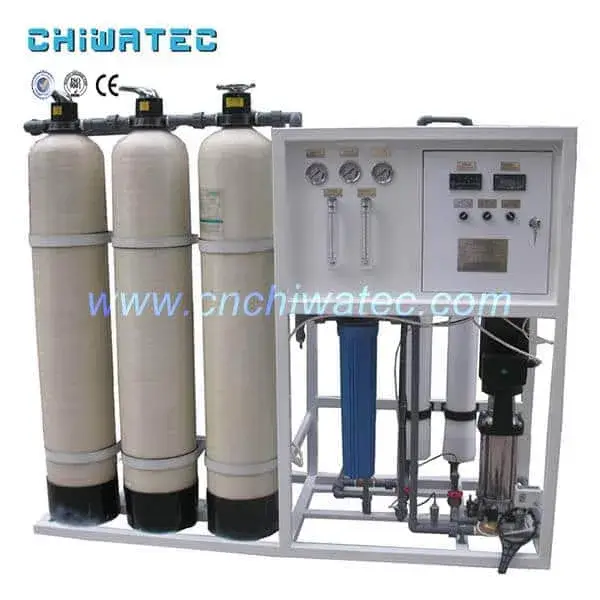
A complete reverse osmosis equipment system comprises three main sections:
| Component | Función | Key Design Parameter |
|---|---|---|
| First-stage RO device | Primary desalination — removes 95-99% of dissolved salts from pretreated feed water | Typically 4-8 pressure vessels with 6-7 elements each |
| Intermediate water tank | Stores first-stage permeate, provides buffer for second-stage feed, allows degasification of CO2 | 30-60 minutes of second-stage feed flow capacity |
| Second-stage RO device | Polishing desalination — further reduces conductivity to achieve target water quality (typically below 5 µS/cm) | Operates at lower pressure (8-12 bar) with higher recovery (85-90%) |
| Cleaning-in-place (CIP) system | Periodic chemical cleaning to remove fouling and scaling from membrane surfaces | Includes acid, caustic, and biocide cleaning tanks with circulation pump and 5-micron cartridge filter |
| Pretreatment system | Multimedia filter, ion exchange, precision filtration — removes suspended solids and colloids before RO | SDI below 3.0, turbidity below 0.2 NTU at RO inlet |
For a comprehensive approach to RO system health monitoring, refer to Diagnosis of reverse osmosis water treatment system.
Two-Stage RO Filtration Process Explained
High-purity water systems commonly use a two-stage RO configuration to achieve water quality suitable for pharmaceutical, electronics, and laboratory applications:
- First-stage RO: Feed water (typically pretreated to SDI below 3.0) enters the first RO stage at 12-16 bar for brackish water or 55-70 bar for seawater. The first stage removes 95-99% of dissolved salts, producing permeate with conductivity of 10-50 µS/cm depending on feed water quality. The first-stage concentrate (brine) is discharged at 20-30% of the feed flow rate.
- Second-stage RO: The first-stage permeate is collected in the intermediate tank, then fed to the second RO stage at lower pressure (8-12 bar). The second stage removes an additional 80-95% of the remaining dissolved solids, producing final permeate with conductivity below 5 µS/cm (often 0.5-2 µS/cm). The second-stage concentrate is recycled back to the first-stage feed to achieve overall system recovery of 70-85%.
- Final polishing: For ultrapure water applications, the two-stage RO permeate may be further treated by electrodeionization (EDI) or mixed-bed ion exchange to achieve resistivity of 18.2 MΩ·cm.
The two-stage configuration also provides operational flexibility: during low-demand periods, the second stage can be bypassed, reducing energy consumption by 30-40% while still producing acceptable quality (10-50 µS/cm) for less critical applications. For combined RO and ion exchange approaches, see What are the advantages of reverse osmosis-ion exchange combined desalination treatment.
Prevention of Membrane Fouling and Scaling in RO Systems
Effective RO system design must address the natural tendency of membranes to foul and scale. The principal challenges include:
- Microbial fouling (biofouling): When feed water contains high organic content, oxidizing biocides (such as sodium hypochlorite at 0.3-0.5 mg/L) are added in the pretreatment system to control microorganism growth. However, for TFC polyamide membranes — which are damaged by free chlorine — a reducing agent (sodium bisulfite at 1.5-3.0 times the chlorine concentration) must be injected before the RO to eliminate residual chlorine and protect the membrane from oxidative degradation.
- Colloidal fouling: Suspended particles and colloids accumulate on the membrane surface, increasing pressure differentials. Proper multimedia filtration and SDI monitoring (target below 3.0) are essential for prevention.
- Inorganic scaling: Calcium carbonate, calcium sulfate, and silica scale form when their solubility limits are exceeded in the concentrate stream. Antiscalant dosing at 2-5 mg/L and pH adjustment to maintain Langelier Saturation Index (LSI) below 0.5 are standard preventive measures. For a detailed guide on chemical scaling control, see Why should antiscalants be added to reverse osmosis systems.
- Concentration polarization: The accumulation of rejected solutes at the membrane surface creates a higher local concentration than the bulk feed water, reducing effective driving pressure and increasing scaling risk. For in-depth coverage of this phenomenon, refer to The Dangers of Reverse Osmosis Concentration Polarization and How to Eliminate It.
Factors Affecting RO Filtration Efficiency
The performance of RO filtration systems depends on several interconnected variables:
- Feed water temperature: Permeate flux increases by approximately 3% per degree C above 25 degrees C due to lower water viscosity and higher diffusion rates. Conversely, below 10 degrees C, flux decreases by 40-60%, requiring higher operating pressure or additional membrane elements to maintain production capacity.
- Applied pressure: Higher pressure increases permeate flow proportionally but does not significantly improve salt rejection beyond the membrane’s design operating range. Operating at excessive pressure accelerates membrane compaction and shortens element lifespan.
- Feed water salinity: Higher TDS increases osmotic pressure, reducing the net driving pressure available for permeate production. For every 1,000 mg/L increase in feed water TDS, the applied pressure must typically be increased by 0.7-1.0 bar to maintain constant permeate flow.
- Recovery rate: Higher recovery (ratio of permeate to feed flow) increases the average concentration on the feed/concentrate side, raising scaling risk and requiring more frequent chemical cleaning. Most brackish water RO systems operate at 70-80% recovery; seawater systems at 40-50%.
- pH: For TFC membranes, optimal salt rejection occurs at pH 7-8. Below pH 5, rejection of weakly ionized species (such as silica and boron) decreases significantly. For carbon dioxide removal, pH adjustment to 5.5-6.0 is sometimes used in the second stage to facilitate degasification.
Frequently Asked Questions
Q1: What is the reverse osmosis filtration technology principle?
los reverse osmosis filtration technology principle is based on applying pressure greater than the feed water’s osmotic pressure to force water molecules through a semi-permeable membrane while rejecting dissolved salts, organic compounds, bacteria, and viruses. The membrane operates via the solution-diffusion mechanism: water molecules dissolve into the membrane polymer, diffuse through the active layer under a concentration gradient, and desorb on the permeate side. Dissolved contaminants have much lower solubility and diffusivity and are therefore excluded from the permeate stream.
Q2: What is the difference between RO and ultrafiltration (UF)?
The fundamental difference is pore size and separation mechanism. RO membranes have pore sizes of approximately 0.0001 microns (0.1 nm) and reject dissolved salts and ions through the solution-diffusion mechanism. UF membranes have larger pores (0.01-0.1 microns) and remove suspended solids, bacteria, and viruses through physical size exclusion — they do not reject dissolved salts. RO requires 10-70 bar operating pressure depending on feed salinity, while UF operates at 1-5 bar. For most applications requiring high-purity water (conductivity below 50 µS/cm), RO is the appropriate technology.
Q3: How often should RO membranes be replaced?
RO membranes typically last 3-5 years under normal operating conditions with proper pretreatment and maintenance. With excellent feed water quality (SDI below 2.0) and regular chemical cleaning every 3-6 months, membrane lifespan can extend to 7-10 years. Signs that replacement is needed include: salt rejection dropping below 95% (from a baseline of 99%+), normalized permeate flow declining by more than 20% from baseline, or pressure differential increasing by more than 15% despite chemical cleaning.
Q4: Can RO remove bacteria and viruses from water?
Yes, properly operating RO membranes achieve 99.9%+ removal of bacteria and 99.99%+ removal of viruses through size exclusion — bacterial cells (0.5-5 microns) and viruses (0.02-0.4 microns) are orders of magnitude larger than the membrane’s effective pore size (approximately 0.001 microns or 1 nanometer). However, RO should not be relied upon as the sole disinfection barrier in critical applications; UV disinfection or chlorination of the permeate is recommended as a secondary barrier for complete microbial safety.
Q5: Why does RO equipment need a cleaning system?
The cleaning-in-place (CIP) system is essential because even with optimal pretreatment, RO membranes gradually accumulate foulants — organic matter, inorganic scale, biofilms, and colloidal particles — on their surfaces. Periodic chemical cleaning restores membrane performance by dissolving and removing these deposits. A typical cleaning protocol alternates between acidic cleaning (citric acid at pH 2-3) for inorganic scale and alkaline cleaning (NaOH at pH 10-12) for organic fouling and biofilms. Cleaning frequency depends on feed water quality but is typically every 3-6 months for well-maintained systems.
Conclusion & CTA
Understanding the reverse osmosis filtration technology principle — from membrane structure and the solution-diffusion mechanism to two-stage system configuration and fouling prevention — is essential for anyone involved in water treatment system design, operation, or procurement. Modern RO equipment combines advanced thin-film composite membranes with multi-stage configurations, automated control systems, and integrated cleaning systems to reliably produce high-purity water for pharmaceutical, electronics, power generation, and industrial applications worldwide.
Contact CHIWATEC today at [email protected] o [email protected] (WhatsApp available) for expert-designed reverse osmosis systems tailored to your specific water quality requirements and operational conditions.
Related Resources and Further Reading
- The Dangers of Reverse Osmosis Concentration Polarization and How to Eliminate It
- Desalination Methods for Brackish Water (2): Reverse Osmosis Method
- The principle of integrated water purifier
- What are the advantages of reverse osmosis-ion exchange combined desalination treatment
- RO Water Treatment System — CHIWATEC
¿Tiene un proyecto de tratamiento de agua con el que podamos ayudar?
* Diseño, mecanizado, instalación, puesta en marcha, personalización y servicio integral






 Spanish
  English
  Portuguese




