

Food Factory Wastewater Treatment Plant Design: Complete Engineering Case Study 2026
Food factory wastewater treatment plant design requires careful engineering to handle high organic loads, variable flow rates, and stringent discharge standards. This comprehensive engineering case study examines a complete industrial food wastewater treatment system designed by Xi’an CHIWATEC, covering process selection, design parameters, and operational considerations for the A/O biological treatment method. Whether you are planning a new food processing facility or upgrading an existing treatment plant, this guide provides actionable engineering insights backed by real-world application data.
* Last updated: May 2026
Why This Guide Matters
The global food and beverage wastewater treatment market was valued at approximately USD 10.2 billion in 2025 and is projected to reach USD 17.8 billion by 2035, growing at a CAGR of 5.7% (Grand View Research). Food processing facilities generate wastewater with high biochemical oxygen demand (BOD), chemical oxygen demand (COD), total suspended solids (TSS), and fats/oils/grease (FOG) that require specialized treatment approaches. With increasingly stringent environmental regulations worldwide—including China’s GB 8978-1996 Integrated Wastewater Discharge Standard and the U.S. EPA’s updated effluent guidelines for food processing—manufacturers must invest in robust, compliant treatment systems. This case study presents a proven design methodology that balances treatment efficiency, operational simplicity, and capital cost optimization.
Key Industry Trends (2026 Update)
- Energy-efficient biological treatment: The A/O (anoxic/oxic) process continues to dominate food wastewater treatment due to its 30-40% lower energy consumption compared to conventional activated sludge systems, while achieving COD removal rates above 90%.
- Integrated process control: Modern food factory wastewater treatment plants increasingly incorporate PLC-based automation and real-time monitoring, reducing operational labor requirements while improving treatment stability across fluctuating organic loads.
- Zero-liquid discharge (ZLD) adoption: Regulatory pressure in water-scarce regions is driving food processing facilities toward ZLD configurations, combining biological treatment with membrane filtration and evaporation technologies.
- Compact modular designs: Space constraints in existing food factories favor containerized and skid-mounted treatment systems that can be installed rapidly and expanded incrementally as production capacity grows.
1. What Are the Key Characteristics of Food Factory Wastewater?
Wastewater Composition and Pollutant Loading
Food factory wastewater is characterized by high concentrations of organic matter, including proteins, carbohydrates, fats, and oils from raw material processing. Typical pollutant ranges include BOD5 of 800-3,000 mg/L, COD of 1,500-6,000 mg/L, and TSS of 300-1,500 mg/L. The wastewater also contains varying concentrations of nitrogen and phosphorus from cleaning operations and raw material residues. Understanding these characteristics is fundamental to food factory wastewater treatment plant design, as they directly influence process selection and sizing. For comparison, slaughterhouse wastewater treatment faces similar organic loading challenges but with higher protein and blood content.
Flow Variability and Impact Loading
Food processing operations typically follow batch production schedules, resulting in highly variable flow rates and pollutant loads throughout the day. Peak flows can be 2-3 times the average, and organic loads may spike dramatically during cleaning cycles or production changeovers. Any effective treatment system must incorporate equalization capacity and be designed to withstand these hydraulic and organic shock loads without compromising effluent quality.
2. What Design Principles Guide Food Factory Wastewater Treatment Plants?
Fundamental Engineering Criteria
A robust food factory wastewater treatment plant design follows six core principles: (1) selecting treatment structures and design parameters with sufficient flexibility for water quality and quantity fluctuations; (2) adopting proven engineering technologies with demonstrated technical and economic benefits; (3) specifying low-energy, high-efficiency equipment using durable materials; (4) incorporating automation to reduce operational labor and improve reliability; (5) optimizing land use through compact layout planning; and (6) designing for ease of maintenance and future expansion. These principles align with the PLC-based automation strategies now standard in modern wastewater engineering.
Regulatory Compliance Framework
In China, food factory wastewater treatment systems must comply with GB 8978-1996 Integrated Wastewater Discharge Standard (Class I), requiring COD below 100 mg/L, BOD5 below 20 mg/L, and SS below 70 mg/L for direct discharge. International facilities may need to meet local equivalents such as the U.S. EPA Clean Water Act effluent guidelines or EU Urban Wastewater Treatment Directive standards. The design must incorporate sufficient treatment margin to ensure consistent compliance under all operating conditions.
3. How Is the A/O Biological Treatment Process Selected for Food Wastewater?
Process Selection Rationale
The A/O (anoxic/oxic) process is selected for food factory wastewater due to its proven effectiveness in treating high-organic industrial streams. Food wastewater exhibits excellent biodegradability (BOD5/COD ratio typically above 0.5), making biological treatment the most cost-effective approach. Among available technologies—including A2/O, oxidation ditch, SBR, aerated biological filter, and MBR—the A/O process offers the optimal balance of capital cost, operational simplicity, and treatment performance for medium-to-large food processing facilities.
Comparison with Alternative Biological Processes
While the A/O process excels for conventional food wastewater, alternative processes may suit specific applications. The MBR membrane bioreactor offers superior effluent quality and a smaller footprint but at higher capital and operating costs. Biofilm-based processes such as MBBR provide enhanced biomass retention and shock load resistance. The selection ultimately depends on discharge standards, available space, budget constraints, and operator expertise.
4. What Is the Complete Flow Process of an A/O Wastewater Treatment System?
Treatment Train Overview
The complete treatment train for a food factory A/O system consists of: mechanical bar screen → regulating/equalization tank → anoxic tank → aerobic (contact oxidation) tank → secondary clarifier → disinfection → discharge. The regulating tank provides flow equalization and preliminary organic degradation. Raw sewage is then pumped to the anoxic tank where mixed liquor return flow provides denitrification. The aerobic tank, equipped with submerged aeration and biofilm media, achieves COD/BOD removal through biological oxidation. Final clarification separates treated effluent from biomass, with sludge returned to the aerobic tank or periodically wasted.
Key Design Parameters
Critical design parameters for the A/O system include: hydraulic retention time (HRT) of 8-12 hours in the biological stage, sludge retention time (SRT) of 10-20 days, mixed liquor suspended solids (MLSS) of 3,000-5,000 mg/L, dissolved oxygen (DO) of 2-4 mg/L in the aerobic zone, and an internal recirculation ratio of 200-300% from aerobic to anoxic zones. The secondary clarifier is designed with a surface overflow rate of 16-24 m3/m2-day and a solids loading rate of 4-6 kg/m2-hour.
5. What Equipment and Infrastructure Are Required?
Mechanical and Electrical Equipment
A complete food factory wastewater treatment plant design requires: mechanical bar screen with 5-10 mm spacing, submersible sewage pumps with flow control, submersible mixers for the anoxic zone, blowers (roots or centrifugal type) with noise enclosure, microporous tube or disc diffusers for aeration, sludge return pumps, and a control panel with PLC for automated operation. Air delivery requirements are typically 60-90 m3/kg BOD5 removed. The blower room should be soundproofed to maintain workplace noise below 85 dB(A). All wetted components should be constructed from corrosion-resistant materials suitable for pH 6-9 operation.
Sludge Handling System
The A/O process generates relatively small amounts of excess sludge—approximately 0.3-0.5 kg dry solids per kg BOD5 removed. Sludge is periodically wasted from the secondary clarifier underflow and can be dewatered using a belt filter press or centrifuge before disposal. Typical dewatering schedules involve sludge removal every 60 days, with the sludge cake transported to licensed disposal facilities or agricultural land application sites. For comprehensive solids management, refer to industrial wastewater treatment equipment resources.
6. How Does the A/O Process Achieve Nitrogen Removal?
Biological Nitrification and Denitrification
Nitrogen removal in the A/O process occurs through two sequential biological reactions. In the aerobic (oxic) zone, autotrophic nitrifying bacteria (Nitrosomonas and Nitrobacter) oxidize ammonia nitrogen (NH3-N) to nitrite (NO2-N) and then to nitrate (NO3-N). The nitrified mixed liquor is recycled to the anoxic zone, where facultative heterotrophic bacteria use the nitrate as an electron acceptor in the absence of dissolved oxygen, reducing it to nitrogen gas (N2) which escapes to the atmosphere. This denitrification step simultaneously removes organic carbon, reducing overall oxygen demand by up to 25%.
Design Considerations for Nitrogen Removal
Effective nitrogen removal requires careful control of the internal recirculation ratio (typically 200-400% of influent flow), sufficient carbon availability in the anoxic zone (BOD5/N ratio above 4:1), adequate SRT for nitrifier growth (above 10 days at 20 degrees C), and DO control to maintain anoxic conditions below 0.5 mg/L in the denitrification zone. Food processing wastewater generally provides adequate carbon, but facilities processing high-protein products may need supplementary carbon addition. Biofilm technologies can enhance nitrogen removal performance in challenging wastewater streams.
7. What Are the Operational Advantages of the A/O Process?
Key Operational Benefits
The A/O process offers six distinct advantages for food factory wastewater treatment: (1) strong shock-load resistance due to the buffering capacity of the anoxic zone and biofilm support media; (2) low capital investment relative to membrane-based alternatives; (3) reduced operating costs through lower aeration energy requirements (combined nitrification/denitrification saves approximately 25% on aeration energy); (4) built-in nitrogen and phosphorus removal capability; (5) minimal mechanical equipment requirements simplifying daily maintenance; and (6) compact footprint suitable for existing factory sites with space constraints.
Energy Consumption Benchmarking
Typical energy consumption for an A/O-based food factory wastewater treatment plant ranges from 0.35 to 0.55 kWh per m3 of wastewater treated, significantly lower than conventional activated sludge systems (0.6-0.8 kWh/m3) or MBR systems (0.8-1.2 kWh/m3). The primary energy consumers are aeration blowers (50-60% of total), pumping (20-25%), and mixing (10-15%). Installing variable frequency drives on major equipment can reduce energy costs by an additional 15-25%.
8. How Does Sludge Management Work in Food Factory Wastewater Treatment?
Sludge Production and Characteristics
The A/O biological treatment process produces waste activated sludge with typical solids content of 0.8-1.2% after secondary clarification. The sludge yield coefficient for food wastewater treatment ranges from 0.3 to 0.5 kg TSS/kg BOD5 removed. Excess sludge is wasted from the secondary clarifier underflow and directed to aerobic sludge digestion or direct dewatering. Due to the high organic content of food wastewater sludge, aerobic digestion can achieve 35-45% volatile solids reduction over 15-20 days of retention time.
Sludge Dewatering and Disposal Options
Dewatering options for food factory wastewater sludge include belt filter presses (achieving 15-22% cake solids), centrifuge dewatering (18-25% cake solids), and sludge drying beds (25-40% cake solids depending on climate). The dewatered sludge cake can be disposed of through landfill, incineration, or land application where permitted. Some food processors are exploring anaerobic digestion of primary sludge to generate biogas for offsetting plant energy costs. For more on advanced wastewater treatment technologies, including specialized separation processes, refer to our technical resources.
9. What Monitoring and Control Systems Are Essential?
Process Monitoring Parameters
Essential online monitoring for a food factory wastewater treatment plant includes: influent and effluent flow rate (magnetic flow meters), pH (online probe), DO (galvanic or optical sensors), temperature, and MLSS (optical turbidity). Offline laboratory analysis should include COD, BOD5, TSS, NH3-N, total nitrogen, total phosphorus, and oil/grease on a weekly or biweekly schedule. This data enables operators to optimize aeration rates, chemical dosing, and sludge wasting schedules for consistent compliance.
Automation and Control Strategy
Modern treatment plants employ PLC-based control systems with SCADA interfaces for centralized monitoring and operation. Key control loops include: DO control through variable-speed blowers and automated valve positioning; influent flow pacing for chemical dosing; sludge return rate proportional to influent flow; and automated sludge wasting based on SRT or MLSS setpoints. Remote monitoring via secure internet connection allows off-site operators and engineering teams to track performance and receive alarm notifications.
10. How Can CHIWATEC Support Your Food Factory Wastewater Treatment Project?
Custom Engineering Solutions
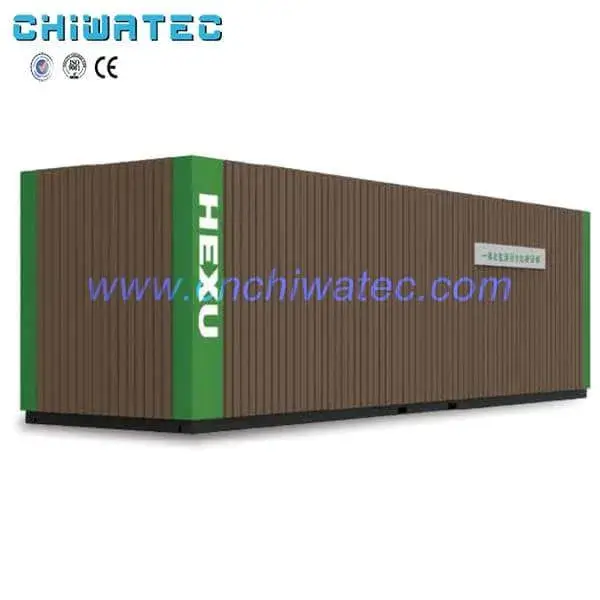
Xi’an CHIWATEC brings decades of specialized experience in designing and manufacturing industrial wastewater treatment systems for the food processing industry. Our engineering team evaluates each project’s specific wastewater characteristics—flow rate, organic loading, discharge standards—to develop tailored food factory wastewater treatment plant design solutions. From initial site assessment and process design through equipment fabrication, installation supervision, commissioning, and operator training, we provide comprehensive support for projects of all scales. Our product portfolio includes complete containerized treatment systems, modular biological treatment units, and custom-engineered solutions for complex wastewater challenges.
One-Stop Service Commitment
Every CHIWATEC project follows a streamlined delivery model: designing, machining, installing, commissioning, and handover with full documentation. We emphasize locally sourced materials for cost efficiency, rigorous factory acceptance testing before shipment, and on-site technical support throughout the commissioning period. Our after-sales service includes spare parts availability, remote troubleshooting, and annual performance optimization reviews to ensure your treatment plant continues to operate at peak efficiency throughout its design life.
Conclusión
Designing an effective food factory wastewater treatment plant design requires a systematic approach that balances pollutant removal efficiency, operational reliability, capital cost, and regulatory compliance. The A/O biological treatment process, as demonstrated in this comprehensive case study, provides a proven, cost-effective solution for treating high-organic food processing wastewater. With proper design parameters, robust equipment selection, and appropriate automation, food manufacturers can achieve consistent discharge compliance while minimizing energy consumption and operational complexity. For expert assistance with your food factory wastewater treatment project, contact Xi’an CHIWATEC today at [email protected] o [email protected]. WhatsApp inquiries are also welcome for immediate project discussions.
Frequently Asked Questions
Q1: What is the typical cost of a food factory wastewater treatment plant?
The capital cost varies significantly based on treatment capacity, effluent quality requirements, and site conditions. For a medium-scale food processing facility (500-1,000 m3/day), a complete A/O-based treatment system typically costs between USD 200,000 and USD 500,000, including equipment, installation, and commissioning. Operating costs range from USD 0.20 to USD 0.50 per m3 treated, covering energy, chemicals, labor, and sludge disposal.
Q2: How long does it take to design and install a food factory wastewater treatment system?
A typical timeline is 8-16 weeks from initial consultation to commissioning: 2-4 weeks for site assessment and process design, 4-8 weeks for equipment fabrication, 2-3 weeks for on-site installation and piping, and 1-2 weeks for commissioning, start-up, and operator training. Modular/containerized systems can reduce the fabrication phase by 30-40%.
Q3: Can the A/O process handle seasonal production variations in food factories?
Yes. The A/O process is inherently robust against seasonal fluctuations. Key design features that accommodate variability include: adequate equalization tank capacity (8-12 hours of average flow), adjustable internal recirculation ratios, and the biofilm support media in the aerobic zone that retains active biomass even during low-load periods. Properly designed systems can handle flow variations of +/- 50% and organic load variations of +/- 100% while maintaining effluent compliance.
Q4: What pretreatment is required before the A/O biological stage?
Pretreatment typically includes: (1) mechanical bar screening (5-10 mm clearance) to remove large solids and packaging debris; (2) an equalization/regulating tank with mixing to balance flow and load fluctuations; (3) pH adjustment to maintain 6.5-8.5 if the raw wastewater is outside this range; and (4) grease/oil removal (API separator or DAF) if FOG concentrations exceed 100 mg/L.
Q5: What effluent quality can be expected from a properly designed A/O treatment system?
A well-designed and operated A/O system treating food factory wastewater can consistently achieve: COD below 100 mg/L, BOD5 below 20 mg/L, TSS below 30 mg/L, NH3-N below 10 mg/L (with adequate SRT and DO), and total nitrogen below 20 mg/L. These values satisfy China’s GB 8978-1996 Class I standard and most international discharge requirements. Adding tertiary polishing (sand filtration or UV disinfection) can further reduce TSS to below 10 mg/L and achieve full pathogen removal.
Related Resources and Further Reading
- Process of Slaughterhouse Wastewater Treatment
- Applications of PLC in Wastewater Treatment Engineering
- Mobile Stand-Alone MBR Membrane Bioreactor Wastewater Treatment Integrated System Technology
- Application of Biofilm Technology in Monosodium Glutamate Wastewater Treatment
- Wastewater Treatment System – CHIWATEC
¿Tiene un proyecto de tratamiento de agua con el que podamos ayudar?
* Diseño, mecanizado, instalación, puesta en marcha, personalización y servicio integral






 Spanish
  English
  Portuguese




