

Deionization Equipment: Complete Guide to Water Deionization Systems 2026
Deionization equipment removes dissolved inorganic ions from water through ion exchange resin technology, producing high-purity water for industrial, laboratory, and commercial applications. This comprehensive guide covers deionization working principles, resin types, regeneration processes, and applications across electronics, pharmaceuticals, power generation, and laboratory sectors. Learn how water deionization systems achieve resistivity up to 18.2 MΩ·cm and compare DI technology with reverse osmosis and distillation in 2026.
1. What Is Deionization Equipment?
Deionization (DI) equipment utilizes ion exchange resins to remove cations (Ca²⁺, Mg²⁺, Na⁺) and anions (Cl⁻, SO₄²⁻, HCO₃⁻) from water, replacing them with hydrogen (H⁺) and hydroxide (OH⁻) ions that combine to form pure H₂O.
1.1 Deionization Working Principle
The deionization process involves two simultaneous ion exchange reactions:
Cation Exchange Reaction:
M⁺ˣ + xH-Re → M-Reₓ + xH⁺
- M⁺ˣ represents cations (Ca²⁺, Mg²⁺, Na⁺, etc.)
- x represents valence number
- H-Re is hydrogen-form cation exchange resin
Anion Exchange Reaction:
A⁻ᶻ + zOH-Re → A-Re₂ + zOH⁻
- A⁻ᶻ represents anions (Cl⁻, SO₄²⁻, HCO₃⁻, etc.)
- z represents valence number
- OH-Re is hydroxide-form anion exchange resin
Water Formation:
H⁺ + OH⁻ → H₂O (neutral pure water)
1.2 Ion Exchange Resin Selectivity
Different ions have varying affinity for ion exchange resins:
Cation Resin Selectivity (strongest to weakest):
Ba²⁺ > Pb²⁺ > Sr²⁺ > Ca²⁺ > Ni²⁺ > Cd²⁺ > Cu²⁺ > Co²⁺ > Zn²⁺ > Mg²⁺ > Ag⁺ > Cs⁺ > K⁺ > NH₄⁺ > Na⁺ > H⁺
Anion Resin Selectivity (strongest to weakest):
SO₄²⁻ > I⁻ > NO₃⁻ > NO₂⁻ > Cl⁻ > HCO₃⁻ > OH⁻ > F⁻
Understanding selectivity is crucial for predicting resin exhaustion patterns and optimizing regeneration schedules.
2. Types of Deionization Systems
2.1 Two-Bed Deionization Systems
Separate cation and anion resin vessels arranged in series:
- First stage: Cation exchange resin converts all cations to H⁺
- Second stage: Anion exchange resin removes all anions and H⁺ combines with OH⁻
- Water quality: 1-10 MΩ·cm resistivity
- Aplicaciones: General laboratory, industrial process water
2.2 Mixed Bed Deionization Systems
Cation and anion resins intimately mixed in single vessel:
- Multiple exchange stages: Water passes through countless cation-anion pairs
- Water quality: 10-18.2 MΩ·cm resistivity (ultrapure)
- Aplicaciones: Electronics, pharmaceuticals, high-pressure boilers, analytical laboratories
- Ventaja: Superior water quality compared to two-bed systems
2.3 Electrodeionization (EDI) Systems
Combines ion exchange resins with electrically driven ion migration:
- Continuous operation: No chemical regeneration required
- Electric field: Drives ions through selective membranes
- Water quality: 10-18 MΩ·cm continuously
- Aplicaciones: Power plant boiler feedwater, pharmaceutical WFI pretreatment
- Advantages: No regeneration chemicals, consistent quality, lower operating cost
2.4 Portable Exchange Tanks
Pre-filled resin tanks exchanged when exhausted:
- Service model: Vendor delivers fresh tanks, collects exhausted ones
- Aplicaciones: Small laboratories, emergency backup, temporary installations
- Advantages: No on-site regeneration, minimal maintenance
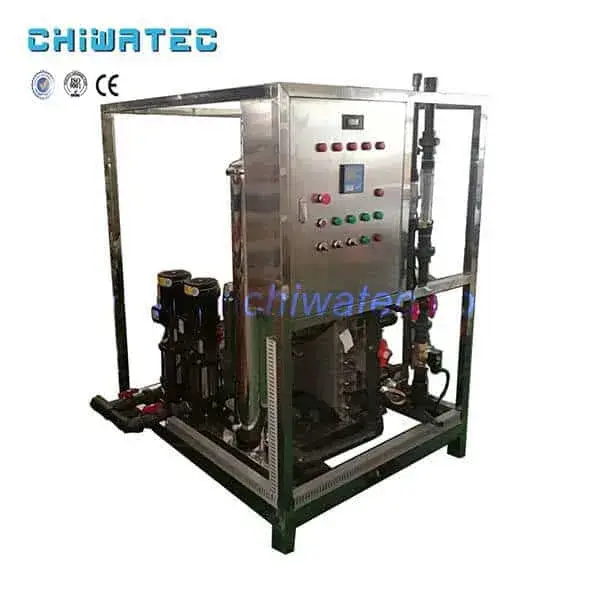
3. Deionization Resin Regeneration
3.1 When Resin Requires Regeneration
Ion exchange resins must be regenerated when exhausted:
- Resistivity decline: Water quality drops below specification
- Ion breakthrough: Specific ions detected in effluent
- Capacity exhaustion: Based on throughput volume
- Warning: Exhausted anion resin releases fluoride gradually, potentially causing bone lesions; exhausted cation resin releases H⁺, increasing water acidity
3.2 Cation Resin Regeneration
Strong acid regeneration restores hydrogen form:
- Regenerant: HCl (4-8%) or H₂SO₄ (2-5%)
- Dosage: 100-200 g/L resin
- Flow rate: 2-4 BV/h
- Reaction: M-Reₓ + xH⁺ → xH-Re + M⁺ˣ
3.3 Anion Resin Regeneration
Strong base regeneration restores hydroxide form:
- Regenerant: NaOH (4-8%)
- Dosage: 80-150 g/L resin
- Temperature: 30-40°C improves efficiency
- Reaction: A-Re₂ + zOH⁻ → zOH-Re + A⁻ᶻ
3.4 Mixed Bed Regeneration
Complex process requiring resin separation:
- Backwash separation: Density difference separates cation/anion resins
- Acid regeneration: HCl regenerates cation resin (bottom layer)
- Base regeneration: NaOH regenerates anion resin (top layer)
- Rinse: Remove excess regenerant
- Remixing: Air or nitrogen mixing restores uniform bed
3.5 Monitoring Requirements
Continuous monitoring prevents bacterial growth and ensures water quality:
- Resistivity/conductivity: Primary water quality indicator
- TOC (Total Organic Carbon): Monitors organic contamination
- Bacterial counts: Ion exchange resins can harbor bacteria
- Specific ions: Silica, sodium for critical applications
4. Applications of Deionization Equipment
4.1 Electronics Manufacturing
- Requirement: 18.2 MΩ·cm ultrapure water
- Aplicaciones: Semiconductor wafer rinsing, PCB cleaning, display manufacturing
- System: RO + EDI + mixed bed polishers
- Contaminant limits: Parts per trillion (ppt) for critical ions
4.2 Pharmaceutical & Biotechnology
- Requirement: USP Purified Water and WFI standards
- Aplicaciones: Drug formulation, injectable production, laboratory analysis
- System: RO + EDI + ozone/UV disinfection
- Compliance: FDA, GMP, pharmacopoeia requirements
4.3 Power Generation
- Requirement: High-purity boiler feedwater
- Aplicaciones: High-pressure boilers, steam turbines
- System: RO + EDI or mixed bed
- Benefits: Prevents scaling, corrosion, turbine damage
4.4 Laboratory & Analytical
- Requirement: Type I, II, III laboratory water (ASTM D1193)
- Aplicaciones: HPLC, ICP-MS, cell culture, reagent preparation
- System: RO + mixed bed or EDI
- Quality: 1-18.2 MΩ·cm depending on application
4.5 Industrial Process Water
- Aplicaciones: Chemical manufacturing, metal finishing, automotive, textiles
- System: Two-bed or mixed bed DI
- Benefits: Consistent quality, improved product quality
5. 2026 Market Trends & Technology Advances
5.1 Global Market Growth
- Market size: Expected to reach $5.2 billion by 2027 (CAGR 6.8%)
- Electronics: Largest application segment (35% of market)
- Asia-Pacific: Fastest growth driven by semiconductor manufacturing
- Pharmaceuticals: Growing demand for GMP-compliant systems
5.2 Technology Innovations
- Advanced EDI: Higher recovery rates, lower energy consumption
- Smart monitoring: IoT-enabled real-time water quality tracking
- Low-leach resins: Reduced TOC for semiconductor applications
- Sanitary design: Improved cleanability for pharmaceutical use
- Energy recovery: Reduced operating costs for large systems
5.3 Sustainability Focus
- Chemical-free EDI: Eliminates regeneration chemical discharge
- High recovery: 90%+ water utilization rates
- Resin recycling: End-of-life resin recovery programs
- Energy efficiency: Low-pressure EDI designs
6. Deionization vs Other Purification Methods
6.1 Comparison Table
| Technology | Resistivity | Removes Ions | Removes Organics | Operating Cost |
|---|---|---|---|---|
| desionización | 1-18.2 MΩ·cm | Excelente | Poor | Medium |
| Osmosis inversa | 0.05-1 MΩ·cm | Good (95-99%) | Bueno | Low |
| Distillation | 0.5-1 MΩ·cm | Bueno | Bueno | High |
| EDI | 10-18 MΩ·cm | Excelente | Poor | Low-Medium |
6.2 Best Practice: Hybrid Systems
Modern ultrapure water systems combine multiple technologies:
- Pretreatment: Multimedia filtration + activated carbon + softening
- Primary purification: Reverse osmosis (removes 95-99% contaminants)
- Polishing: EDI or mixed bed DI (achieves 18.2 MΩ·cm)
- Final treatment: UV disinfection + 0.2μm filtration
7. Conclusion
Deionization equipment remains essential for producing high-purity water across industries. From laboratory research to semiconductor manufacturing, DI technology delivers consistent water quality with resistivity up to 18.2 MΩ·cm.
Key takeaways:
- ✓ Two resin types: Cation (H⁺ form) and anion (OH⁻ form) work together
- ✓ System configurations: Two-bed, mixed bed, EDI for different purity levels
- ✓ Regular regeneration: Critical for maintaining water quality
- ✓ Continuous monitoring: Prevents bacterial growth and ensures specification compliance
- ✓ Hybrid approach: RO + DI/EDI provides optimal performance and economy
Xi’an CHIWATEC Water Treatment Technology supplies complete deionization systems including two-bed DI, mixed bed polishers, and EDI modules. Our engineering team provides customized solutions for electronics, pharmaceuticals, power generation, and laboratory applications with comprehensive technical support.
8. FAQ: Deionization Equipment
Q1: How long does deionization resin last?
Resin lifespan depends on feedwater quality and throughput. Typical service life is 3-5 years for cation resin, 2-4 years for anion resin. Regular regeneration and proper pretreatment extend resin life significantly.
Q2: What is the difference between DI and RO?
Deionization (DI): Removes ions through ion exchange, produces 1-18.2 MΩ·cm water, requires chemical regeneration. Reverse Osmosis (RO): Removes 95-99% of all contaminants through membrane filtration, produces 0.05-1 MΩ·cm water, no chemicals required.
Q3: Can deionization remove bacteria?
No, deionization resins do not remove bacteria and can actually harbor bacterial growth. Post-DI disinfection (UV, ozone, or 0.2μm filtration) is required for bacteria-free water.
Q4: What is ultrapure water (UPW)?
Ultrapure water has resistivity of 18.2 MΩ·cm at 25°C with extremely low TOC, bacteria, and particles. Produced by RO + EDI + mixed bed DI + UV + filtration. Required for semiconductor and pharmaceutical manufacturing.
Q5: How often should DI resin be regenerated?
Regeneration frequency depends on feedwater TDS and flow rate. Typical intervals: 1-7 days for continuous operation. Monitor resistivity and regenerate when quality drops below specification.
Further Reading:
¿Tiene un proyecto de tratamiento de agua con el que podamos ayudar?
* Diseño, mecanizado, instalación, puesta en marcha, personalización y servicio integral






 Spanish
  English
  Portuguese




