

Water Softening System Performance: Complete Guide to CHIWATEC Softener Equipment and Features 2026
What makes a high-performance water softening system? From boiler feedwater protection to industrial process water treatment, water softeners are essential for preventing scale-related damage and efficiency losses. This comprehensive guide explores CHIWATEC softening system equipment performance characteristics, including FLECK automatic controller technology, time and flow control types, regeneration optimization, and installation best practices. CHIWATEC has been engineering industrial water softening system for over a decade, delivering reliable solutions that protect boilers, pipes, and process equipment from hard water damage.
*Last Updated: March 2026 | Industry-Verified Technical Data*
Why This Guide Matters
Water hardness is one of the most common and costly water quality issues in industrial and commercial operations. Industry data indicates that boiler failure rates due to water quality problems can reach 25% in improperly protected systems — making water softening one of the most cost-effective investments in industrial water treatment. The global water softener market was valued at approximately USD 12.8 billion in 2025 and is projected to reach USD 22.4 billion by 2034, growing at a CAGR of 6.2% (Grand View Research, 2025). Understanding the performance characteristics of modern water softening equipment — from automatic controllers to regeneration efficiency — is essential for selecting the right system and maximizing its operational benefits.
Key Industry Trends (2026 Update)
- Demand-initiated regeneration (DIR): Modern water softeners increasingly use DIR technology, which triggers regeneration based on actual water usage rather than a fixed timer, reducing salt and water consumption by 35-45% compared to time-controlled systems.
- IoT-connected softeners: Smart water softeners with Wi-Fi connectivity and mobile app monitoring allow operators to track salt levels, water usage, and system performance remotely, receiving alerts when maintenance is needed.
- High-efficiency resin technology: Advanced macroporous ion exchange resins with improved regeneration efficiency reduce salt consumption by 20-30% while maintaining 99%+ hardness removal.
- FDA-compliant softening for food and beverage: Growing regulatory requirements for consistent water quality in food processing and beverage production are driving adoption of certified water softening systems with validated performance documentation.
1. What Is a CHIWATEC Water Softening System and How Does It Perform?
System Overview
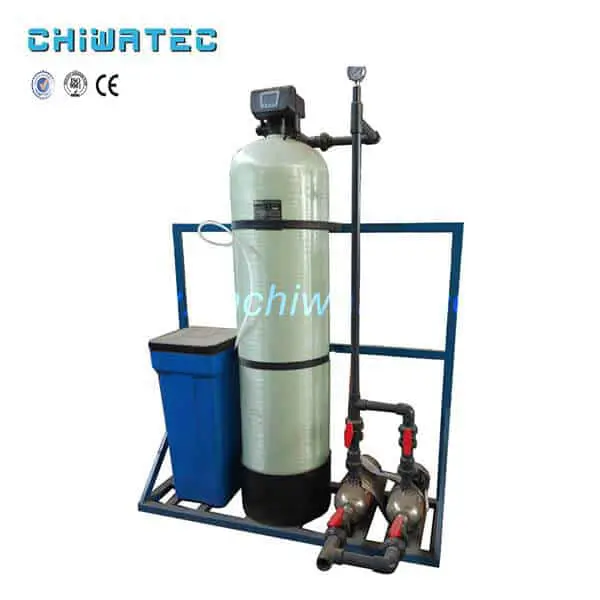
CHIWATEC water softening systems are engineered to remove calcium (Ca2+) and magnesium (Mg2+) ions from feedwater using ion exchange technology. The systems incorporate American FLECK automatic controllers — widely recognized as the industry standard for reliability and precision — integrated with high-quality ion exchange resin and corrosion-resistant FRP or stainless steel pressure vessels. Performance specifications for a standard CHIWATEC softening system include: hardness removal efficiency of 98-99.5%, treated water hardness below 2 mg/L as CaCO3 (achieving 0-1 gpg for most applications), operating pressure range of 30-90 psi, and feedwater temperature range of 2-50 degrees C.
The CHIWATEC series of softening equipment is designed for applications ranging from small commercial systems (0.5-2 m3/hr) to large industrial installations (10-100+ m3/hr), with dual-tank configurations available for continuous soft water supply during regeneration cycles.
For a complete overview of our water softening system product range, please visit our product page.
2. What Are the Key Performance Characteristics of Industrial Water Softeners?
Critical Performance Parameters
The performance of a water softening system is defined by several key parameters that determine its effectiveness and efficiency in a given application:
- Exchange capacity: The total amount of hardness that can be removed between regenerations, expressed in grains per cubic foot of resin (typically 30,000-40,000 grains/ft3 for standard cation resin at 10-15 lb salt dosage).
- Service flow rate: The recommended continuous flow rate for optimal contact time. Standard design: 6-10 gpm per ft2 of resin bed cross-sectional area. Higher flow rates reduce contact time and may cause hardness leakage.
- Hardness leakage: Residual hardness in treated water during normal operation. A well-designed system should maintain treated water hardness below 2 mg/L (0.12 gpg).
- Regeneration efficiency: The percentage of resin exchange capacity restored per unit of regenerant salt. Modern systems achieve 70-85% regeneration efficiency at standard 8-10 lb/ft3 salt dosage.
- Water efficiency: Volume of water used during regeneration as a percentage of total treated water. Typical regeneration consumes 20-60 gallons per ft3 of resin (backwash + brine draw + rinse).
3. How Does the FLECK Automatic Controller Improve Softener Performance?
FLECK Controller Technology
CHIWATEC incorporates American FLECK automatic controllers in its softening systems — a globally recognized benchmark for reliability and precision in water softening control. FLECK controllers offer several performance-enhancing features:
- Time control type: Regeneration is initiated at a preset time (typically 2:00 AM during low-demand periods) after a fixed number of days. This is the most economical control option suitable for applications with consistent daily water consumption.
- Flow control type: Regeneration is triggered when a preset volume of water has been treated, regardless of elapsed time. This is more efficient than time control for applications with variable water usage, as regeneration occurs only when the resin’s exchange capacity is actually consumed.
- Demand-initiated (DIR) control: Advanced FLECK controllers with DIR technology monitor real-time water usage and regenerate only when sufficient hardness has been removed to justify regeneration, achieving 35-45% salt savings compared to time-controlled operation.
4. What Is the Impact of Water Quality on Boiler Performance?
Boiler Failure Rates and Water Quality
In operating industrial boilers, the boiler failure rate due to water quality problems can reach up to 25% when proper water treatment is not implemented. Hard water in boiler systems causes multiple operational issues:
- Scale formation: Calcium and magnesium compounds precipitate on heat transfer surfaces, forming insulating deposits that reduce thermal efficiency. Even 1 mm of scale increases fuel consumption by 5-10%.
- Tube overheating: Scale acts as a thermal insulator, preventing effective heat transfer from combustion gases to boiler water. This causes tube metal temperatures to rise, leading to tube failure through creep, bulging, or rupture.
- Caustic embrittlement: Concentrated caustic chemicals under scale deposits can cause intercrystalline cracking of boiler tube metal.
- Reduced steam quality: Foaming and carryover caused by high dissolved solids in boiler water result in wet steam that damages downstream equipment.
5. What Is the Standard Process Cycle of an Automatic Water Softener?
The Four-Phase Operating Cycle
The CHIWATEC series of automatic water softening equipment uses a process system based on the time control or flow control method to complete the cycle process of softening and regeneration. The standard cycle consists of four phases:
- Service (softening) phase: Hard water flows downward through the resin bed. Calcium and magnesium ions are exchanged for sodium ions. This phase continues until the resin’s exchange capacity is nearly exhausted.
- Backwash phase (10-15 minutes): Water flows upward through the resin bed at a rate sufficient to expand the bed by 50-70%, removing accumulated suspended solids and reclassifying the resin beads.
- Brine draw / regeneration phase (30-60 minutes): Brine solution (10-12% NaCl) is drawn from the brine tank through the resin bed. The high sodium ion concentration displaces calcium and magnesium ions from the resin exchange sites.
- Rinse phase (slow then fast, 20-40 minutes): Fresh water rinses residual brine and displaced hardness ions from the resin bed. After the final fast rinse, the system returns to service.
6. How Does Automation Level Affect Softener Performance?
Degrees of Automation
Modern water softening systems offer varying levels of automation that directly impact operational efficiency and labor requirements:
- Fully automatic operation: The automatic water softening device automatically completes the entire cycle of softening and regeneration without operator intervention. The controller initiates each phase based on time or flow measurement, monitors system pressure, and returns the system to service after regeneration. This is the standard configuration for all CHIWATEC commercial and industrial softening systems.
- Semi-automatic operation: Requires manual initiation of the regeneration cycle but automatically sequences through the backwash, brine draw, and rinse phases. Suitable for applications where regeneration is coordinated with other plant operations.
- Manual operation: All regeneration phases are manually controlled via individual valve positions. Economical for very small systems or applications with infrequent regeneration requirements.
Fully automatic operation is strongly recommended for most industrial applications, as it eliminates the risk of forgotten regenerations, ensures consistent treated water quality, and minimizes operator labor costs.
7. What Are the Different Control Valve Types for Water Softeners?
Time Control vs. Flow Control
The fully automatic controllers equipped in CHIWATEC softening systems are divided into two primary types, each suited for different application profiles:
- Time control type: Regeneration is initiated at a preset time interval (e.g., every 2-7 days regardless of water usage). Best suited for applications with consistent daily water consumption, such as schools, hotels, and apartment buildings with predictable occupancy patterns. Advantages: simpler controller, lower cost, adequate for stable-load applications.
- Flow control type: Regeneration is triggered based on the total volume of water treated since the last regeneration. The controller tracks water usage via a flow meter and initiates regeneration when a preset volume is reached. This type is more efficient where daily water consumption varies significantly — regeneration occurs only when actually needed, avoiding unnecessary salt and water consumption.
For critical applications requiring uninterrupted soft water supply, CHIWATEC offers twin-alternating (duplex) systems with two resin tanks: while one tank is in service, the other is in standby or regeneration mode, ensuring continuous soft water availability 24/7.
8. How to Select the Right Softening System for Your Application?
Selection Criteria
Selecting the correct water softening system requires matching equipment specifications to application requirements. Key selection factors include:
- Feedwater hardness (gpg or mg/L as CaCO3): Determines the required resin volume and regeneration frequency. Multiply flow rate (GPM) by hardness (gpg) by 24 hours to calculate daily hardness removal requirement in grains.
- Peak and average flow rates: The system must handle maximum instantaneous flow without exceeding recommended service flow rates (6-10 gpm/ft2 of bed area).
- Continuous vs. intermittent operation: Dual-tank systems for continuous flow applications, single-tank for batch or intermittent processes.
- Iron and manganese levels: Feedwater with iron above 2 ppm or manganese above 0.3 ppm requires additional pretreatment or specialized resin cleaning.
- Available space and installation conditions: Consider brine tank size, equipment footprint, and floor drainage requirements.
Contact CHIWATEC for application-specific recommendations and customized water softening system designs tailored to your feedwater analysis and production requirements.
9. What Maintenance Is Required for Optimal Softener Performance?
Routine Maintenance Schedule
Maintaining peak performance of a water softening system requires regular attention to several key components:
- Weekly checks: Verify salt level in brine tank (maintain at least half-full), check for salt bridging (hard crust forming above water level), inspect for visible leaks at valve connections, and record water usage meter readings.
- Monthly checks: Test treated water hardness using titration kit or hardness test strips (target: below 2 mg/L as CaCO3), inspect brine tank for sludge accumulation at bottom, verify regeneration cycle timing, and check backwash flow rate and pattern.
- Quarterly maintenance: Clean brine tank and salt grid assembly, inspect and lubricate valve seals and O-rings, verify flow meter calibration, and test resin sample for iron fouling or degradation.
- Annual maintenance: Full resin bed inspection and replacement if degraded, valve rebuild kit installation (every 5-7 years), pressure vessel internal inspection, control board battery replacement, and system performance benchmarking.
10. How Does CHIWATEC Ensure Softening System Quality and Reliability?
Quality Assurance and Support
CHIWATEC’s softening system equipment is manufactured under stringent quality control standards. After introducing the American FLECK automatic controller, CHIWATEC developed a comprehensive series of softening equipment designed specifically for the water quality conditions and operational requirements of industrial and commercial applications. Key quality features include:
- Premium component selection: FLECK controllers (proven 10-15 year service life), high-grade ion exchange resin (8% DVB cross-linking for optimal balance of capacity and durability), corrosion-resistant FRP pressure vessels rated to 150 psi, and schedule 80 PVC or stainless steel piping.
- Factory testing: Each system undergoes hydrostatic pressure testing, control valve cycle testing, and functional performance verification before shipment.
- Documentation and support: Complete operating manuals, installation drawings, electrical schematics, and troubleshooting guides provided with each system. Remote technical support available during installation and commissioning.
- Custom engineering: CHIWATEC offers customized softening system designs for special requirements — high-temperature feedwater, high-iron applications, space-constrained installations, and integration with existing water treatment infrastructure.
For a comprehensive water softening system solution tailored to your specific application, CHIWATEC provides complete engineering, manufacturing, and after-sales support.
Conclusión
Water softening system performance depends on the integration of quality components, proper system design, and effective control technology. CHIWATEC softening equipment — incorporating American FLECK automatic controllers, high-grade ion exchange resin, and corrosion-resistant pressure vessels — delivers the performance characteristics required for reliable industrial and commercial water softening: 98-99.5% hardness removal, automated regeneration cycles, flexible time or flow control options, and proven durability with 10-15 year component service life. By selecting the appropriate control type, system capacity, and maintenance schedule, operators can protect boilers and process equipment from scale damage, reduce energy consumption by 5-15%, and minimize chemical and water costs through efficient regeneration management.
Contact CHIWATEC today at [email protected] o [email protected] (WhatsApp: +86 18292684865) for professional guidance on selecting the right water softening system and optimizing its performance for your specific water treatment requirements.
Frequently Asked Questions
Q1: What is the difference between time-controlled and flow-controlled water softeners?
Time-controlled softeners regenerate at fixed intervals (e.g., every 3 days at 2:00 AM) regardless of actual water usage. Flow-controlled softeners track the volume of water treated and regenerate only when a preset volume has been processed. Flow control is generally more efficient because it avoids unnecessary regenerations during periods of low water usage, saving 35-45% on salt costs compared to timed regeneration. Flow control is recommended for applications with variable daily water consumption, while time control may be adequate for consistent-load applications.
Q2: How often should water softener resin be replaced?
Under normal operating conditions with proper maintenance, high-quality cation exchange resin used in water softening systems should be replaced every 10-15 years. Factors that accelerate resin degradation include: chlorine exposure (reduces life to 3-5 years), iron fouling above 2 ppm (requires periodic cleaning), aggressive regeneration conditions, and frequent thermal cycling. Indicators that resin needs replacement include: hardness breakthrough despite proper salt dosage, increased salt consumption to maintain treated water quality, resin bead fragmentation in backwash discharge, and reduced system flow capacity.
Q3: Can a water softener remove iron from water?
Standard water softeners can remove dissolved ferrous iron (Fe2+) up to concentrations of 2-3 ppm through the same ion exchange mechanism that removes calcium and magnesium. However, ferric iron (Fe3+) — which forms when dissolved iron is exposed to air or chlorine — precipitates as insoluble iron hydroxide that can foul the resin bed. For feedwater with iron above 2-3 ppm, a dedicated iron removal system (greensand filter, catalytic oxidation filtration) is recommended upstream of the softener, or a specialized iron-cleaning resin and periodic resin cleaning with sodium hydrosulfite should be used.
Q4: What size water softener do I need for my boiler system?
The required softener size is calculated based on: (1) hourly makeup water flow rate (typically 3-5% of boiler steaming capacity for condensate return systems, up to 100% for once-through systems), (2) feedwater hardness, and (3) desired regeneration frequency. A general guideline: for a 10,000 lb/hr boiler with 10 gpg feedwater hardness, a softener with 2-3 ft3 of resin (exchange capacity of 60,000-90,000 grains) regenerated every 3-4 days is typically adequate. CHIWATEC engineers can perform a detailed sizing calculation based on your specific boiler parameters.
Q5: Is softened water safe for drinking?
Yes, softened water is safe for drinking. The ion exchange process replaces calcium and magnesium ions with sodium ions. For typical hardness levels of 10-15 gpg, the additional sodium in softened water is approximately 30-50 mg per 8-ounce glass — significantly less than the sodium content of many naturally sodium-rich foods (a slice of bread contains 130-200 mg of sodium). However, individuals on physician-prescribed low-sodium diets should be aware of the increased sodium intake from softened drinking water. In such cases, a separate unsoftened drinking water tap or a potassium chloride regenerant can be used to minimize sodium addition.
Related Resources and Further Reading
- Water Softener Resin Regeneration: Complete Guide to Methods, Accessories, and Consumables 2026 — Comprehensive guide to resin regeneration methods, accessories, concentration optimization, and maintenance for extended resin life
- Ion Exchange Method in Water Softening: Principles and Technology — Detailed explanation of the chemical principles behind ion exchange for water softening applications
- Technical Specifications and Installation Guide for Water Softeners — Sizing, installation, and commissioning parameters for commercial and industrial water softening systems
- Importancia de la selección de resinas para equipos de ablandamiento de agua de calderas — How cross-linking degree, mesh size, and capacity affect boiler system performance and resin longevity
- CHIWATEC Water Softening System Products — Browse our complete range of commercial and industrial water softening equipment
¿Tiene un proyecto de tratamiento de agua con el que podamos ayudar?
* Diseño, mecanizado, instalación, puesta en marcha, personalización y servicio integral






 Spanish
  English
  Portuguese




