

Brackish Water Desalination Device: Complete Guide to Bitter Water RO Treatment Systems 2026
Is your water supply affected by high chloride or mineral content? Brackish water — also known as bitter water — contains elevated levels of dissolved salts, particularly chlorides, that make it unpleasant to drink and damaging to plumbing systems. This comprehensive guide covers brackish water desalination technology, RO-based bitter water treatment devices, system features, and key selection criteria for residential, commercial, and industrial applications. Updated with 2026 standards.
* Last Updated: May 2026 | Industry-Verified Data
Why This Guide Matters
Brackish water affects millions of people worldwide, particularly in inland regions where groundwater interacts with salt-bearing geological formations. According to WHO guidelines, drinking water should contain chloride levels below 250 mg/L for palatability, and total dissolved solids (TDS) below 600 mg/L. When natural water sources exceed these levels, desalination is required. The global brackish water desalination market was valued at approximately USD 2.8 billion in 2025 and is projected to reach USD 5.1 billion by 2034 (Grand View Research), driven by population growth, climate-induced freshwater scarcity, and declining costs of reverse osmosis technology.
Key Industry Trends (2026 Update)
- Low-energy RO membranes for brackish water: New thin-film composite (TFC) membranes specifically designed for brackish water achieve salt rejection of 99.2-99.5% at operating pressures of only 8-12 bar, reducing energy consumption by 30-40% compared to seawater RO systems.
- Solar-powered brackish water desalination: Off-grid solar-powered RO systems for remote communities have achieved levelized water costs below USD 0.50/m3, making decentralized desalination economically viable for the first time in many developing regions.
- Smart monitoring and IoT integration: Modern brackish water RO devices incorporate real-time TDS monitoring, remote alerts for membrane fouling or system malfunction, and automatic flush cycles that extend membrane life by 20-30%.
- Zero liquid discharge (ZLD) for concentrate management: New regulations in water-stressed regions require brine management for medium-to-large brackish water RO installations, driving adoption of ZLD technologies that recover 98-99% of feed water as product.
1. What Is Brackish Water and Why Does It Need Treatment?
Defining Brackish Water
Brackish water, commonly called bitter water in many regions, is water that contains more dissolved salts than freshwater but less than seawater. The term is defined by chloride concentration: according to Chinese national standards (GB 5749-2022), drinking water should have chloride levels below 250 mg/L. When chloride exceeds this threshold, water is classified as brackish and requires desalination before it is suitable for drinking or industrial use. Brackish water typically has TDS ranging from 1,000 to 15,000 mg/L, compared to freshwater (below 1,000 mg/L) and seawater (approximately 35,000 mg/L). For a detailed comparison of available technologies, see the comparative analysis of reverse osmosis vs. electrodialysis for brackish water desalination.
The Sources and Impact of Brackish Water
Brackish groundwater is found naturally in many inland sedimentary basins worldwide, where the water has dissolved minerals from surrounding rock formations over geological timescales. Human activities can also create brackish conditions: agricultural irrigation concentrates salts through evaporation, coastal aquifer over-extraction draws seawater into freshwater lenses (saltwater intrusion), and industrial discharges can elevate TDS in receiving waters. The health effects of consuming high-chloride water include taste issues, potential gastrointestinal irritation at very high levels, and increased corrosion of metal plumbing — leading to elevated levels of copper, lead, and zinc in tap water.
2. How Does a Brackish Water Desalination Device Work?
The Reverse Osmosis Principle
The brackish water desalination device uses reverse osmosis (RO) technology to remove dissolved salts and minerals. In RO, feed water is pressurized and forced through a semi-permeable membrane that allows water molecules to pass while rejecting dissolved ions, including chlorides, sulfates, calcium, magnesium, sodium, and other contaminants. The key difference between brackish water RO and seawater RO is the operating pressure — brackish water RO systems typically operate at 8-15 bar (120-220 psi), while seawater RO requires 50-80 bar (750-1200 psi) due to the higher osmotic pressure of seawater. For a focused overview, refer to the desalination methods for brackish water using reverse osmosis.
The Complete Treatment Process
A standard brackish water desalination system includes several stages: pre-treatment — multimedia filtration to remove suspended solids, activated carbon filtration to remove chlorine and organic compounds (protecting RO membranes from oxidation), and antiscalant dosing to prevent mineral scaling; high-pressure pumping — a vertical multistage centrifugal pump (typically 316 stainless steel for corrosion resistance) pressurizes the pre-treated water to the required operating pressure; membrane separation — the pressurized water flows across the RO membrane surface, with approximately 70-80% passing through as product water (permeate) and 20-30% remaining as concentrated brine (reject); post-treatment — the permeate may undergo pH adjustment, remineralization, or UV disinfection before distribution. See the main process flow description of reverse osmosis pure water equipment for detailed technical specifications.
3. What Are the Standard Features of a Brackish Water Desalination Device?
Core System Components
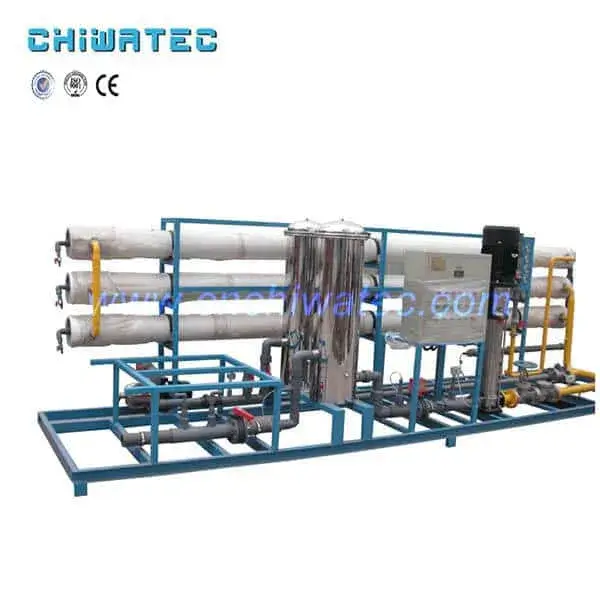
Standard brackish water RO desalination devices are constructed with stainless steel outer surfaces and frames (304 or 316 grade for corrosion resistance), activated carbon pre-filters (removing chlorine and improving taste), automatic control valves and program controllers, cartridge-type TFC membrane elements (spiral-wound modules of 2.5-inch, 4-inch, or 8-inch diameter), automatic flow systems, spiral water inlet valves, low-pressure switches protecting the high-pressure pump, and vertical high-pressure multistage centrifugal pumps. Each component is selected for reliability in high-salinity environments.
Optional Upgrades and Advanced Features
Higher-specification systems may include: energy recovery devices (pressure exchangers or turbochargers that capture energy from the brine stream, reducing energy consumption by 25-35%), variable frequency drive (VFD) pump control for precise pressure adjustment, online TDS and conductivity monitoring with digital display, automatic membrane flush cycles, remote telemetry via cellular or Wi-Fi connection, and chemical dosing systems for antiscalant and pH adjustment.
4. What Is the Difference Between Brackish Water RO and Seawater RO?
Pressure and Energy Requirements
The fundamental difference lies in operating pressure. Brackish water RO systems operate at 8-15 bar (120-220 psi), while seawater RO requires 50-80 bar (750-1200 psi). This translates directly to energy consumption — brackish water RO typically consumes 0.5-1.5 kWh/m3 of product water, compared to 3.0-6.0 kWh/m3 for seawater RO. The lower pressure also means brackish water systems use less expensive piping, fittings, and pressure vessels (PVC or fiberglass rather than duplex stainless steel).
Membrane Selection and Recovery Rate
Brackish water RO membranes have looser pore structures than seawater membranes, allowing higher water permeability at lower pressure. Recovery rates also differ — brackish water RO systems achieve 70-85% recovery, while seawater RO systems typically achieve 40-50% due to the higher osmotic pressure limit at the membrane surface. The higher recovery of brackish water systems means less brine disposal volume per unit of product water, reducing environmental impact and disposal costs.
5. How to Select the Right Brackish Water Desalination System?
Capacity and Sizing
Selecting the correct system capacity depends on the application. Small residential systems typically produce 100-500 L/h (0.5-3 m3/day) and serve individual households or small communities. Commercial systems range from 1-50 m3/day for hotels, hospitals, and schools. Industrial systems can exceed 1,000 m3/day for municipal water supply or industrial process water. The system should be sized at 1.2-1.5 times the expected peak daily demand to allow for maintenance downtime and seasonal variations.
Feed Water Quality Considerations
Pre-treatment requirements depend on feed water quality. Key parameters include: TDS level (determines required pressure and membrane type), chloride concentration (primary contaminant), hardness (requires antiscalant or softening to prevent scaling), iron and manganese (above 0.3 mg/L requires pre-filtration), turbidity and SDI (below 5 required), and bacterial content (requires chlorination or UV). The best practices for antiscalant treatment and dosing in reverse osmosis systems provides detailed guidance on chemical dosing strategies.
6. How Does the Pre-Treatment System Protect the RO Membranes?
Multi-Stage Pre-Treatment
Proper pre-treatment is essential for reliable RO operation and long membrane life. The standard pre-treatment train includes: multimedia filtration (graded sand, anthracite, and gravel removing suspended solids down to 10-25 microns), activated carbon filtration (removing free chlorine that can destroy TFC membranes at concentrations above 0.1 mg/L), antiscalant injection (preventing calcium carbonate, calcium sulfate, barium sulfate, and silica scale formation), and cartridge filtration (5-micron absolute filters as a final safety barrier). For an in-depth overview of pre-treatment configurations, see the analysis of five common reverse osmosis pretreatment processes.
The Cost-Benefit of Proper Pre-Treatment
Investing in adequate pre-treatment extends RO membrane life from an average of 2-3 years to 5-7 years in brackish water applications. Given that membrane replacement costs typically represent 15-25% of total system operating costs, proper pre-treatment pays for itself within 1-2 years of operation. For a typical 100 m3/day brackish water RO system, this translates to annual savings of USD 3,000-8,000 in membrane replacement costs alone.
7. What Is the National Standard for Brackish Water Quality?
Regulatory Framework
In China, drinking water quality for brackish water sources is governed by GB 5749-2022 (Standards for Drinking Water Quality) and GB/T 5750 (Standard Examination Methods for Drinking Water). The key parameter for brackish water is chloride, with a limit of 250 mg/L for drinking water. Total dissolved solids (TDS) are limited to 1,000 mg/L, though the recommended level for palatability is below 600 mg/L. WHO guidelines similarly recommend chloride below 250 mg/L and TDS below 600 mg/L.
Testing and Compliance
Regular water quality testing is essential for brackish water desalination systems. Key parameters to monitor include: feed water TDS, permeate TDS (target below 200 mg/L for drinking), chloride concentration, conductivity, pH, and pressure differential across the membrane. Online TDS meters provide real-time monitoring, while laboratory analysis every 3-6 months provides comprehensive quality assurance. Systems producing water for public supply must comply with local regulatory requirements.
8. How to Maintain a Brackish Water Desalination Device?
Routine Maintenance Schedule
Regular maintenance ensures reliable operation and extends system life. Daily tasks include verifying operating pressures, flow rates, and permeate quality. Weekly tasks include recording system data. Monthly tasks include inspecting and replacing cartridge pre-filters and checking chemical dosing levels. Quarterly tasks include performing membrane cleaning if normalized pressure drop has increased by 15% or permeate flow has decreased by 15%. Annual tasks include inspecting high-pressure pump seals and bearings, calibrating instrumentation, and conducting a comprehensive system audit.
Membrane Cleaning and Replacement
RO membranes require periodic chemical cleaning to remove fouling layers. Acid cleaning (citric acid or hydrochloric acid at pH 2-3) removes inorganic scales, while alkaline cleaning (sodium hydroxide at pH 11-12) removes organic fouling and biofilms. Cleaning is typically needed every 3-6 months for brackish water systems. When membrane performance cannot be restored by cleaning (permeate flow below 70% of design or salt passage exceeding 10%), replacement is required. The pollution control methods for reverse osmosis systems provides comprehensive guidance on identifying and addressing membrane fouling issues.
9. What Are the Common Problems and Troubleshooting Tips?
High Pressure Drop
Increasing pressure differential across the RO membrane indicates fouling. Common causes include: particulate fouling (ineffective pre-filtration), biological fouling (bacterial growth in warm feed water), scale formation (inadequate antiscalant dosing), and colloidal fouling (high SDI in feed water). Solution: identify the foulant type through visual inspection and membrane autopsy, then perform targeted chemical cleaning. Pre-treatment optimization prevents recurrence.
High Permeate TDS
Elevated salt passage can result from: damaged membrane elements (O-ring leaks, glue line failure, or membrane oxidation from chlorine exposure), operating at too low pressure, or membrane compaction. Checking and replacing O-rings resolves 30-40% of high-TDS complaints. If membrane damage is confirmed, replace affected elements. Preventing chlorine exposure through properly maintained activated carbon pre-filters is the most effective prevention strategy.
10. What Is the Future of Brackish Water Desalination Technology?
Emerging Technologies
Several emerging technologies promise to improve brackish water desalination. Forward osmosis (FO) uses natural osmotic pressure of a draw solution to pull water through the membrane, requiring less energy than RO. Capacitive deionization (CDI) is suited for lower-salinity brackish water (below 5,000 mg/L TDS) and can achieve 70-90% salt removal at 0.1-0.5 kWh/m3. Electrodialysis reversal (EDR) offers higher recovery rates (90-95%) for brackish water with better resistance to silica scaling. For a broader perspective on different desalination methods, see the distillation and electrodialysis methods for brackish water desalination.
Integration and Decentralization
The trend in brackish water desalination is toward smaller, decentralized systems powered by renewable energy. Containerized RO plants that can be deployed rapidly are becoming the standard for emergency water supply and remote community applications. These systems feature plug-and-play operation, remote monitoring via cellular networks, and modular capacity expansion. The levelized cost of water from small-scale solar-powered brackish water RO systems (50-500 m3/day) has decreased by 60% over the past decade, making decentralized desalination increasingly competitive.
Conclusión
Brackish water desalination devices based on reverse osmosis technology provide a proven, cost-effective solution for treating bitter water with high chloride and mineral content. Understanding the working principles, system components, pre-treatment requirements, and maintenance procedures enables users to select, operate, and maintain the right system for their specific water quality and capacity requirements. With advances in low-energy membranes, solar-powered operation, smart monitoring, and zero-liquid-discharge technologies, brackish water desalination is becoming increasingly accessible and sustainable for communities worldwide.
For expert guidance on selecting and installing a brackish water desalination system for your specific application, contact CHIWATEC today at [email protected] o [email protected] or via WhatsApp at 008618292684865. CHIWATEC provides comprehensive water treatment solutions including design, machining, installation, commissioning, and customized one-stop service.
Frequently Asked Questions
Q1: What is the difference between brackish water RO and seawater RO?
Brackish water RO operates at lower pressure (8-15 bar vs. 50-80 bar for seawater RO), consumes less energy (0.5-1.5 kWh/m3 vs. 3-6 kWh/m3), achieves higher recovery rates (70-85% vs. 40-50%), and uses less expensive materials. The membranes differ — brackish water membranes have higher water permeability at lower pressure, while seawater membranes are tighter to reject the higher salt content.
Q2: What chloride level requires brackish water treatment?
According to Chinese national standard GB 5749-2022 and WHO guidelines, drinking water should contain chloride below 250 mg/L. When natural water sources exceed this level or TDS exceeds 1,000 mg/L, treatment with a brackish water desalination device is recommended. Many users treat water with chloride above 200 mg/L to ensure a safety margin and improve taste.
Q3: How much water do brackish water RO systems waste?
Standard brackish water RO systems recover 70-85% of feed water as product, meaning 15-30% is discharged as brine. This compares favorably with seawater RO (40-50% recovery). Higher recovery systems can achieve 90-95% using multiple-stage or brine recycling configurations. Brine can be managed through evaporation ponds, brine concentration, or zero-liquid-discharge systems.
Q4: How long do RO membranes last in brackish water systems?
With proper pre-treatment and maintenance, RO membranes in brackish water systems typically last 3-5 years. Factors that extend membrane life include: effective pre-treatment, operation within design parameters, regular cleaning (every 3-6 months), and protection from chlorine. Well-maintained systems can achieve 5-7 years of membrane life.
Q5: Can a brackish water desalination device be used for seawater?
Standard brackish water RO devices are not suitable for seawater desalination. Seawater has TDS of approximately 35,000 mg/L, requiring operating pressures of 50-80 bar that exceed the design limits of brackish water system components. Attempting to use a brackish water system for seawater will result in very low production, poor rejection, and potential equipment damage.
Related Resources and Further Reading
- Comparative Analysis: Reverse Osmosis vs. Electrodialysis for Brackish Water Desalination
- Desalination Methods for Brackish Water (2): Reverse Osmosis Method
- Desalination Methods for Brackish Water (1): Distillation and Electrodialysis
- Best Practices for Antiscalant Treatment and Dosing in Reverse Osmosis Systems
- Main Process Flow Description of Reverse Osmosis Pure Water Equipment
¿Tiene un proyecto de tratamiento de agua con el que podamos ayudar?
* Diseño, mecanizado, instalación, puesta en marcha, personalización y servicio integral






 Spanish
  English
  Portuguese




